United States Student Visa 2026: Requirements, Costs & Steps
A United States student visa is the legal requirement for any foreign national who wants to study full-time at an American school, college, or university. The rules changed in a major way this year. On July 16, 2026, the Department of Homeland Security (DHS) published a final rule ending the decades-old “duration of status” system, replacing it with a fixed admission period for most student visa holders. This guide walks through every stage of the process, from choosing the right visa category to sitting the interview, and explains exactly what the new rule means for anyone applying from Europe, the United Kingdom (UK), Australia, Canada, the Middle East, or Asia.
What Is a United States Student Visa?
A United States student visa is a nonimmigrant visa that authorizes a foreign citizen to enter the country and study at an approved institution. It is not the same as an entry permit. A Customs and Border Protection (CBP) officer makes the final admission decision at the port of entry, even after a visa has been approved and stamped into the passport. Two main categories exist: the F visa for academic study and the M visa for vocational or non-academic training. A third category, the J visa, covers exchange visitors rather than degree-seeking students.
Who Needs a United States Student Visa?
Yes, any non-U.S. citizen or permanent resident who plans to study full-time at an American institution needs a student visa, with one narrow exception: citizens of Canada and Bermuda generally don’t need a visa to enter as students, though they must still present a valid Form I-20 at the border. Everyone else must secure an F, M, or J visa before departure. A visitor (B) visa does not permit degree study, even for a single semester, and using one for that purpose counts as a violation of its terms.
Types of United States Student Visas
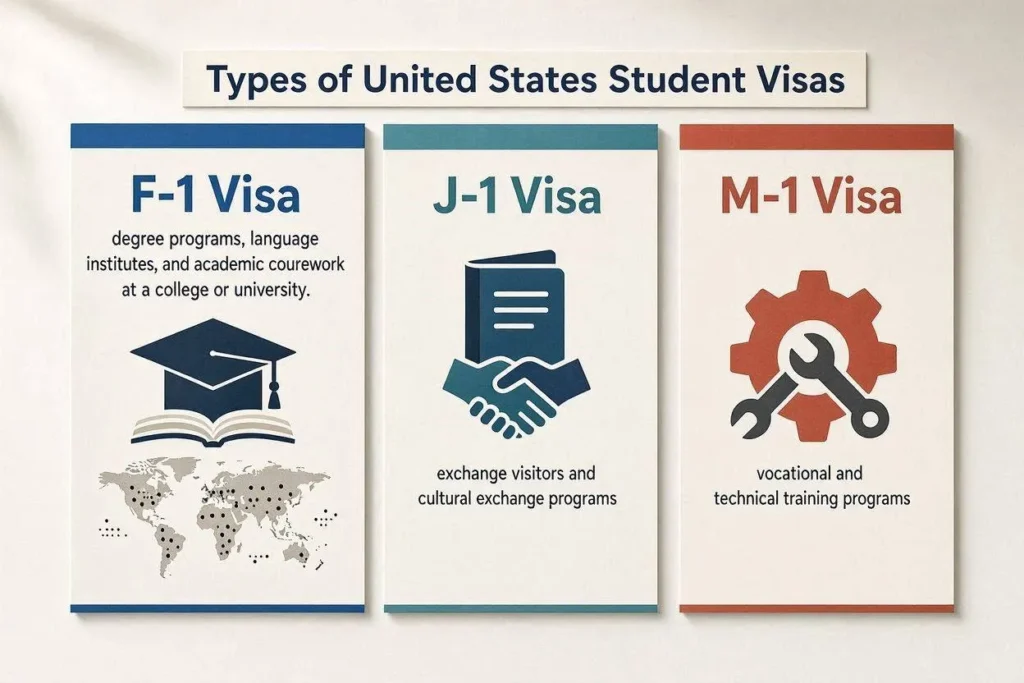
Three visa categories cover almost every international student, and each one maps to a specific kind of program.
F-1 Visa
The F-1 visa is the visa most international students use, covering degree programs, language institutes, and academic coursework at a college or university. Roughly one million foreign students held F-1 status in the 2025–2026 academic year, spread across more than 8,700 Student and Exchange Visitor Program (SEVP)-certified schools. A student heading to a four-year computer science program, for example, would apply under this category.
M-1 Visa
The M-1 visa applies to vocational or non-academic training, such as culinary school, aviation mechanics, or technical certificate programs. Financial proof requirements run stricter for M-1 applicants than for F-1 applicants, since M-1 study can’t be extended or converted into a new program once the original course of study ends.
J-1 Visa
The J-1 visa serves exchange visitors, including high school exchange students, visiting scholars, and researchers sponsored through a designated exchange program. Funding for a J-1 program often comes partly or fully from a government or institutional sponsor, unlike F-1 and M-1 programs, which students typically self-fund or finance through loans.
The Big Change for 2026: The End of “Duration of Status”
No, F-1 and J-1 students will no longer be admitted for an open-ended period once the new rule takes effect on September 15, 2026. Since 1978, most F and J visa holders entered the country under “duration of status” (D/S), meaning their authorized stay lasted as long as their academic program did, with no fixed end date stamped at entry. DHS Secretary Markwayne Mullin described the old system as one that let some visa holders become “forever students” by continuously re-enrolling to avoid departure.
Under the new rule:
- F-1 and J-1 students are admitted for the length of their program, up to a maximum of four years per admission.
- Language-training students face a shorter 24-month cap.
- I-visa holders, covering foreign media representatives, are limited to 240 days per admission, with one possible 240-day extension.
- Students who need more time beyond the initial period must file Form I-539 with U.S. Citizenship and Immigration Services (USCIS) and undergo biometrics and background screening, rather than relying on a school-issued extension.
Students already in the country under the old D/S system when the rule takes effect generally keep their status through the end of their current program, or for up to four additional years, whichever applies under the rule’s transition provisions. Anyone applying for a first-time F-1 or J-1 visa after September 15, 2026 should plan around the fixed-term structure from the outset, since renewal now requires a formal USCIS filing rather than an automatic continuation.
How to Apply for a United States Student Visa
The application sequence runs through five stages, and the order can shift slightly depending on the embassy or consulate handling the case.
Step 1: Get Accepted by a SEVP-Certified School
A school must hold SEVP certification before it can enroll F or M students. Once admitted, the school registers the student in the Student and Exchange Visitor Information System (SEVIS) and issues Form I-20, the certificate of eligibility that confirms admission and estimated program costs.
Step 2: Pay the SEVIS I-901 Fee
The SEVIS I-901 fee costs $350 (roughly €322, £275, or ₹29,300 at mid-2026 exchange rates) for F and M students, and payment must happen before the visa interview. Applicants should keep the electronic payment receipt, since consular officers ask to see it.
Step 3: Complete Form DS-160
Form DS-160 is the online nonimmigrant visa application, submitted through the Consular Electronic Application Center (CEAC). The form collects personal, academic, and travel history, and it requires a digital photo meeting specific formatting rules. A printed confirmation page from this step goes into the interview document file.
Step 4: Schedule Your Visa Interview
Interview wait times vary widely by embassy location and season, so applicants should book an appointment as early as possible after receiving the I-20. New students can receive a visa up to 365 days before their program start date, though entry into the United States is restricted to no earlier than 30 days before that date.
Step 5: Attend the Interview
A consular officer reviews the applicant’s documents and asks questions to confirm genuine intent to study and to depart afterward. Digital fingerprint scans are typically collected at this stage. Some applications require additional administrative processing after the interview, which can extend the timeline by several weeks.
Documents You Need for Your Visa Interview
Consular officers expect a specific, organized set of paperwork, and missing even one item can delay approval.
- Passport valid for at least six months beyond the intended stay
- Form DS-160 confirmation page, printed after online submission
- Form I-20, signed by both the student and a school official
- SEVIS I-901 fee receipt, showing proof of payment
- Visa application fee receipt, if payment is required before the interview
- Passport-style photo, meeting the Department of State’s formatting requirements
- Academic records, such as transcripts, diplomas, and standardized test scores
- Financial documents, such as bank statements, education loan approval letters, or sponsor affidavits
Consistency matters across every document. An officer who spots a mismatch between the DS-160 entry and the bank statement, for example, is likely to flag the file for further review.
United States Student Visa Cost Breakdown
| Fee | Amount (USD) | Approximate Equivalent |
| SEVIS I-901 fee | $350 | €322 / £275 / ₹29,300 / AED 1,285 |
| Visa application fee (MRV) | $185 | €170 / £145 / ₹15,500 / AED 680 |
| Visa Integrity Fee (new for 2026) | $250 | €230 / £196 / ₹20,900 / AED 918 |
| Visa issuance fee | Varies by nationality | Check the reciprocity table for the applicant’s country |
The Visa Integrity Fee is a new charge introduced in 2026 to fund expanded document verification, and it applies in addition to the standard application and SEVIS fees for many applicants. Total upfront government fees for a first-time F-1 applicant now often exceed $780 (about €718 / £613), before university tuition deposits or travel costs.
How to Prepare for the Visa Interview
Preparation reduces the risk of refusal more than any single document does. Applicants should rehearse clear, specific answers about their chosen program, their post-graduation plans, and how they intend to fund three to four years of study, not just the first year. Officers also review DS-160 entries against social media activity as part of expanded 2026 vetting procedures, so applicants should keep their online presence consistent with what they’ve stated on the form.
A student applying to study mechanical engineering, for instance, should be ready to explain why that specific university and program fit their academic background, rather than giving a generic answer about wanting to live in the United States.
Common Reasons for Visa Denial
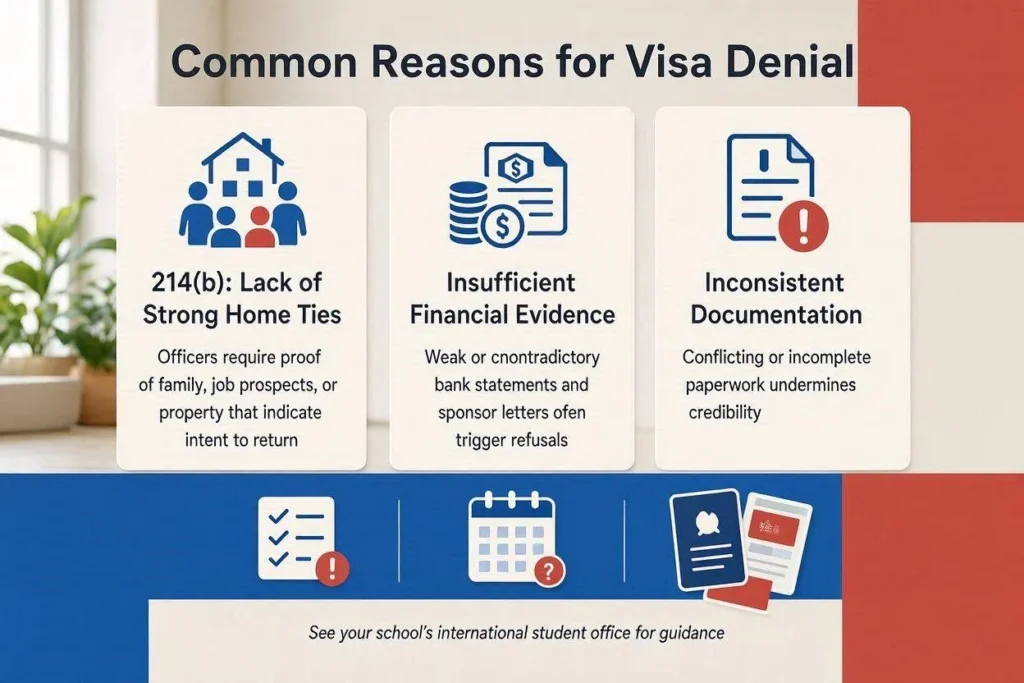
Most F-1 and M-1 refusals happen under Section 214(b) of the Immigration and Nationality Act, which requires every applicant to prove strong ties to their home country and a genuine intent to return after finishing the program. Officers weigh factors such as family connections, job prospects, and property ownership back home. Weak or inconsistent financial evidence causes a large share of refusals too, particularly when a bank statement doesn’t match the funding amount stated on the I-20.
Reapplication is possible after a 214(b) refusal, if the applicant can present new evidence or demonstrate a genuine change in circumstances since the last interview. Simply reapplying with the same file rarely changes the outcome.
What Happens After You Get Your Visa
Getting the visa stamped is not the final step. Two areas deserve attention well before graduation.
Optional Practical Training
Optional Practical Training (OPT) allows F-1 graduates to work in the United States in a field related to their degree, typically for up to 12 months, with a 24-month extension available for STEM (science, technology, engineering, and mathematics) graduates. An Employment Authorization Document from USCIS is required before starting OPT employment.
Extending Your Stay Under the New Rule
Students who need more time than their initial fixed admission period allows must file Form I-539 with USCIS well before their authorized stay expires. The filing triggers biometrics collection and a background check, and processing times will likely run longer than the school-based extensions students relied on under the old duration-of-status system. Filing early, ideally several months ahead of the expiration date, reduces the risk of falling out of status while a decision is pending.
Recommended Application Timeline
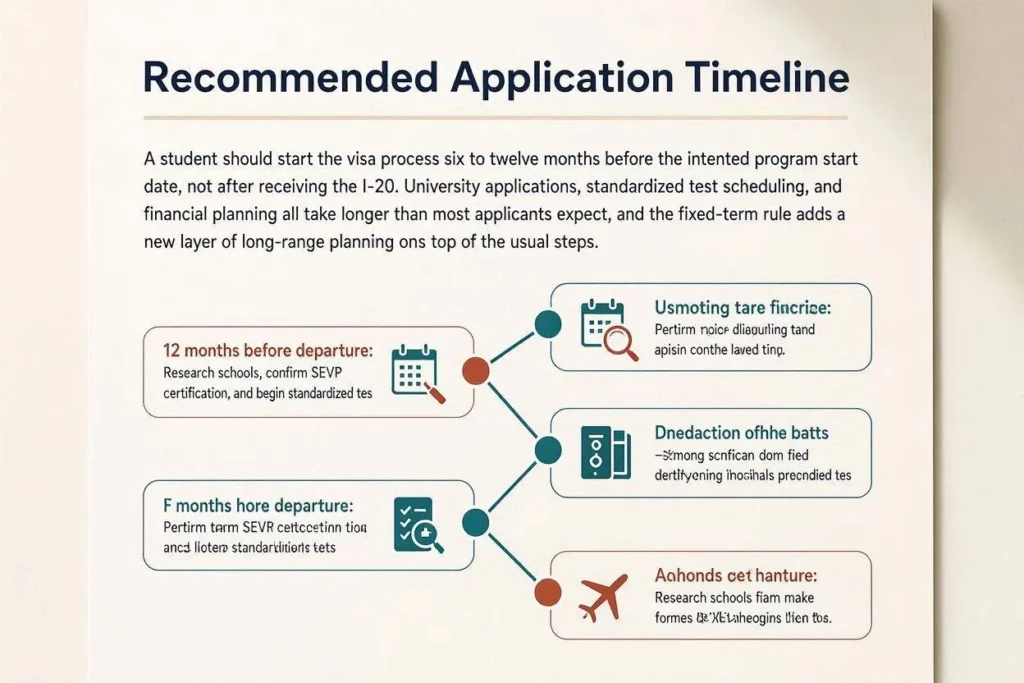
A student should start the visa process six to twelve months before the intended program start date, not after receiving the I-20. University applications, standardized test scheduling, and financial planning all take longer than most applicants expect, and the fixed-term rule adds a new layer of long-range planning on top of the usual steps.
- 12 months before departure: Research schools, confirm SEVP certification, and begin standardized testing if required.
- 8–10 months before departure: Submit university applications and arrange financial documentation, including loan approvals or sponsor letters.
- 6 months before departure: Receive the I-20, pay the SEVIS fee, and complete Form DS-160.
- 4–6 months before departure: Book the visa interview appointment as soon as a slot opens, since posts in high-demand countries fill up quickly.
- 30 days before the program start date: This marks the earliest point of entry into the United States on a student visa; arriving sooner requires a separate visitor visa application.
Delaying any one of these steps tends to compress the whole timeline, and interview backlogs in 2026 have made early action more valuable than in previous years.
Applying from Europe, the UK, Australia, Canada, the Middle East, and Asia
Core requirements stay the same regardless of nationality, but regional differences shape how the process actually plays out on the ground.
Europe and the UK. Interview wait times at major posts in London, Paris, Berlin, and Madrid have fluctuated through 2026, sometimes stretching to several weeks during peak intake seasons in July and August. Students applying from smaller European countries without a local U.S. embassy often need to travel to a neighboring country for their interview, which adds cost and lead time that applicants from larger countries don’t face. Currency conversion also matters here: a student budgeting in euros or pounds should track the dollar exchange rate close to their fee payment dates, since SEVIS and application fees are billed in U.S. dollars.
Australia. Fewer U.S. consular posts serve the region compared with Europe or Asia, with interviews concentrated mainly in Sydney, Melbourne, and Perth. That concentration can mean longer domestic travel for students based in regional areas, so booking flights and accommodation around the interview date becomes part of the planning, not an afterthought.
Canada. Canadian and Bermudian citizens generally skip the visa requirement entirely under a long-standing exemption, though a valid Form I-20 is still required at the port of entry. This exemption doesn’t extend to permanent residents of Canada who hold other nationalities; those applicants follow the standard F-1, M-1, or J-1 process through their home country’s consulate or a designated third-country post.
The Middle East. Financial documentation often draws closer scrutiny for applicants relying on sponsor affidavits rather than personal bank accounts, particularly when a sponsor is a relative rather than the applicant. Sponsors should prepare notarized letters, translated bank statements, and a clear explanation of the funding relationship well before the interview date. Students from Gulf countries applying under government scholarship programs should bring the official scholarship award letter as a primary financial document, since it typically satisfies proof-of-funds requirements on its own.
Asia. India and China together account for the largest share of F-1 applicants worldwide, and interview backlogs at posts in both countries have run longer than the global average through parts of 2026, with wait times in India reportedly reaching into the hundreds of days at some points this year. Applicants from Southeast Asian countries, including Vietnam, Indonesia, and the Philippines, tend to face closer review of intent-to-return evidence, so demonstrating concrete post-graduation plans in the home country carries real weight during the interview.
Applicants anywhere in the world can use EducationUSA, the Department of State’s global advising network, to get official, no-cost guidance on choosing a school and preparing an application. EducationUSA operates advising centers across all six regions covered here, and the guidance stays consistent regardless of which center a student contacts.
Bringing Your Spouse or Children
Yes, a spouse and unmarried minor children can accompany an F-1 or M-1 student, under the F-2 or M-2 dependent visa categories. Each dependent needs an individual Form I-20 issued by the school, along with proof of the relationship, such as a marriage certificate for a spouse. Dependents don’t pay the SEVIS fee, though they do need their own DS-160 and interview. Minor children on F-2 or M-2 status can attend public or private school in the United States while accompanying the primary visa holder.
The United States student visa process demands precision at every stage, and the 2026 shift away from duration of status raises the stakes for planning ahead. Students who file complete documentation, prepare specific answers for their interview, and track the new fixed-term deadlines will move through the system with far fewer surprises than those who treat the visa as a formality.
FAQS
How long does a United States student visa application take?
Processing time varies by embassy, running from a few days to several weeks after the interview. Applicants should apply at least three to six months before their program start date.
Can I work while on an F-1 student visa?
Yes, F-1 students can work on-campus part-time and may qualify for off-campus authorization through Curricular Practical Training or Optional Practical Training after meeting eligibility requirements.
What is the difference between an F-1 and an M-1 visa?
The F-1 visa covers academic degree programs and language study, while the M-1 visa covers vocational and non-academic training, with stricter financial proof rules.
Does the new 2026 rule affect students already studying in the United States?
Existing duration-of-status holders generally keep their status through their current program or up to four additional years, per the rule’s transition provisions.
Can I reapply after a 214(b) visa denial?
Yes, reapplication is allowed if the applicant presents new evidence of ties to their home country or a genuine change in circumstances since the prior interview.
Conclusion
A United States student visa requires five things: a SEVP-certified school acceptance, the SEVIS fee, Form DS-160, a set of consistent supporting documents, and a well-prepared interview. The 2026 shift away from duration of status adds a sixth requirement for F-1 and J-1 students specifically: tracking the fixed four-year admission period and filing Form I-539 well before it expires, rather than assuming automatic continuation.
Students who start the process six to twelve months ahead, keep their financial and academic paperwork consistent across every form, and prepare specific, direct answers for the interview reduce their refusal risk far more than any single document can. The visa itself is not the finish line. Maintaining status, tracking the new fixed-term deadlines, and planning for Optional Practical Training or a change of status matter just as much after arrival as the application does before it.
For students applying from Europe, the UK, Australia, Canada, the Middle East, or Asia, the paperwork stays identical; only the interview wait times, sponsor documentation norms, and consular post locations shift by region. Getting those regional details right, alongside the standard requirements, is what separates a smooth application from a delayed one.
Michael Reynolds
Michael Reynolds leads ImmigrationWin’s immigration, visa, and global mobility content division. He specializes in researching immigration policies, visa requirements, application processes, and international relocation pathways for individuals, families, students, and professionals. With extensive experience analyzing immigration regulations and official government guidance, Michael brings a research-driven approach to complex immigration topics and changing visa policies. He is the primary author of ImmigrationWin’s visa guides, immigration resources, and country-specific content, helping readers better understand their options and make informed decisions about their international journey.
Related Posts