
How to Get a US Work Visa: Types, Costs, and Step-by-Step Process
To work legally in the United States, a foreign national usually needs two approvals: a petition cleared by U.S. Citizenship and Immigration Services (USCIS), and then a visa issued through the Department of State. Almost nobody skips the sponsorship step. A few categories, notably O-1 and E-2, offer a narrower route that doesn’t depend on a traditional employer-employee relationship.
The short version, for temporary work visas: get a qualifying job offer, have the employer file Form I-129, wait for USCIS to approve it, apply at a consulate with Form DS-160, and get admitted by a border officer. Each stage waits on the one before it. The rest of this covers what each step actually involves, what it costs in 2026, and where the permanent-residence track diverges.
How to Get a US Work Visa in 5 Steps
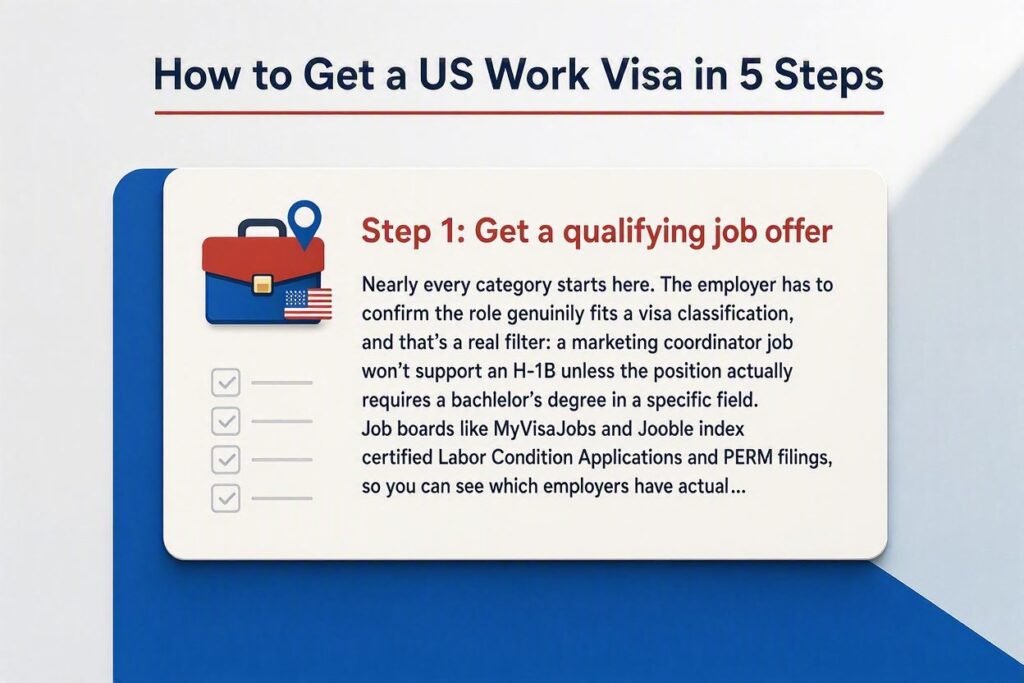
Step 1: Get a qualifying job offer
Nearly every category starts here. The employer has to confirm the role genuinely fits a visa classification, and that’s a real filter: a marketing coordinator job won’t support an H-1B unless the position actually requires a bachelor’s degree in a specific field. Job boards like MyVisaJobs and Jooble index certified Labor Condition Applications and PERM filings, so you can see which employers have actually sponsored before instead of guessing.
Step 2: The employer files a petition
Form I-129 (Petition for a Nonimmigrant Worker) for temporary categories. Form I-140 (Immigrant Petition for Alien Workers) for permanent ones. Some classifications, including H-1B, H-2A, and most EB-2 and EB-3 cases, need a labor certification from the Department of Labor first. For permanent categories that process is called PERM, and it exists to confirm the hire won’t displace qualified U.S. workers or drag down prevailing wages for the occupation.
Step 3: USCIS decides
Three things get scrutinized: whether the position fits the category, whether the worker’s education and experience fit the position, and whether the employer followed program rules. Standard H-1B processing typically runs a few months and varies by service center; USCIS publishes live figures at egov.uscis.gov/processing-times, which is worth checking rather than trusting any number printed in an article. Premium processing, requested on Form I-907, buys a decision within 15 business days for an extra fee.
Step 4: Apply at an embassy or consulate
With the petition approved, applicants outside the U.S. fill out Form DS-160 online, pay the application fee, and book an interview. A consular officer reviews the approved petition, checks intent, and confirms the applicant is admissible. Interview availability is the wild card. Waits swing from a couple of weeks to several months depending on the post and the season, and the State Department’s appointment wait times tool gives current figures by city.
Step 5: Enter and start work
CBP inspects every arriving traveler and decides whether to admit them under the approved classification. Admission creates a Form I-94 record, which sets the exact date you have to leave or extend. One detail people get wrong constantly: employment can begin only after admission. Not when the I-129 approval notice arrives, and not when the visa is stamped.
The Permanent Track: PERM, I-140, and Priority Dates
Employment-based Green Card cases run longer and add steps the list above doesn’t cover. Most EB-2 and EB-3 cases start with PERM labor certification, then the I-140, then a wait for a priority date to become current under the monthly Visa Bulletin. Only then does the case finish, either through a consulate abroad or through adjustment of status on Form I-485 if the worker is already in the U.S. For applicants born in India or China, the priority date wait can dwarf every other stage combined.
Temporary vs. Permanent Categories
| Visa | Track | Who qualifies | Employer sponsorship |
| H-1B | Temporary | Specialty occupation professionals with a bachelor’s degree or equivalent | Required |
| L-1 | Temporary | Intracompany transferees with 1 year abroad in the prior 3 years | Required |
| O-1 | Temporary | Extraordinary ability in science, art, business, or athletics | Required, though an agent can petition |
| TN | Temporary | Canadian and Mexican professionals under USMCA | Required |
| H-2A | Temporary | Seasonal agricultural workers from designated countries | Required |
| H-2B | Temporary | Seasonal non-agricultural workers from designated countries | Required |
| EB-1 | Permanent | Priority workers: extraordinary ability, outstanding researchers, multinational executives | Often waived for extraordinary ability |
| EB-2 | Permanent | Advanced degrees or exceptional ability | Required, unless filing a National Interest Waiver |
| EB-3 | Permanent | Skilled workers, professionals, and other workers | Required |
EB categories are immigrant classifications, frequently miscategorized as temporary elsewhere.
The H-1B Cap and the Weighted Selection Process
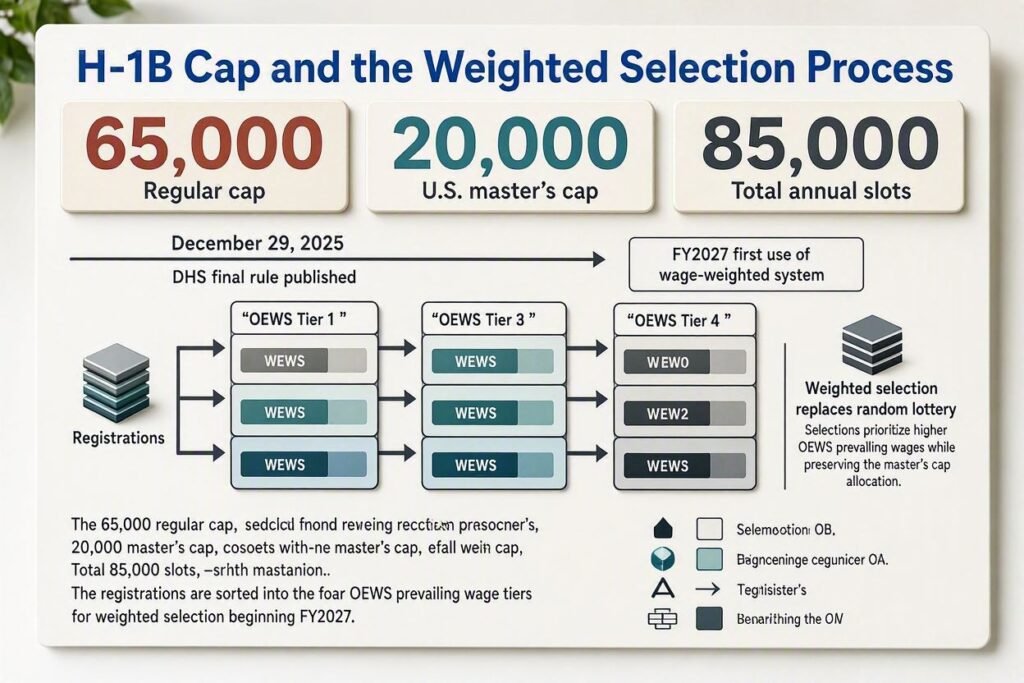
H-1B is capped at 65,000 in the regular pool, plus 20,000 reserved for holders of a U.S. master’s degree or higher. That’s 85,000 slots a fiscal year, and demand has always exceeded it.
The selection method changed. A DHS final rule published December 29, 2025 replaced the purely random lottery with a wage-weighted system, used for the first time in the FY2027 cap season. Registrations are sorted into the four OEWS prevailing wage levels, and entries scale with the level: a Level IV offer gets four entries, Level III three, Level II two, Level I one. Selection is still random within that weighted pool, and a beneficiary is counted once toward the cap no matter how many registrations name them. If several employers register the same person, USCIS assigns the lowest applicable wage level across all of them.
Registration costs $215 per beneficiary, paid by the employer before selection and not refunded if the registration loses. For FY2026, USCIS processed 343,981 eligible registrations and selected roughly 118,660 beneficiaries, about a 35% selection rate. That’s a very different picture from FY2024, when close to 781,000 registrations produced a 14.2% rate. The $215 fee and the requirement that each beneficiary use a unique passport are widely credited with squeezing out duplicate filings.
Getting selected still isn’t approval. The employer has 90 days from the selection notice to file the I-129, and USCIS still has to approve it on the merits. Cap-exempt employers, mainly universities and nonprofit research institutions, sit outside all of this and can file year-round.
US Work Visa Costs and Fees in 2026
Fees changed substantially in 2024 and again in 2026, and several older guides still quote a single flat I-129 fee that no longer exists. Current structure for an H-1B:
- Form I-129 base fee: $780 for H-1B
- Asylum Program Fee: $600 for most employers, $300 for small employers
- ACWIA fee: $750 or $1,500, depending on employer size
- Fraud Prevention and Detection fee: $500 on H-1B and L-1 petitions
- Public Law 114-113 fee: $4,000, for employers with 50+ U.S. employees where more than half hold H-1B or L-1 status
- H-1B cap registration: $215 per beneficiary
- Premium processing (Form I-907): $2,965 as of March 1, 2026, up from $2,805
- DS-160 application (MRV) fee: $205 for petition-based categories (H, L, O, P, Q, R), $315 for E treaty visas
- Reciprocity issuance fee: $0 to over $300, based on citizenship
Who Pays Which Fee
Employers absorb the I-129 fee and its statutory surcharges, and federal regulation bars them from taking reimbursement from the beneficiary for the base and ACWIA fees. Premium processing can be split or paid by the employee. The MRV fee and any reciprocity fee normally come out of the applicant’s pocket.
Two additional charges are unsettled and worth watching before you budget.
The $100,000 H-1B Fee
The $100,000 H-1B fee, imposed by proclamation on certain petitions filed for consular notification, was dealt a blow on June 8, 2026, when the U.S. District Court for the District of Massachusetts vacated the agency guidance implementing it. The government appealed, and the fee has continued to be collected on qualifying petitions while the appeal is pending. It does not apply to change-of-status petitions filed for people already in the United States. Check the current status on the USCIS I-129 page before filing, because this has moved more than once.
The $250 Visa Integrity Fee
The $250 Visa Integrity Fee was created by the One Big Beautiful Bill Act in July 2025 and is charged at visa issuance rather than at application, with annual inflation adjustments built in. Implementation has been uneven. As of late July 2026 the State Department’s fee schedule still listed no amount, payment portal, or collection procedure, while some consular posts had begun collecting. Confirm with your post before the interview.
Work Visa Processing Times by Stage
| Stage | Typical timeline |
| Labor certification (PERM) | 6 to 12 months |
| I-129 petition, standard | Several months, varies by service center |
| I-129 petition, premium processing | 15 business days |
| DS-160 interview scheduling | Weeks to months, by post |
| I-140 petition (EB-2/EB-3) | 6 to 14 months |
Put those together and the spread is enormous. A developer filing H-1B with premium processing might get a decision in three weeks, wait a few more for an interview slot, and start work within a few months of filing. A skilled tradesperson going the EB-3 route without any premium option is looking at PERM, then I-140, then a priority date wait, which realistically means two years or more. For applicants chargeable to India or China, that last stage alone can run far longer, so check the Visa Bulletin for your category and country before assuming any total.
Can You Get One Without a Sponsor?
Yes, though the list is short. The O-1 allows filing through an agent rather than an employer, provided the applicant can show extraordinary ability backed by sustained national or international recognition. The E-2 lets a citizen of a treaty country run their own U.S. business after investing a substantial amount of capital. And the EB-2 National Interest Waiver lets certain advanced-degree professionals self-petition for a Green Card when their work benefits the country enough to justify skipping labor certification.
The trade-off is evidence. An O-1A applicant generally has to document at least three of eight USCIS criteria: major awards, published material about them, judging the work of others, original contributions of major significance, and so on. That’s a very different exercise from producing a diploma and an offer letter.
Common Reasons Work Visa Applications Get Denied
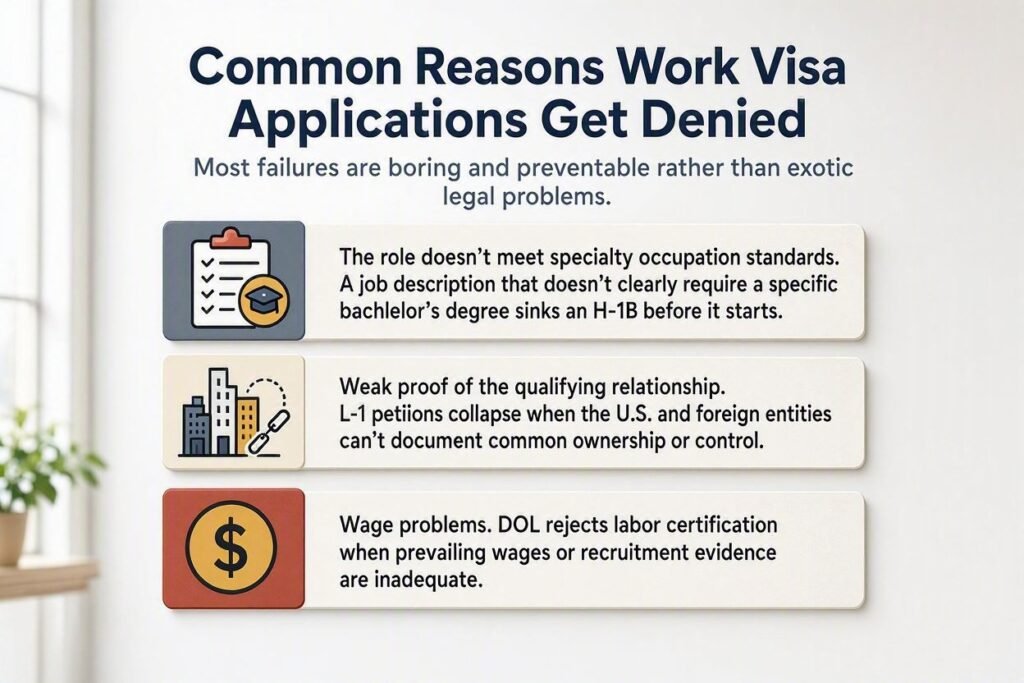
Most failures are boring and preventable rather than exotic legal problems.
The role doesn’t meet specialty occupation standards. A job description that doesn’t clearly require a specific bachelor’s degree sinks an H-1B before it starts.
Weak proof of the qualifying relationship. L-1 petitions collapse when the U.S. and foreign entities can’t document common ownership or control.
Wage problems. DOL rejects labor certifications when the offered wage sits below the certified prevailing wage for that occupation and location.
Sloppy paperwork. Missing pay stubs, mismatched job titles, unexplained employment gaps. Each one invites a Request for Evidence, and each RFE costs weeks.
Immigrant intent. For nonimmigrant visas, a consular officer can refuse an applicant who can’t show meaningful ties back home.
Planning Around Timelines and Fee Changes
Most of what goes wrong here is sequencing, not eligibility. People start the visa application before the petition is approved, book flights before admission, or spend a year on an EB-3 without checking whether their priority date is anywhere near current. Work backward from the date you need to be at a desk, add the PERM or lottery stage if your category has one, and you’ll usually find the real constraint isn’t your qualifications but the calendar.
The other thing to build in is fee volatility. Between the 2024 fee rule, the March 2026 premium processing increase, the $100,000 proclamation fee still moving through the courts, and a Visa Integrity Fee that some consulates collect and others don’t, any cost figure in any guide, this one included, has a short shelf life. Price your case against the USCIS fee schedule and your consular post’s instructions in the week you file, not the week you start researching.
Frequently Asked Questions

Michael Reynolds
Michael Reynolds leads immigration content at ImmigrationWin, covering visa requirements, application and relocation pathways. He researches immigration policies and official government guidance to explain changing rules clearly. His guides help students, families, and professionals make informed decisions about moving abroad.
Related Posts