
US Work Visa Requirements: Categories, Costs & Application Steps
Meeting US work visa requirements starts with matching your job offer to the right visa category. Each one comes with its own eligibility rules, wage rules, and paperwork, and the differences matter more than people expect. A marketing analyst with an offer from a Chicago software firm is on a completely different path than a seasonal ranch hand from Guatemala or a Toronto-based manager transferring to her company’s Austin office. Below is every major category, the paperwork behind it, and the fee changes that have been reshaping H-1B sponsorship since late 2025.
What Is a US Work Visa?
A US work visa is a document issued by the Department of State that authorizes a foreign national to enter the United States for paid employment. There are two categories: nonimmigrant (temporary) and immigrant (permanent). Nonimmigrant visas like H-1B, L-1, and O-1 let someone work for a fixed period, usually one to six years, and the worker is expected to leave the country afterward unless their status changes. Immigrant visas lead to a green card and permanent residence. USCIS approves the underlying petition first; the State Department issues the visa stamp second. No approved petition, no consulate interview. That’s just how it works.
What Are the Main Types of US Work Visas?
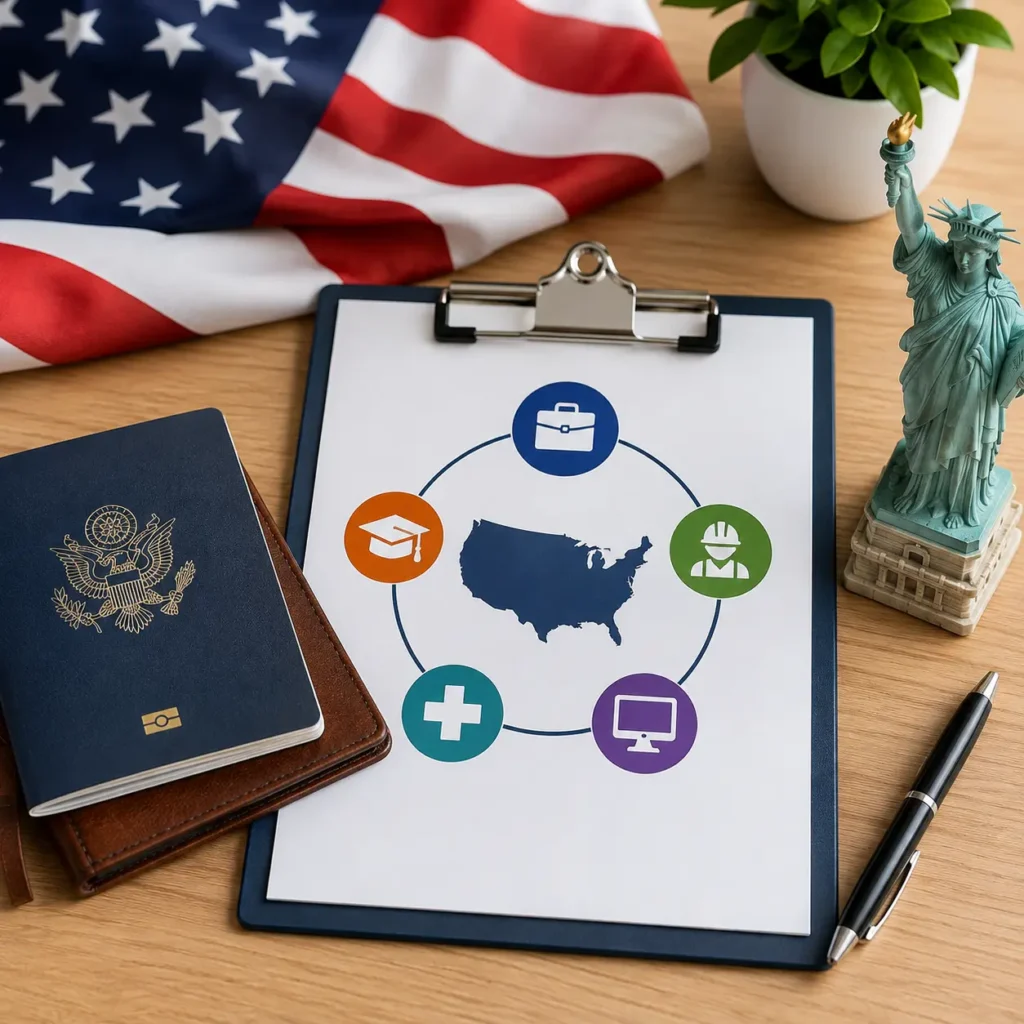
Six visa categories cover almost every foreign worker entering the US labor market, from seasonal farm labor to executives transferring within a multinational company.
H-1B Visa (Specialty Occupation)
Requires a bachelor’s degree or its equivalent in a specialty occupation tied to a specific job offer. USCIS caps new H-1B issuance at 65,000 per fiscal year, plus another 20,000 reserved for applicants with a U.S. master’s degree or higher. Registration opens in March, and because demand exceeds supply most years, USCIS runs a lottery before petitions can be filed on April 1. A software engineer with a computer science degree from a foreign university still qualifies, as long as a credential evaluation confirms the degree is equivalent to a U.S. bachelor’s. Employers have to file a Labor Condition Attestation with the Department of Labor before submitting Form I-129, confirming the offered wage meets or beats the prevailing wage for that role and location.
H-2A Visa (Temporary Agricultural Worker)
Covers seasonal farm labor for citizens of specific designated countries, with no annual cap. Employers must prove through actual recruitment efforts that no qualified U.S. worker is available. Think of a Mexican citizen hired to pick fruit in California’s Central Valley during a six-month harvest. Unlike H-1B sponsors, H-2A employers also have to provide housing, meals or cooking facilities, and transportation, and reimburse travel costs once the worker completes half the contract.
H-2B Visa (Temporary Non-Agricultural Worker)
Applies to seasonal, non-agricultural work. It’s capped at 66,000 visas per fiscal year, split evenly: 33,000 from October through March, 33,000 from April through September. Landscaping crews, resort staff, and seafood processing plants lean on this category constantly. If the employer can’t show that no qualified U.S. worker was available, USCIS denies the petition, no matter how urgent the seasonal need is.
L-1 Visa (Intracompany Transferee)
Lets a multinational company move an employee from a foreign branch to a U.S. office, provided that worker held a managerial, executive, or specialized-knowledge role abroad for at least one continuous year within the prior three. L-1A covers managers and executives (max stay of seven years); L-1B covers specialized-knowledge staff (capped at five). Neither has an annual quota. A German engineer relocating from Siemens’ Munich office to lead a product line in Orlando would qualify under L-1A, assuming she’d been there long enough.
O-1 Visa (Extraordinary Ability)
Reserved for people with extraordinary ability in the sciences, arts, education, business, or athletics, or extraordinary achievement in film and television. Evidence usually means major awards, published work, an above-peer salary, or a track record of critical acclaim. Picture a biotech researcher with three patents and over 500 citations across peer-reviewed journals. No cap limits O-1 issuance, and it can be renewed indefinitely in one-year increments as long as the underlying work continues.
EB Green Card Categories (Permanent Work Visas)
Permanent employment-based immigration runs through five preference categories, EB-1 through EB-5, capped at 140,000 combined visas per year including spouses and children. EB-1 covers extraordinary-ability individuals, outstanding professors and researchers, and multinational executives, and allows self-petitioning in some cases. EB-2 and EB-3 usually need a labor certification confirming no qualified U.S. worker is available at the prevailing wage. EB-5 requires an investment between $800,000 and $1,050,000 in a job-creating enterprise employing at least 10 full-time U.S. workers (figures per USCIS’s current investment thresholds). Wait times vary sharply by birth country, and applicants born in India have consistently faced the longest backlogs across nearly every EB category in recent years, per the State Department’s Visa Bulletin; check the current bulletin for exact wait estimates, since they shift monthly.
What Are the General US Work Visa Requirements?
Stepping back from green cards to the temporary categories above: most nonimmigrant work visas come down to five things:
- A specific job offer, concrete enough to mean a signed letter or contract, not a verbal agreement or a vague expression of interest
- An approved USCIS petition
- Proof of qualifications matching the role
- A valid passport, valid for at least six months beyond the intended stay unless a country-specific agreement exempts the traveler
- For most categories outside H-1B and L-1, evidence of intent to return home once the authorized stay ends
Qualifications differ by category. H-1B applicants need a bachelor’s degree or equivalent experience. O-1 applicants need documented extraordinary ability. H-2A and H-2B applicants need to be citizens of a country DHS has designated as eligible. And if the applicant already lives in the U.S. on another visa, a change-of-status request can replace the need for a new consular interview, provided they stayed in lawful status the whole time.
How Do You Apply for a US Work Visa?
Four stages, in order, no skipping ahead:
- The employer files the petition. Form I-129 goes to USCIS, along with the LCA, job description, and proof of the worker’s qualifications.
- USCIS reviews and approves. Standard processing can take several months. Paying the $2,500 premium processing fee for eligible categories cuts that down to about 15 calendar days.
- The applicant completes Form DS-160. This online application has to be filled out, with the confirmation page printed before scheduling an interview.
- The applicant attends a visa interview. Wait times swing by embassy and season; some posts book eight weeks out, others offer next-week slots.
A Brazilian software developer with an approved H-1B petition, for example, typically waits two to four weeks between filing the DS-160 and sitting for the interview at the U.S. Consulate in São Paulo, though that window moves with demand. Once the consular officer approves the visa, the applicant gets a passport stamp, not a guarantee of entry. Customs and Border Protection makes the actual admission call at the port of entry.
How Much Does a US Work Visa Cost?
The baseline nonimmigrant visa fee is $205 per applicant, but the real total depends heavily on category and nationality. Applicants from certain countries also owe a reciprocity fee once approved, which mirrors what the applicant’s home country charges American citizens for similar visas. Premium processing adds another $2,500.
H-1B is the exception that has thrown employer budgeting into flux over the past year, and it’s worth reading the next section before treating any single number here as settled. In short: a presidential proclamation (Proclamation 10973) attached a $100,000 fee to most new H-1B petitions filed after September 21, 2025, for beneficiaries entering from abroad. Before that, a typical H-1B filing (attorney fees, government filing fees, no premium processing) ran roughly $4,000 to $6,000 total, according to immigration-law estimates from that period. Whether the $100,000 fee actually applies to a given hire today depends on the current litigation status, discussed below, so employers budgeting for 2026 hires should confirm the fee’s status with counsel or USCIS.gov before assuming either number.
How Long Does US Work Visa Processing Take?
Total processing runs three to eight months from filing to visa issuance, but that window compresses or stretches depending on category and season. H-1B cases move faster once selected in the lottery, since petitions can be filed starting April 1 with an October 1 work start date, a fixed five-to-six month runway. L-1 petitions without premium processing often take four to six months, while premium processing shrinks USCIS’s decision window to roughly 15 calendar days, leaving the consular interview as the main wildcard. H-2A and H-2B cases run on tighter, seasonal timelines because employers have to file close to the work’s actual start date. If the applicant needs a visa stamp rather than just a status change, add another two to six weeks for interview scheduling and administrative processing, since some cases require extra security or documentation review after the interview.
What Changed for US Work Visa Requirements Recently?
Quite a bit, and the fee piece in particular hasn’t stopped moving. In September 2025, Proclamation 10973 added a $100,000 fee to new H-1B petitions filed on or after September 21, 2025, for beneficiaries outside the U.S. without a valid H-1B visa already. Change-of-status filings for people already in the country were carved out early on, and existing H-1B holders and approved extensions were never subject to it.
The fee’s actual collection has swung back and forth through the courts since then:
- June 2026 — a federal district court vacated the implementing guidance
- Shortly after — an administrative stay briefly reinstated the fee
- July 24, 2026 — the First Circuit Court of Appeals declined to revive the fee, leaving it vacated (not being collected) while the government’s appeal continues
- September 20, 2026 — Proclamation 10973, a temporary 12-month order, lapses on its own terms unless extended
Because the fee originated from executive action rather than legislation, courts retain the authority to strike it down or modify it further, similar to how earlier fee increases in the EB-5 investor program were challenged in prior years. Employers should treat “is the fee in effect right now” as a live question rather than a settled fact, and check current status before filing.
Separately, a December 16, 2025 proclamation (10998) expanded U.S. entry restrictions to nationals of 39 countries, effective January 1, 2026. It’s easy to overstate this one for work-visa purposes:
- “Full” restriction (19 countries, including Afghanistan, Iran, Syria, and Yemen) — barred from essentially all visa categories
- “Partial” restriction (the remaining countries) — loses access only to B-1/B-2 tourist/business, F, M, and J visas; H-1B, L-1, and O-1 are unaffected
Employers weighing H-1B sponsorship under the fee uncertainty are increasingly looking at L-1 and O-1 as alternatives, since neither carries the disputed fee.
Can F-1 Students Transition to a Work Visa?
Yes, through Optional Practical Training (OPT), a 12-month employment authorization tied to their degree field, extendable to 36 months for STEM graduates. During OPT, many students file for the H-1B lottery while still on student status, relying on “cap-gap” protection to bridge the gap between OPT expiring and an approved H-1B start date. Take a computer science graduate from Purdue on a 24-month STEM OPT extension: she gets three separate shots at the H-1B lottery before that authorization runs out. If her registration isn’t selected, the options narrow fast: O-1 for those with strong publication or award records, a switch to a different visa category, or leaving the U.S. once OPT ends.
What Documents Do You Need for a US Work Visa Interview?
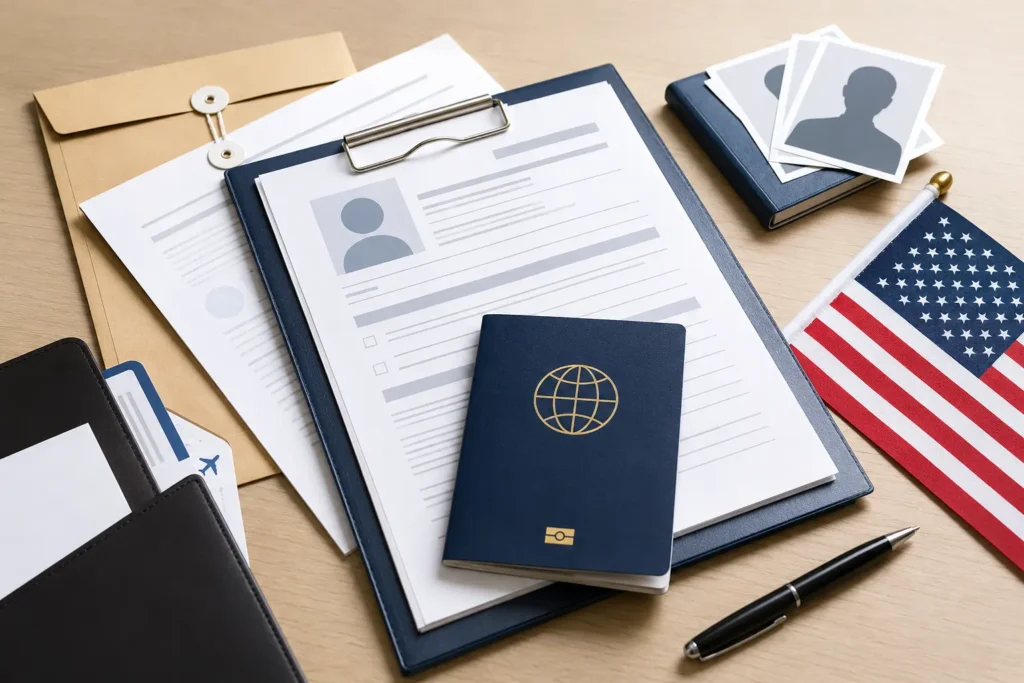
Seven core documents, generally: a valid passport, the DS-160 confirmation page, a printed fee receipt, a passport-style photo meeting State Department specs, the petition receipt number from Form I-129 or I-797, and (for H-1B, H-2A, and H-2B applicants specifically) acknowledgment of the Legal Rights and Protections pamphlet. L-1 applicants under a blanket petition also need Form I-129S. Consular officers often ask for more beyond this baseline: pay stubs, degree certificates, an employer letter confirming the job offer is still active. A Filipino nurse applying for an H-1B, for instance, should bring her nursing license, transcript with credential evaluation, and a signed offer letter from the sponsoring hospital, even though none of those three show up on the State Department’s official checklist. Missing documentation is one of the most common reasons an interview ends in administrative processing instead of an approval on the spot.
Conclusion
H-1B remains the most common route for skilled professionals, but with its fee status genuinely unsettled in court, L-1 and O-1 are worth a serious look for anyone who qualifies. Confirm eligibility early, gather documentation ahead of time, and check the fee and policy details against USCIS.gov before filing. That last step matters more this year than most.
FAQs

Michael Reynolds
Michael Reynolds leads immigration content at ImmigrationWin, covering visa requirements, application and relocation pathways. He researches immigration policies and official government guidance to explain changing rules clearly. His guides help students, families, and professionals make informed decisions about moving abroad.
Related Posts