
How to Sponsor a Work Visa: A Step-by-Step Guide for U.S. Employers
A hiring manager finds the right candidate. Then finds out the candidate needs a visa, and suddenly the process involves two federal agencies, a stack of forms, and a timeline nobody explained upfront. That gap, between “we want to hire this person” and “this person can legally start,” is where most employers get stuck.
Sponsorship isn’t complicated once you see the sequence: pick the right visa category, clear labor certification, file with USCIS, then wait through processing and an interview. What trips employers up is skipping a step or filing out of order. Here’s each stage in the order it actually happens, with the costs and timelines attached.
What Does It Mean to Sponsor a Work Visa?
Sponsoring a work visa means a U.S. employer formally agrees to employ a foreign worker and files the required petitions with federal agencies on that worker’s behalf. The employer, not the employee, carries legal responsibility for the filing, the wage commitment, and the accuracy of every document submitted. A software company in Austin, for example, needs to file Form I-129 with U.S. Citizenship and Immigration Services (USCIS) before an engineer from Brazil can start work under H-1B status. This isn’t a favor or a formality. It’s a binding legal relationship between the employer and two federal agencies: the Department of Labor (DOL) and USCIS.
Two sponsorship paths exist. Temporary sponsorship covers nonimmigrant work visas like H-1B or L-1, tied to a specific job for a fixed period. Permanent sponsorship leads to a green card through an employment-based immigrant visa category, and that path can take years rather than months. Employers usually need to understand both tracks, because many foreign workers start on a temporary visa and later move toward permanent residency through the same employer.
Who Can Sponsor a Work Visa?
Most U.S. employers can, as long as they meet basic legal, financial, and operational eligibility criteria set by DOL and USCIS. A sponsoring entity doesn’t need to be a large corporation. Startups, nonprofits, hospitals, even sole proprietors can sponsor foreign workers, provided they demonstrate a genuine job opening and the ability to pay the offered wage.
Employer Eligibility Requirements
Before filing any sponsorship petition, an employer must:
- Operate a legitimate business with a valid Federal Employer Identification Number (FEIN)
- Offer a bona fide, full-time, or otherwise qualifying position
- Demonstrate the financial ability to pay the prevailing wage for the role
- Maintain a genuine employer-employee relationship, including the right to direct and control the worker’s tasks
- Comply with federal wage, labor, and recordkeeping requirements
- Keep a public access file available for DOL audit if the visa category requires a labor condition application
A restaurant group with $200,000 in annual revenue and three locations meets this bar as easily as a 500-person manufacturing firm. Size matters less than documentation. Missing wage records or an unclear reporting structure will stall a petition no matter how big the company is.
Employee Eligibility Requirements
A foreign worker has to satisfy separate criteria tied to the chosen visa category. Most categories require:
- A job offer matching the worker’s qualifications
- Education or experience credentials that meet the position’s minimum requirements
- Admissibility to the United States (no disqualifying criminal, health, or immigration-violation history)
- Supporting documentation such as degree evaluations, licenses, or employment verification letters
If the position requires a bachelor’s degree in computer science, the candidate’s foreign transcript typically needs a credential evaluation confirming U.S. equivalency before USCIS will approve the petition.
How to Sponsor a Work Visa: Step-by-Step Process
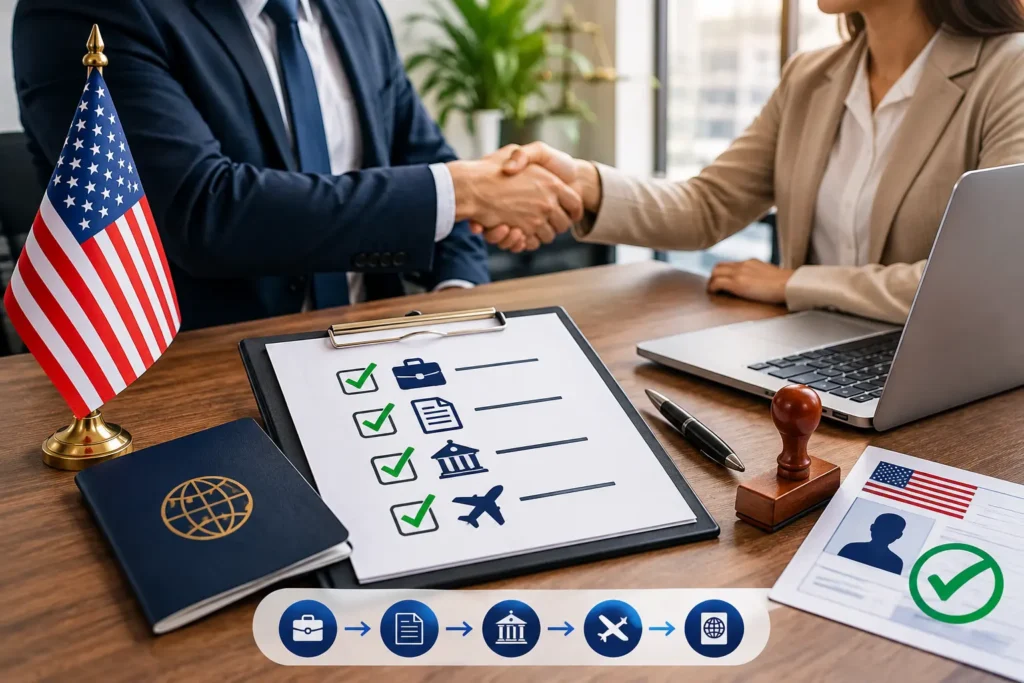
Employers work through five sequential stages: selecting the visa category, securing labor certification where required, filing the USCIS petition, waiting through government processing, and completing the consular or adjustment-of-status interview. Skip or rush any one of these and you’re looking at the delays behind most denied or returned petitions.
Step 1: Choose the Right Visa Category
The category depends on the role, the worker’s qualifications, and whether you want temporary or permanent status. A multinational company transferring a manager from its London office would use L-1A; a hospital hiring a physical therapist with a bachelor’s degree would more likely pursue H-1B or an EB-3 green card. Choose wrong here and you can waste months, because switching categories mid-process often means starting over.
Step 2: Secure Labor Certification from the Department of Labor
Most employment-based visa categories require DOL clearance before USCIS will even accept a petition. Two forms handle this, depending on the track:
- Labor Condition Application (LCA) — required for H-1B, H-1B1, and E-3 categories, confirming the employer will pay the prevailing wage and won’t displace U.S. workers
- PERM Labor Certification — required for most EB-2 and EB-3 green card sponsorships, involving a recruitment process that proves no qualified U.S. worker is available for the role
PERM recruitment alone typically runs 60 to 180 days, since the employer has to place job orders, run print advertisements, and document the outcome before submitting Form ETA-9089 to DOL. Skip a single recruitment step and DOL will reject the application outright.
Step 3: File the Petition with USCIS
Once labor certification clears (if it’s required), the employer files the appropriate petition:
- Form I-129, Petition for a Nonimmigrant Worker — for temporary categories including H-1B, L-1, O-1, and TN
- Form I-140, Immigrant Petition for Alien Worker — for permanent employment-based green card categories
USCIS reviews the petition for accuracy, wage compliance, and evidence that the worker meets the category’s standards. A petition claiming “specialty occupation” status under H-1B needs a job description that ties the role directly to a bachelor’s degree in a specific field. A vague description invites a Request for Evidence (RFE), USCIS’s formal demand for more proof before it will rule on the case.
Step 4: Wait for Approval and NVC or USCIS Processing
If USCIS approves the petition and the worker is applying from abroad, the case moves to the National Visa Center (NVC) for immigrant visa processing, or the worker applies directly for a nonimmigrant visa stamp at a U.S. consulate. Workers already inside the United States on a different status may instead file Form I-485 to adjust status without leaving the country. A software engineer already working on Optional Practical Training (OPT) inside the U.S., for instance, would typically adjust status rather than depart for consular processing.
Step 5: Attend the Visa Interview
The final stage is an in-person interview, either at a U.S. embassy or consulate abroad or, for adjustment-of-status cases, at a USCIS field office. Consular officers verify identity, review supporting documents, and confirm the worker isn’t inadmissible under any ineligibility ground. Approval here results in visa issuance and, for immigrant visa cases, a sealed document packet the worker has to present unopened at the U.S. port of entry.
Which Work Visa Categories Are Available?
Ten major categories cover most employment-based sponsorship, split between temporary nonimmigrant status and permanent immigrant status. Which one fits depends on the worker’s role, the employer’s structure, and how long the stay is meant to last.
Temporary (Nonimmigrant) Work Visas
| Visa | Best For | Annual Cap |
| H-1B | Specialty occupations requiring a bachelor’s degree | 85,000 (65,000 regular + 20,000 U.S. master’s exemption) |
| L-1A/L-1B | Intracompany transferees (executives, managers, specialized knowledge staff) | None |
| O-1 | Individuals with extraordinary ability in sciences, arts, business, or athletics | None |
| TN | Canadian and Mexican professionals under USMCA | None |
| E-3 | Australian professionals in specialty occupations | 10,500 |
| H-2A/H-2B | Seasonal agricultural or non-agricultural workers | H-2B: 66,000 (split across two half-year periods) |
The H-1B lottery adds a wrinkle a lot of guides skip over. Registration opens in March each year, and USCIS runs a random electronic selection whenever registrations exceed the 85,000 cap, which happens every single year. An employer registering a candidate in March 2026 for an October 1, 2026 start date has no guarantee of selection, even with a fully qualified worker and a completed job offer in hand.
Permanent (Immigrant) Employment-Based Visas
| Category | Description | Share of Annual 140,000 Cap |
| EB-1 | Priority workers: extraordinary ability, outstanding researchers, multinational executives | 28.6% |
| EB-2 | Advanced-degree professionals or exceptional ability | 28.6% |
| EB-3 | Skilled workers, professionals, and unskilled workers | 28.6% |
| EB-4 | Special immigrants (religious workers, certain government employees) | 7.1% |
| EB-5 | Immigrant investors creating U.S. jobs | 7.1% |
EB-1 applicants with extraordinary ability can self-petition without an employer or labor certification. EB-2 candidates can also skip employer sponsorship entirely through a National Interest Waiver (NIW), if their work serves the national interest strongly enough to justify bypassing labor certification.
How Much Does It Cost to Sponsor a Work Visa?
Somewhere between $3,000 and $15,000 in combined government filing fees and legal costs, depending on the category and whether you use premium processing. A nonprofit filing a straightforward H-1B petition without premium processing sits at the low end; a multinational corporation sponsoring an EB-1 executive with expedited review sits at the high end.
Direct government fees include:
- Form I-129 base filing fee: roughly $460 to $780, depending on employer size and category
- Form I-140 base filing fee: $715 as of 2026
- American Competitiveness and Workforce Improvement Act (ACWIA) fee: $750 (employers with 1–25 full-time employees) or $1,500 (26 or more), required for H-1B filings
- Fraud Prevention and Detection fee: $500 for initial H-1B and L-1 petitions
- Asylum Program Fee: $600 for standard employers, $300 for small employers, $0 for nonprofits, added to most I-129 filings under 2025 fee legislation
- Premium Processing fee: $2,965 as of March 1, 2026, for expedited 15-business-day review of Form I-129 or I-140
- PERM filing: no government fee, but recruitment advertising typically runs $1,000 to $3,000
Worth flagging: a $100,000 supplemental fee tied to certain new H-1B petitions was introduced by presidential proclamation in September 2025. A federal district court vacated it on June 8, 2026, and after a brief administrative stay, the First Circuit Court of Appeals denied the government’s request to reinstate the fee on July 24, 2026. So as of this writing, the fee isn’t being collected, but the government’s appeal is still pending, and the underlying proclamation is set to expire on September 20, 2026 unless renewed. Employers budgeting for new H-1B filings should confirm current enforcement status before assuming either way.
Attorney fees add another $2,000 to $8,000 per case on top of government charges, depending on firm size and case complexity. By law, employers (not workers) have to pay the ACWIA fee and the Fraud Prevention fee. Asking the employee to cover these specific charges violates DOL wage rules.
How Long Does Work Visa Sponsorship Take?
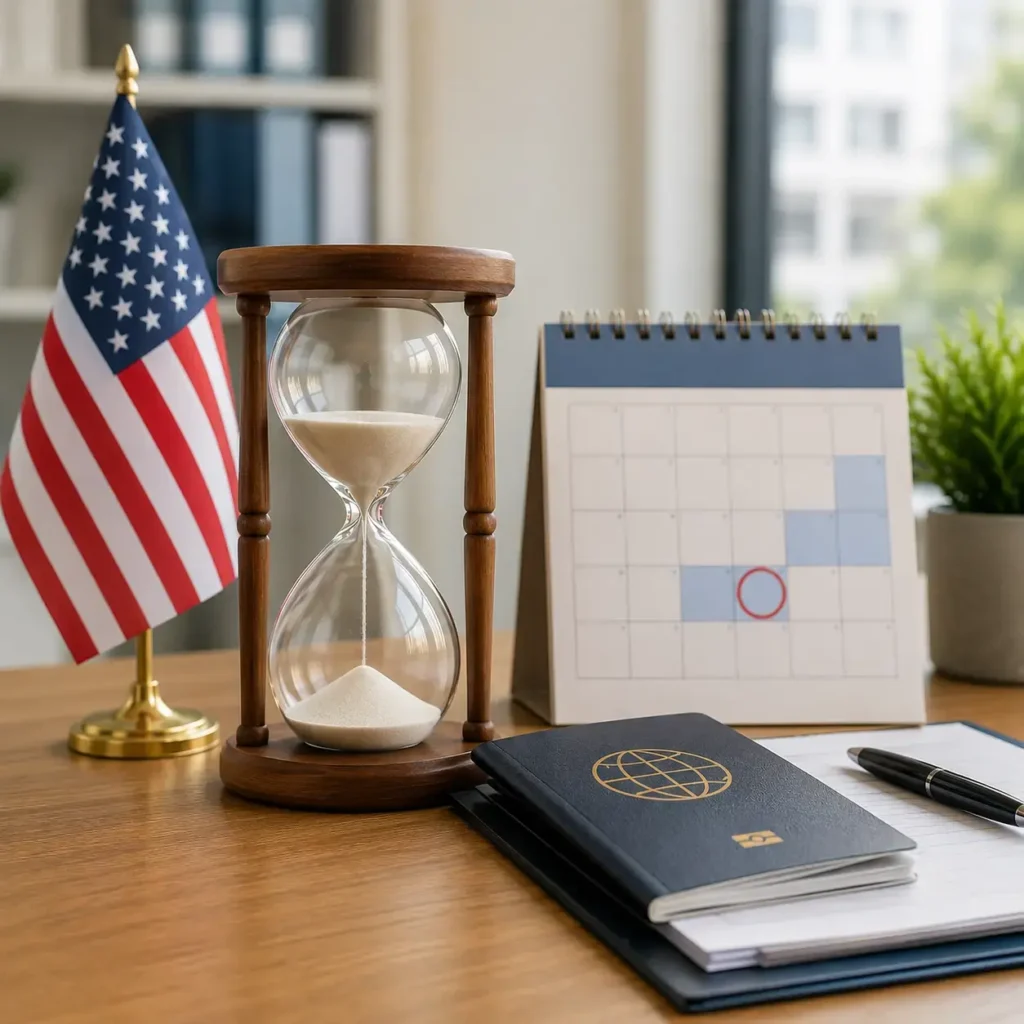
Anywhere from 2 months to over 10 years. It depends entirely on the visa category and the worker’s country of birth. An L-1 transfer with premium processing can finish in as little as 15 business days after filing. An EB-2 green card for a worker born in India, on the other hand, faces a backlog that’s stretched past a decade in recent visa bulletin cycles, thanks to per-country caps that limit each nation to 7% of the annual 140,000 employment-based allocation.
Realistic ranges by stage:
- LCA certification: 7 business days
- PERM recruitment and filing: 60 to 180 days for recruitment, then 6 to 12 months for DOL adjudication
- Form I-140 standard processing: 6 to 8 months; 15 business days with premium processing
- Form I-129 standard processing: 2 to 6 months depending on category and service center; 15 business days with premium processing
- Consular visa interview scheduling: 2 to 8 weeks after NVC document review, though wait times vary sharply by country
Country of birth matters more than any other single factor for green card timelines. A Canadian software engineer and an Indian software engineer with identical qualifications and identical EB-2 petitions can face timeline differences measured in years, purely because of per-country visa allocation limits.
What Happens After the Visa Is Approved?
Once USCIS or a consular officer approves the visa, the worker can enter the United States and begin employment under the terms in the petition. Nonimmigrant workers receive an admission stamp or electronic I-94 record tied to their specific employer and job. Changing employers under H-1B, for instance, requires the new employer to file a fresh I-129 petition before the worker can start the new role.
Immigrant visa holders have more steps after entry. They have to pay the USCIS immigrant fee before receiving a permanent resident card (a green card), which typically arrives by mail within a few weeks of admission. Every immigrant visa holder also has to complete a medical exam through an authorized panel physician before the interview stage. Not optional, regardless of age.
Employers keep compliance obligations after approval, too. H-1B sponsors must maintain a Public Access File documenting wage compliance for the life of the petition, and any material change to the worker’s job duties, work location, or salary can trigger a requirement to file an amended petition.
Common Mistakes That Delay or Deny Sponsorship

Incomplete wage documentation, mismatched job descriptions, and missed filing deadlines account for most of the trouble, and all three are avoidable with earlier prep. A mid-size logistics company that waits until August to start an H-1B case for an October 1 start date has already missed the March registration window and has to wait a full year for the next lottery cycle.
Frequent errors include:
- Filing an LCA with a prevailing wage below the actual market rate for the position and geographic area, which triggers a DOL audit
- Submitting a job description that doesn’t clearly connect to the required degree field, inviting an RFE from USCIS
- Failing to notify USCIS of a change in worksite location, which can void H-1B status under DOL’s material-change rules
- Underestimating PERM recruitment timelines and missing the 180-day validity window on the prevailing wage determination
- Assuming a pending green card petition guarantees employment authorization without also filing Form I-765 for a valid Employment Authorization Document
A worker whose PERM prevailing wage determination expires before recruitment wraps up has to restart the entire wage determination, tacking months back onto an already long timeline. Employers who keep a compliance calendar tracking wage determination expiration dates, LCA posting requirements, and petition validity periods sidestep most of these setbacks.
Conclusion
Sponsoring a work visa comes down to five concrete stages: category selection, labor certification, USCIS filing, government processing, and the final interview. Costs run from roughly $3,000 for a straightforward nonimmigrant petition to well over $15,000 for an expedited green card case, and timelines range from 15 business days under premium processing to more than a decade for backlogged green card categories tied to country of birth. Employers who track wage determination deadlines, file complete job descriptions, and register early for capped categories like H-1B avoid the delays that trip up most first-time sponsors. The process runs on documentation and timing. Treat both as fixed requirements, not afterthoughts, and you’ll move workers from job offer to approved status with the fewest complications.
FAQs

Michael Reynolds
Michael Reynolds leads immigration content at ImmigrationWin, covering visa requirements, application and relocation pathways. He researches immigration policies and official government guidance to explain changing rules clearly. His guides help students, families, and professionals make informed decisions about moving abroad.
Related Posts