Green Card vs Work Visa: Key Differences Explained
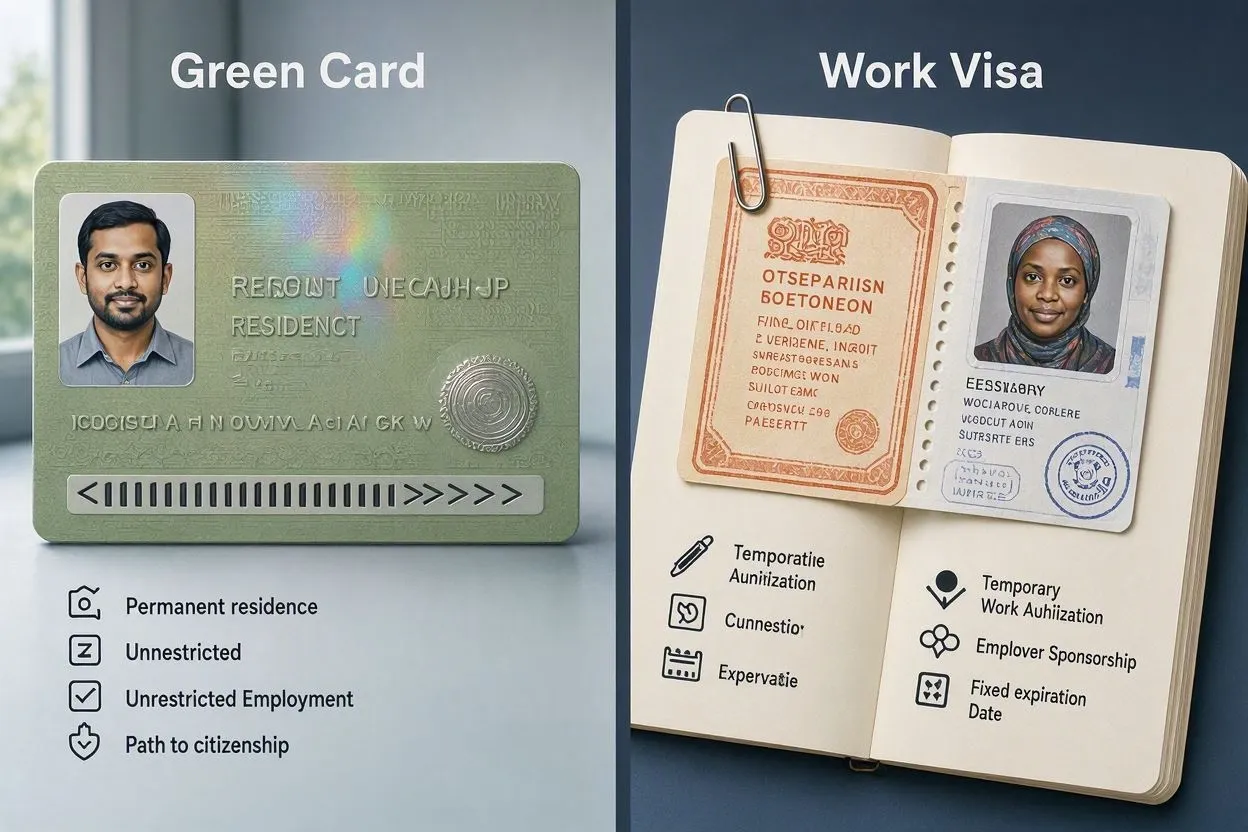
A green card grants lawful permanent resident (LPR) status with no expiration on your right to stay. A work visa grants temporary permission to work in the United States for a fixed period tied to a specific job or employer. That single distinction, permanent versus temporary, drives every other difference between the two: cost, processing time, family sponsorship rights, and what happens if you change jobs.
Roughly 1,085,196 temporary work visas were issued in fiscal year 2024, the most recent full-year total published in the Department of State’s Nonimmigrant Visa Detail Table, compared with just 52,500 employment-based green cards issued that year, per DHS data. That gap tells you which path is harder to get, and why the comparison matters before you file anything.
What Is the Difference Between a Green Card and a Work Visa?
The core difference is permanence: a green card confers indefinite lawful permanent residency, while a work visa confers temporary nonimmigrant status that expires on a set date. Green card holders can live and work anywhere in the country for any employer, indefinitely, and can eventually apply for U.S. citizenship. Work visa holders stay tied to the employer or purpose named on their petition, and their authorized stay ends when the visa expires, usually within 1 to 6 years depending on category.
Immigration law treats these as two separate tracks: USCIS handles green card adjudication inside the United States, while the Department of State manages visa issuance through U.S. embassies and consulates abroad. A person can hold a work visa without ever becoming eligible for a green card, and a person can obtain a green card without having held a work visa first. Family-sponsored green cards, for example, don’t require any prior work visa at all.
What Is a Green Card?
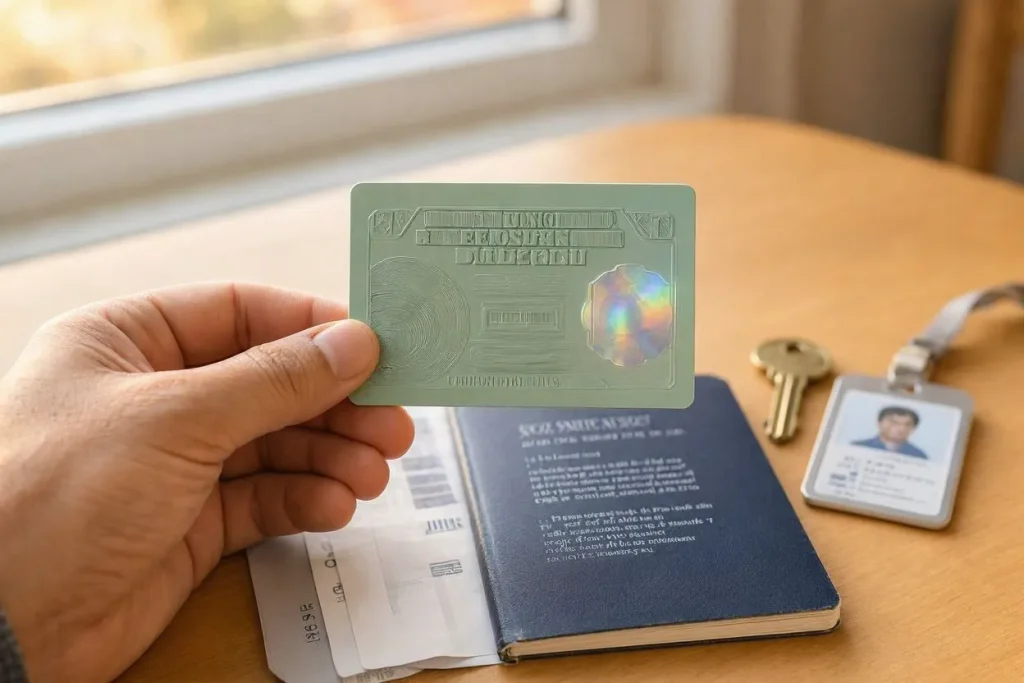
A green card is the common name for a Permanent Resident Card, the document proving lawful permanent resident status in the United States. LPRs can work for any employer, live anywhere in the country, and travel internationally with the ability to re-enter using the card and a valid passport. The card carries a 10-year validity period for standard permanent residents, or 2 years for conditional residents in marriage-based cases where the marriage was under 2 years old at approval.
Green cards fall into two broad categories: family-sponsored and employment-based. Employment-based green cards run through five preference levels, EB-1 through EB-5.
- EB-1 covers workers with extraordinary ability, such as Olympic athletes or Nobel laureates.
- EB-2 covers advanced-degree professionals and those with exceptional ability.
- EB-3 covers skilled workers, professionals, and other workers with a job offer. This category accounted for 23,370 green cards in FY2024, or 45% of all employment-based green cards issued that year, per USCIS’s Employment-Based Preference Category report.
- EB-4 covers special categories like religious workers.
- EB-5 covers investors who commit capital and create at least 10 permanent jobs.
What Is a Work Visa?
A work visa is a temporary, nonimmigrant document that authorizes a foreign national to work in the United States for a defined period, usually tied to a specific employer or job category. A work visa doesn’t grant permanent status. It grants conditional, time-limited permission that ends when the visa expires or the underlying job ends, whichever comes first.
The most common work visa categories:
- H-1B visas, for specialty occupations requiring a bachelor’s degree, such as engineering or software development
- H-2A visas for temporary agricultural workers
- H-2B visas, for temporary non-agricultural seasonal workers
- L-1 visas, for intracompany transferees moving between related business entities
- O-1 visas, for individuals with extraordinary ability in their field
- TN visas for eligible Canadian and Mexican professionals under USMCA
- E-2 visas for treaty investors and their essential employees
H-1B visas dominated specialty-occupation hiring in FY2024: 219,659 workers were admitted, 20.2% of all temporary work visas that year, according to the State Department’s FY2024 Nonimmigrant Visa Detail Table. Workers from India accounted for 150,647 of those H-1B recipients, or 68.6% of the total. H-2A visas were even more common overall. 315,328 were issued in FY2024, making up 29.1% of all temporary work visas, with 90.6% going to workers from Mexico.
How Do Green Cards and Work Visas Differ in Duration?
Green cards carry no expiration on underlying status. Work visas expire on a fixed schedule that varies by category. An H-1B visa, for example, is valid for an initial 3-year period and can be extended once for a maximum of 6 years total. After that ceiling, the worker must either qualify for a green card petition already in process or leave the country. A green card’s 10-year card must be renewed through Form I-90, but the underlying permanent resident status doesn’t expire along with the physical card. Only the document does.
Conditional green cards work differently. A couple married less than 2 years at the time of approval receives a 2-year conditional card instead of the standard 10-year card. Before that 2-year window closes, the couple must file Form I-751 to remove the conditions and receive the full 10-year card. Miss that filing, and the immigrant risks losing status entirely. It’s a real deadline with real consequences, not a formality.
Which Work Visas Can Lead to a Green Card?
Several nonimmigrant work visas, including H-1B, L-1, and O-1, can lead to a green card, but no work visa automatically converts into one. Each visa category and each green card category are adjudicated separately, under separate legal standards, by separate government bodies.
| Work Visa | Typical Green Card Path |
| H-1B | EB-2 or EB-3, through employer PERM labor certification |
| L-1A (executive/manager) | EB-1C, multinational executive/manager category |
| L-1B (specialized knowledge) | EB-2 or EB-3, through PERM |
| O-1 (extraordinary ability) | EB-1A, no employer sponsorship required |
| TN | No direct EB category; usually requires a separate H-1B or other visa first |
| E-2 | No direct EB category; treaty investors often shift to EB-5 |
Dual intent is the legal doctrine that lets H-1B and L-1 holders pursue a green card while still maintaining their nonimmigrant status. Without it, applying for permanent residency could be read as violating the terms of a temporary visa. F-1 student visas and most other nonimmigrant categories lack this protection, which is why moving from those categories into a green card process carries more risk.
What Are the Eligibility Requirements for a Green Card vs a Work Visa?
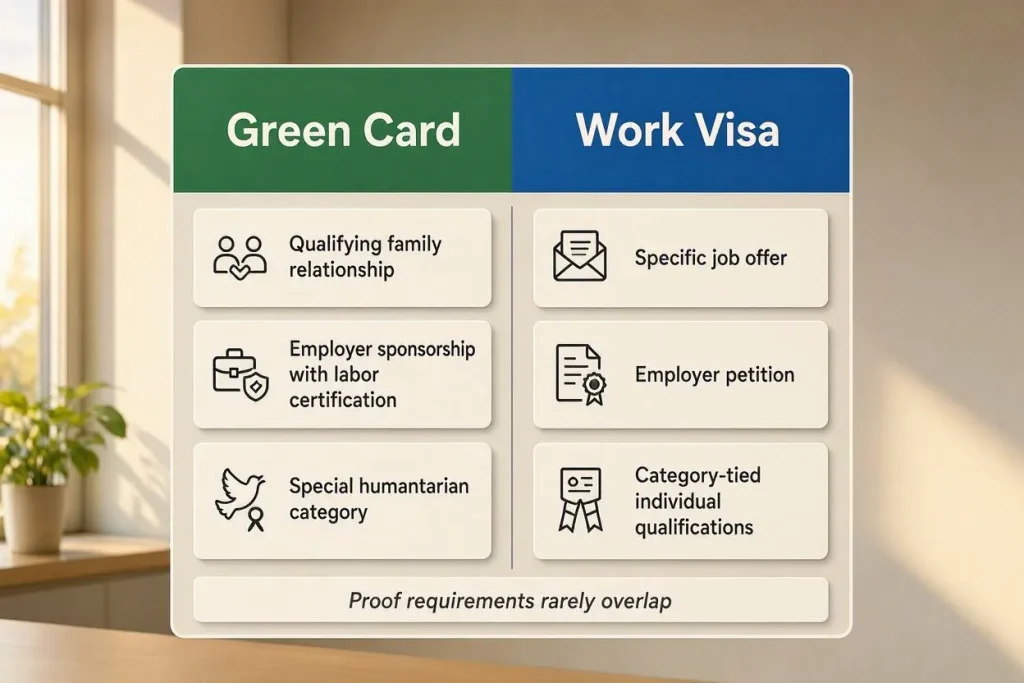
Green card eligibility depends on a qualifying family relationship, an employer sponsorship with labor certification, or a special humanitarian category. Work visa eligibility depends on a specific job offer, employer petition, or individual qualification tied to one nonimmigrant category. The two tracks rarely overlap in their proof requirements.
For employment-based green cards, most EB-2 and EB-3 petitions require the employer to complete PERM labor certification first, a process where the Department of Labor confirms no qualified U.S. worker is available for the role. That step alone can take 6 to 12 months before the employer even files Form I-140, based on DOL’s Office of Foreign Labor Certification processing time reports. For family-based green cards, the petitioner files Form I-130 to establish the relationship, then the beneficiary files Form I-485 if inside the United States, or completes consular processing abroad.
Work visa eligibility hinges on the visa category itself. H-1B applicants need a bachelor’s degree or equivalent in a specialty field and a job offer matching that specialty. L-1 applicants need at least 1 year of employment abroad with a qualifying related entity within the past 3 years. O-1 applicants need documented evidence of extraordinary ability: awards, media coverage, or a track record of significant contributions in their field.
How Much Does a Green Card Cost Compared to a Work Visa?
A green card through adjustment of status typically costs more in government filing fees than most work visa petitions, and the gap widens further once concurrent forms are added. All figures below reflect the USCIS fee schedule (Form G-1055) as of August 2026. Form I-485, the core adjustment of status application, costs $1,440. Applicants who file Form I-765 for a work permit while their I-485 is pending pay a reduced $260, and those who add Form I-131 for advance parole pay $630. Filed together, those three forms total $2,330, not counting attorney fees.
Work visa costs run lower on the employee side but higher on the employer side for certain categories. An H-1B petition filed on Form I-129 costs $780 in base filing fees for employers with more than 25 full-time employees, plus a $600 Asylum Program Fee most employers of that size must pay when filing I-129 or I-140 petitions. Employers seeking a faster decision can add premium processing through Form I-907, which rose to $2,965 for I-129 and I-140 filings when USCIS’s rate increase took effect on March 1, 2026, and remains the current fee. That fee guarantees action within 15 business days, not approval.
Employment-based green card sponsorship adds Form I-140, the immigrant petition employers file after PERM approval, on top of the employee’s own I-485 costs. Between PERM processing, I-140 filing, and I-485 adjustment, a single employment-based green card case routinely runs several thousand dollars in government fees before legal representation is factored in.
How Long Does Each Process Take?
Work visas generally process faster than green cards, often in months rather than years, because they skip the multi-stage petition-then-adjustment sequence a green card demands. An H-1B petition without premium processing typically takes several months from filing to decision, while premium processing shortens that window to 15 business days.
Green card timelines stretch considerably longer. Immediate relatives of U.S. citizens adjusting status from inside the United States can expect roughly 10 to 14 months from filing to approval, based on USCIS’s published processing-time ranges for Form I-485 as of mid-2026 (these shift by field office, so check the current range before relying on it). Employment-based cases take longer still once PERM certification, I-140 approval, and visa bulletin priority dates enter the picture. Applicants born in countries with high demand, particularly India and China, can face backlogs stretching years beyond the base processing time due to per-country annual visa caps, as reflected in the Visa Bulletin’s final action dates for EB-2 and EB-3.
What Rights Does a Green Card Holder Have That a Work Visa Holder Doesn’t?
Green card holders can work for any employer without restriction, travel internationally without a separate travel document, sponsor certain family members, and apply for U.S. citizenship. A work visa holder can’t do any of that without additional filings or status changes. A work visa holder who wants to switch employers usually needs a new or amended petition before starting the new job. A green card holder just starts working.
Travel illustrates the gap clearly. A green card holder re-enters the country with the card and a passport, the way any returning resident would. A work visa holder generally re-enters using the visa stamp in their passport, valid only for the specific status and employer named on the underlying petition. Leave that employer, and the visa itself can become invalid for future entry. Green card holders also qualify for many federal public benefits after a 5-year waiting period under the federal “qualified alien” rules in most cases, a pathway closed to nonimmigrant work visa holders entirely.
Can a Work Visa Holder Sponsor Family Members?

No. A nonimmigrant work visa holder cannot independently sponsor family members for immigration; only U.S. citizens and lawful permanent residents can file immigrant petitions on a relative’s behalf. A work visa holder can typically bring a spouse and unmarried children under 21 as dependents on a derivative visa (an H-4 for H-1B holders, for example, or an L-2 for L-1 holders), but that dependent status still expires when the principal visa expires.
A green card holder, once approved, can file Form I-130 to petition for a spouse or unmarried child. Naturalized U.S. citizens gain an even broader sponsorship reach, extending to parents, married children, and siblings.
Does a Work Visa Guarantee a Green Card?
No. Holding a work visa does not guarantee eventual green card approval, and no automatic conversion exists between the two statuses. Each is evaluated independently: a worker can hold a valid H-1B visa for the full 6-year maximum and still be denied a green card if the underlying labor certification, employer petition, or adjustment application doesn’t meet USCIS standards.
Certain visa categories do position holders more favorably. H-1B and L-1 status both carry dual intent, meaning the holder can pursue permanent residency without jeopardizing their current nonimmigrant status, a protection F-1 students and most other visa categories don’t share. Even with dual intent, approval depends on separate factors: employer sponsorship, PERM certification outcomes, priority date movement on the visa bulletin, and admissibility. A pending green card case can also stall if the worker changes employers before certain milestones, so timing matters as much as the underlying visa category.
Which One Should You Pursue: Green Card or Work Visa?
Choose a work visa if the goal is short-term employment tied to one employer or project. Choose a green card if the goal is permanent settlement, family sponsorship, or an eventual path to citizenship. The two aren’t always competing options. Many immigrants use a work visa as the entry point, then pursue a green card once eligible, particularly through employer sponsorship in the EB-2 or EB-3 categories.
Factors worth weighing before deciding which path fits a given situation:
- Employer willingness to sponsor PERM labor certification and cover I-140 costs
- Country of birth, since per-country visa caps create longer waits for applicants from India and China
- Family circumstances, including whether a spouse or children need derivative status
- Career flexibility needs, since work visas restrict job changes more than green cards do
- Timeline tolerance, given the multi-year gap between average work visa processing and average green card processing
A software engineer from Germany on an H-1B visa, sponsored by an employer willing to file PERM and I-140, might reach a green card within 2 to 4 years. A software engineer from India in the same job, same employer, and same visa category could wait considerably longer because of per-country caps on the EB-2 category, sometimes a decade or more, based on how far behind the Visa Bulletin’s India EB-2 final action date has fallen in recent years. The visa category is identical; the outcome isn’t.
Conclusion
The fee schedule alone marks the difference sharply: $1,440 for adjustment of status against $780 for an H-1B petition, with the value each buys measured in decades versus years. For most applicants, the work visa is the door, and the green card is the room on the other side of it.
FAQs

Michael Reynolds
Michael Reynolds leads immigration content at ImmigrationWin, covering visa requirements, application and relocation pathways. He researches immigration policies and official government guidance to explain changing rules clearly. His guides help students, families, and professionals make informed decisions about moving abroad.
Related Posts