
How to Find a Job That Sponsors Visa: A Step-by-Step U.S. Guide
The fastest way to find a job that sponsors a visa in the United States is to target roles at companies with a documented sponsorship history, in industries that routinely file visa petitions, using search terms that surface those listings directly. Job boards rarely make this easy on their own. You’ll need a combination of targeted search operators, public government data, and a resume that signals sponsorship needs without burying it.
This guide breaks the process into eleven concrete steps, pulled from real employer sponsorship data, job board tactics, and the mistakes candidates repeatedly make.
What Does Visa Sponsorship Mean?
Here’s what sponsorship actually asks of an employer: they file a petition with U.S. Citizenship and Immigration Services (USCIS) on your behalf, and from that point on, it’s their name on the line. They have to prove you’re qualified for the role, and that no equally qualified American applicant was available for it. That also means filing a Labor Condition Application (LCA) with the Department of Labor, covering the legal fees, and staying compliant for as long as you’re on the payroll. None of this is free: a typical H-1B petition runs a company $5,000 to $10,000 in filing fees, attorney costs, and premium processing, depending on firm size and urgency. That’s why a company’s sponsorship history matters more than its job titles. Once a company has paid that bill, it’s far more willing to pay it again than one sponsoring for the first time.
If you’re applying from outside the U.S., there’s a bigger number to watch. A September 2025 presidential proclamation added a $100,000 fee on new H-1B petitions for beneficiaries abroad, and where that stands right now is genuinely up in the air: a federal court vacated it in June 2026, an appeals court refused to pause that ruling in July 2026, but the government is still fighting it and says it’ll start collecting again if it wins. Check the USCIS H-1B FAQ page for the latest before you assume either way. One thing that has stayed consistent through all of it: the fee hasn’t applied to people already in the U.S. switching from OPT to H-1B status.
Which Visa Category Fits Your Situation?
Your visa category depends on your current status, your field, and whether you hold a U.S. degree already. Figure this out before you start applying. Otherwise you’ll waste time on roles you were never eligible for in the first place.
Here’s a rundown of the main categories international candidates go after:
| Visa | Who it’s for | Cap / notes |
| H-1B (Specialty Occupation Visa) | Bachelor’s degree or higher in a field related to the job | Capped at 85,000 new visas a year (65,000 regular plus 20,000 reserved for U.S. master’s degree holders). Since February 2026, the cap is filled by a wage-weighted lottery, not a flat random draw. DHS now weights entries by the job’s offered wage level, so a higher-paying role has a better shot at selection than an entry-level one does |
| O-1 (Extraordinary Ability Visa) | Candidates with sustained national or international acclaim in their field | No annual cap |
| TN (Trade NAFTA/USMCA Visa) | Canadian and Mexican citizens in specific professional categories | Faster and cheaper filing process than the H-1B |
| J-1 (Exchange Visitor Visa) | Students and early-career professionals, under Intern and Trainee categories | Sponsored through a designated program sponsor rather than the employer directly |
| EB-2/EB-3 (Employment-Based Green Card, second and third preference) | Candidates pursuing permanent residency | Typically pursued after several years of H-1B status |
If you’re a recent graduate on Optional Practical Training (OPT), your timeline is tighter than a candidate applying from abroad, because OPT work authorization expires and only converts to H-1B status if your employer wins the annual lottery.
Which Industries and Companies Sponsor Most Often?

Technology, healthcare, higher education, engineering, and finance sponsor the highest volume of work visas, with technology alone accounting for roughly a third of all H-1B petitions filed each year. Sponsorship depends more on role than on company size: a 50-person startup with a specialized engineering need will sponsor just as readily as a Fortune 500 firm if the role requires skills the U.S. labor market is short on. Sponsorship is role-dependent within a single company, too. A large bank might sponsor quantitative analysts and software engineers freely while rarely sponsoring retail branch staff, because the shortage argument only holds up for specialized roles.
| Industry | Example sponsors | Typical sponsored roles | Annual petition volume |
| Technology | Amazon, Nvidia, Intel | Software engineer, data scientist | 20,000+ combined (Amazon entities) |
| IT consulting | Tata Consultancy Services, Infosys | IT consultant, systems analyst | Several thousand each |
| Professional services | Ernst & Young | Auditor, financial analyst | 12,000+ |
| Healthcare | Hospitals, specialty clinics | Physician, nurse, researcher | Varies by state shortage designation |
| Higher education | University systems and affiliated nonprofits | Professor, postdoctoral researcher | Cap-exempt; filed year-round, not counted against the 85,000 annual cap |
How to Search Job Boards for Sponsorship Listings
Search using Boolean operators and sponsorship-specific keywords rather than browsing standard job board categories, since most postings don’t advertise sponsorship in the title. Standard keyword searches like “software engineer” return thousands of results with no sponsorship signal at all.
Boolean search tactics
Try stacking your target role together with sponsorship language using AND, OR, and NOT on LinkedIn or Google. A few worth trying:
- “Data Analyst” AND “visa sponsorship” pulls up postings that spell out sponsorship up front.
- “Software Engineer” OR “Backend Developer” AND “H-1B” casts a wider net on titles without losing the visa filter.
- “Marketing Manager” AND “sponsorship” NOT “internship” cuts out unpaid and short-term listings, which rarely come with sponsorship anyway.
Platforms with built-in sponsorship filters
A handful of sites skip the Boolean guesswork and let you filter for sponsorship directly. Wellfound (formerly AngelList) lets startup job seekers filter listings by visa sponsorship availability. Handshake, used by most U.S. universities, includes the same filter for students still enrolled or on OPT. Specialized boards focused entirely on sponsorship, including databases that track H-1B filing history by employer, let you skip the guesswork and search directly by visa type, industry, and location.
How to Verify a Company’s Sponsorship History
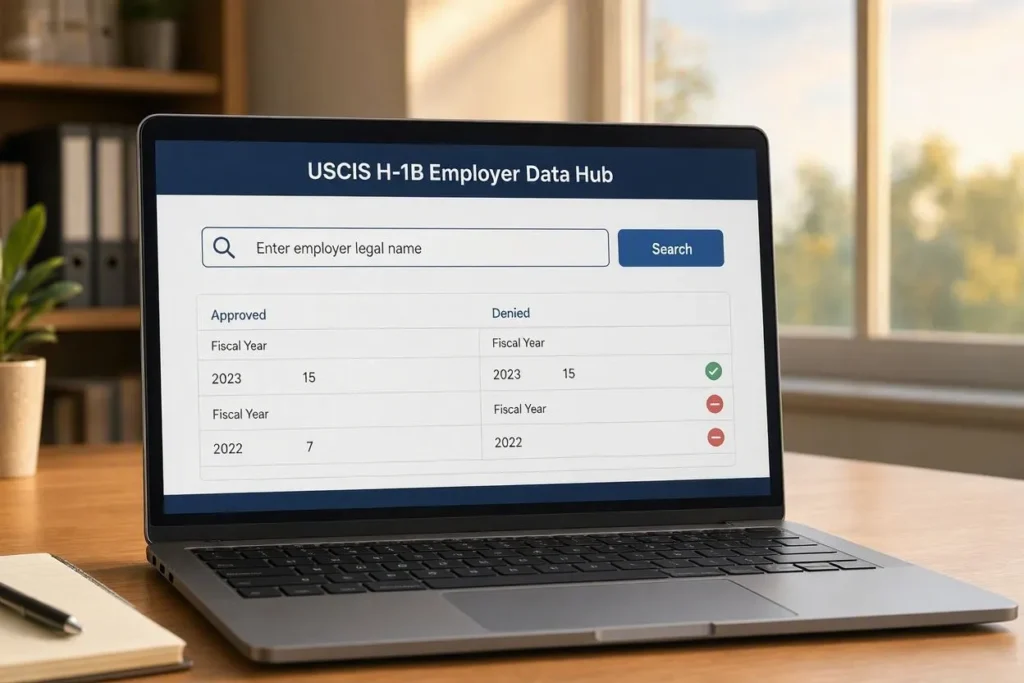
Verify a company’s sponsorship history using the USCIS H-1B Employer Data Hub, a free public tool that lists every employer’s approved and denied petitions by fiscal year. This step avoids the biggest time sink in a sponsorship job search: applying to companies that have never filed a petition and have no internal process for doing so.
Search the employer’s exact legal name (not always the brand name you’d recognize), then check:
- Total petitions filed over the last three fiscal years
- Approval-to-denial ratio for that employer
- Job function clustering: whether petitions concentrate in your target role (200 approvals in software engineering and zero in marketing tells you exactly where your odds are strongest)
- Third-party databases built on the same DOL and USCIS filings, searchable by occupation, prevailing wage, and year-over-year trends, useful for convenience, though the government source stays the most current and accurate
Why Cap-Exempt Employers Deserve Extra Attention
Cap-exempt employers skip the H-1B lottery entirely, filing petitions on a rolling basis year-round instead of competing for one of 85,000 annual slots. This distinction matters because it removes the lottery’s timing risk from your search entirely.
Cap-exempt status applies to universities and their affiliated nonprofit entities, nonprofit research organizations, and governmental research organizations. A postdoctoral researcher at a university-affiliated hospital, for example, can be sponsored in March, June, or November, whenever the position opens, instead of waiting for the once-a-year lottery window that runs every March for an October start date. If your field overlaps with research, teaching, or academic medicine, prioritizing cap-exempt employers can cut months, sometimes over a year, off your timeline.
How to Position Your Resume and LinkedIn Profile
On your resume
State your work authorization status in one clear line near the top, rather than leaving employers to guess or discover it after an interview. Ambiguity here costs candidates interviews, because recruiters screening hundreds of applications will skip anything requiring extra clarification. A single line under your contact information, “Authorized to work in the U.S. on OPT through [date]; requires H-1B sponsorship for continued employment,” confirms you can start working immediately and flags the sponsorship need without making it the headline of your application.
On LinkedIn
Follow the same approach on LinkedIn by adding your work authorization status to your “About” section, since recruiters filtering candidates by immigration status will see it before they open your resume at all. Weight your resume toward the specific skills tied to sponsored roles in your field: if USCIS data shows a target company sponsors machine learning engineers at three times the rate of general software developers, lead with machine learning projects instead of generic full-stack experience.
How to Bring Up Sponsorship in Interviews and Cover Letters
Mention sponsorship needs directly once a recruiter confirms interest, rather than volunteering it in your opening cover letter paragraph or withholding it until an offer is on the table. Timing determines whether the conversation feels like a disclosure or an ambush.
A cover letter can note your authorization status in a single closing sentence, similar to the resume phrasing above, without dwelling on it. In a first-round interview, if a recruiter asks about your long-term work authorization, answer directly with your current status and timeline: “I’m currently on OPT through August, and I’d need H-1B sponsorship to continue in this role past that date.” Confidence in the delivery matters as much as the content: recruiters interpret hesitation as a sign you’re uncertain about your own eligibility, not as courtesy.
Avoid raising sponsorship before a recruiter has expressed genuine interest in your background, since doing so can shift the entire conversation toward logistics before your qualifications get a fair hearing.
Sponsorship Scams to Watch For
Yes, they’re real, and common enough that immigration attorneys and advocacy groups keep publishing warnings about them. Most follow the same script: an upfront fee, a promise to guarantee your visa, or a fake job offer designed to get your personal documents out of you. Learn to spot it early. Some of these scams can put your immigration status at risk even if you had no idea what you were caught up in.
Watch for:
- Payment requested before any job offer or petition filing happens
- A “guaranteed” visa outcome. No legitimate employer or agency can promise USCIS will approve anything
- A job offer with no interview, especially for a role that’s supposed to be skilled
- Pressure to sign quickly, or to hand over your passport and financial details before an actual employment relationship exists
A real employer pays its own sponsorship costs. It won’t ask you to cover filing or attorney fees. So if a recruiter or “consultancy” wants money upfront, that’s your answer: it’s fraud, and the conversation should end there.
When to Start: Timing Your Search Around the H-1B Lottery
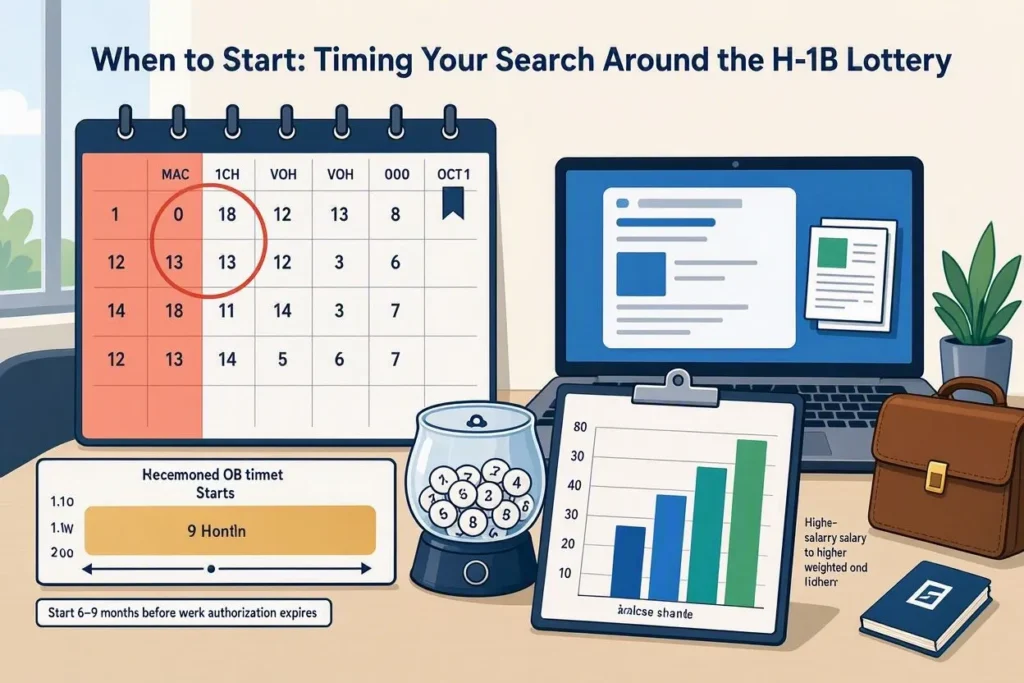
Start your search at least six to nine months before your current work authorization expires, since the H-1B lottery registration period runs every March for an October 1 start date. Missing this window means waiting a full additional year if your target role isn’t cap-exempt.
Since the lottery now weights entries by wage level, a role offering a higher salary has better odds of selection than an identical entry-level role. If you’re weighing two offers with similar duties but different pay, that difference is worth factoring into which one gives you a real shot at the cap.
For candidates on OPT, this timing is especially unforgiving: the 12-month OPT period (or 36 months total with the STEM Optional Practical Training extension for eligible degree fields) has to overlap with your employer’s ability to register and win the lottery. A candidate whose OPT expires in December, for instance, needs an employer registered and selected in the March lottery of that same year to avoid a work authorization gap. Building in a six-month buffer gives you room to interview, receive an offer, and let your employer complete registration before the deadline.
Conclusion
Finding a job that sponsors visa status comes down to replacing guesswork with verification at every stage: confirming your visa category before applying, checking a company’s actual filing history instead of trusting a job posting’s wording, and timing your search around the March H-1B registration window rather than discovering it too late. Candidates who combine Boolean search tactics with public USCIS data consistently cut months off a process that, done blindly, can stretch past a full year.
FAQs

Michael Reynolds
Michael Reynolds leads immigration content at ImmigrationWin, covering visa requirements, application and relocation pathways. He researches immigration policies and official government guidance to explain changing rules clearly. His guides help students, families, and professionals make informed decisions about moving abroad.
Related Posts