Passport Rules For Infants: What U.S. Parents Need To Know
Every U.S. citizen infant needs an individual passport book for international air travel, regardless of age. A two-week-old flying to London carries the same document requirement as an adult. No family passport exists, and no exemption applies to babies who travel on a parent’s lap.
The passport rules for infants differ from adult rules in three specific ways: both parents must appear in person, the passport stays valid for only 5 years, and the application cannot be renewed by mail when it expires. Parents who understand those differences before booking travel avoid the two failures that derail most infant applications: bringing the wrong birth certificate and starting too late.
All fees, processing times, and requirements below were verified against U.S. Department of State and U.S. Customs and Border Protection guidance current to September 2026.
Does Your Baby Need A Passport?
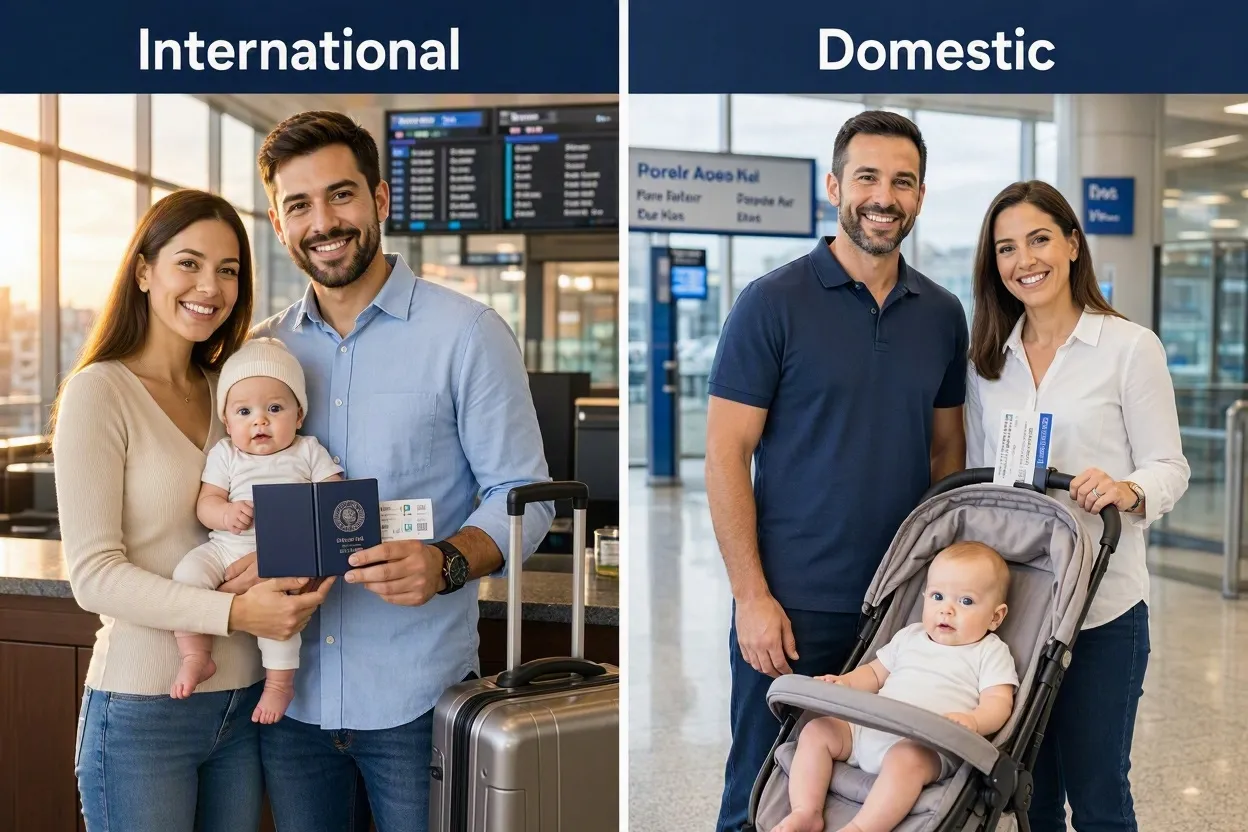
Yes, your baby needs a passport for international air travel, and no, your baby does not need one for domestic flights. The answer changes based on how your family leaves the country and where you go.
Air Travel Outside The United States
A passport book is mandatory for every child, including infants, flying into or out of the United States. U.S. Customs and Border Protection applies the requirement to all air arrivals, with narrow exceptions for lawful permanent residents, refugees, and asylees who present Form I-551 or equivalent status evidence. A newborn flying from Miami to Nassau needs a book, not a card. Passport cards are invalid for air travel at any age.
Land And Sea Travel To Canada And Mexico
U.S. and Canadian citizen infants may cross land and sea borders with a copy of a birth certificate instead of a passport. Children under 16 arriving by land or sea from Canada or Mexico can present an original or copy of a U.S. birth certificate, a Consular Report of Birth Abroad (CRBA), or a Certificate of Naturalization. The exception comes from the Western Hemisphere Travel Initiative (WHTI), which sets the document standard for these crossings. Officers at the port of entry make the final admissibility decision on any document presented.
Closed-Loop Cruises
Infants on closed-loop cruises need a certified birth certificate rather than a passport. A closed-loop sailing departs a U.S. port and returns to that same U.S. port. Miami to the Bahamas and back to Miami qualifies, while Seattle to Vancouver one-way does not. Two cautions apply. Cruise lines set their own rules, and several including Holland America and Princess require a passport for any minor traveling with just one adult. A passport book remains the only document that lets a family fly home if a medical emergency forces disembarkation in a foreign port.
Domestic Flights Inside The United States
The Transportation Security Administration does not require identification for passengers under 18 on domestic flights. Airlines are separate. Carriers routinely ask for proof of age when a baby flies as a lap infant on a free or discounted fare, and a hospital birth record or immunization card usually satisfies that request. Check the airline’s policy before the airport, not at the gate.
Which Birth Certificate The State Department Accepts
Only a certified birth certificate from a state or county vital records office proves your baby’s citizenship. The decorative hospital certificate with footprints and a logo is a keepsake with no legal standing, and acceptance agents reject it. That rejection is the single most common reason infant applications fail.
A certified copy carries a raised seal, an embossed stamp, or a registrar’s signature. Order one from the vital records office in the state where your baby was born. Turnaround runs 2 to 6 weeks in most states, and expedited ordering costs extra. The State Department accepts paper only and refuses digital birth certificates, mobile credentials, and electronic copies, so a PDF on your phone won’t work at the counter. Bring the original certified copy plus one photocopy on 8.5 × 11 inch (216 × 279 mm) paper, printed on one side.
What To Do When Your Newborn Has No Birth Certificate Yet
U.S. Customs and Border Protection accepts three alternative documents for a newborn whose certified birth certificate has not arrived. Any one of the following works at a land or sea port of entry:
- Hospital-issued birth record naming the child and parents
- Letter on hospital letterhead confirming the birth details
- Letter from the delivering physician stating the child’s name, the time and place of birth, and the parents’ names
Note the limit carefully. Those three documents satisfy CBP at a border crossing. None of them satisfies the State Department on a passport application, which requires the certified vital records copy without exception. A family driving to Tijuana with a three-week-old can rely on the hospital letter; the same family flying to Tijuana cannot. Officers retain discretion over every document presented at the border, so carry more proof than you think you need.
Documents Both Parents Must Bring To The Appointment
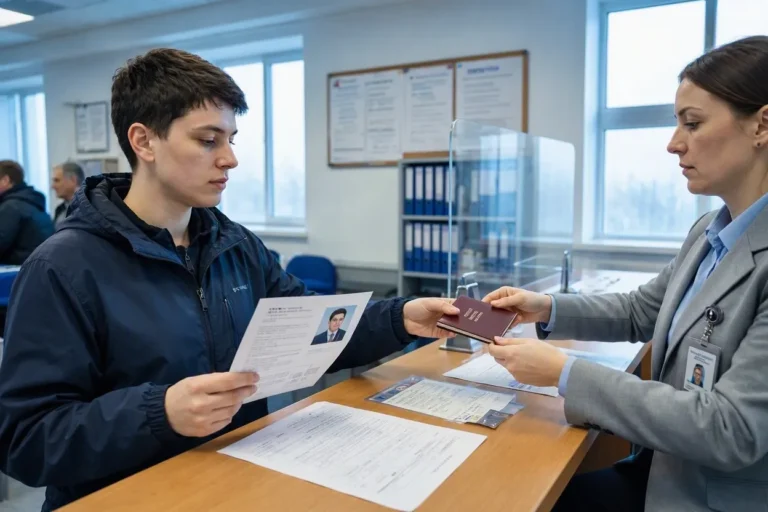
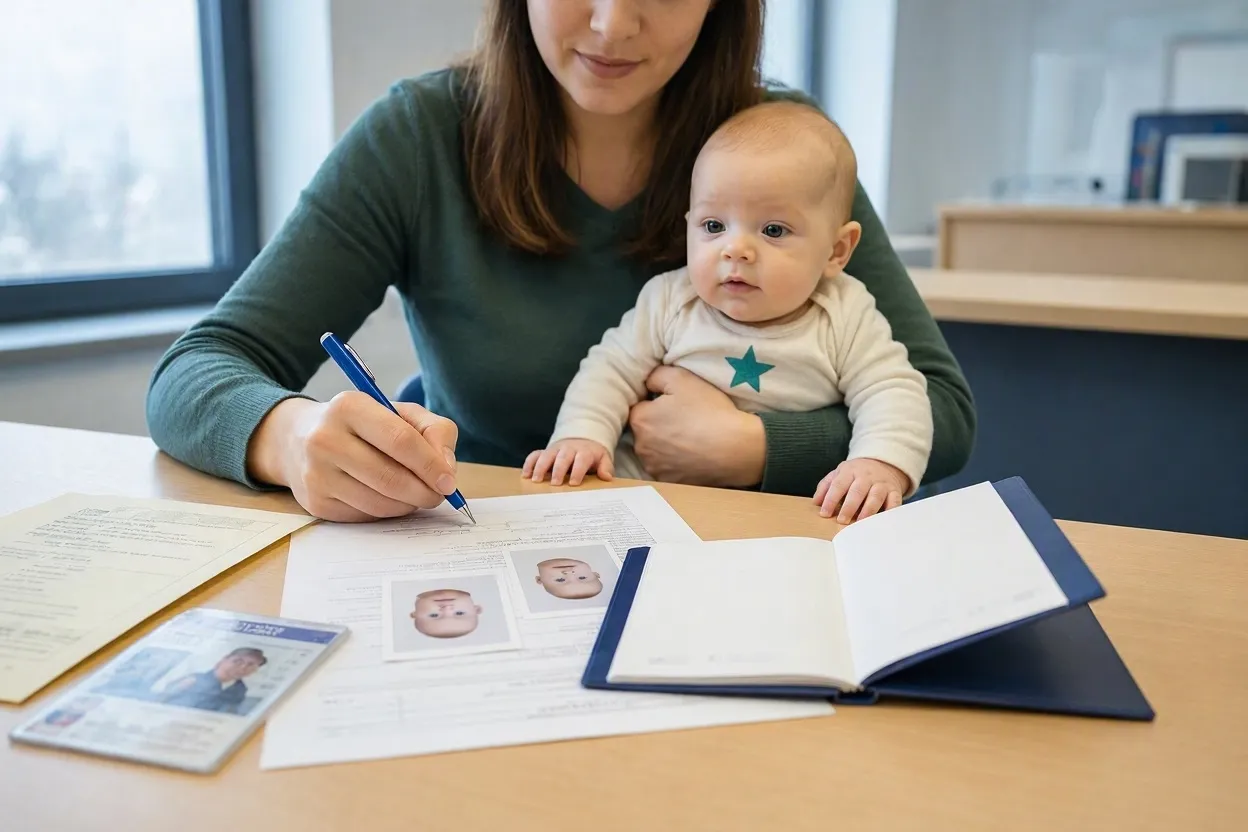
Both parents or legal guardians must appear in person with the baby, each carrying physical photo identification. Applications for children under 16 use Form DS-11, completed but left unsigned until the acceptance agent administers the oath. Signing early invalidates the entire application.
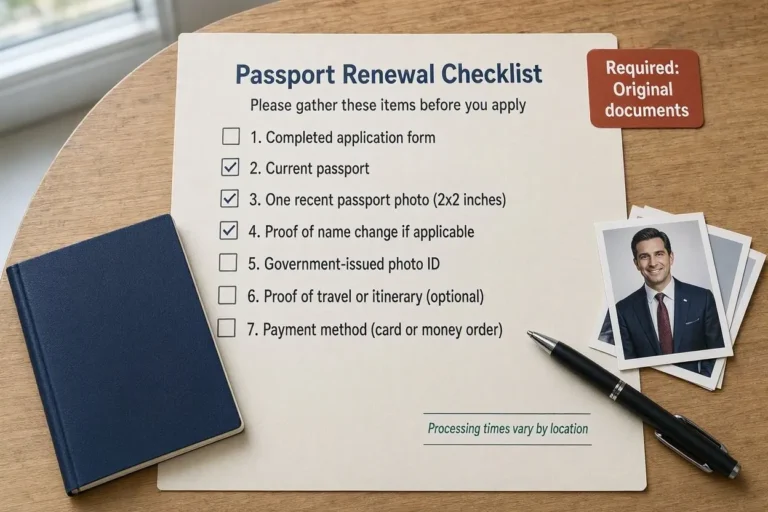
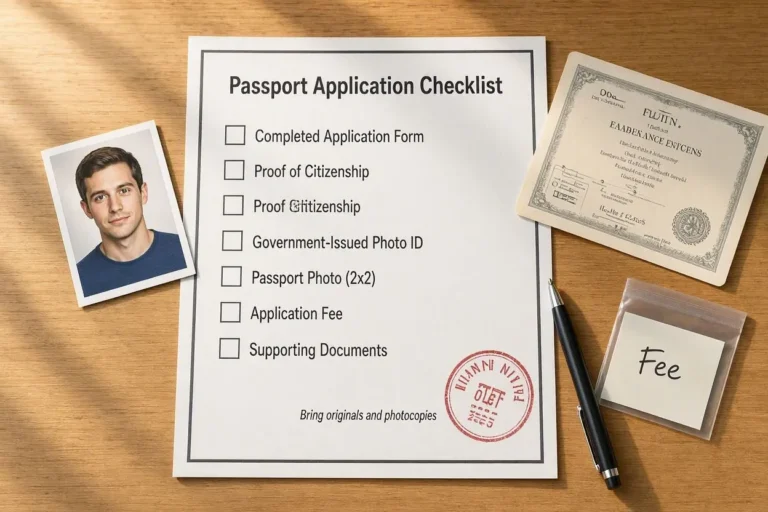
Bring the following to the acceptance facility:
- Completed Form DS-11, printed single-sided on white letter-size paper
- Certified birth certificate (original plus one photocopy)
- Photo identification for each parent, such as driver’s licenses or enhanced driver’s licenses, plus front-and-back photocopies
- One passport photo, unattached to the form
- Two separate payments, one to the U.S. Department of State and one to the facility
Acceptance facilities include post offices, public libraries, and county clerk offices. Many require appointments, and appointment availability tightens sharply between April and August. A parent whose identification comes from a different state than the application state must bring a second photo ID.
How To Apply When One Parent Cannot Attend
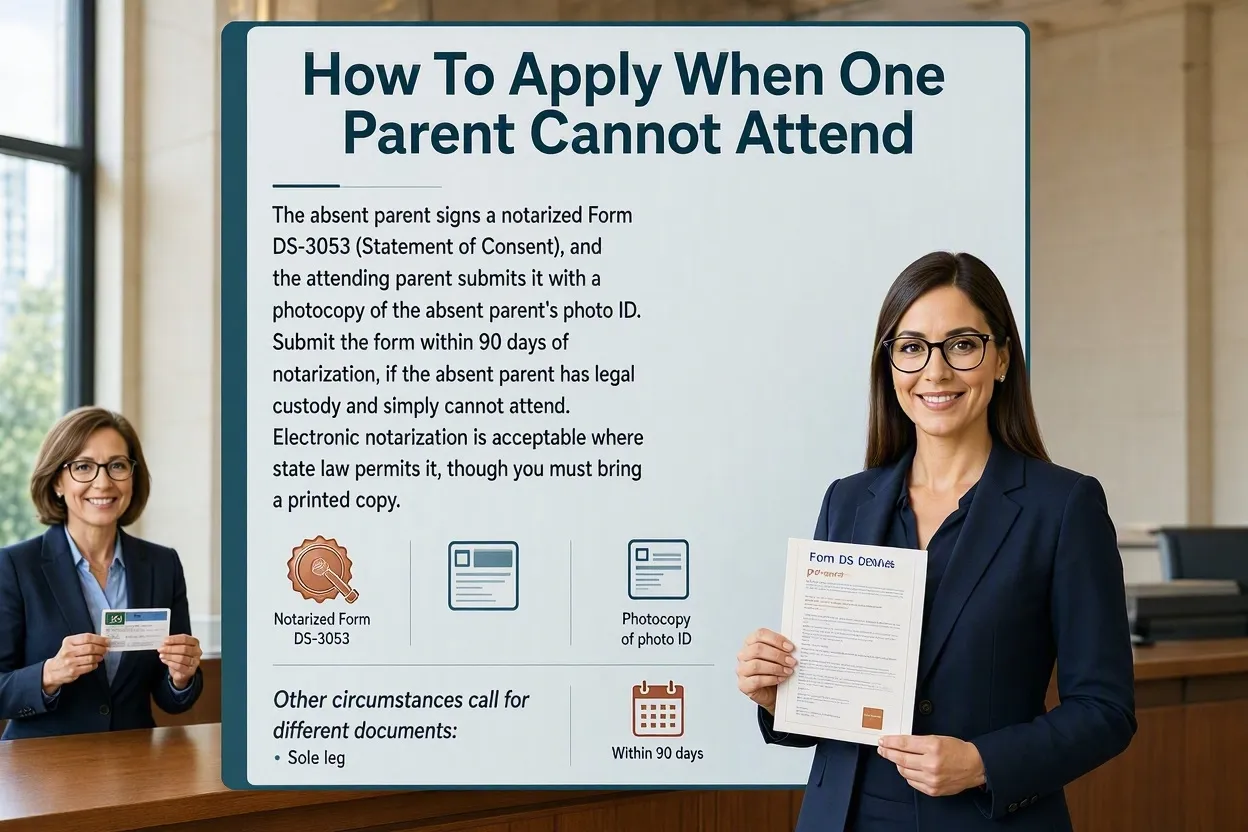
The absent parent signs a notarized Form DS-3053 (Statement of Consent), and the attending parent submits it with a photocopy of the absent parent’s photo ID. Submit the form within 90 days of notarization, if the absent parent has legal custody and simply cannot attend. Electronic notarization is acceptable where state law permits it, though you must bring a printed copy.
Other circumstances call for different documents:
- Sole legal custody: a court order granting sole custody or specific authority to apply
- Only living parent: a certified copy of the other parent’s death certificate
- Only parent listed at birth: a certified birth certificate or adoption decree naming one parent
- Unlocatable second parent: Form DS-5525 (Statement of Special Family Circumstances)
- Neither parent available: a notarized DS-3053 from both parents, submitted by the accompanying adult
One geographic trap catches military and expatriate families. A parent living in any of 55 countries, including Nigeria, the Philippines, Guatemala, Ukraine, and the United Arab Emirates, cannot use a local notary for Form DS-3053 and must visit a U.S. embassy or consulate instead. Check the current country list on travel.state.gov before scheduling the notarization.
What To Enter When Your Baby Has No Social Security Number
Enter zeros in box 5 of Form DS-11 and attach a signed, dated statement, if your baby has never been issued a Social Security number. The statement must contain this exact declaration: “I declare under penalty of perjury under the laws of the United States of America that the following is true and correct: I have never been issued a Social Security Number by the Social Security Administration.”
Many newborns fall into this gap. Hospitals submit Social Security applications through the Enumeration at Birth program, and the card can take several weeks to arrive, often longer than parents expect when travel is booked. Federal law requires you to supply the number if one exists, so use the baby’s number rather than a parent’s whenever the card has arrived.
How To Take A Passport Photo Of A Newborn
The State Department allows a baby’s eyes to be partially or fully closed, while every other requirement matches the adult standard. All other children must have their eyes open. The relaxed eye rule applies to infants alone.
Technical specifications stay fixed regardless of age:
- Size: 2 × 2 inches (51 × 51 mm), in color
- Head height: 1 to 1⅜ inches (25 to 35 mm) from chin to crown
- Background: plain white or off-white, with no pattern, texture, or shadow
- Age of photo: taken within the past 6 months
- Subject: the baby alone, facing the camera
Rejections rarely come from the baby. Photos fail because a parent’s fingertip appears at the frame edge, a blanket shows texture, or a pacifier stays in the baby’s mouth. The reliable method for an infant who can’t hold her head up: lay her flat on a smooth white sheet and shoot straight down from above, with no hands supporting her. A car seat draped with a white sheet behind the head works as a second option. Use window daylight and skip the flash, which startles babies and casts hard shadows.
Do not staple or attach the photo to Form DS-11. The acceptance agent reviews the photo first, then attaches it.
What An Infant Passport Costs
A passport book for a child under 16 costs $135 total: a $100 application fee plus a $35 acceptance facility fee. Fees split between two recipients and require two separate payments.
| Document | Application Fee | Facility Fee | Total |
| Passport Book | $100 | $35 | $135 |
| Passport Card | $15 | $35 | $50 |
| Book And Card | $115 | $35 | $150 |
Optional charges stack on top:
- Expedited processing: $60
- 1-to-3-day return delivery: $23.36
Pay the State Department by check or money order made out to “U.S. Department of State,” with the baby’s name and date of birth written in the memo line. Separate checks per child are preferred, though one check covering siblings is accepted when the memo lists every applicant’s name and date of birth. Facility fees follow the facility’s own payment rules, which vary by location. A post office and a county library may accept different methods. A family of three children applying together pays $405 for books alone.
How Long An Infant Passport Takes From Birth To Mailbox
Budget 10 to 16 weeks from your baby’s birth to a passport in hand under routine service. The timeline stacks four separate waits that no single government page presents together:
- Certified birth certificate: 2 to 6 weeks from the state vital records office
- Application transit to a passport agency: up to 2 weeks
- Processing: 4 to 6 weeks routine, or 2 to 3 weeks expedited
- Return mail: roughly 2 weeks
Processing time counts only the days your application sits at a passport agency or processing center. The clock starts when the envelope arrives, not when you hand the form to a postal clerk. Families traveling within 14 calendar days can book an appointment at a regional passport agency with proof of international travel. Applications submitted more than 3 weeks before departure go to a standard acceptance facility instead. Parents who booked a trip for a baby due in March should order the birth certificate the week the baby comes home, not the month before the flight.
Why Your Baby’s Passport Expires At Age Five
A passport issued to a child under 16 stays valid for exactly 5 years from the issue date and cannot be renewed. A baby who receives a passport at 2 months old holds an expired document by kindergarten. Each replacement requires a fresh in-person application on Form DS-11, with both parents present and the full $135 paid again.
Adults renew by mail or online with Form DS-82. That option never applies to minors under 16, no matter how many passports the child has held. Appearance creates a second, quieter problem. A passport photo taken at 6 weeks bears little resemblance to the same child at age 4, and border officers occasionally ask additional questions as a result. Carrying the certified birth certificate alongside the passport resolves those questions quickly.
How To Check The Destination Country’s Six-Month Validity Rule
Many countries deny entry to travelers whose passports expire within 6 months of arrival, and the rule applies to infants exactly as it applies to adults. Airlines enforce the requirement at check-in and deny boarding independently of any government. The rule interacts badly with the 5-year infant validity window. A passport issued to a newborn in January 2026 expires in January 2031, which means a family trip in September 2030 fails a six-month validity check even though the passport remains technically valid.
Verify the requirement this way:
- Open the Country Information pages on travel.state.gov
- Search the destination country by name
- Read the “passport validity” or “entry and exit requirements” section
How To Protect Your Child Through The Passport Issuance Alert Program
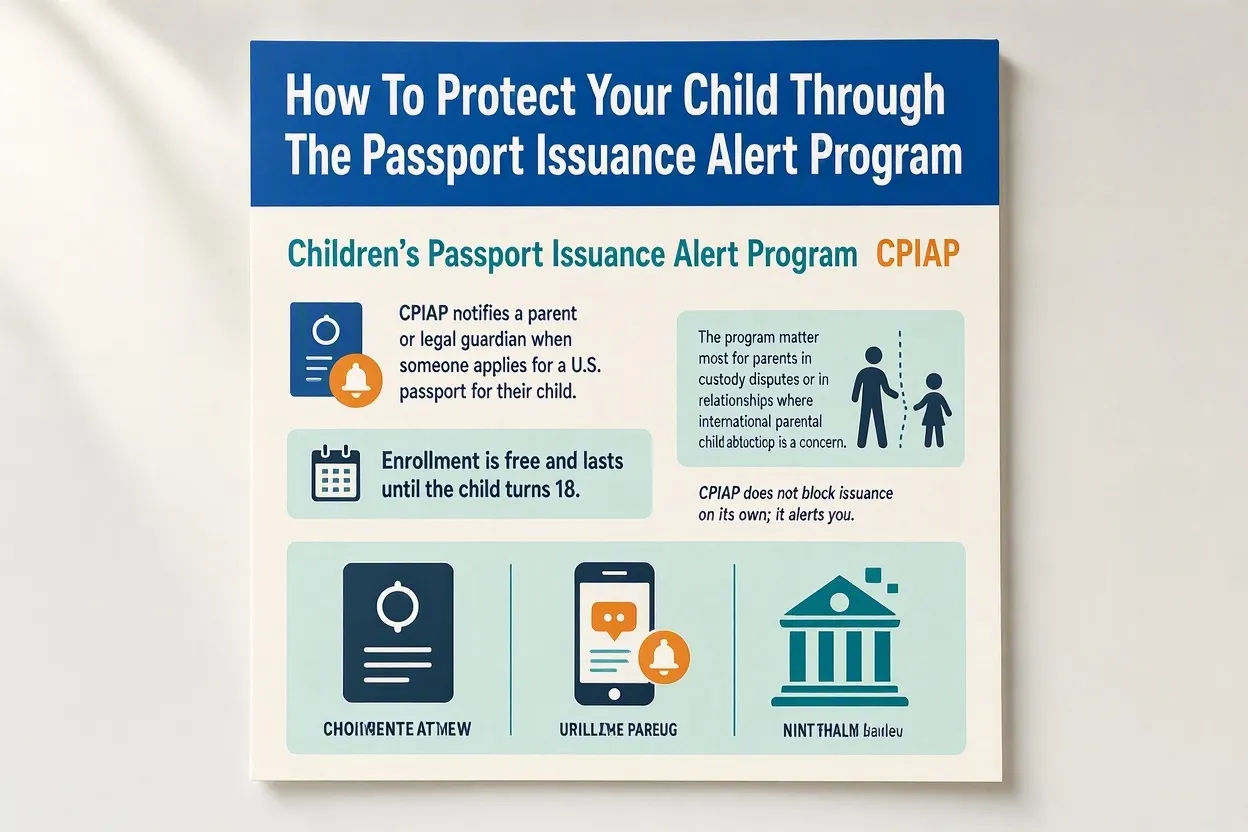
The Children’s Passport Issuance Alert Program (CPIAP) notifies a parent or legal guardian when someone applies for a U.S. passport for their child. Enrollment is free and lasts until the child turns 18.
The program matters most for parents in custody disputes or in relationships where international parental child abduction is a concern. CPIAP does not block issuance on its own. The program alerts you, giving you time to act through a court if needed. Parents who hold a court order restricting international travel should supply that order to the State Department separately. Enroll through the International Parental Child Abduction section of travel.state.gov.
Conclusion
Passport rules for infants reward parents who work backward from the departure date. Count 16 weeks back from your flight, and the certified birth certificate should already be ordered by that point. The three documents that decide whether the appointment succeeds are the certified birth certificate with its raised seal, both parents’ photo identification, and a single 2 × 2 inch photo of a baby alone on white. Passport rules for infants also carry one cost most families underestimate: $135 per child, repeated every 5 years until the child turns 16.
Applications wait at the acceptance facility for one signature, the one you give under oath, after the agent asks for it.
Frequently Asked Questions

Michael Reynolds
Michael Reynolds leads ImmigrationWin’s immigration, visa, and global mobility content division. He specializes in researching immigration policies, visa requirements, application processes, and international relocation pathways for individuals, families, students, and professionals. With extensive experience analyzing immigration regulations and official government guidance, Michael brings a research-driven approach to complex immigration topics and changing visa policies. He is the primary author of ImmigrationWin’s visa guides, immigration resources, and country-specific content, helping readers better understand their options and make informed decisions about their international journey.
Related Posts