Damaged Passport Replacement: Rules, Forms & Fast Options
A water stain across the photo page. A dog that mistook your travel documents for a chew toy. A washing machine cycle you forgot about. Any of these can turn a valid U.S. passport into a rejected one at the airport gate.
Damaged passport replacement means applying for a brand-new passport book, not a renewal, once your existing passport has physical damage that affects its readability, integrity, or security features. Unlike a routine renewal, the process requires an in-person visit, a full new-application fee, and surrender of the damaged document itself.
If your passport is torn, water-stained, moldy, missing pages, or delaminating, you can’t renew it by mail with Form DS-82. You’ll file Form DS-11 in person and pay the same fee a first-time applicant pays ($165 for an adult book in 2026). If the damage happened during a FEMA-declared disaster, Forms DS-5504 and DS-64 can waive the application fee entirely.
What Counts as a Damaged Passport
A passport is damaged when its cover, data page, or visa pages have physical harm that compromises readability or security features. The State Department’s own list names water damage, mold, significant tears, unofficial markings on the data page, missing or torn-out visa pages, and hole punches. Delamination, where the plastic coating over the photo page peels or separates, causes the same rejection even though government pages rarely spell out that specific failure mode.
Normal wear sits below that threshold. A bent corner from riding in a back pocket, or visa pages that no longer lie perfectly flat after years of handling, won’t get you turned away. Border officials and airline staff apply a simple test: if any character on the data page is unreadable, or the document’s structural integrity looks compromised (a coffee spill blurring the birth date field, a curling laminate edge that eventually tears off and exposes the embedded photo), the passport gets flagged.
“Damaged” vs. “Lost or Stolen”: Why the Wording Trips People Up
Here’s a quirk worth knowing before you start: the disaster-relief paperwork for a damaged passport still runs through Form DS-64, officially titled the “Lost and Stolen Passport” form. If your passport was damaged, not lost, during a qualifying disaster, you still use DS-64, just filling in the section that describes the disaster and the date instead of a theft. It’s a naming inconsistency in the government’s own form set, not a sign you’ve picked the wrong document.
Can You Renew a Damaged Passport, or Do You Need a Full Replacement?
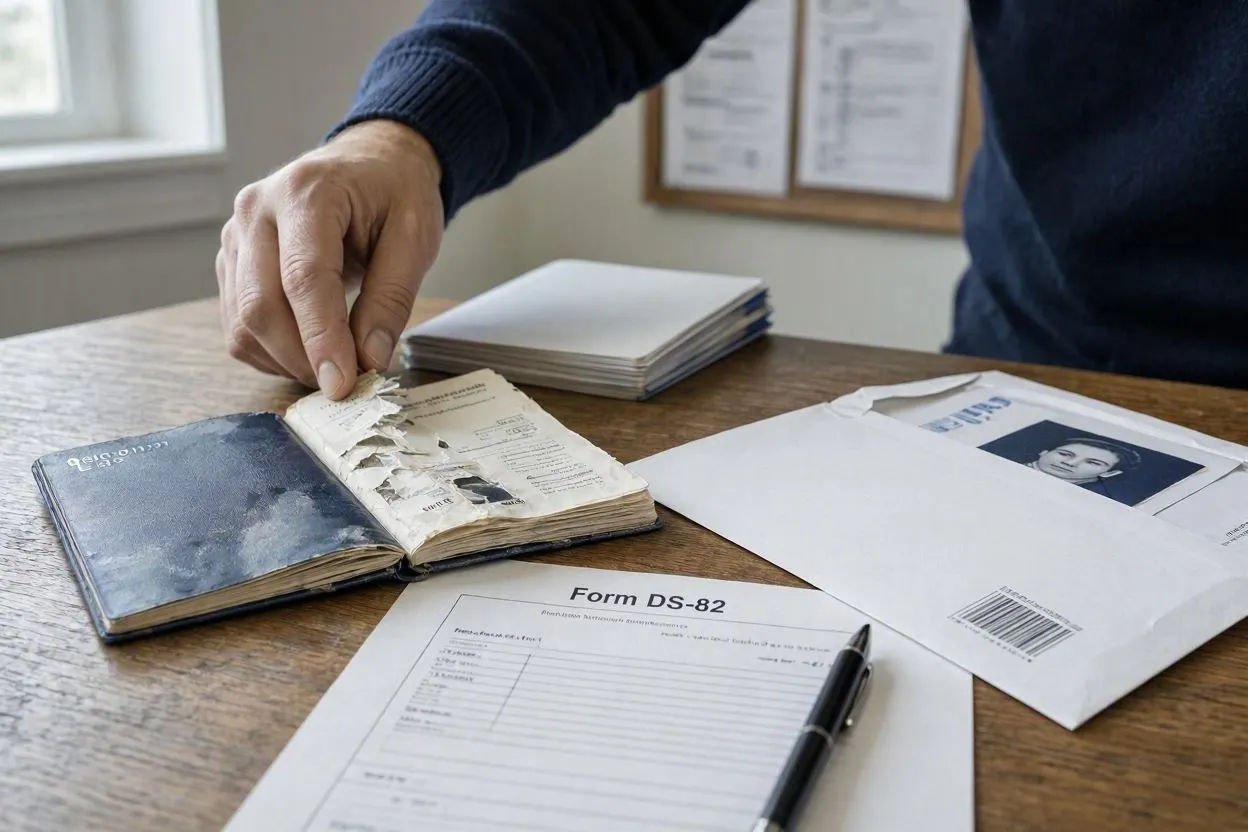
No. Form DS-82, the mail-in renewal, requires you to submit your current passport as proof of a continuous, verifiable identity record. A torn or waterlogged booklet often triggers a rejection or a long delay while an examiner tries to verify pages they can’t fully read.
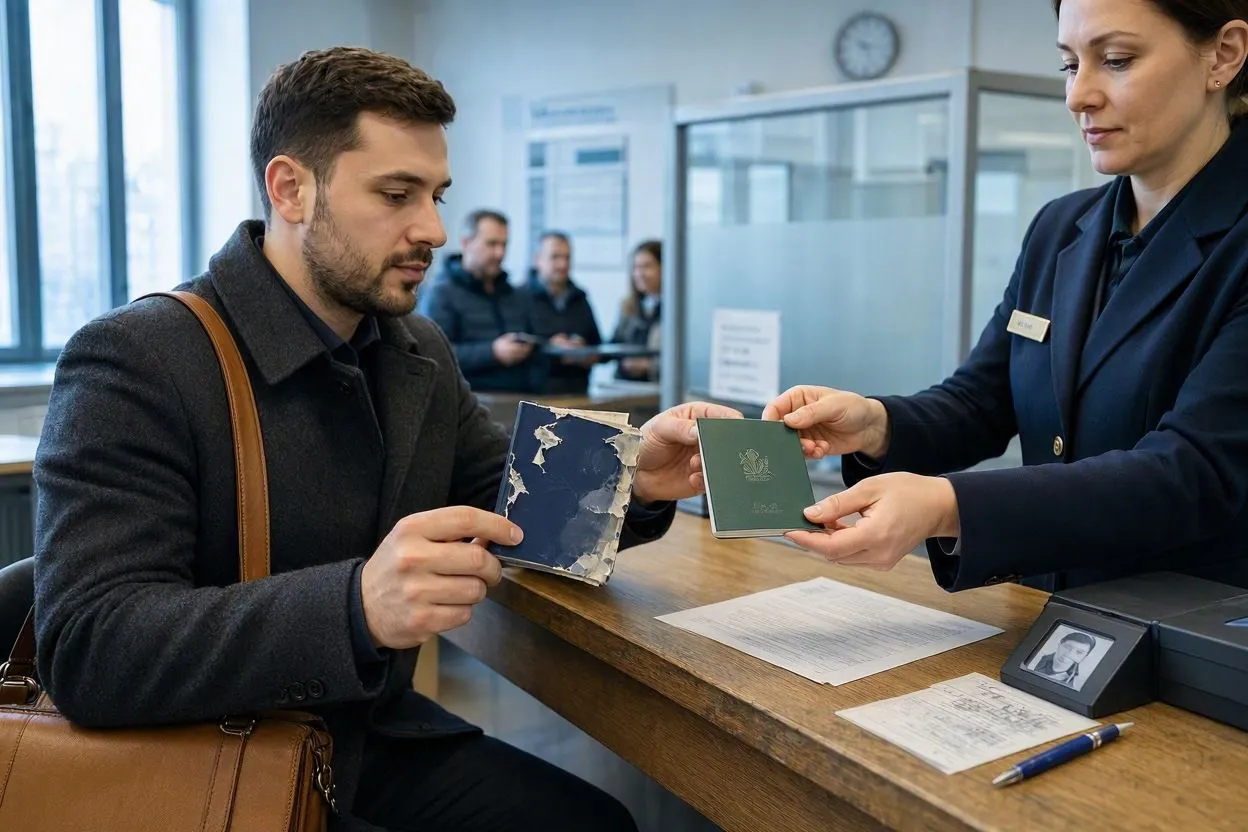
Once a passport can’t reliably serve that function, the government treats the case as a new application. If your passport shows disqualifying damage, you’ll apply using Form DS-11 in person at an acceptance facility, and you’ll pay full first-time-applicant fees rather than the lower renewal fee, even if your passport still has three years of validity left. Remaining validity has no bearing on whether damage disqualifies the document.
What You’ll Need to Bring
Both the standard and disaster-related paths require an in-person visit with the following:
- The damaged passport itself (it gets surrendered for destruction)
- A completed application form (DS-11 for standard damage, DS-5504 for disaster-related)
- Citizenship evidence, such as a birth certificate or naturalization certificate, plus a photocopy
- A government-issued photo ID
- A passport photo that meets current size and background rules
- Full payment, unless a disaster waiver applies
- For standard damage only: a signed statement describing how the damage happened, naming the object or event and the date rather than a vague “water damage” note
- For disaster damage only: Form DS-64 documenting the disaster’s name, date, and location
Forms Required for Damaged Passport Replacement
Two paths, two form sets.
Standard damage, unrelated to a disaster, uses Form DS-11 plus the signed damage statement above. Applicants who don’t qualify for a disaster waiver, or who’d rather not wait on eligibility confirmation, can skip the disaster paperwork and file DS-11 directly.
Disaster-related damage uses Form DS-5504 (the replacement application tied to the waiver claim) combined with Form DS-64 (which documents the loss and names the qualifying disaster).
How to Apply, Step by Step
Standard Damage (No Disaster Involved)
Gather the damaged passport, your signed statement, a completed DS-11, citizenship evidence with a photocopy, and a compliant photo. Bring all of it in person to a post office, county clerk’s office, or passport agency, since appointments can book out two to three weeks and fees are paid on-site.
The old passport is destroyed during processing, along with any valid visas inside it. A traveler holding an unused five-year Brazilian visa in a water-damaged passport, for instance, loses that visa and has to reapply through the relevant embassy once the new passport arrives.
Damage From a Federally Declared Disaster
Confirm the disaster appears on the State Department’s published eligibility list before starting paperwork; not every storm that hits the news gets a fee waiver attached. Complete Forms DS-5504 and DS-64, noting the disaster’s name, date, and where you were located when the loss happened. Add a written statement confirming your passport fees won’t be reimbursed through another source, like homeowner’s insurance, since the waiver doesn’t allow double recovery for the same loss.
Mail the package if travel is more than three weeks away. If you’re traveling within two weeks, don’t mail anything; book an in-person passport agency appointment instead.
Passport Photo Requirements
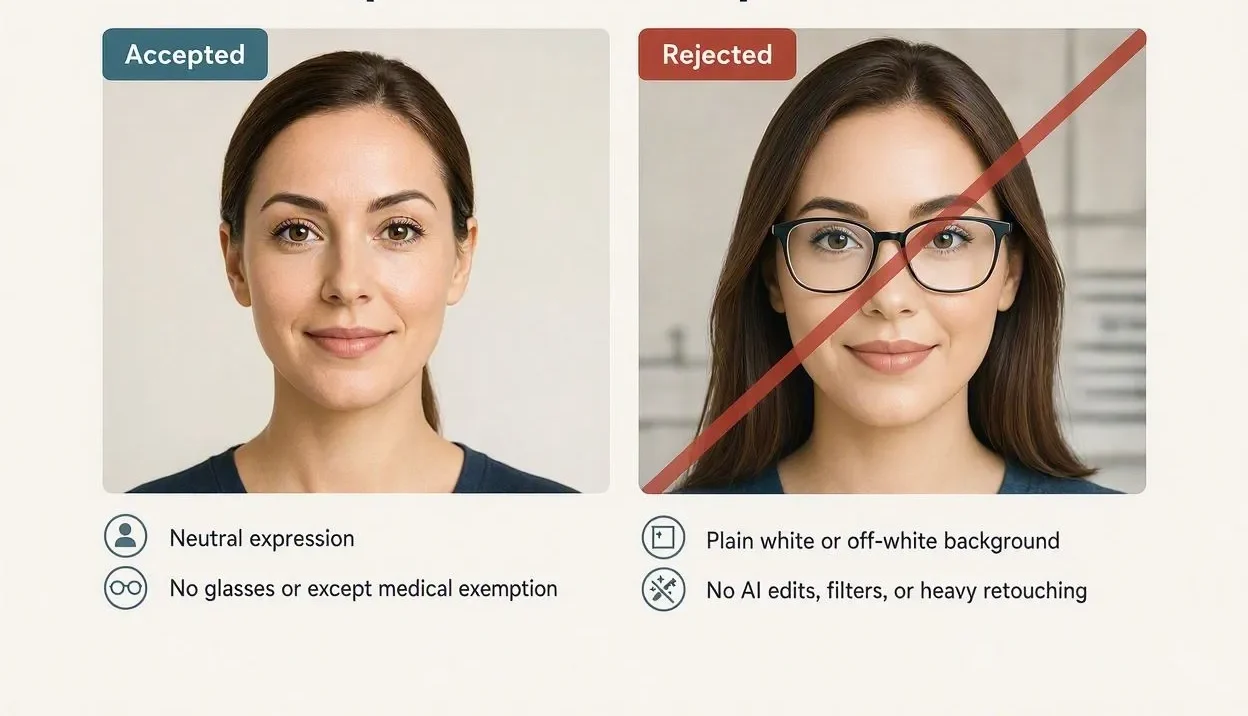
A rejected photo is one of the most common reasons a damaged-passport application stalls, so it’s worth getting right the first time. As of 2026, the State Department’s digital screening has gotten stricter: photos need a plain white or off-white background, a neutral expression, and no glasses except for a documented medical exemption. AI-edited, filtered, or heavily retouched photos, including beauty filters and portrait blur, get flagged and bounced back. Head coverings are allowed only for religious or medical reasons. A drugstore kiosk photo taken without checking the current specs is a frequent culprit behind delays.
Damaged Passport Replacement Cost and Fees
Standard replacement for an adult costs $165 total: a $130 application fee paid to the Department of State, plus a $35 execution fee paid to the acceptance facility. A passport card alone runs $65, and a combined book-and-card application costs $195. Minors under 16 pay less: $135 for a book, covering a $100 application fee and the same $35 execution fee.
| Item | Cost |
| Adult passport book (application + execution) | $130 + $35 = $165 |
| Adult passport card (application + execution) | $30 + $35 = $65 |
| Adult book and card combined | $160 + $35 = $195 |
| Minor passport book, under 16 (application + execution) | $100 + $35 = $135 |
| Expedited processing (optional) | $60 |
| 1–3 day delivery (optional) | $22.05 |
| File search fee (if citizenship or prior passport proof is missing) | $150 |
| Disaster-related replacement (if disaster is on the eligibility list) | Application and file search fees waived |
For comparison, a routine DS-82 mail renewal costs the same $130 application fee but skips the $35 execution fee entirely, since there’s no in-person visit. That $35, plus the loss of mail-in convenience, is really what a damaged passport costs you over a clean renewal.
Two add-ons inflate the total further. Expedited processing costs an extra $60 per application, and 1–3 day delivery back to your address adds $22.05. If you can’t provide adequate proof of a previous U.S. passport or citizenship record, a $150 file search fee gets added on top, which happens more often than applicants expect when an old passport was damaged badly enough that even the number and issue date are illegible.
Fee Waivers for Passports Damaged in a Federally Declared Disaster
Yes, under the Disaster Recovery Reform Act of 2018, the government waives passport fees for damage sustained during certain declared disasters. The application fee waiver stays valid for three years after the disaster’s declaration date. The file search fee waiver runs for eighteen months, a shorter window worth flagging separately since a disaster old enough to still qualify for one may have already aged out of the other.
Eligibility depends entirely on whether the specific disaster appears on the State Department’s maintained list, tied to a matching FEMA declaration number. A general “there was a hurricane in my area” claim without that number won’t qualify. As of 2026, the list includes entries like the Commonwealth of the Northern Mariana Islands’ Super Typhoon Sinlaku (DR-4910-MP, declared April 23, 2026) and the Crow Tribe of Montana’s severe winter storm and straight-line winds (DR-4915, declared May 29, 2026), each carrying its own expiration date for both waiver types. Check the exact declaration date against the current list rather than assuming a disaster you remember from the news is still active; older events roll off the file-search window well before the application-fee window closes.
Three things disqualify an applicant even when the disaster itself qualifies:
- No prior passport on record. First-time applicants can’t claim the waiver, since it only covers replacement of a passport that already existed.
- Expired passport at the time of loss. The waiver restores travel capability; it doesn’t reissue a document that was already invalid when it was lost.
- Reimbursement through another channel. If insurance is covering your passport fees, you have to disclose that and forgo the waiver.
If You Need a Passport Immediately: Life-or-Death Emergency Service
Most damaged-passport cases don’t need same-day service, but if yours does, the government has a narrow path for it. Life-or-death emergency service applies when an immediate family member (parent, legal guardian, child, spouse, sibling, or grandparent) has died, is in hospice care, or has a life-threatening illness, and you need to travel abroad within roughly two weeks. You’ll need documentation (a death certificate, mortuary statement, or signed hospital letter, translated into English if it isn’t already), proof of your travel plans, and an appointment at one of the 26 regional passport agencies, arranged by calling the National Passport Information Center at 1-877-487-2778.
If your situation is urgent but doesn’t meet that bar, the separate Urgent Travel Service covers travelers within 14 calendar days of international departure, no family emergency required, through the same passport agency appointment system.
How Long Damaged Passport Replacement Takes
Standard processing takes 4 to 6 weeks door-to-door; expedited service cuts that to roughly 2 to 3 weeks. In-person appointments at a passport agency, reserved for travelers departing within 14 calendar days, can produce a passport in as few as 3 business days once the application is submitted and error-free.
A single missing signature on the DS-11, or a photo with the wrong background, adds days back onto any timeline. Build in a buffer of at least one extra week beyond the advertised minimum.
Will Airlines or TSA Accept a Damaged Passport for Travel?
No, not automatically. Airlines and border officials can deny boarding or entry when a passport shows disqualifying damage. TSA doesn’t publish a formal checklist the way the State Department does, but agents follow the same underlying standard: if the data page’s text or photo isn’t clearly legible, or the document’s integrity looks compromised, it gets rejected.
A torn corner near the photo with a fully legible data page might slide through domestic TSA screening, since TSA primarily checks identity for domestic flights and accepts other IDs too. Hand that same passport to a foreign immigration officer, or to airline check-in staff verifying validity before an international flight, and the review gets a lot stricter, with a real chance of denial. Replace it before booking travel and the risk disappears.
DIY Application vs. Using an Expediting Service
| Factor | DIY (Direct DS-11 Filing) | Expediting Service |
| Government fees | $130 application + $35 execution ($165 adult total) | Same $165 government fees, paid separately |
| Service fee | None | Varies by provider, generally under $150 |
| Error-checking | Self-reviewed | Reviewed by staff before submission |
| Typical timeline | 4–6 weeks routine, 2–3 weeks expedited | Often 2–4 business days on the fastest tier, per provider marketing |
| Appointment handling | You book the acceptance facility visit | Service coordinates it |
| Best fit | Travel more than 4 weeks out | Travel within 2–3 weeks, or replacing several passports at once |
Both paths end in the same passport, issued through the same government process. What actually differs is who catches an error before it costs you a week. Take a family of four replacing damaged passports after a flood, three weeks until departure: DIY filing runs $660 in combined government fees. Layer an expediting service on top of those same fees and the total typically climbs past $1,100. You’re paying for a second set of eyes on the paperwork, not a faster government, and on a tight timeline that can be worth it.
Common Mistakes That Delay Replacement
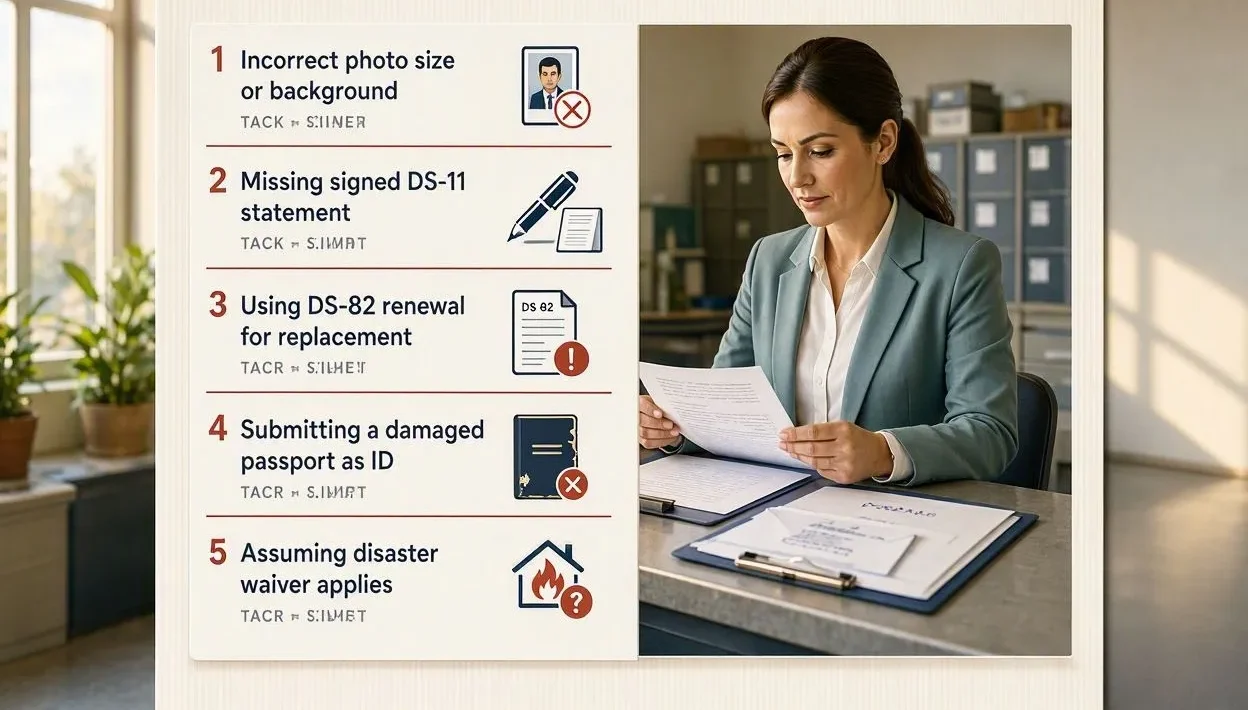
A photo that doesn’t meet current size or background specs causes more rejections than any other single error. Forgetting the signed statement is another one; examiners can’t process a DS-11 without it. Some applicants confuse DS-82 renewal with DS-11 replacement and mail in a renewal using a damaged passport as identity proof, only to have it bounced back weeks later. Others assume a disaster automatically qualifies for a waiver without checking the declaration date, and end up with an incomplete DS-64 or a denied claim. Any one of these adds one to three weeks onto a timeline that already runs four to six.
Preventing the Next Damaged Passport
A hard-shell or RFID passport case protects the laminate and spine far better than a bare passport riding loose in a bag or back pocket, and it’s the single cheapest way to avoid this whole process next time. If you travel with a passport for years between renewals, keep it somewhere it won’t sit near liquids (a water bottle in the same pocket is a common culprit) and check the photo page laminate periodically for lifting at the corners, since that’s usually the first sign delamination is coming.
Special Cases: Dual Nationals, Second Passports, and Consular Records
Dual nationals face one extra layer when a U.S. passport gets damaged abroad: the nearest U.S. embassy or consulate handles the DS-11 application directly, rather than a domestic acceptance facility, and processing times there depend on staffing at that specific post. A U.S. citizen living in Lisbon whose passport suffers water damage during a storm applies through the U.S. Embassy in Lisbon rather than mailing anything to a domestic processing center.
Business travelers and government contractors who hold a second passport book under a valid special-issuance authorization still have to replace a damaged first passport through the standard DS-11 process. The second book doesn’t substitute for it.
Anyone whose supporting citizenship document is a damaged Consular Report of Birth Abroad (CRBA) faces an added step: that record has to be replaced or amended through the State Department’s vital records office before it can serve as citizenship evidence, adding a separate request and timeline on top of the passport replacement itself.
Conclusion
Damaged passport replacement always means an in-person application, a new set of fees, and surrender of the old document, since mail-in renewal simply isn’t available once a passport shows disqualifying wear. Confirm which form set applies, check disaster-waiver eligibility against the current declaration list rather than what you remember from the news, and budget the full $165 adult fee (or the waived amount, if a qualifying disaster applies). File early and bring every required document on the first visit, and the standard four-to-six-week window rarely needs to stretch any longer than that.
FAQs

Michael Reynolds
Michael Reynolds leads immigration content at ImmigrationWin, covering visa requirements, application and relocation pathways. He researches immigration policies and official government guidance to explain changing rules clearly. His guides help students, families, and professionals make informed decisions about moving abroad.
Related Posts