Passport Application Mistakes: How to Avoid Delays, Denials, and Costly Errors
The passport application mistakes that cause the most delays are unacceptable photos, the wrong form, a Form DS-11 signed too early, missing photocopies, and incorrect payments. The U.S. Department of State names bad photos as the number one reason it puts applications on hold. Every error pauses processing until you respond, and routine service already takes 4 to 6 weeks before mailing time is counted. This guide covers all three stages: preventing mistakes before you apply, responding when the State Department catches one, and correcting a passport that arrives with an error printed on it.
What Are the Most Common Passport Application Mistakes?
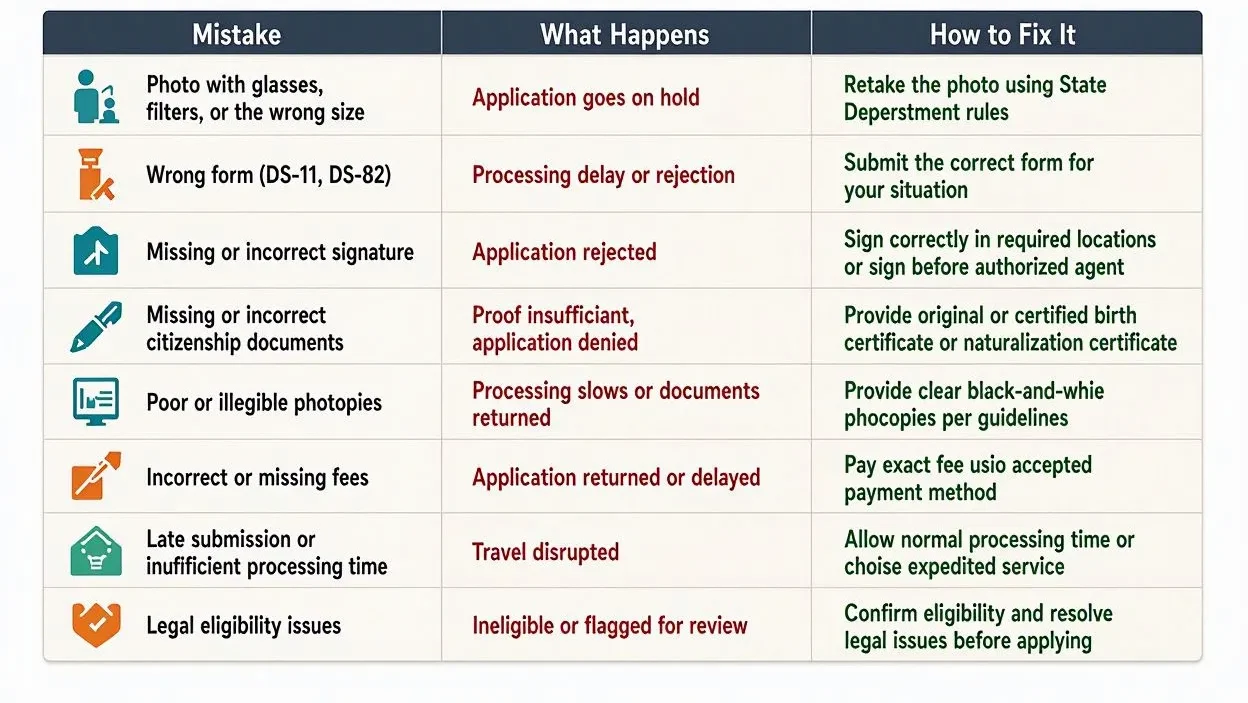
The most common mistakes involve photos, forms, signatures, citizenship documents, photocopies, fees, timing, and legal eligibility. Most of them take less than 10 minutes to prevent. The table below pairs each error with its consequence and its fix.
| Mistake | What Happens | How to Fix It |
| Photo with glasses, filters, or the wrong size | Application goes on hold | Retake the photo using State Department rules |
| Wrong form (DS-11, DS-82, or DS-5504) | Application is suspended | Match the form to your situation |
| Form DS-11 signed before the appointment | Acceptance agent rejects the form | Print a new, unsigned form |
| Digital or photocopied birth certificate | Citizenship is not proven | Submit a certified paper original (long-form preferred) |
| Missing photocopies | Acceptance is delayed | Copy documents on single-sided 8.5 x 11-inch paper |
| One combined payment for Form DS-11 | Payment is refused | Pay 2 separate fees |
| Applying 4 weeks before a trip | Passport arrives after departure | Apply at least 3 months ahead |
| Child support debt over $2,500 | Application is denied | Pay the state agency before applying |
Photo Mistakes
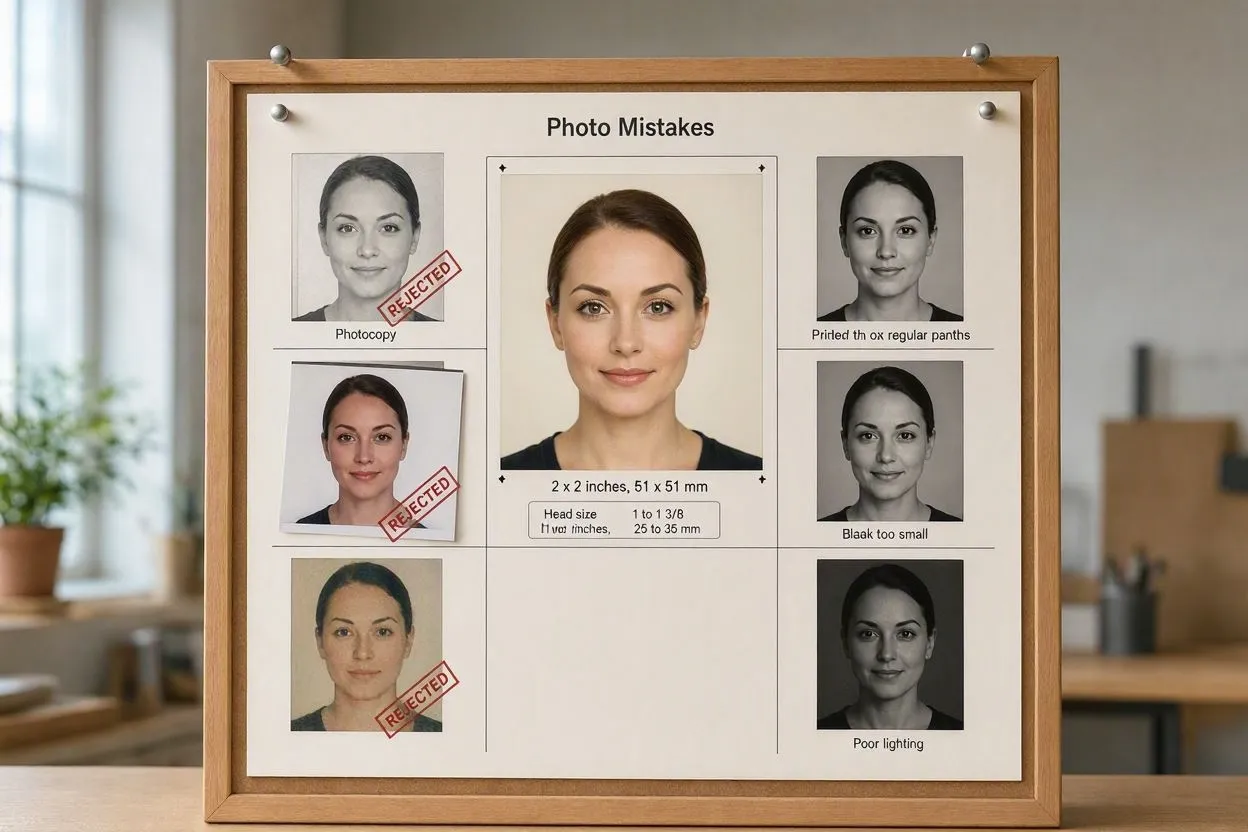
Photo errors are the top reason the State Department holds passport applications. Out of every rule in the photo requirements, this is the one people trip over most. A compliant photo is in color, taken within the last 6 months, and measures 2 x 2 inches (51 x 51 mm). Your head has to measure 1 to 1 3/8 inches (25 to 35 mm) from the bottom of the chin to the top of the head. Photocopies, scanned images, and photos printed on regular paper all get rejected, so print on matte or glossy photo paper instead.
Wearing Glasses, Hats, or Headphones
Eyeglasses of any kind must come off for the photo, including glasses resting on top of your head. The State Department tightened this rule back in 2016 and still enforces it strictly. The only exception is medical, and it requires a signed note from your doctor. Hats follow similar logic: you’ll need a signed statement that the head covering is religious attire worn daily in public, or a doctor’s statement for a medical head covering. Uniforms, camouflage clothing, and headphones all lead to rejection. Jewelry and facial piercings are fine, as long as they don’t hide your face.
Editing, Filtering, or Using AI Tools
The State Department accepts only the original, unedited photo. Phone filters, background-removal apps, stretching, red-eye correction, and artificial intelligence (AI) enhancement all make a photo unacceptable. A common example is swapping a beige wall for a white background with an editing app. Stand in front of a white sheet instead and retake the picture.
Stapling or Reusing an Old Photo
Leave the photo loose inside the application envelope. The acceptance agent or passport employee reviews it and staples it for you. Reusing a spare print from your last passport doesn’t work either, since the photo must be less than 6 months old.
If Your Passport Photo Gets Rejected
A rejected photo puts your application on hold. It doesn’t deny it outright. Send a compliant replacement photo following the instructions in the State Department’s letter, and review of your file resumes from where it left off.
Form Mistakes
Choosing the wrong form is one of the costliest passport application mistakes because the State Department cannot process the wrong form for your situation. The fix usually means starting over with a new application.
Which Passport Form Do You Need?
Form DS-11 is required for first-time applicants, children under 16, and adults whose last passport was lost, stolen, damaged, issued before age 16, or issued more than 15 years ago. Every other situation maps to a specific form:
| Form | Use It For | How You Submit It |
| DS-11 | First passports, children under 16, and ineligible renewals | In person at an acceptance facility |
| DS-82 | Renewing an undamaged passport issued at age 16 or older within the last 15 years | By mail |
| Online renewal | Adults 25 or older renewing an eligible 10-year passport | opr.travel.state.gov |
| DS-5504 | Name changes or data errors within 1 year of issuance (used for passport correction) | By mail, no fee |
| DS-64 | Reporting details of a lost or stolen passport | With Form DS-11 |
| DS-3053 | Notarized consent (Statement of Consent) from a parent who cannot attend a child’s appointment | With the child’s Form DS-11 |
Pick the document type carefully too. A passport card costs $30 but covers only land and sea travel to Canada, Mexico, Bermuda, and the Caribbean. Anyone who orders only a card and then books a flight to Europe will need a passport book.
Signing Form DS-11 at Home
Leave Form DS-11 unsigned until the passport acceptance agent tells you to sign it. The agent verifies your identity, gives you an oath, and watches you sign in person. Skipping that sequence is one of the most common rejection causes at the counter. A form signed at the kitchen table can’t be accepted, and you’ll have to complete a fresh copy before the appointment continues. Bring the unsigned form and a pen.
Printing Double-Sided or Leaving Fields Blank
The State Department does not accept double-sided forms. Complete the application with the Form Filler tool at pptform.state.gov, then print each page on a separate sheet. Blank fields cause delays of their own. The Social Security Number (SSN) field matters most, since federal tax law (26 U.S.C. 6039E) allows the Internal Revenue Service (IRS) to charge a $500 penalty for leaving it out. Applicants replacing a lost or stolen passport who skip those details on Form DS-11 get a request to submit Form DS-64 later.
DS-82 Renewal Mistakes
Form DS-82 has its own failure points, separate from DS-11. Mailing it without the actual expired or current passport attached is the most common one; the form asks you to send in your existing book, and the State Department returns applications missing it. Others include using DS-82 for a passport that’s damaged (it isn’t eligible by mail, regardless of age or expiration), skipping the new photo, or sending a personal check when the facility or agency in question requires a money order. Since DS-82 has no separate acceptance fee, applicants sometimes overpay by adding one out of habit from an old DS-11 filing.
Timing Mistakes
Plan for up to 10 weeks from mailing to delivery with routine service. Mailing your application to the State Department takes up to 2 weeks, routine processing takes 4 to 6 weeks, and return mail takes up to 2 more weeks. Expedited processing cuts the middle step to 2 to 3 weeks for an extra $60. As a planning rule of thumb, don’t book firm travel plans until you’re at least 8 months out from a first-time or renewal application if you want a cushion against peak-season slowdowns. For a July 15 departure, a routine application mailed after May 6 risks missing the flight.
Many countries require a passport valid for six months beyond your travel dates, so check expiration dates before booking. Demand peaks between late winter and summer, and the State Department recommends applying between October and December. Travelers leaving in less than 3 weeks need an appointment at one of the 28 regional passport agencies and centers the State Department currently operates, which they can book once they’re within 14 calendar days of travel.
A note on expediting services: Legitimate third-party expediting services, such as CIBT/VisaCentral, Fastport, and RushMyPassport (offered through AAA), can walk your application through a regional passport agency for a fee on top of government charges. These are different from the unofficial “Gov”-named renewal sites described below. A real expediter never asks to submit your online renewal on your behalf, since only you can do that.
Document Mistakes
Missing or incorrect documents stop an application at the acceptance counter or during review. Each document category has strict format rules.
Submitting the Wrong Proof of Citizenship
A driver’s license proves identity, not U.S. citizenship. It’s a distinction several competing guides get wrong. Acceptable citizenship documents include a U.S. birth certificate (the long-form version is strongly preferred over an abstract or short-form certificate), a full-validity undamaged U.S. passport, a Consular Report of Birth Abroad, and a Certificate of Naturalization or Citizenship. Paper only. Mobile or electronic birth certificates don’t count, and neither do hospital keepsake certificates with footprints. A certified copy carries the registrar’s seal or stamp. Applicants who can’t produce any citizenship evidence may pay a $150 file search fee.
Getting Your Original Documents Back
Your original documents come back separately by First Class Mail, up to 4 weeks after the passport arrives. That gap is normal and doesn’t mean anything was lost.
Forgetting the Photocopies
Form DS-11 applications require a photocopy of your citizenship evidence and a photocopy of the front and back of your government photo ID. Use 8.5 x 11-inch (216 x 279 mm) paper and copy onto one side only. Applicants whose ID comes from a different state than the one where they’re applying need a second photo ID. For example, a Florida driver’s license presented at a post office in Georgia requires a second form of photo identification.
Note that “acceptance facility” covers a range of locations: post offices, public libraries, and county clerk of court offices are the most common. Requirements can vary slightly by location, so it’s worth confirming photocopy and payment rules with your specific facility before you go.
Skipping Name-Change Documents
Your application needs a legal name-change document whenever your current name differs from the name on your citizenship evidence. Legal name-change documents (marriage certificate, divorce decree, court order) must be original or certified copies. Some people have used a different name for years without legal paperwork. Their route is Form DS-60, an affidavit completed by 2 people (affiants) who have known the applicant by both names, plus 3 public records showing 5 or more years of use of the new name.
Renewing a Damaged Passport
A damaged passport cannot be renewed by mail. Damage includes water damage, mold, stains, significant tears, unofficial markings, and missing pages. Novelty stamps from theme parks or tourist attractions count as unofficial markings. Folded pages and small bends are normal wear. A damaged passport requires Form DS-11 in person, a signed statement explaining the damage, and the damaged passport itself.
Payment Mistakes
Form DS-11 applicants pay 2 separate fees: the application fee to the U.S. Department of State, and a $35 acceptance fee (sometimes labeled an execution fee on official fee charts) to the facility. Write the application fee check or money order to “U.S. Department of State” and add the applicant’s name and date of birth in the memo line. Cash isn’t accepted by mail. The acceptance facility sets its own payment methods for the $35 fee, so check before you go.
| Service | Application Fee | Acceptance (Execution) Fee |
| Adult passport book (Form DS-11) | $130 | $35 |
| Adult passport card (Form DS-11) | $30 | $35 |
| Adult book and card (Form DS-11) | $160 | $35 |
| Adult book renewal (Form DS-82 or online) | $130 | None |
| Child passport book (under 16) | $100 | $35 |
| Data error correction (Form DS-5504) | $0 | None |
| Expedited service (optional) | Add $60 | None |
| 1 to 3-day return delivery (optional) | Add $22.05 | None |
Wrong amounts hold up processing, and the stakes are high: by law, the State Department keeps the application fee and the acceptance fee even when no passport is issued. The $60 expedite fee is the only refundable charge, and only when the State Department misses its expedited timeframe.
Online Passport Renewal Problems and Mistakes
Online renewal saves a trip to the post office, but ineligible applicants and unofficial websites create new categories of passport application mistakes. Each one has a specific rule behind it.
Who Qualifies for Online Renewal?
Online passport renewal is open to adults age 25 or older renewing a 10-year passport that expires within 1 year or expired less than 5 years ago. You must be located in a U.S. state or territory when you submit, and you can’t change personal details such as your name or sex. Online renewals can’t be expedited, so you shouldn’t have international travel planned for at least 6 weeks. Your passport must be in your possession, undamaged, and never reported lost or stolen. Switching from a book to a card only, or from a card to a book only, requires renewal by mail.
Traveling on the Passport You Just Renewed
The State Department cancels your current passport the moment you submit an online renewal. Say you submit a renewal on Tuesday and fly to Cancún on Friday. That passport no longer works for international travel, full stop. Keep the old passport at home rather than mailing it in, because it remains valid proof of citizenship even after cancellation.
Using Unofficial Renewal Websites
The only official online renewal site is opr.travel.state.gov. Companies with “Gov” in their names aren’t authorized to accept online renewals, and no third party can submit an online application on your behalf. These sites charge extra fees and collect personal data. Check that the web address ends in .gov before entering anything. (This is different from the legitimate expediting services mentioned above, which assist with in-person DS-11 or mail-in DS-82 filings rather than submitting your online renewal.)
Child Passport Mistakes
Children under 16 must apply in person with Form DS-11 every time they need a passport. Their passports are valid for 5 years and can’t be renewed by mail. A passport issued at age 10 expires at age 15, and the replacement requires a new in-person appointment. Both parents or guardians must appear with the child. When one parent can’t attend, that parent signs a notarized Form DS-3053 (Statement of Consent) for the other parent to bring, or the attending parent presents evidence of sole custody.
Child Photo Rules
Children’s photos follow their own rules: no other person can appear in the frame, although a baby’s eyes don’t need to be fully open.
Legal Holds That Block a Passport
Child support debt over $2,500 blocks a passport application until the balance is paid to the state child support agency (42 U.S.C. 652(k)). Several other legal holds exist under the same regulation, 22 CFR 51.60:
- Seriously delinquent federal tax debt certified by the IRS leads to denial or revocation until it’s resolved through the IRS.
- Covered sex offenders under International Megan’s Law must submit a signed, dated statement with the application.
- An outstanding federal, state, or local felony arrest warrant blocks issuance until it’s resolved.
- A federal grand jury subpoena in a felony investigation or prosecution can also trigger a denial.
- Probation or parole terms that explicitly forbid international travel can prevent issuance too, when violating them could trigger a federal arrest warrant.
Paperwork can’t fix any of these holds, so clear them before paying non-refundable fees.
What Happens When the State Department Finds a Mistake?
Why was my passport application suspended? Most commonly it’s a photo, form, or documentation issue. The State Department pauses the application and sends a suspension letter or email requesting the missing information. You have 90 days from the date on that letter or email to respond (travel.state.gov’s “respond to a letter” guidance). Follow the instructions exactly and include the reference details requested. Missing the deadline can end in denial, and a new application means paying the fees again.
Status updates arrive at the email address listed on your application, and you can check progress at passportstatus.state.gov. Moving during processing? Call the National Passport Information Center (NPIC) at 877-487-2778 to update your mailing address.
How Do You Fix a Mistake on an Issued Passport?
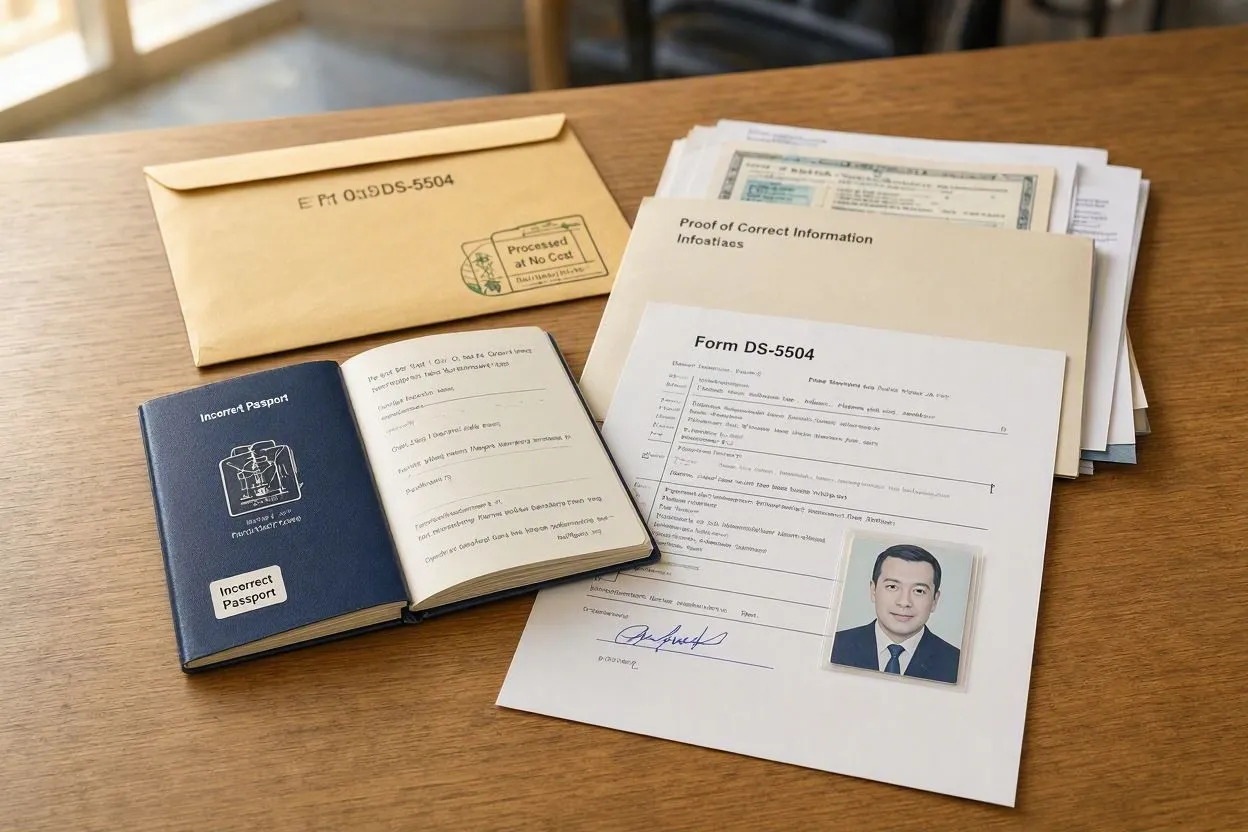
Mail Form DS-5504, along with the incorrect passport, 1 color photo, and proof of the correct information, to fix a data or printing error at no cost. This is the standard passport correction process. Data errors include a misspelled name, a wrong date of birth, or an incorrect place of birth. Printing errors include discoloration, crooked printing, and missing information on the data page. Reporting the error within 1 year of issuance gets you a corrected passport with full validity: 10 years for adults, 5 years for children under 16. Wait longer than that, and you’ll get a passport valid only until the original expiration date.
Name changes follow a similar timeline. Form DS-5504 covers name changes within 1 year of issuance at no cost, with an optional $60 expedite fee. Beyond 1 year, eligible adults renew with Form DS-82 and a certified name-change document.
Should You Travel on a Passport With an Error?
No. Any mismatch between your passport and your airline ticket or visa, even something as small as a typo, can lead to denied boarding or refused entry. A single transposed letter in a surname is enough to trigger questions at check-in. File Form DS-5504 as soon as you spot the error, especially within the first year, when the correction is free and keeps full validity.
Pre-Submission Checklist
- Confirm the form matches your situation (DS-11, DS-82, online, or DS-5504).
- Print every page single-sided from pptform.state.gov.
- Leave Form DS-11 unsigned until the acceptance agent asks.
- Check that the photo is 2 x 2 inches (51 x 51 mm), unedited, glasses-free, and under 6 months old.
- Pack a certified paper birth certificate (long-form preferred) or other original citizenship evidence.
- Copy citizenship evidence and both sides of your photo ID onto single-sided 8.5 x 11-inch paper.
- Enter your SSN and every required field.
- Write a separate check to “U.S. Department of State” with the applicant’s name and date of birth in the memo line.
- Bring a second payment for the $35 acceptance/execution fee.
- Verify that child support debt, federal tax debt, and any felony warrants or subpoenas are resolved.
- Count backward 10 weeks from your departure date.
Conclusion
Most passport application mistakes trace back to 5 details: the photo, the form, the signature, the paperwork, and the payment. Checking each one against State Department rules before submission prevents the letters, holds, and resubmissions that push a passport past a departure date. Filing between October and December avoids the spring peak, and routine service currently takes 4 to 6 weeks of processing plus up to 2 weeks of mailing in each direction.
Frequently Asked Questions

Michael Reynolds
Michael Reynolds leads ImmigrationWin’s immigration, visa, and global mobility content division. He specializes in researching immigration policies, visa requirements, application processes, and international relocation pathways for individuals, families, students, and professionals. With extensive experience analyzing immigration regulations and official government guidance, Michael brings a research-driven approach to complex immigration topics and changing visa policies. He is the primary author of ImmigrationWin’s visa guides, immigration resources, and country-specific content, helping readers better understand their options and make informed decisions about their international journey.
Related Posts