

O1 Visa Requirements: Criteria, Fees and How to Apply
An O1 visa is a temporary US work visa for people who can prove extraordinary ability or achievement, usually by meeting at least three of eight evidence criteria, with a US employer or agent filing Form I-129 for them. There’s no annual cap. There’s no lottery either, which is why demand keeps climbing: the State Department issued 19,457 O-1 visas in fiscal year 2024, up 57.4% from 2013, and British nationals received more of them than any other country for the 28th year in a row.
Approval covers up to three years. After that, you renew in one-year steps for as long as the qualifying work continues, with no lifetime limit. This guide walks through who qualifies, what officers expect to see in the evidence, what it costs at today’s USCIS fee levels, and how the steps differ for applicants in Canada, the UK and the US.
What Is O1 Visa and Who Is It For?
The O-1 is a nonimmigrant visa reserved for people who have risen to the top of their field in the sciences, education, business, athletics, the arts, or film and television. USCIS calls the standard “sustained national or international acclaim.” It’s a high bar. Officers aren’t asking whether you’re good at your job; they’re asking whether recognized experts outside your workplace already treat you as one of the leading names in your area.
The people who clear that bar look different from field to field. A machine-learning engineer whose open-source library runs inside thousands of companies fits. So does a cinematographer with two Sundance selections, or a founder whose seed round came from a top-tier accelerator. A competent mid-level manager, however valuable to the company, usually doesn’t.
O-1A vs O-1B: Which Category Fits You
Your field decides the category: O-1A covers sciences, education, business and athletics, while O-1B covers the arts and the motion picture and television industry. Each one carries its own legal standard, so picking the wrong category is an early, avoidable mistake.
| Category | Fields covered | Legal standard |
| O-1A | Sciences, education, business, athletics | Extraordinary ability shown by sustained national or international acclaim |
| O-1B (arts) | Fine and performing arts, music, design, culinary arts | Distinction: recognized as prominent, renowned or leading in the field |
| O-1B (film and TV) | Motion picture and television industry | Extraordinary achievement: recognized as outstanding, notable or leading |
Two companion categories ride alongside. O-2 covers essential support staff who travel with an O-1 artist or athlete, and O-3 covers the O-1 holder’s spouse and unmarried children under 21.
O1 Visa Requirements: Who Qualifies
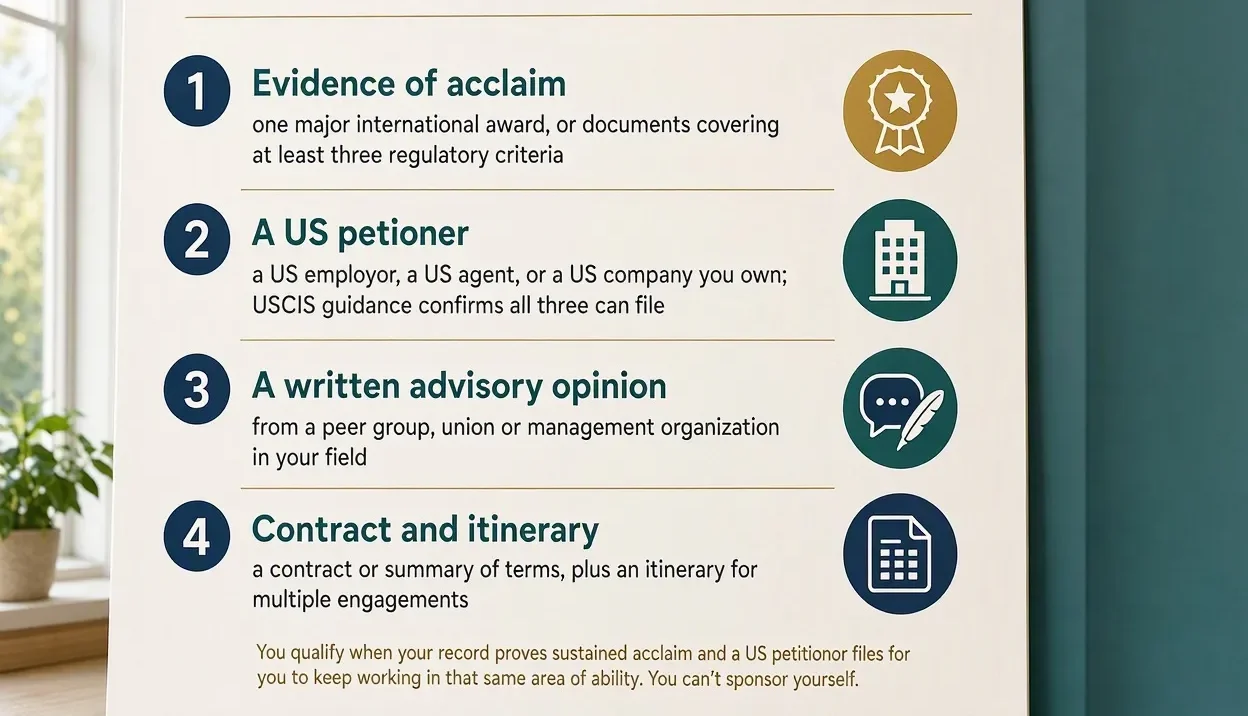
You qualify when your record proves sustained acclaim and a US petitioner files for you to keep working in that same area of ability. You can’t sponsor yourself. Every case needs these pieces in place before filing:
- Evidence of acclaim: one major international award, or documents covering at least three regulatory criteria.
- A US petitioner: a US employer, a US agent, or a US company you own. USCIS guidance confirms all three can file.
- A written advisory opinion from a peer group, union or management organization in your field.
- A contract or summary of terms, plus an itinerary if you’ll work several engagements.
The agent route matters more than most pages admit. If you’re a freelance composer with five studio clients, a single US agent can file one petition covering every engagement on your itinerary, and that petition stands in for five separate employer filings.
Early-career applicants run into the hardest wall. University HR offices such as UT Dallas warn that most postdoctoral roles struggle to meet the standard, because USCIS also checks whether the position itself calls for someone at the top of the field.
The One-Award Shortcut
A single major internationally recognized award, at the level of a Nobel Prize, satisfies the evidence requirement on its own. It has to be won, not merely nominated, for O-1A. Film and TV applicants get a slightly wider door: a nomination for an Academy Award, Emmy, Grammy or Directors Guild Award counts under the O-1B rules. Almost nobody files this way. The rest build their case criterion by criterion.
O1 Visa Criteria: The 8 Evidence Categories for O-1A
O-1A applicants must document at least three of the eight criteria in 8 CFR 214.2(o)(3)(iii), and USCIS then judges the full record before approving. Three is the floor. An officer who counts three weak criteria and sees no real acclaim behind them will still deny.
| # | Criterion | Evidence that usually works | Evidence that usually fails |
| 1 | Nationally or internationally recognized awards | An industry prize with published selection rules and a small winner pool | Employee-of-the-month or internal company awards |
| 2 | Membership in associations requiring outstanding achievement | IEEE Fellow, National Academy of Sciences | Any group you join by paying dues |
| 3 | Published material about you | A feature on your work in a major trade or national outlet | Articles you wrote, press releases |
| 4 | Judging the work of others | Journal peer review, grant panels, startup competition judging | Informal mentoring |
| 5 | Original contributions of major significance | Licensed patents, methods other teams adopted, backed by expert letters | Work nobody outside your lab uses |
| 6 | Authorship of scholarly articles | First-author papers in high-impact journals with strong citations | Publications typical of anyone in your role |
| 7 | Critical role for a distinguished organization | Founder, lead engineer or principal investigator at a well-known entity | A generic staff title with no proof of impact |
| 8 | High salary or remuneration | Pay well above Department of Labor wage data for your field | Market-rate salary |
Quality beats volume every time. Yale’s scholar office points out that a handful of citations in journals like Nature, Science or Cell can carry more weight than dozens in minor outlets, and the same logic holds for press: one national feature outranks ten local mentions.
O-1B Criteria for the Arts, Film and Television
O-1B applicants need either a nomination or award of significant national or international standing, or at least three of six criteria showing distinction or extraordinary achievement. The six criteria are:
- A lead or starring role in productions or events with a distinguished reputation.
- National or international recognition through critical reviews or published material.
- A lead, starring or critical role for organizations with a distinguished reputation.
- Major commercial or critically acclaimed successes, shown by box office receipts, ratings or similar indicators.
- Significant recognition from organizations, critics, government agencies or recognized experts.
- A high salary or substantial remuneration compared with others in the field.
A London theatre director with West End reviews in national papers, a sold-out run at a festival and letters from two artistic directors already has the bones of a three-criterion case.
Comparable Evidence for Nontraditional Fields
If a criterion doesn’t fit your occupation, 8 CFR 214.2(o)(3)(iv) lets you submit comparable evidence instead, for O-1A and O-1B arts cases. Film and TV petitions can’t use this clause. Founders use it most: seed funding from a highly selective accelerator or a well-known angel investor can stand in for an award, because the selection process itself signals peer recognition.
The Advisory Opinion Most Applicants Forget
Every O-1 petition needs a written advisory opinion, called a consultation, from an appropriate US peer group, labor organization or management organization under 8 CFR 214.2(o)(5). Skip it and USCIS can’t approve the case. For O-1A, that’s often a professional society in your discipline. Film and TV cases need two opinions, one from a labor union and one from a management organization.
Unions such as SAG-AFTRA, the Directors Guild of America and the American Federation of Musicians run dedicated desks for these requests. They work to their own timelines, and some charge a processing fee. Request the letter while you’re still collecting evidence, not after. A narrow exception applies when no appropriate peer group exists, but it’s rare, and USCIS won’t assume it on your behalf.
How to Apply for O1 Visas, Step by Step
The process moves from building evidence to a USCIS petition, then ends with either a visa stamp abroad or a change of status inside the US. Here’s the order most successful cases follow:
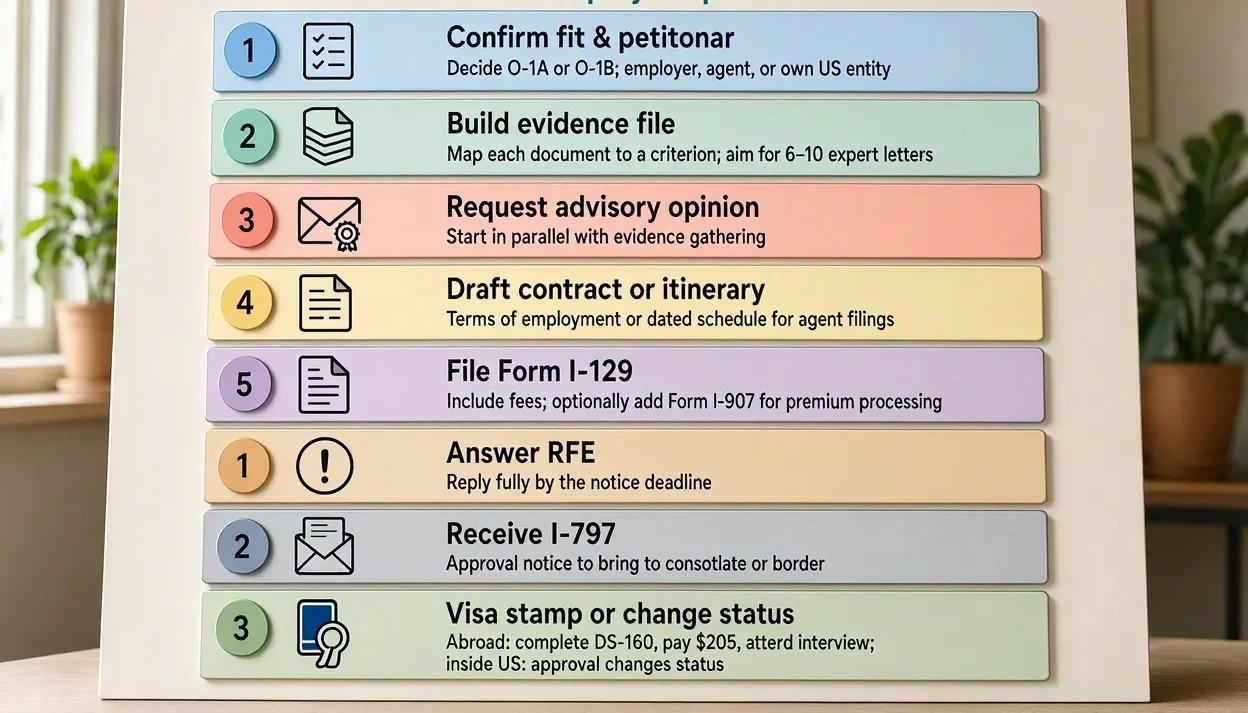
- Confirm the fit and the petitioner. Decide between O-1A and O-1B, and settle who files: employer, agent or your own US entity.
- Build the evidence file. Map every document to a specific criterion. Many attorneys aim for six to ten letters from independent experts who can explain why your work matters.
- Request the advisory opinion. Start this in parallel with step 2, since unions and peer groups set their own pace.
- Draft the contract or itinerary. USCIS wants the terms of employment, or a dated schedule of engagements for agent filings.
- File Form I-129 with fees. Add Form I-907 if you want premium processing. USCIS accepts O petitions up to one year before the start date.
- Answer any Request for Evidence (RFE). Reply in full by the deadline on the notice.
- Receive the I-797 approval notice. This is the document you’ll carry to the consulate or the border.
- Get the visa stamp or switch status. Abroad, that means Form DS-160, the $205 visa fee and an interview; inside the US, the approval itself changes your status.
O1 Visa Fees and Total Cost
Government fees for an O-1 petition run from $530 to $1,655 before premium processing, depending on employer size and nonprofit status. These are the figures on the current USCIS fee schedule (Form G-1055, edition 10/01/26):
| Fee | Large employer (26+ full-time staff) | Small employer (25 or fewer) | Nonprofit |
| Form I-129, O classification | $1,055 | $530 | $530 |
| Asylum Program Fee | $600 | $300 | $0 |
| Required USCIS subtotal | $1,655 | $830 | $530 |
| Premium processing, Form I-907 (optional) | $2,965 | $2,965 | $2,965 |
| Consular visa fee, if applying abroad | $205 | $205 | $205 |
Watch for outdated numbers. Several well-ranked pages still quote a $460 petition fee and $2,500 for premium processing; both disappeared with the April 2024 fee rule and the premium increase that took effect on March 1, 2026.
Legal fees sit on top. UT Dallas tells staff to expect $5,000 to $6,000 in attorney costs, and one Michigan firm publishes an $8,000 flat fee that includes RFE responses. Who pays varies by employer. Some universities require the employee to cover everything, petition and premium fees included, so get that answer in writing before anyone files.
O1 Visa Processing Time
Premium processing gets a USCIS decision or RFE within 15 business days for $2,965; regular processing varies by service center, and USCIS posts current times on its processing-times page. That 15-day clock covers USCIS only. Evidence gathering, the consultation letter and the consulate add their own time.
| Stage | Planning estimate |
| Gathering evidence and expert letters | 4 to 10 weeks |
| Advisory opinion (run alongside evidence work) | 2 to 6 weeks |
| USCIS decision with premium processing | 15 business days |
| USCIS decision without premium processing | Varies; check USCIS processing times |
| Decision after an RFE response (premium cases) | 15 business days from receipt of the response |
| Visa stamp at a consulate | Depends on that post’s appointment wait |
| Entry for Canadian citizens | Same day, at the port of entry |
The first two rows are planning estimates drawn from typical case flow, not official USCIS figures. A researcher with a fixed September 1 start date and a strong file typically books premium processing in early summer, which leaves room for one RFE cycle before the start date.
Applying From Canada, the UK or Inside the US
Where you are when USCIS approves the petition sets your next step, and Canadian citizens have the shortest route of anyone. Everyone else either visits a consulate or changes status from within the country.
O-1 for Canadian Citizens
Canadian citizens don’t need an O-1 visa stamp; they present the I-797 approval notice at a US port of entry or at a preclearance facility in a Canadian airport. Bring your passport, the approval notice and a copy of the petition. Customs and Border Protection officers issue the I-94 record on the spot. Family members who aren’t Canadian citizens, such as an Indian-born spouse, still need O-3 visas from a consulate. So do Canadian permanent residents.
Should a Canadian pick O-1 over TN? The TN is cheaper and faster, but it only covers professions on the USMCA list and requires non-immigrant intent. Founders, artists and athletes rarely fit that list. Anyone planning a green card is usually better served by the O-1.
O-1 for UK Applicants
UK applicants file Form DS-160, pay the $205 fee and interview at the US Embassy in London or the Consulate General in Belfast after USCIS approves the petition. Britain sent 2,691 people to the US on O-1 visas in fiscal year 2024, which works out to roughly one in seven worldwide.
Bring the I-797 notice, your passport and a full copy of the petition to the interview. The State Department narrowed interview waivers in 2025, so most applicants should plan for an in-person appointment. USCIS approval doesn’t guarantee a visa, and consular officers can still refuse issuance or place a case in administrative processing.
Changing Status Inside the US
If you’re already in the US in valid status, such as H-1B or F-1 OPT, your employer can request a change of status to O-1 on the same Form I-129, with no trip abroad. File before your current status expires. You can’t start O-1 work until USCIS approves the change.
J-1 holders face one hard rule. If the two-year home residency requirement under INA §212(e) applies to you, you can’t change status in the US. You can still get an O-1 by applying for the visa abroad, though, and later extensions can happen inside the US.
O-3 Dependents and O-2 Assistants
Spouses and unmarried children under 21 qualify for O-3 status, which allows full-time study but no employment in the US. Their stay tracks the O-1 holder’s. When the principal extends, dependents inside the US file Form I-539, either together with the O-1 extension or separately before their own status runs out. A child loses O-3 status on their 21st birthday.
O-2 status works differently. It’s for an assistant who is an integral part of an O-1 artist’s or athlete’s performance, like a tennis player’s long-time coach or a film director’s established camera operator. O-2 workers need their own petition and their own consultation. Scientists, academics and business professionals can’t bring O-2 assistants.
O Visa Dual Intent and the Green Card Path
The O-1 permits a limited form of dual intent: filing a green card petition or labor certification can’t, by itself, be used to deny an O-1 petition, extension or admission. The rule sits in 8 CFR 214.2(o)(13). In practice, plenty of holders start on an O-1 and later self-petition under EB-1A or EB-2 NIW once their record grows.
One trap catches people every year. If you file Form I-485 to adjust status while on an O-1, travelling abroad without an advance parole document can abandon that application. H-1B and L-1 holders have an exception here; O-1 holders don’t.
O-1 vs H-1B vs TN vs EB-1A
The O-1 suits proven high achievers who want to avoid the H-1B lottery, the TN suits Canadian and Mexican professionals in listed occupations, and EB-1A is the permanent-residence route for the same caliber of talent.
| Factor | O-1 | H-1B | TN | EB-1A |
| Type | Temporary work visa | Temporary work visa | Temporary work status | Green card |
| Annual cap or lottery | None | 85,000 cap with lottery | None | None, but subject to visa bulletin dates |
| Core standard | Extraordinary ability or achievement | Specialty job, bachelor’s degree or equivalent | Profession on the USMCA list | Extraordinary ability, 3 of 10 criteria |
| Who files | Employer, agent or own US entity | Employer | Employer offer; Canadians apply at the border | You can self-petition |
| Dual intent | Limited, under 8 CFR 214.2(o)(13) | Yes | No | Not applicable |
| Maximum stay | No limit, one-year extensions | Six years in most cases | No limit, three-year renewals | Permanent |
The H-1B column carries real uncertainty right now. A September 2025 proclamation added a $100,000 payment for certain new H-1B petitions, and on September 18, 2026 the White House extended it through September 21, 2027. Courts have blocked collection so far, and DHS separately proposed a $103,265 fee for cap-subject H-1B petitions in August 2026. That volatility is pushing more employers to look hard at the O-1 for candidates who qualify.
Common Reasons for RFEs and Denials
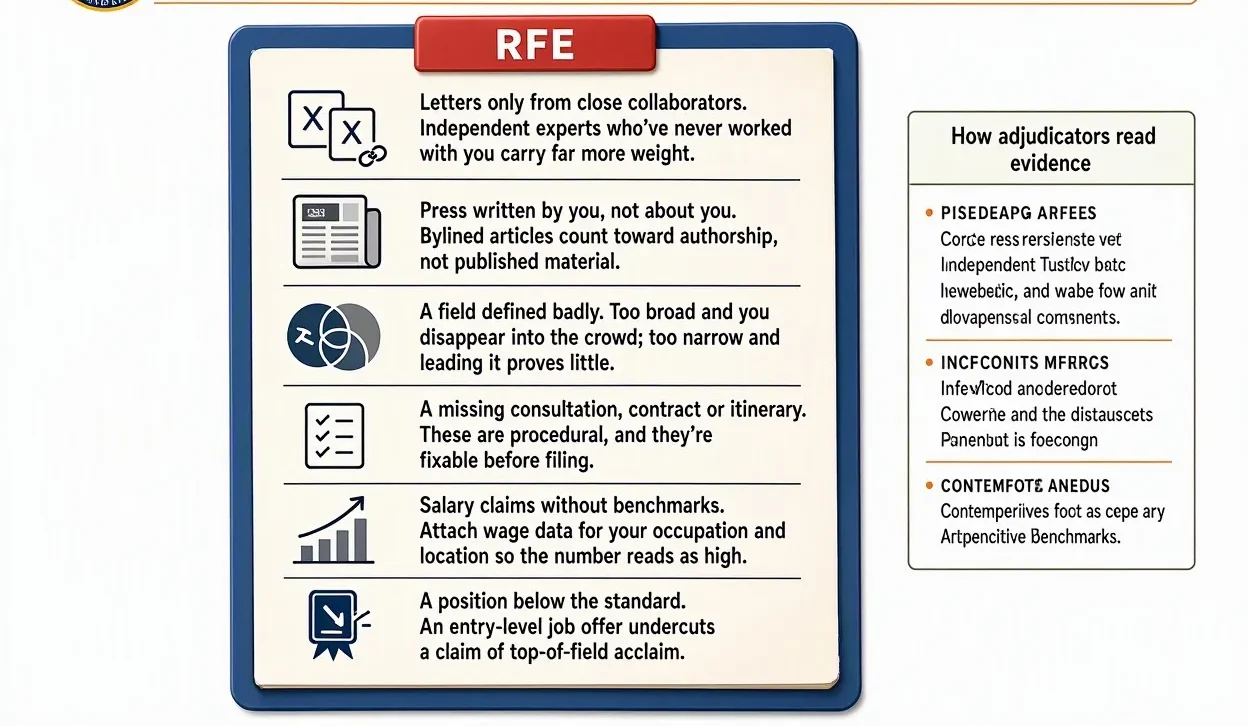
Most O-1 RFEs trace back to evidence that proves activity instead of acclaim. Officers know the difference between reviewing three manuscripts and chairing a journal’s review board. These are the patterns that draw RFEs most often:
- Letters only from close collaborators. Independent experts who’ve never worked with you carry far more weight.
- Press written by you, not about you. Bylined articles count toward authorship, not published material.
- A field defined badly. Too broad and you disappear into the crowd; too narrow and leading it proves little.
- A missing consultation, contract or itinerary. These are procedural, and they’re fixable before filing.
- Salary claims without benchmarks. Attach wage data for your occupation and location so the number reads as high.
- A position below the standard. An entry-level job offer undercuts a claim of top-of-field acclaim.
Take a fintech founder who lists “business” as the field. An officer sees thousands of competitors. Narrow it to “real-time fraud detection for payments” and the same press coverage, funding and patents suddenly place the founder near the top.
Conclusion
The O1 visa is the right choice if independent experts already recognize you as a leader in your field and you can prove it on paper. It doesn’t reward potential. It rewards a documented record, and that record has to survive an officer who reads hundreds of these files.
Start with an honest audit against the eight O-1A criteria or the six O-1B ones, and line up the advisory opinion early. Budget for the current fees rather than the old ones. If you’re Canadian, remember the border is your consulate; if you’re British, you’re applying from the country that sends more O-1 workers than any other. Given how unsettled H-1B costs are this year, a qualified candidate who waits on the lottery is often choosing the slower, riskier road.
O1 Visa FAQs

Michael Reynolds
Michael Reynolds leads immigration content at ImmigrationWin, covering visa requirements, application and relocation pathways. He researches immigration policies and official government guidance to explain changing rules clearly. His guides help students, families, and professionals make informed decisions about moving abroad.
Related Posts