
New Zealand Golden Visa 2026: Complete Guide to Active Investor Plus Visa Requirements, Costs & Application
The New Zealand Golden Visa — officially the Active Investor Plus Visa (AIP) — grants indefinite residency to investors who commit NZD $5 million (approximately USD $2.99 million) under the Growth category or NZD $10 million (approximately USD $5.98 million) under the Balanced category. The program launched in its current form on 1 April 2025 and has received 659 applications representing NZD $3.87 billion in potential investment as of April 2026.
Growth category investors reach permanent residency (PR) in 3 years with just 21 days of physical presence in New Zealand. Balanced category investors reach PR in 5 years with 105 days of presence. Both pathways lead to New Zealand citizenship eligibility after 5 years of permanent residency.
This guide covers every aspect of the 2026 program — 2 investment categories, eligible investments, NZD $27,470 government fee, application steps, compliance obligations, the June 2026 philanthropic reform, property purchase rights, and the pathway to New Zealand citizenship and Australia work rights.
What Is the New Zealand Golden Visa?
The Active Investor Plus Visa (AIP) is New Zealand’s residency-by-investment program, administered by Immigration New Zealand (INZ) and New Zealand Trade and Enterprise (NZTE). It replaced the old Investor 1 and Investor 2 categories on 1 April 2025 with simplified investment structures, lower thresholds, and no English language requirement.
The AIP visa grants an indefinite right to live, work, and study in New Zealand from the date of approval. The visa is not temporary — it is a resident visa class, not a work or visitor visa. Approval in Principle (AIP) is issued first, followed by full resident visa status once the investment is transferred to New Zealand.
2026 Program Stats (as of 31 March 2026): 659 applications received — 524 Growth category, 111 Balanced category, 24 other. Total potential investment: NZD $3.73 billion. More than NZD $1 billion already committed. 80% of applications receive Approval in Principle within 4 months. 35.5% of all applicants are from the United States — more than China and Hong Kong combined. Source: Immigration New Zealand, April 2026.
Key Features of the New Zealand Golden Visa
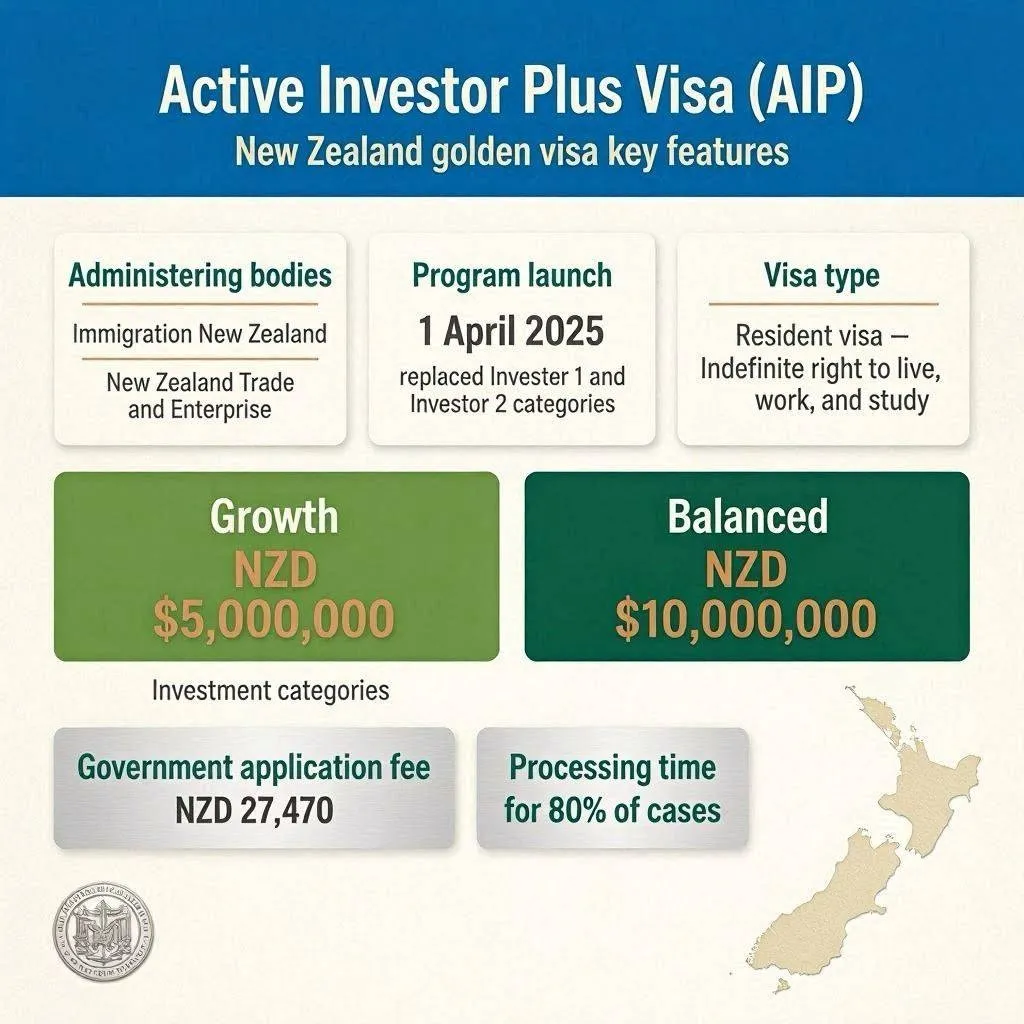
| Feature | Details |
|---|---|
| Official Program Name | Active Investor Plus Visa (AIP) |
| Administering Body | Immigration New Zealand (INZ) + New Zealand Trade and Enterprise (NZTE) |
| Program Launch | 1 April 2025 (replaced Investor 1 & Investor 2 categories) |
| Visa Type | Resident visa — indefinite right to live, work, and study |
| Investment Categories | 2 — Growth (NZD $5M) and Balanced (NZD $10M) |
| Government Application Fee | NZD $27,470 |
| Processing Time (80% of cases) | Approval in Principle within 4 months (average: 35 working days in 2026) |
| PR Pathway — Growth | 3 years after investment + 21 days physical presence |
| PR Pathway — Balanced | 5 years after investment + 105 days physical presence |
| Citizenship Eligibility | After 5 years of permanent residency (1,350 days minimum presence) |
| New Zealand Passport Rank | 6th globally — visa-free access to 183 countries (Henley Index 2026) |
| English Requirement | None for the main applicant |
| Family Inclusion | Spouse/de facto partner + dependent children up to age 24 |
Investment Categories — Growth vs Balanced
The AIP visa offers 2 investment pathways with different minimum investments, risk profiles, timelines, and eligible asset classes. Choosing the right category depends on investment capacity, risk tolerance, and residency timeline.
| Factor | Growth Category | Balanced Category |
|---|---|---|
| Minimum Investment | NZD $5 million (~USD $2.99M) | NZD $10 million (~USD $5.98M) |
| Investment Period | 3 years (36 months) | 5 years (60 months) |
| Minimum Physical Presence | 21 days over 3 years | 105 days over 5 years (reducible) |
| PR Eligibility | After 3 years | After 5 years |
| Eligible Assets | Managed funds, direct equity in NZ businesses, philanthropic donations (from June 2026) | Managed funds, direct equity, listed equities, listed bonds, philanthropic donations |
| Risk Profile | Higher risk — venture capital, private equity, growth funds | Lower risk — listed equities and bonds permitted |
| Compliance Questionnaires | At 24 months and 36 months | At 24 months and 60 months |
| Best Suited For | Investors who want fastest PR timeline with minimum presence | Investors seeking diversified, lower-risk portfolio with stable returns |
From 6 March 2026, AIP visa holders can purchase one residential property valued at NZD $5 million or more for personal use. This property right is separate from the investment requirement — the property does not count toward the NZD $5M or $10M investment threshold. The Overseas Investment Office (OIO) targets a 5-working-day processing time for these property applications.
Eligible Investments Under the Active Investor Plus Visa
Growth Category — Eligible Investment Types
Growth category investments must be in higher-risk, high-growth assets that actively contribute to the New Zealand economy. 3 investment types qualify under the Growth category:
| Investment Type | Description | Key Requirements |
|---|---|---|
| Approved Managed Funds | Private equity, venture capital, and growth funds on INZ’s approved list (~70 funds as of January 2026) | Must appear on Invest New Zealand’s current approved fund list. Fund investment period may extend beyond 3-year visa period — capital may be locked for 7–10 years. |
| Direct Equity in NZ Businesses | Direct equity stakes in unlisted New Zealand companies | Investment must be for productive use, not passive holding. Independent valuation required. Business must be registered in New Zealand. |
| Philanthropic Donations (from June 2026) | Donations to approved New Zealand charities or DOC conservation projects — up to 20% of investment (max NZD $1M) | Charity must hold Inland Revenue donee status, have 5+ years of compliant annual returns, and qualify as Tier 1–3 reporting charity. Disclose any existing relationship with the charity. |
Balanced Category — Eligible Investment Types
Balanced category investments permit a broader, more diversified asset mix including publicly listed securities. 5 investment types qualify:
- Approved managed funds (same list as Growth category)
- Direct equity in New Zealand businesses
- Listed equities — shares in NZX-listed or approved internationally listed companies with NZ exposure
- Listed bonds — bonds issued by New Zealand entities listed on a recognized exchange
- Philanthropic donations to approved charities or Department of Conservation projects
The June 2025 75/25 rule applies to Balanced category: at least 75% of the investment must be held in listed equities or bonds at all times, with a maximum of 25% in bank accounts or term deposits.
What Does NOT Qualify as an Investment
- Bank deposits or term deposits (beyond the 25% cap for Balanced; none permitted for Growth)
- Residential property (even NZD $5M+ properties — these are a separate personal use right, not an investment)
- Investments in overseas companies without New Zealand operations
- Loans to third parties or personal lending
- Assets for personal use including vehicles, artwork, or collectibles
- Investments where the main applicant has excessive personal control that reduces commercial substance
INZ determines whether an investment is acceptable at the time it is made — not at the time of application. Investment value is determined at the time of investment, inclusive of all fees (management fees, brokerage fees, transaction fees). INZ does not endorse or guarantee the performance or returns of any approved investment.
Who Can Apply — Eligibility Requirements
The AIP visa has no nationality restrictions. Investors of any nationality can apply. These are the 6 core eligibility requirements:
| Requirement | Details |
|---|---|
| Age | Must be 18 or older. No upper age limit. |
| Investment Capacity | Must have NZD $5M (Growth) or NZD $10M (Balanced) in qualifying funds, lawfully acquired. |
| Good Health | Must pass a medical examination and chest X-ray. INZ may require further tests. |
| Good Character | Must provide police certificates from every country of citizenship and any country lived in for 12+ months over the last 10 years. Certificates must be less than 6 months old. |
| Fit and Proper Person | Must confirm compliance with immigration, employment, and taxation laws across all businesses influenced or controlled. |
| Source of Funds | Must demonstrate the investment funds were lawfully acquired — through business income, asset sales, inheritance, investment returns, or other legitimate sources. AML/KYC checks apply. |
English Language Requirement
No English language requirement applies to the main applicant for the AIP visa. This was one of the key changes introduced in April 2025. Family members included in the application may have English requirements depending on their planned activities — for example, children enrolling in schools or partners taking employment. Confirm current requirements for dependants with a licensed immigration adviser.
Family Members Who Can Be Included
- Spouse or de facto partner (including same-sex partners)
- Dependent children up to age 24 — children aged 21–24 must be single and financially dependent on the main applicant
- Children born after the original application can be included in the permanent resident visa application
Family members included in the AIP visa receive the same indefinite residency rights as the main applicant — the right to live, work, and study in New Zealand without restriction.
How to Apply for the New Zealand Golden Visa — 6-Step Process
Step 1: Engage a Licensed Immigration Adviser and Tax Counsel (Months 1–2)
Engaging a licensed New Zealand immigration adviser is the first action. The AIP visa application involves complex investment documentation, source of funds analysis, and compliance obligations that make professional guidance essential. Immigration advisers must be licensed by the Immigration Advisers Authority (IAA) — verify licensing status before engaging.
Simultaneously, engage a New Zealand tax adviser. The AIP visa triggers New Zealand tax residency obligations. Investors moving significant capital into New Zealand need to understand income tax, foreign investment fund (FIF) rules, and any double tax agreement (DTA) between New Zealand and their home country before the investment is transferred.
Step 2: Select Investment Category and Target Investments (Months 2–3)
Choose Growth or Balanced category based on investment capacity, risk tolerance, and preferred PR timeline. For Growth category, review the Invest New Zealand approved managed fund list (updated January 2026 — approximately 70 funds). For direct equity, identify qualifying New Zealand businesses and arrange independent valuations.
Complete AML/KYC verification with the target investment vehicles. Finalize the investment mandate or subscription documents before submitting the visa application.
Step 3: Prepare and Submit the Application (Months 3–5)
Submit the complete visa application to INZ online. A well-prepared application with a thorough cover letter, clearly indexed evidence, and a comprehensive source-of-funds narrative processes faster. INZ specifically recommends including a clear evidence index and summary table showing how funds were accumulated.
Required Documents for the AIP Visa Application
- Valid passport with sufficient validity for the application period
- 2 passport-size photographs (head and shoulders)
- Completed medical examination and chest X-ray from an INZ-approved panel doctor
- Police certificates from every country of citizenship and every country of 12+ months residence in the last 10 years
- Source of funds documentation — bank statements, tax returns, payslips, dividend records, sale agreements, financial audit reports
- Investment plan or mandate confirming the chosen investment vehicle and amount
- Independent valuation reports for direct equity investments
- Cover letter indexing all evidence and explaining how each document satisfies each requirement
- Completed Resident Visa Declaration forms for dependants (if including family)
- English translations for all non-English documents (certified translations)
Step 4: INZ Processing and Approval in Principle (Months 5–9)
80% of AIP applications receive Approval in Principle (AIP) within 4 months of submission. The average processing time in 2026 is approximately 35 working days, though INZ notes this excludes time taken by applicants to respond to information requests.
During processing, INZ conducts background checks, verifies source of funds, and confirms investment eligibility. INZ may request additional documentation — respond promptly, as delays in providing information extend the timeline and are excluded from the official processing window.No interview is required for the AIP visa.
INZ makes decisions based on the written application and supporting documentation. This distinguishes the New Zealand program from some other investor visa programs that require in-person presentations or committee reviews.
Step 5: Transfer Investment Funds to New Zealand (Within 6 Months of AIP)
Once Approval in Principle is granted, the investment must be transferred to New Zealand within 6 months. A 6-month extension can be requested if additional time is needed. INZ accepts 3 methods of fund transfer:
- Direct bank transfer from the main applicant’s own account
- Transfer from a joint account shared with family members included in the application
- Transfer through a recognized third-party intermediary acting formally on the applicant’s behalf
Use a specialist foreign exchange provider rather than a standard bank transfer for large NZD transactions. On a NZD $5 million transfer, the difference between a bank’s spread and a specialist FX provider’s rate can reach NZD $50,000–$150,000.
Step 6: Compliance, Questionnaires, and Permanent Residency Application
The resident visa comes with ongoing obligations during the investment period. INZ requires 2 compliance questionnaires during the investment period — the structure differs by category:
| Category | Questionnaire 1 | Questionnaire 2 | PR Application Eligible |
|---|---|---|---|
| Growth | At 24 months from investment date (3-month window to complete) | At 36 months from investment date (3-month window to complete) | After 36 months + 21 days presence |
| Balanced | At 24 months from investment date (3-month window to complete) | At 60 months from investment date (3-month window to complete) | After 60 months + 105 days presence |
After successfully completing the investment period and meeting presence requirements, apply for the Permanent Resident Visa for the main applicant and all family members included in the original application. Children born after the original application can also be included at this stage.
New Zealand Golden Visa Costs — Full Breakdown
The NZD $5M or $10M investment is not a cost — the capital remains the applicant’s money, held in approved NZ investments. These are the actual fees and advisory costs associated with the AIP visa:
| Cost Category | Amount | Notes |
|---|---|---|
| INZ Government Application Fee | NZD $27,470 | One fee covers main applicant and included family members. Non-refundable. |
| Medical Examinations | NZD $400–$800 per person | Required for main applicant and all included dependants aged 11+. Costs vary by country. |
| Police Certificates | NZD $50–$400 per certificate | Required from each country — fees vary significantly by nation. |
| Immigration Adviser Fees | NZD $10,000–$30,000 | Licensed adviser for full application preparation and lodgement. Varies by complexity. |
| Tax Adviser Fees | NZD $5,000–$20,000 | New Zealand and home-country tax structuring — critical before fund transfer. |
| Fund Due Diligence | NZD $5,000–$15,000 | Independent assessment of approved managed funds (optional but strongly recommended). |
| Independent Business Valuation | NZD $8,000–$25,000 | Required for direct equity investments in unlisted NZ businesses. |
| FX Transfer Costs | 0.1%–0.5% of transfer amount | Use a specialist FX provider. On NZD $5M, savings vs bank can reach NZD $50,000–$150,000. |
| Property Purchase Costs (optional) | NZD $80,000–$200,000+ | Stamp duty (if any), legal fees, OIO application fee for the NZD $5M+ property right. |
| Total Advisory and Government Costs | ~NZD $60,000–$120,000 | Excluding property purchase and investment capital. |
The investment capital (NZD $5M or $10M) is your money — not a fee. After the 3 or 5-year investment period, you can withdraw, reinvest, sell, or transfer the capital as you wish. Returns from the investment (dividends, capital gains, fund distributions) belong to you and are subject to New Zealand tax during the investment period.
Pathway from Resident Visa to Permanent Residency to Citizenship
Stage 1: Resident Visa (AIP Visa)
The AIP visa is granted as a resident visa immediately upon approval. It grants indefinite rights to live, work, and study in New Zealand from day one of approval. The investor must maintain the qualifying investment and meet minimum presence requirements during the investment period.
Stage 2: Permanent Resident Visa
Apply for Permanent Resident Visa after completing the investment period and meeting presence requirements. Growth category applicants apply after 3 years with 21 days of physical presence. Balanced category applicants apply after 5 years with 105 days of physical presence.
Balanced category investors can reduce the 105-day requirement by investing additional capital in Growth-eligible assets: 14 days reduction per additional NZD $1 million invested in Growth investments, down to a minimum of 63 days.
The Permanent Resident Visa has no ongoing investment requirement and no minimum presence requirement. It is an unconditional right to reside in New Zealand indefinitely.
Stage 3: New Zealand Citizenship
New Zealand citizenship requires 5 years as a holder of a residence-class visa and a minimum of 1,350 days of physical presence, with at least 240 days in each of the 5 years. For Growth category investors, the realistic citizenship timeline is 8 to 10 years from the initial application date, given the minimum presence requirements of the AIP visa (21 days over 3 years) versus the citizenship requirements (240 days per year for 5 years).
Investors whose primary objective is a New Zealand passport must plan for the citizenship timeline from the outset. The AIP visa’s minimum presence requirements do not accumulate toward citizenship — the higher citizenship presence standard begins from the date of permanent residency.
The Australia Bonus — Special Category Visa
New Zealand citizens automatically qualify for Australia’s Special Category Visa (subclass 444), which grants the right to live and work in Australia indefinitely without applying for Australian citizenship or a separate Australian visa. This makes the New Zealand Golden Visa effectively a dual residency pathway to both New Zealand and Australia for long-term planning.
| Stage | Timeline from Application | What You Get |
|---|---|---|
| AIP Visa Approval | 4–6 months from application | Indefinite NZ residency — live, work, study in New Zealand |
| Investment Transfer | Within 6 months of AIP approval | Resident visa activated — investment period begins |
| Permanent Resident Visa (Growth) | ~3 years after investment | Unconditional NZ residency — no investment or presence requirement |
| Permanent Resident Visa (Balanced) | ~5 years after investment | Unconditional NZ residency — no investment or presence requirement |
| NZ Citizenship | ~8–10 years (Growth) / ~10–12 years (Balanced) | NZ passport — 183 countries visa-free + Australia Special Category Visa (444) |
2026 Policy Updates and Recent Reforms
The AIP program has evolved significantly since launching in April 2025. These are the 4 major policy changes that took effect in 2026:
1. Property Purchase Rights (March 2026)
From 6 March 2026, AIP visa holders can purchase or build one residential property in New Zealand valued at NZD $5 million or more for personal use. Previously, non-residents were generally prohibited from purchasing existing residential property in New Zealand under the Overseas Investment Act. The OIO targets a 5-working-day processing time for these applications.
The property does not count toward the NZD $5M or $10M investment threshold. It is a separate personal benefit of the visa, not part of the investment structure.
2. Overseas Investment Act Reforms (March 2026)
The Overseas Investment Act (OIA) reforms that took effect in March 2026 introduced fast-track consent pathways for AIP visa holders making investments in New Zealand. This reduced the administrative burden for direct equity investments requiring OIA consent.
3. Philanthropic Donations Permitted (June 2026)
From 1 June 2026, Growth category investors can allocate up to 20% of the NZD $5 million minimum investment (maximum NZD $1 million) to philanthropic donations. Requirements for qualifying donations:
- The receiving charity must hold current Inland Revenue donee status
- The charity must have filed at least 5 years of compliant annual financial returns
- The charity must qualify as a Tier 1, 2, or 3 reporting charity under the Charities Act
- Donations must be used exclusively within New Zealand
- Donations to approved Department of Conservation (DOC) projects also qualify — the DOC publishes an approved project list
- Applicants must disclose any pre-existing relationship with the recipient charity — applications may be declined where conflicts of interest exist
4. June 2025 75/25 Rule (Balanced Category)
A June 2025 amendment introduced a maximum 25% cap on cash holdings for Balanced category investors. At least 75% of the Balanced category investment must be held in listed equities or bonds at all times. This change was designed to prevent passive cash parking in New Zealand bank accounts. Pre-June 2025 applicants were offered a no-cost variation window to restructure their investments to comply.
Investment Risks — What Every Applicant Must Understand
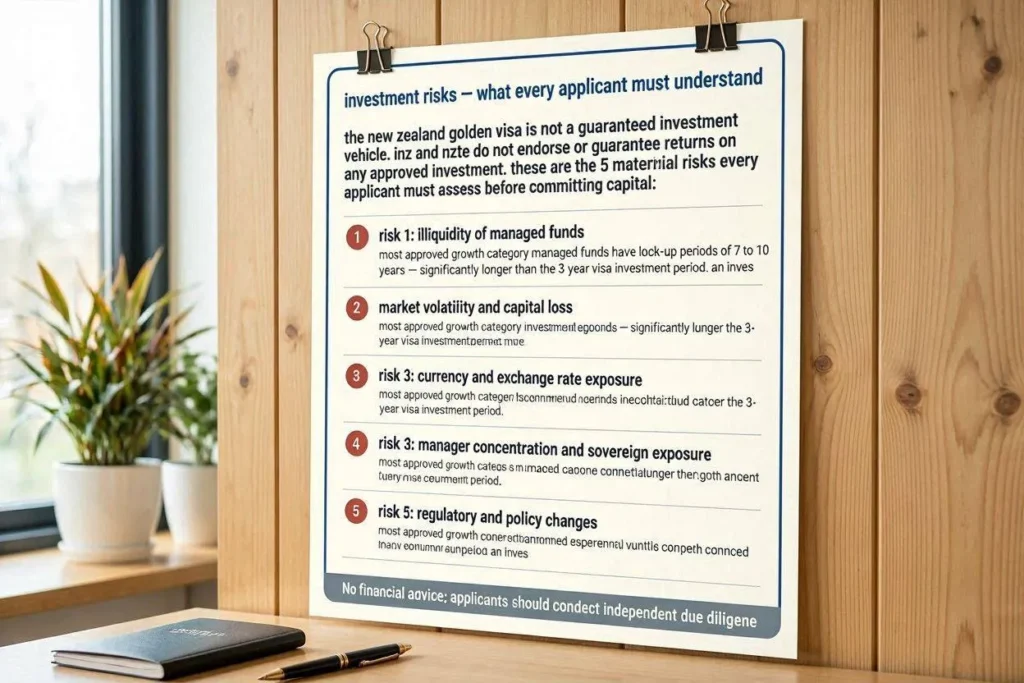
The New Zealand Golden Visa is not a guaranteed investment vehicle. INZ and NZTE do not endorse or guarantee returns on any approved investment. These are the 5 material risks every applicant must assess before committing capital:
Risk 1: Illiquidity of Managed Funds
Most approved Growth category managed funds have lock-up periods of 7 to 10 years — significantly longer than the 3-year visa investment period. An investor who receives permanent residency after 3 years cannot simply withdraw their NZD $5 million from a venture capital fund that has a 10-year investment horizon. Capital may remain locked beyond the visa period.
Risk 2: Uncertain Investment Returns
Target returns quoted by approved managed funds — often 15% to 25% internal rate of return (IRR) for venture capital funds — are aspirational, not guaranteed. New Zealand’s venture capital market is small and concentrated. Many approved funds are managing their first or second fund and have limited track records. Historical returns from earlier funds do not guarantee future results.
Risk 3: Market and Sector Concentration
Single-fund Growth category investors may face concentrated exposure to one sector — for example, climate technology, agricultural technology, or deep technology. If that sector underperforms, the entire investment is affected. Balanced category investors can diversify across listed equities and bonds to reduce concentration risk.
Risk 4: New Zealand Tax Obligations
The AIP visa triggers New Zealand tax residency. New Zealand taxes residents on worldwide income, including income from offshore investments. The Foreign Investment Fund (FIF) rules apply to offshore portfolio investments — investors holding foreign shares or managed funds outside New Zealand may face NZ tax on deemed income even without receiving actual distributions. Obtain NZ tax advice before transferring funds.
Risk 5: Policy Risk
The AIP program has undergone multiple changes since April 2025. Investment thresholds, eligible asset classes, presence requirements, and property purchase rules have all been modified within the program’s first year. Future policy changes could affect investment requirements, PR timelines, or eligible fund lists. Monitor INZ announcements throughout the investment period.
New Zealand Golden Visa vs. Other Global Investor Visa Programs
| Country | Minimum Investment | PR Timeline | Presence Required | Citizenship Timeline |
|---|---|---|---|---|
| New Zealand (Growth) | NZD $5M (~USD $3M) | 3 years | 21 days / 3 years | 8–10 years |
| New Zealand (Balanced) | NZD $10M (~USD $6M) | 5 years | 105 days / 5 years | 10–12 years |
| Australia (SIV) | AUD $5M (~USD $3.3M) | 4 years | 40 days / 4 years | Not available via SIV |
| Portugal (Golden Visa) | EUR €500K (~USD $545K) | 5 years | 7 days / year | 5 years |
| Malta (MEIN) | EUR €600K–€750K | 12 months | Minimal | 1–3 years (citizenship) |
| UAE Golden Visa | AED $2M (~USD $545K) | 10 years (renewable) | None required | Not available via Golden Visa |
| US EB-5 (Rural) | USD $800K | 2–5 years | No minimum during PR process | 5 years from Green Card |
| UK (No longer active) | GBP £2M–£10M | 3–5 years | 180 days / year | 5–6 years |
New Zealand offers the lowest presence requirement of any major investor visa program globally. Just 21 days over 3 years for the Growth category makes it practical for investors who do not intend to relocate immediately but want a stable long-term residency option in a high-quality, politically stable country.
Why Investors Choose New Zealand — 6 Key Advantages
| Advantage | Details |
|---|---|
| Political Stability | Consistently ranked among the world’s least corrupt and most stable countries. Strong rule of law. Transparent regulatory environment. |
| New Zealand Passport Power | 6th globally on the Henley Passport Index 2026. Visa-free or visa-on-arrival access to 183 countries including the US, UK, EU, Japan, and Singapore. |
| Australia Access | New Zealand citizenship grants the right to live and work in Australia indefinitely under the Special Category Visa (subclass 444) — effectively providing access to 2 of the world’s most desirable economies. |
| Education Quality | 8 universities ranked in the global top 500. Strong primary and secondary school systems. AIP visa children can attend public schools as residents. |
| Healthcare | High-quality public healthcare system. Residents have subsidized access to public health services. |
| Quality of Life | Clean environment, outdoor lifestyle, multicultural society. Low population density — New Zealand has 5.2 million people across 268,021 km² (103,483 square miles). |
7 Common Mistakes That Delay or Derail AIP Visa Applications
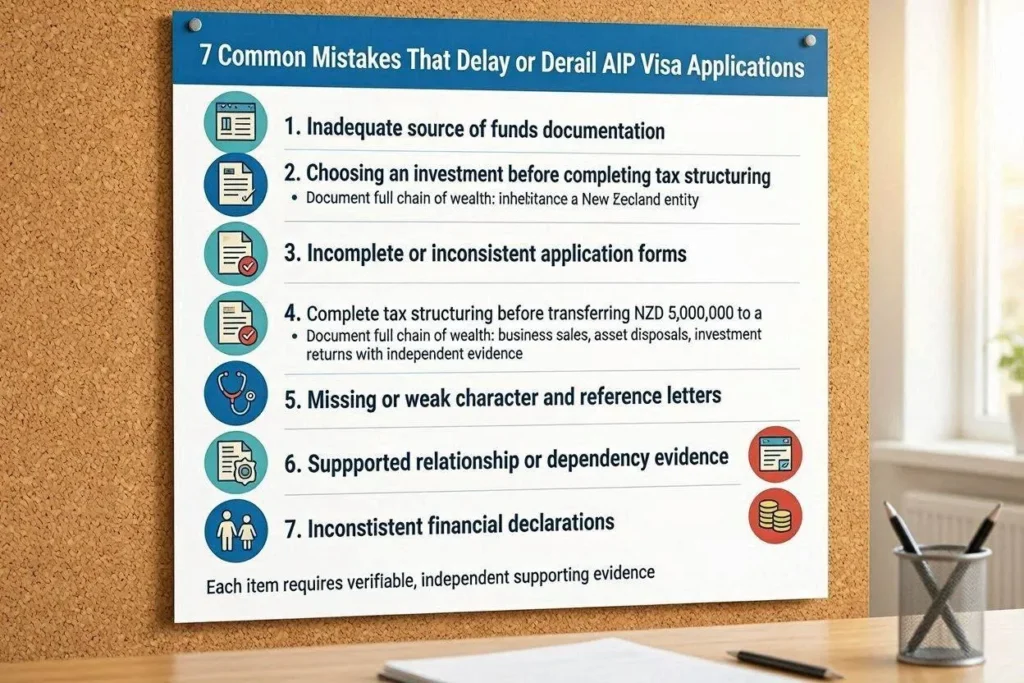
- Inadequate source of funds documentation. INZ treats source of funds as an institutional-grade AML/KYC review. Bank statements alone are insufficient. Document the full chain of wealth accumulation — business sales, asset disposals, inherited funds, investment returns. Every material source needs independent supporting evidence.
- Choosing an investment before completing tax structuring. Transferring NZD $5M to New Zealand before understanding NZ tax residency implications can create unexpected tax obligations. Engage a NZ tax adviser before — not after — the investment is made.
- Selecting a managed fund without independent due diligence. The Invest New Zealand approved fund list is not an endorsement of fund quality or returns. Many funds on the list are small, new, and investing in high-risk sectors. Conduct independent due diligence on any fund before subscribing.
- Missing compliance questionnaire deadlines. INZ sends questionnaires at 24 months and at the end of the investment period (36 or 60 months). Applicants have 3 months to complete each. Missing these deadlines can jeopardize permanent residency eligibility.
- Underestimating the citizenship presence requirement. Investors who plan to obtain New Zealand citizenship must achieve 240 days of physical presence per year for 5 years after permanent residency. This is far more demanding than the AIP visa’s minimum 21 or 105-day requirement. Plan the long-term timeline before applying.
- Not disclosing existing charity relationships for philanthropic investments. From June 2026, any pre-existing relationship with a recipient charity must be disclosed. Failure to disclose is grounds for application rejection — not just delay.
- Using a non-licensed immigration adviser. Immigration advisers in New Zealand must be licensed by the Immigration Advisers Authority (IAA). Using an unlicensed person to assist with a visa application is illegal in New Zealand and invalidates the application. Verify IAA licensing before engaging any adviser.
- 635 applications from 2,155 people representing NZD $3.73 billion in committed capital in the program’s first year indicates genuine demand from serious investors. The program is competitive, well-structured, and growing. If the investment capacity, risk profile, and long-term residency goals align — the New Zealand Golden Visa is one of the strongest investor residency programs in the world.
Frequently Asked Questions

Michael Reynolds
Michael Reynolds leads ImmigrationWin’s immigration, visa, and global mobility content division. He specializes in researching immigration policies, visa requirements, application processes, and international relocation pathways for individuals, families, students, and professionals. With extensive experience analyzing immigration regulations and official government guidance, Michael brings a research-driven approach to complex immigration topics and changing visa policies. He is the primary author of ImmigrationWin’s visa guides, immigration resources, and country-specific content, helping readers better understand their options and make informed decisions about their international journey.
Related Posts