
Malta Golden Visa 2026: Complete Guide to Residency by Investment
The Malta Golden Visa — officially the Malta Permanent Residence Programme (MPRP) — grants non-EU nationals permanent EU residency from €169,000 (rent route) or €474,000 (purchase route). Processing takes 4 to 6 months. There is no minimum stay requirement. One application covers up to 4 generations of family. Malta is the only EU programme that grants permanent residency from day one, not a temporary permit.
What Is the Malta Golden Visa?
The Malta Golden Visa is a residency-by-investment programme that grants non-EU, non-EEA, and non-Swiss nationals permanent residence in Malta in exchange for a qualifying financial investment. The scheme launched in 2021 and is administered by the Residency Malta Agency — the government body that manages all applications, licensing, and due diligence.
Most EU golden visa programmes offer a temporary residence permit that must be renewed every 2 to 5 years. Malta does not. The MPRP grants an indefinite residence card from the date of approval. That card renews every 5 years as an administrative step, but the underlying residency status is permanent.
The programme does not grant Maltese citizenship automatically. Citizenship is available separately through the Malta Exceptional Investor Naturalisation (MEIN) programme, which requires a larger financial commitment and additional residency time.
Malta Golden Visa — Key Facts at a Glance
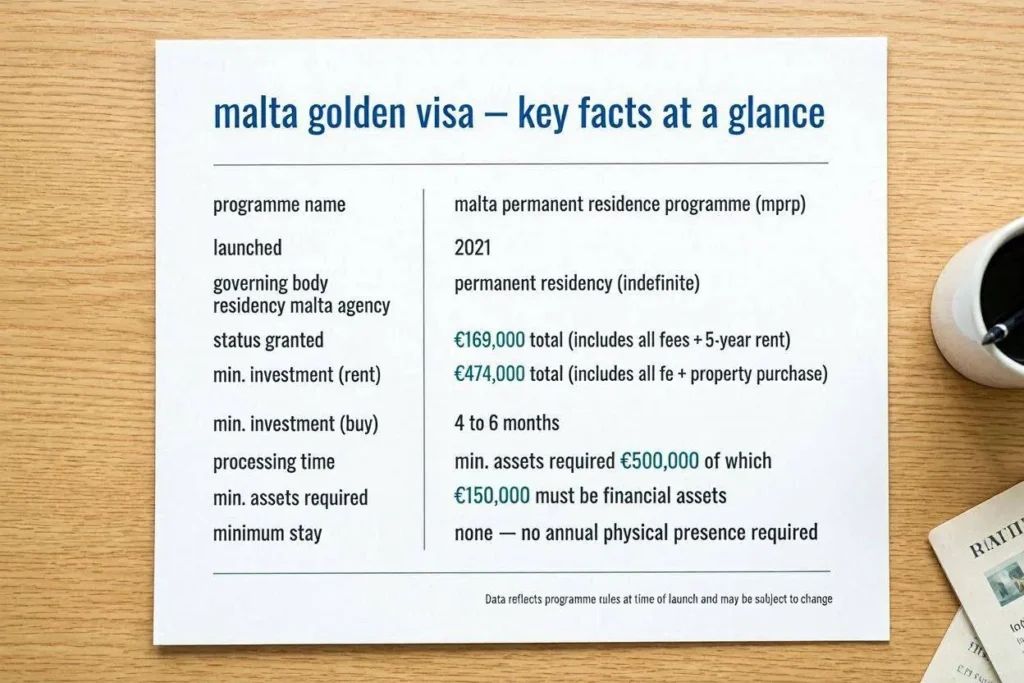
| Programme name | Malta Permanent Residence Programme (MPRP) |
| Launched | 2021 |
| Governing body | Residency Malta Agency |
| Status granted | Permanent residency (indefinite) |
| Min. investment (rent) | €169,000 total (includes all fees + 5-year rent) |
| Min. investment (buy) | €474,000 total (includes all fees + property purchase) |
| Processing time | 4 to 6 months |
| Min. assets required | €500,000 (of which €150,000 must be financial assets) |
| Minimum stay | None — no annual physical presence required |
| Schengen access | Visa-free travel across 27 Schengen countries, 90 days per 180-day period |
| Family inclusion | Spouse, children (all ages if unmarried), parents, grandparents |
| Path to citizenship | Yes — via MEIN programme after qualifying period |
| English official? | Yes — Malta is an English-speaking EU country |
| Malta passport rank | 6th globally in 2026 (visa-free access to 190 countries) |
Who Qualifies for the Malta Golden Visa?
To qualify for the MPRP, the main applicant must meet all 5 of the following conditions:
- Be at least 18 years old at the time of application.
- Hold a clean criminal record — all adult dependants must also provide police clearance.
- Demonstrate assets of at least €500,000, of which a minimum of €150,000 must be in financial assets such as savings, stocks, or bonds. Alternatively, total assets of €650,000 with €75,000 in financial assets satisfy this requirement.
- Hold valid health insurance covering the full European Union for all applicants.
- Meet the programme’s investment requirements — property purchase or rental plus government contribution and NGO donation.
The programme targets 4 primary applicant profiles:
- Investors. High-net-worth investors seeking a secure EU base without full relocation.
- Business owners. Entrepreneurs and business owners who need consistent, visa-free EU access for meetings and operations.
- Families. International families planning a long-term European foothold with full family inclusion.
- Remote workers. Globally mobile professionals and remote workers who want EU residency without being tied to one country.
Malta Golden Visa Cost — Full Breakdown
The total cost depends on whether the applicant chooses the rental route or the property purchase route. Both routes require the same government contribution, administration fee, and NGO donation. The property cost is what differs.
| Requirement | Rent Route | Buy Route | Notes |
| Government Contribution | €58,000 | €28,000 | Non-refundable |
| Admin Fee | €40,000 | €40,000 | Non-refundable |
| Property Cost | €14,000/yr x 5 yrs | Min €375,000 | 5-year commitment |
| NGO Donation | €2,000 | €2,000 | Mandatory |
| Total Minimum | ~€169,000 | ~€474,000 | Excluding legal fees |
| Assets Required | €500,000 | €500,000 | €150K must be liquid |
Important: The figures above cover the main applicant, spouse, minor children, and dependent parents. Additional fees apply for adding adult children (aged 18 to 29) or grandparents. Legal fees for a licensed agent typically run €10,000 to €20,000 and are separate from the figures above.
2 Investment Options: Rent vs. Buy
Option 1 — Rent (from €169,000 total)
Rent a residential property in Malta or Gozo for a minimum of 5 years at an annual rent of at least €14,000 per year. Properties in Gozo and the south of Malta have a lower minimum annual rent threshold of €10,000.
This route suits applicants who do not plan to live in Malta full-time and prefer not to tie up capital in real estate. The rental commitment ends after 5 years, at which point the residency remains valid indefinitely.
Option 2 — Purchase (from €474,000 total)
Purchase a residential property in Malta worth at least €375,000. Properties in Gozo or the south of Malta qualify at a lower threshold of €300,000. The property must be held for a minimum of 5 years.
This route makes sense for applicants who plan to use Malta as a residential or investment base. Malta’s property market showed average transaction prices of approximately €310,000 (~£260,000 / ~$365,000) in 2026, with values in prime areas of Valletta, Sliema, and St. Julian’s sitting higher.
Required Documents
All documents must be submitted in English or accompanied by a certified English translation. The Residency Malta Agency accepts originals or notarised copies.
- Valid passport for main applicant and all dependants
- Recent passport-sized photographs
- Birth certificates for all applicants
- Marriage certificate (if applicable)
- Police clearance certificates from country of birth and all countries of residence in the past 10 years
- Medical declaration forms for all applicants
- Proof of assets — bank statements, investment portfolios, property valuations
- Proof of income or source of funds (e.g., audited accounts, employment contracts, sale proceeds documentation)
- Property lease or purchase agreement for qualifying Maltese property
- Valid health insurance covering the EU for all applicants
- Due diligence forms as specified by the Residency Malta Agency
Application Process — 7 Steps
Step 1: Engage a licensed agent.
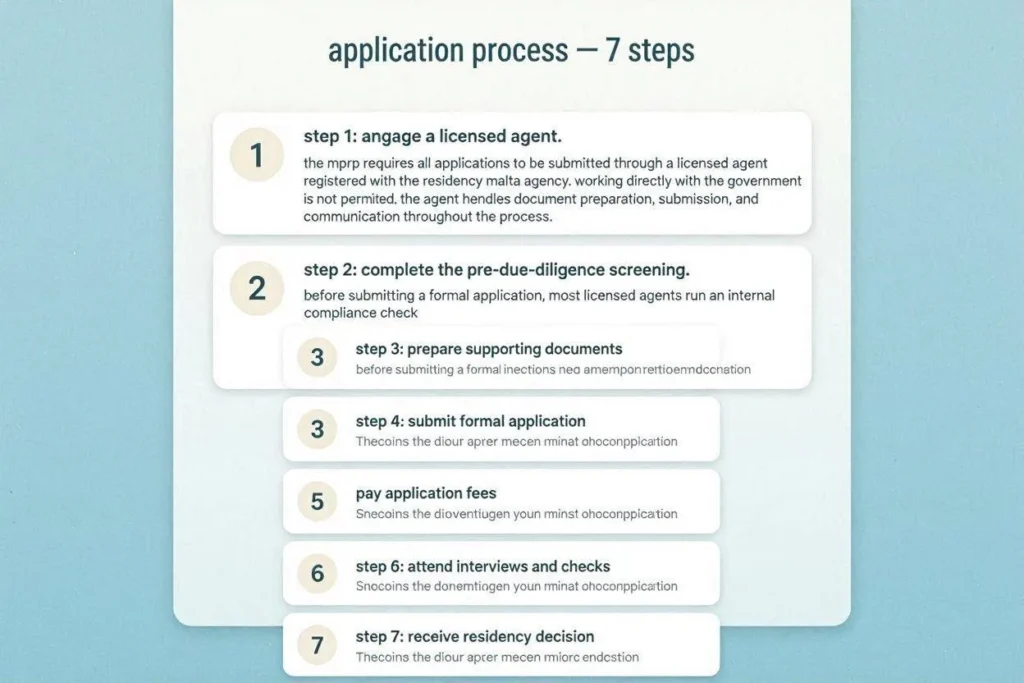
The MPRP requires all applications to be submitted through a licensed agent registered with the Residency Malta Agency. Working directly with the government is not permitted. The agent handles document preparation, submission, and communication throughout the process.
Step 2: Complete the pre-due-diligence screening.
Before submitting a formal application, most licensed agents run an internal compliance check on the applicant and all adult dependants. This identifies any potential issues before paying the non-refundable government fees.
Step 3: Submit the application and pay the administration fee.
The agent submits the full application package to the Residency Malta Agency along with the €40,000 administration fee. This fee is non-refundable regardless of the outcome.
Step 4: Undergo the 4-tier government due diligence.
The Residency Malta Agency applies a 4-tier due diligence process covering identity verification, source-of-funds checks, criminal background screening, and international compliance checks. Malta’s due diligence is among the most thorough in the EU investment migration space.
Step 5: Receive an Approval in Principle (AIP).
If the application passes due diligence, the Agency issues an Approval in Principle. At this stage the applicant has typically 8 months to fulfil the investment conditions — signing the lease agreement or completing the property purchase.
Step 6: Fulfil the investment requirements.
Pay the government contribution (€58,000 or €28,000 depending on the route), make the €2,000 NGO donation, and provide proof of the qualifying property lease or purchase.
Step 7: Collect the residence card.
After all investment conditions are confirmed, the Residency Malta Agency issues the permanent residence card. The main applicant and all included dependants receive individual cards. A single visit to Malta is required for biometric data collection. Total processing from submission to card issuance: 4 to 6 months.
8 Key Benefits of the Malta Golden Visa
- Immediate permanent status. Permanent residency from day one — not a temporary permit subject to renewal deadlines.
- Schengen access. Visa-free travel across all 27 Schengen Area countries for up to 90 days in any 180-day period.
- No stay requirement. No minimum number of days per year required in Malta to maintain permanent residency.
- Four-generation family inclusion. Spouse, children of all ages (if unmarried), parents, and grandparents included in one application — up to 4 generations.
- Full residency rights. Right to live, work, and study in Malta indefinitely. Work permit applications available under standard Maltese labour laws.
- Territorial tax system. Foreign-source income not remitted to Malta is not subject to Maltese taxation. Malta has over 70 double taxation treaties in force.
- Pathway to a top-6 passport. Malta ranks 6th globally for passport strength in 2026, providing visa-free or visa-on-arrival access to 190 countries once citizenship is obtained via the MEIN programme.
- Stable, English-speaking EU economy. English is an official language. Malta sits at 35th on the Global Atlas of Risk and Readiness 2026, with GDP growth of 4.0% projected for 2026 and an unemployment rate of 2.7% as of Q1 2025.
Malta MPRP vs. Other EU Golden Visa Programmes
Malta’s MPRP stands apart from comparable programmes in Greece, Portugal, and Spain on 4 key dimensions:
| Feature | Malta MPRP | Portugal / Greece |
| Status granted | Permanent residency | Temporary (renewable) |
| Min. investment | €169,000 (rent route) | €250K–€500K+ |
| Processing time | 4–6 months | 6–18 months |
| Min. stay required | None | 7–14 days/year (varies) |
| Family inclusion | 4 generations | Spouse + children only |
| Path to citizenship | Yes (via MEIN) | Yes (after 5 years) |
| Official language | English | Local language required |
| Schengen access | Yes — 90/180 days | Yes — 90/180 days |
The most significant difference is residency status. Portugal and Greece issue renewable temporary residence permits. Malta issues an indefinite permanent residence card at approval — no renewal deadlines, no minimum stay, no annual compliance risk.
The 4-generation family rule is unique to Malta globally. No other EU residency-by-investment programme includes grandparents as standard dependants without a separate application.
Malta Golden Visa Tax Implications
The MPRP does not impose a tax residency obligation. Holding Maltese permanent residency and not residing in Malta means the applicant is not automatically subject to Maltese income tax on worldwide income.
Malta’s territorial tax model taxes income arising in Malta and foreign income remitted to Malta at standard progressive rates. Foreign income not remitted to Malta — including foreign capital gains — is not taxed in Malta. This makes the MPRP attractive to investors, fund managers, and business owners with income sources outside Malta.
Applicants who choose to reside in Malta full-time and become tax resident can apply for Malta’s flat-rate non-domicile tax regime, which charges a minimum annual tax of €15,000 on foreign income remitted to Malta. Professional tax advice from a Malta-licensed advisor is essential before making any residency or tax decision.
Note: Tax laws change. The information above reflects 2026 published rules. Consult a licensed Maltese tax advisor for advice specific to your circumstances.
Malta Citizenship by Investment — The MEIN Route
The Malta Exceptional Investor Naturalisation (MEIN) programme offers a direct route to Maltese citizenship. As of July 2025, Malta replaced its previous citizenship-by-investment scheme with the merit-based MEIN programme, which imposes a strict annual cap on approvals.
MEIN requires the applicant to first hold Malta permanent residency (MPRP) and then make one of 2 contribution levels:
- €750,000 contribution after 12 months of MPRP residency.
- €600,000 contribution after 36 months of MPRP residency.
Both tiers also require a property purchase of at least €700,000 (or a lease of €16,000 per year for 5 years) and a €10,000 donation to a Malta-registered NGO. Processing for MEIN takes 12 to 36 months after the contribution, depending on tier and due diligence outcomes.
Maltese citizenship carries one of the world’s strongest passports — ranked 6th globally in 2026 with visa-free or visa-on-arrival access to 190 countries including the USA, UK, Canada, Australia, Japan, and all EU member states.
Common Mistakes to Avoid
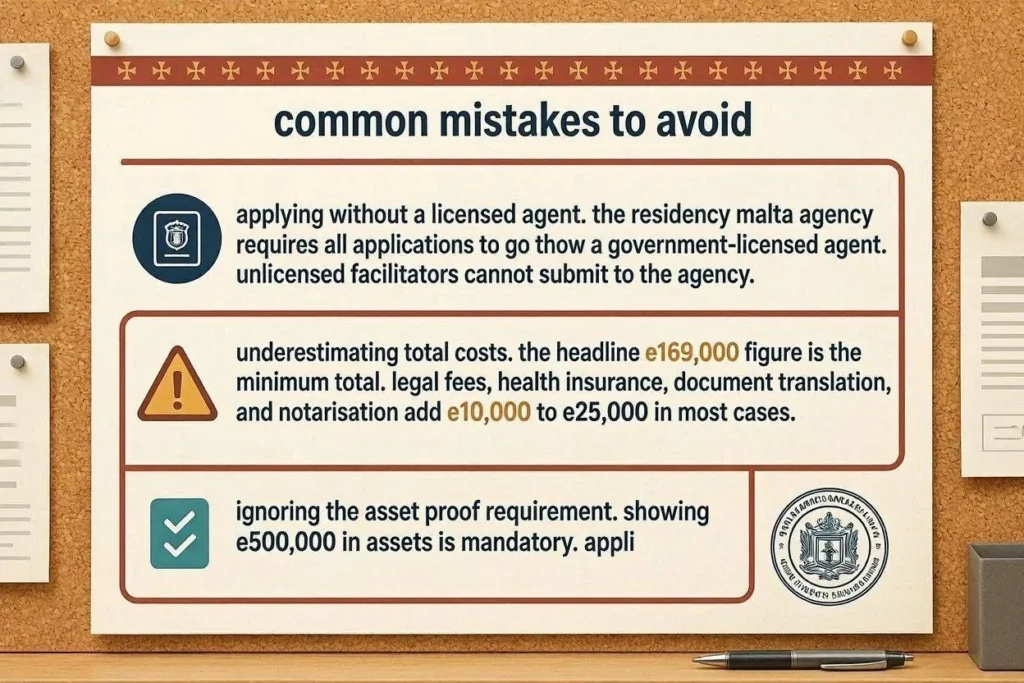
- Applying without a licensed agent. The Residency Malta Agency requires all applications to go through a government-licensed agent. Unlicensed facilitators cannot submit to the Agency.
- Underestimating total costs. The headline €169,000 figure is the minimum total. Legal fees, health insurance, document translation, and notarisation add €10,000 to €25,000 in most cases.
- Ignoring the asset proof requirement. Showing €500,000 in assets is mandatory. Applicants who cannot clearly document asset origins face rejection at due diligence.
- Choosing the wrong property route without a long-term plan. Buying makes financial sense if you plan to use or rent the property. Renting makes more sense for applicants who want maximum flexibility and lower upfront capital commitment.
- Confusing MPRP with MEIN. MPRP gives permanent residency. MEIN gives citizenship. They are separate programmes with different costs, timelines, and eligibility conditions.
Final Takeaway
The Malta Golden Visa (MPRP) is the only EU residency-by-investment programme that grants permanent residency status from day one, includes up to 4 generations of family, imposes no minimum stay requirement, and operates in English. Starting from €169,000 on the rental route, it is also one of the more accessible EU investment migration options in 2026.
For investors, families, and internationally mobile professionals seeking a credible EU base without full relocation, Malta offers a combination of legal permanence, Schengen mobility, tax efficiency, and lifestyle quality that comparable programmes in Portugal, Greece, and Spain do not match in the same package.
Frequently Asked Questions

Michael Reynolds
Michael Reynolds leads ImmigrationWin’s immigration, visa, and global mobility content division. He specializes in researching immigration policies, visa requirements, application processes, and international relocation pathways for individuals, families, students, and professionals. With extensive experience analyzing immigration regulations and official government guidance, Michael brings a research-driven approach to complex immigration topics and changing visa policies. He is the primary author of ImmigrationWin’s visa guides, immigration resources, and country-specific content, helping readers better understand their options and make informed decisions about their international journey.
Related Posts