
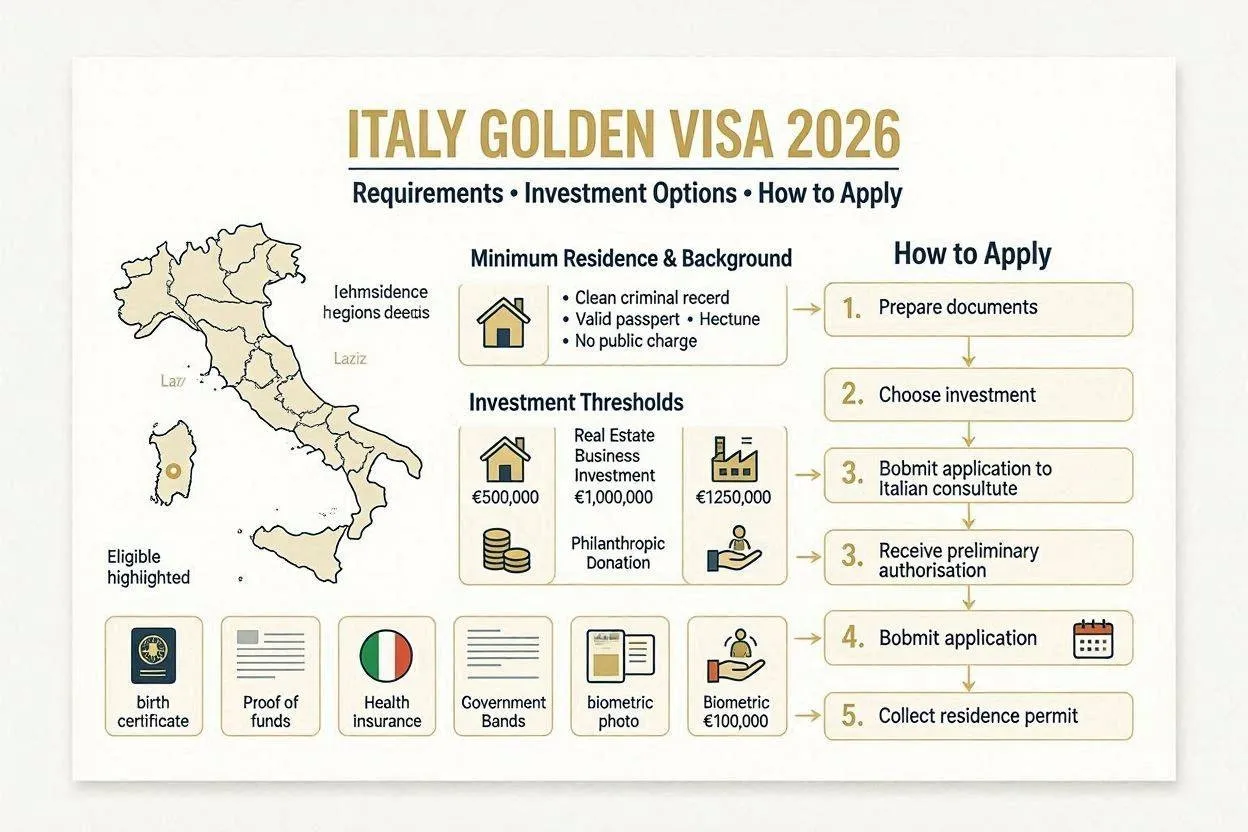
Italy Golden Visa 2026: Requirements, Investment Options & How to Apply
The Italy Golden Visa — officially the Investor Visa for Italy, grants a 2-year residence permit to non-EU nationals who make one qualifying investment: €250,000 in an innovative startup, €500,000 in an Italian company, €1 million for a philanthropic donation, or €2 million in government bonds. No minimum stay is required. The Nulla Osta pre-approval takes 25–60 days and the full process completes in 3–6 months.
What Is the Italy Golden Visa?
The Italy Golden Visa is a residency-by-investment program introduced in 2017 under Article 26-bis of the Consolidated Immigration Act (Legislative Decree No. 286/1998). It targets non-EU nationals who want a legal route to live in Italy without relocating full time.
The program is fully operational in 2026 with no processing backlogs and no annual entry quotas. Applications are accepted year-round through the official portal managed by the Ministry of Enterprises and Made in Italy (MIMIT).
3 things make Italy stand out from every other European golden visa still running in 2026: no minimum stay requirement, pre-approval before capital is deployed, and one of the lowest EU entry points at €250,000.
4 Italy Golden Visa Investment Routes in 2026
Choose exactly one route. You cannot split capital across multiple categories or combine routes in a single application. The investment must be made after you receive the visa and within 3 months of entering Italy.
| Investment Route | Minimum Amount | Risk Profile | Best For |
|---|---|---|---|
| Innovative Startup (equity) | €250,000 | Higher — early stage | Entrepreneurs, startup founders |
| Established Italian Company (equity) | €500,000 | Moderate — operating business | Business investors, equity buyers |
| Philanthropic Donation | €1,000,000 | Lowest — non-returnable | HNWIs prioritising social impact |
| Government Bonds (BTP) | €2,000,000 | Lowest — sovereign debt | Conservative capital preservation |
Route 1: Innovative Startup — €250,000
€250,000 is the lowest entry point in the program. The target company must be registered as an innovative startup (startup innovativa) under Italian law. Interest in this route has grown in 2025–2026 as hard-asset-backed startups have emerged as lower-risk options within the category.
Investments made before submitting the visa application do not qualify. The equity stake is purchased after you arrive in Italy and within 3 months of entry.
Route 2: Established Italian Company — €500,000
€500,000 buys equity in an operating Italian company that is not listed on a stock exchange. Most applicants historically chose this route over the startup option because of the perceived lower risk of an established business.
Route 3: Philanthropic Donation — €1,000,000
A donation of €1,000,000 to a project of public interest — culture, education, scientific research, or heritage preservation — qualifies under this route. The capital is non-returnable. This route appeals to investors who want Italian residency without a commercial investment obligation.
Route 4: Government Bonds (BTP) — €2,000,000
A direct purchase of €2,000,000 in Italian government bonds (Buoni del Tesoro Poliennali, BTP). This is the highest-cost route but carries sovereign credit risk rather than commercial risk. Conservative investors and family offices typically prefer this structure.
Who Qualifies for the Italy Golden Visa?
The Italy Investor Visa is open to all non-EU, non-Schengen nationals aged 18 or above. 3 baseline requirements apply to every applicant regardless of investment route:

- Clean criminal record from every country of residence in the last 10 years
- Sufficient legally sourced funds to cover the chosen investment amount, evidenced by bank statements
- No existing Italian residence or tax residence that disqualifies the investment timing rules
Russian and Belarusian nationals are excluded from the program since July 2023, including dual nationals who hold either passport, in compliance with EU Recommendation C(2022)554. This suspension shows no indication of being lifted as of June 2026.
Family Members Included
The following family members qualify for a residence permit of the same duration as the main applicant at no additional investment cost:
- Spouse or civil partner
- Children under 18
- Children over 18 who are physically or mentally dependent on the investor
- Parents who are dependent and cannot live independently
Siblings are not eligible under any circumstance. Independent adult children do not qualify.
How to Apply for the Italy Golden Visa — Step-by-Step Process
The Italy Golden Visa process has 6 stages from initial submission to receiving the residence permit. The total timeline is 3 to 6 months.
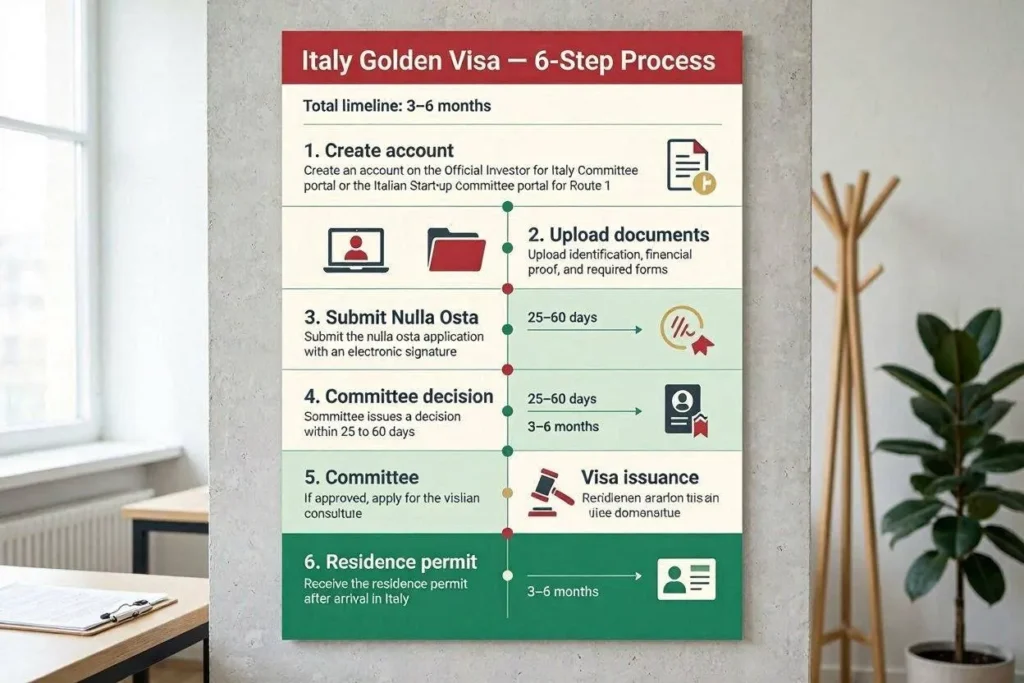
- Create an account on the official Investor Visa for Italy Committee portal (or the Italian Start-Up Committee portal for Route 1). Upload your documents and submit the Nulla Osta application with an electronic signature.
- The Committee issues a decision within 25 to 60 days. For startup investments, the Italian Start-Up Committee handles the review separately. There are no current backlogs as of mid-2026.
- Once the Nulla Osta is approved, apply for an Italian D-type long-stay entry visa at the Italian consulate in your home country within 6 months of receiving the Nulla Osta. Biometric fingerprints are required in person at the consulate (mandatory since 11 January 2025).
- Consulate processing takes 10 to 20 days, with a legal maximum of 90 days.
- Enter Italy. Within 8 days of arrival, apply for the residence permit (permesso di soggiorno) at the local police station (Questura) or post office. Within 3 months of entry, execute the qualifying investment and upload confirmation to the Investor Visa Committee portal.
- The Committee evaluates the investment evidence and issues the 2-year residence permit card (permesso di soggiorno). The permit is valid from the date of your arrival in Italy.
Nulla Osta — What It Is and Why It Matters
Nulla Osta is Italian for no impediment — a pre-approval certificate confirming the investor and the proposed investment both meet the program requirements. It is the critical first step.
The Nulla Osta protects investors from a risk that plagues other residency programs: deploying capital before knowing whether the application succeeds. Under the Italian system, you commit no money until after the Nulla Osta is in hand and the entry visa is granted.
Documents Required for the Italy Golden Visa
Upload all documents to the Investor Visa Committee portal at the Nulla Osta stage. Incomplete files are the single most common reason for delays.
| Document | Details |
|---|---|
| Valid passport | Full copy, valid for at least 3 months beyond planned stay |
| Detailed CV | Professional background, qualifications, prior investments |
| Proof of funds | Bank statements from the last 3 months showing the investment amount |
| Source of funds declaration | Evidence of legal origin and transferability of the capital |
| Investment description | Characteristics of the planned investment and written consent from the recipient entity |
| Clean criminal record | From every country of residence in the last 10 years |
| Health insurance | Coverage valid in Italy for the duration of stay |
| Proof of accommodation | Confirmed address in Italy for the entry visa stage |
Italy Golden Visa: Validity, Renewal, and Path to Permanent Residency
| Stage | Duration | Requirement |
|---|---|---|
| Initial residence permit | 2 years | Maintain the qualifying investment |
| First renewal | 3 years | New Nulla Osta required; prove investment is still held. Apply at least 60 days before expiry. |
| Subsequent renewals | 3 years each | Same renewal process; investment must remain active |
| Permanent residency | After 5 years | Spend at least 183 days per year in Italy (continuous legal residence) |
| Italian citizenship | After 10 years | 183 days per year for 10 consecutive years; language test (B1 Italian) |
No minimum stay is required to renew the temporary residence permit. Investors who do not relocate to Italy can hold the permit indefinitely through renewals as long as the investment is maintained.
Permanent residency (carta di soggiorno) requires physical presence of at least 183 days per year for 5 consecutive years. Italian citizenship requires 10 consecutive years of the same. Both are governed by standard Italian immigration law, not the Golden Visa program itself.
Italy Flat Tax Regime for New Residents (Neo-Residenti) — 2026 Update
The flat tax regime is legally separate from the Golden Visa. Qualifying for the investor visa does not automatically enroll you in the tax regime — you must separately apply to Agenzia delle Entrate.
From 1 January 2026, the neo-residenti regime under Article 24-bis TUIR operates as follows:
| Tax Residency Start Date | Annual Flat Tax | Family Member Surcharge | Duration |
|---|---|---|---|
| Before 11 August 2024 | €100,000 (grandfathered) | €25,000 each | Up to 15 years (grandfathered rate) |
| 11 August 2024 – 31 December 2025 | €200,000 (grandfathered) | €25,000 each | Up to 15 years (grandfathered rate) |
| From 1 January 2026 | €300,000 per year | €50,000 each | Up to 15 years |
The €300,000 annual substitute tax covers all foreign-sourced income — dividends, interest, rental income, capital gains — regardless of the total amount. The tax is due in full by 30 June each year. If the payment is missed, the regime lapses immediately.
Eligibility condition: Applicants must not have been Italian tax residents for at least 9 of the 10 years preceding the election. Confirm current figures with Agenzia delle Entrate before relying on them — the flat tax amount has changed 3 times since 2017.
Southern Italy 7% Flat Tax — Retirees Only
Retirees moving to qualifying municipalities with fewer than 20,000 inhabitants in Sicily, Calabria, Sardinia, Campania, Basilicata, Abruzzo, Molise, or Puglia can opt for a 7% flat tax on all foreign pension income for up to 10 years. This regime is accessed through the Elective Residency Visa, not the Golden Visa.
Italy Golden Visa vs Greece, Portugal, and Hungary — 2026 Comparison
| Program | Min. Investment | Min. Stay | Citizenship | Real Estate Route | Status 2026 |
|---|---|---|---|---|---|
| Italy | €250,000 (startup) | None for permit | 10 years | No | Fully operational |
| Greece | €250,000 | None | 7 years | Yes (raised €800K in major cities) | Fully operational |
| Portugal | €250,000 | 7 days/year | 5 years | No (real estate removed) | Operational, delays 12+ months |
| Hungary | €250,000 | None | Not available | Yes (€500K) | Operational |
| Spain | — | — | — | — | Terminated 2025 |
Italy’s structural advantage over Greece: Italy approves the Nulla Osta before you deploy capital. Greece requires investment upfront. A rejected Greek application means the investment is tied up during an appeal. Italy eliminates that risk entirely.
Italy vs Portugal: Portugal requires 7 days of physical presence per year and is running 12+ months behind on processing. Italy processes Nulla Osta in 25–60 days with no backlogs.
Italy Golden Visa Total Costs in 2026
| Cost Item | Amount | Notes |
|---|---|---|
| Investment — Startup route | €250,000 | Minimum; returnable if startup performs |
| Investment — Company equity | €500,000 | Returnable depending on exit |
| Investment — Philanthropic donation | €1,000,000 | Non-returnable |
| Investment — Government bonds | €2,000,000 | Returnable at maturity |
| Legal / advisory fees | €5,000–€20,000 | Varies by firm and complexity |
| Consulate visa fee | €116 | Standard Italian national visa fee |
| Residence permit application fee | €200–€300 approx. | Payable at the Questura |
| Flat tax (if electing) | €300,000/year | Optional; applies only if tax resident |
Italy Golden Visa for US and UK Nationals
UK Nationals Post-Brexit
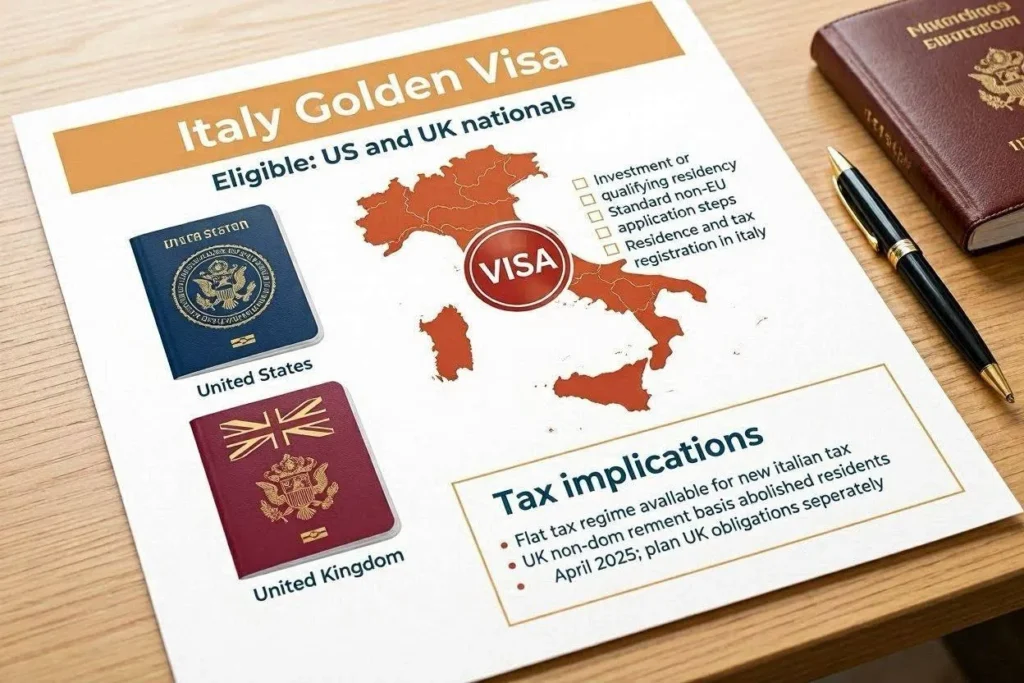
Yes — UK nationals qualify for the Italy Golden Visa as non-EU citizens since Brexit. The immigration steps are identical to any other non-EU applicant.
UK nationals who became Italian tax residents benefit from the flat tax regime, but UK tax obligations must be planned separately. The UK abolished the non-dom remittance-basis regime in April 2025, making Italy’s flat tax a direct comparison for internationally mobile UK residents. Whether Italy’s €300,000 fixed annual charge beats the UK’s new system depends entirely on the size and source of the investor’s foreign income.
UK applicants should also plan for UK Statutory Residence Test implications and the UK-Italy double tax treaty before committing capital.
US Nationals
Yes — US nationals qualify for the Italy Golden Visa on the same basis as all other non-EU applicants.
Critical tax point: The United States taxes US citizens on worldwide income regardless of where they live. Becoming an Italian tax resident and electing the neo-residenti flat tax covers Italian tax obligations on foreign income — it does not end the US filing requirement. The US-Italy double tax treaty and foreign tax credits prevent the same income from being taxed twice, but US applicants must work with a cross-border tax professional before electing the Italian flat tax regime.
It is not the right choice for investors primarily seeking real estate as the qualifying asset, or for those who need a path to citizenship faster than 10 years. For citizenship speed, Portugal offers 5-year naturalisation (with 7 days/year minimum stay). For real estate, Greece still allows it from €250,000 in non-prime locations.
Frequently Asked Questions

Michael Reynolds
Michael Reynolds leads ImmigrationWin’s immigration, visa, and global mobility content division. He specializes in researching immigration policies, visa requirements, application processes, and international relocation pathways for individuals, families, students, and professionals. With extensive experience analyzing immigration regulations and official government guidance, Michael brings a research-driven approach to complex immigration topics and changing visa policies. He is the primary author of ImmigrationWin’s visa guides, immigration resources, and country-specific content, helping readers better understand their options and make informed decisions about their international journey.
Related Posts