Netherlands Student Visa 2026: Requirements, Fees & Process by Nationality
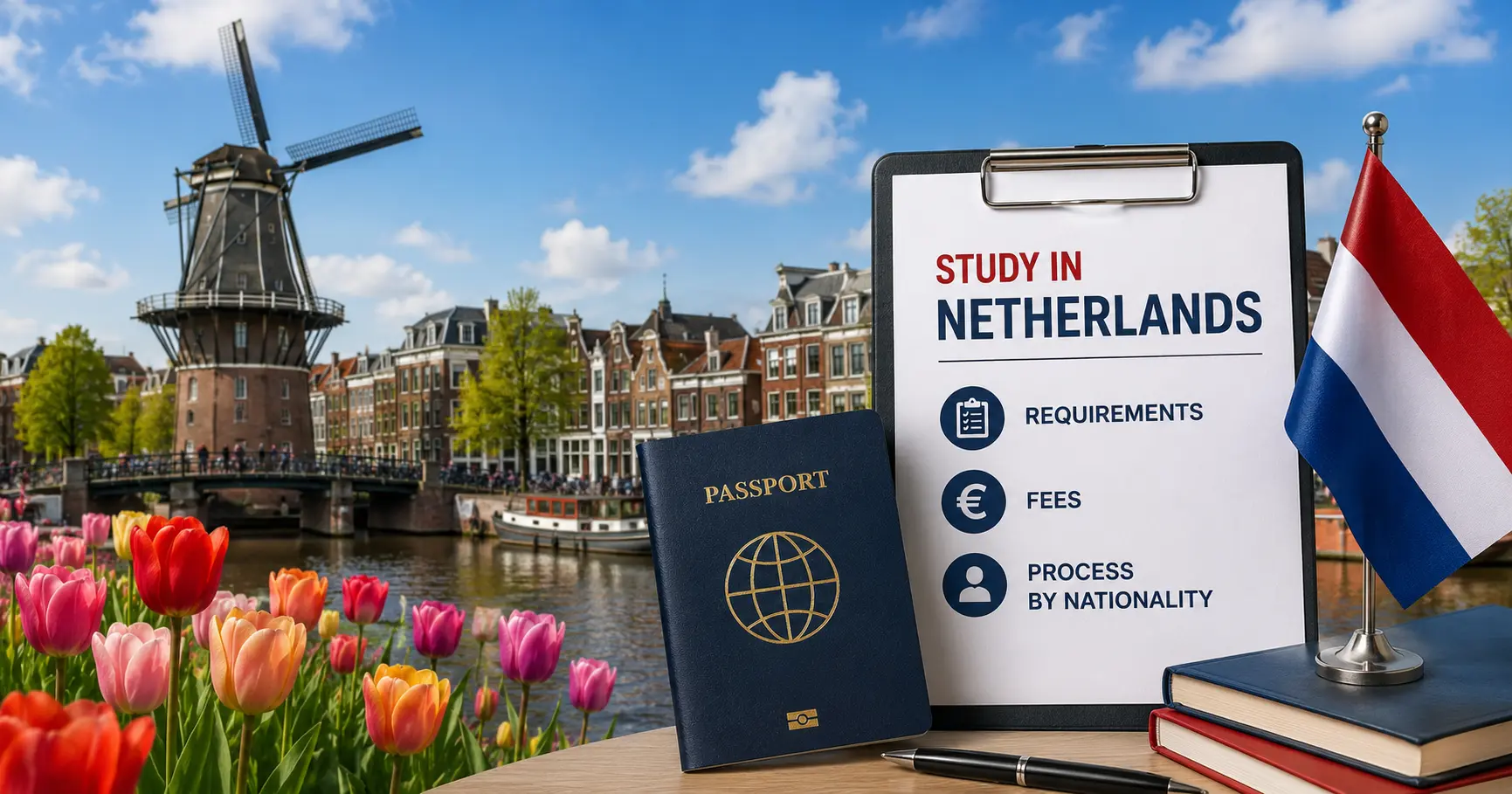
Studying in the Netherlands means navigating an immigration system that treats every nationality differently. A single search for “Netherlands student visa” pulls guides written for Indian applicants, American exchange students, and Chinese undergraduates alike, often without saying which nationality the steps apply to. This guide separates the process by passport, covering the United States, Canada, Japan, Australia, New Zealand, South Korea, Monaco, Europe, China, Taiwan, and applicants from the Middle East and the rest of Asia, with 2026 figures verified against current IND sources.
Do You Need a Netherlands Student Visa?
Yes, most international students need a residence permit to study in the Netherlands, though whether you also need an MVV entry visa depends entirely on your nationality. Citizens of the United States, Canada, Japan, Australia, New Zealand, South Korea, Monaco, and the EU/EEA skip the MVV step and travel to the Netherlands directly. Students from China, Taiwan, the Middle East, and the rest of Asia generally need both the MVV and the residence permit, applied for together through the university.
This split confuses most applicants, because a majority of guides online are written for one nationality group and quietly assume the reader belongs to it. An Indian or Saudi applicant reading a US-focused guide will miss the embassy step entirely. A Canadian reading a Middle East-focused guide will plan for a visa appointment that never applies to them. This guide separates both routes clearly, with 2026 figures verified against IND sources, so you can follow the process that actually matches your passport.
MVV vs. VVR: The Two-Document System
The Netherlands uses two separate documents to manage international student stays. The MVV (Machtiging tot Voorlopig Verblijf, or provisional residence permit) functions as a 90-day entry visa sticker placed in the passport. The VVR (Verblijfsvergunning Regulier, or residence permit) is the biometric card issued after arrival that authorizes the full duration of study.
Most non-exempt nationalities need both documents through a combined process called the TEV procedure (Toelating en Verblijf), which bundles the MVV and VVR into a single application submitted by the university. Exempt nationalities skip the MVV portion of this bundle entirely. Either way, the university applies for the residence permit directly with the IND (Immigration and Naturalisation Service), and the student’s role stays the same: supply documents, pay the fee, and wait for the decision.
Visa Requirements by Nationality: Exemptions and Special Cases
MVV requirements depend entirely on nationality. Citizens of EU/EEA member states across Europe do not need an MVV, since freedom-of-movement rules apply automatically within the bloc. Outside Europe, the Netherlands extends the same exemption to citizens of the United States, Canada, Japan, Australia, New Zealand, South Korea, and Monaco. All exempt nationalities still need a residence permit for study purposes lasting longer than 90 days; only the embassy visa step gets removed.
China and Taiwan follow separate paths. Mainland Chinese applicants previously needed a Nuffic Certificate, a document verifying English proficiency and academic credentials, before the university could file an MVV application. The IND removed this requirement in 2023, and Chinese students no longer need to apply to Nuffic for this document as part of their visa file. Taiwanese applicants were never subject to this requirement and follow the standard MVV process used by other non-exempt nationalities.
Applicants from the Middle East and the rest of Asia, outside the exempt list above, follow the standard MVV route: the university still files the TEV application, but the student must also collect the MVV sticker at a Dutch embassy or consulate in their home country before travel, a step exempt-country applicants skip entirely. This adds an embassy appointment and biometric collection stage to the timeline, typically before departure rather than after arrival.
The distinction that matters most: nationality determines whether the embassy visit happens before departure on the MVV route, or gets skipped in favor of an in-country IND appointment after arrival on the MVV-exempt route. The residence permit requirement, financial proof, and 2026 income figures apply identically regardless of which route a student follows.
Step-by-Step Application Process
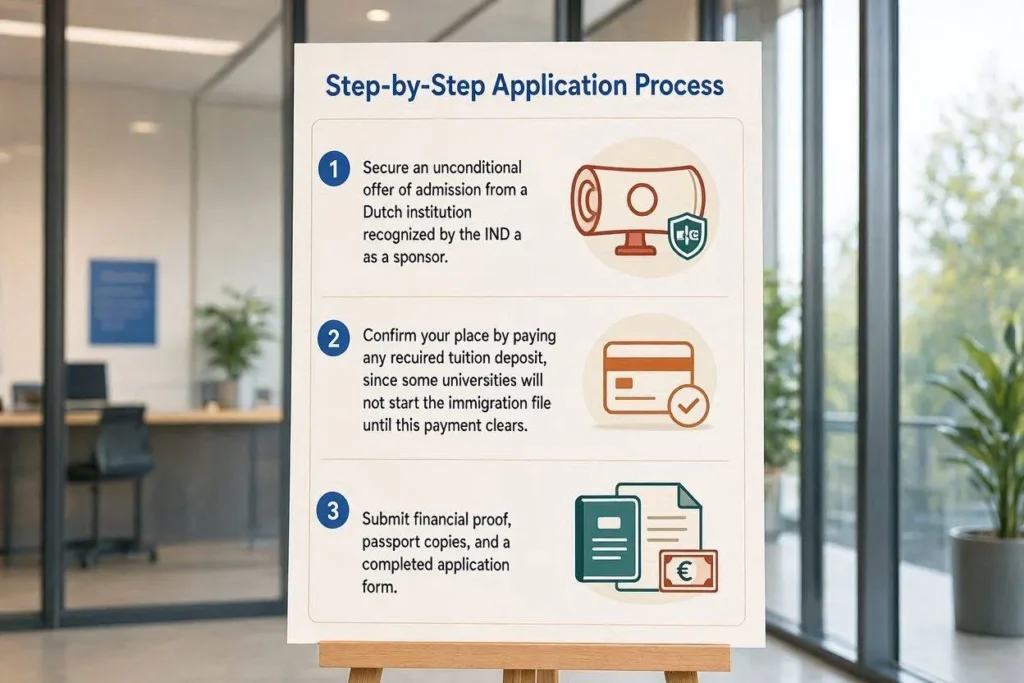
The process runs through the university as a recognized IND sponsor, which reduces application errors and centralizes communication for the student.
- Secure an unconditional offer of admission from a Dutch institution recognized by the IND as a sponsor.
- Confirm your place by paying any required tuition deposit, since some universities will not start the immigration file until this payment clears.
- Submit financial proof, passport copies, and academic records to the university’s international office through their document portal.
- The university files the residence permit application directly with the IND, adding the MVV component automatically if your nationality requires it.
- Receive the IND decision, tracked through a V-number reference issued at filing.
- Exempt-nationality students travel directly to the Netherlands using their passport. Non-exempt students book an appointment at their home country’s Dutch embassy or consulate to collect the MVV sticker and provide biometrics before departure.
- Collect your VVR residence permit card at an IND desk after registering with your local municipality.
2026 Financial Requirement
The 2026 IND study norm is €1,130.77 per month, confirmed as the current income standard the IND maintains for students. Twelve months of proof equals €13,569.24, though this figure covers living costs only and excludes tuition.
Universities sometimes set a slightly higher internal buffer to protect against bank fees or exchange-rate shifts; some set the minimum at €1,140 a month to guarantee students clear the IND threshold after transfer costs. The study norm changes every year on January 1, so applicants should confirm the exact figure with their university’s international office close to their application date.
Six proof methods exist: funds in a personal bank account, a lump-sum deposit to the university, a scholarship declaration, funds from a company, or a private-sponsor statement from someone abroad or within the Netherlands. Exchange students from MVV-exempt countries may also prove financial means through a signed bank letter rather than a full 12-month deposit, depending on university policy.
Application Fees for 2026
The IND residence permit fee for students in 2026 ranges from approximately €210 to €254, depending on the sponsoring institution and whether the fee reflects a first application, change of purpose, or extension. Non-exempt applicants pay this fee as part of the combined MVV and residence permit filing, since the TEV procedure charges a single fee for both documents. Universities typically collect this fee directly from students and forward payment to the IND. IND fees adjust every January 1, so confirming the exact current amount with your university before payment protects against outdated figures circulating in older guides.
Additional costs to budget include a university administrative fee, often around €35, and mandatory health insurance, which runs approximately €400 for the first six months under an MVV or residence permit.
Processing Time
The IND’s legal maximum decision period is 90 days, though recognized-sponsor applications submitted by universities are usually decided within 2 to 4 weeks once the file is complete. Exempt-nationality applicants can expect the full timeline from offer acceptance to permit in hand to span roughly 10 to 14 weeks. Non-exempt applicants should add extra time on top of that window for the embassy appointment and MVV sticker collection, which typically adds 2 to 4 additional weeks depending on embassy appointment availability.
Delays typically stem from incomplete financial documentation or late tuition deposits rather than IND backlog, so submitting a complete file early gives the strongest chance of a fast decision.
Required Documents Checklist
A complete application file generally includes:
- Valid passport, with at least six months of remaining validity
- Unconditional admission letter from a recognized Dutch institution
- Proof of financial means covering 12 months at the current study norm
- Proof of health insurance meeting Dutch coverage standards
- Confirmed Netherlands address, since the IND requires documented housing before submission
- Academic transcripts and diplomas supporting the admission decision
- English-language proficiency scores, typically IELTS 6.0 to 6.5 or TOEFL iBT 80 to 92, when the program requires them
Housing proves harder to secure than most applicants expect. In cities like Amsterdam and Utrecht, rental housing runs scarce, and students should arrange documented accommodation before or alongside offer acceptance rather than after arrival.
Health Insurance Rules
International students who remain full-time and do not take paid work can typically rely on private or home-country insurance during their studies. The moment a student begins any paid employment in the Netherlands, even a single shift, Dutch law requires enrollment in public health insurance (basisverzekering), which costs approximately €130 to €145 per month in 2026. Students who never work under a TWV work permit generally remain on private coverage without needing to switch.
Working While Studying: The 16-Hour Rule
Students on a Dutch residence permit can work up to 16 hours per week during the academic year, or full-time in June, July, and August, regardless of MVV status. The employer, not the student, must obtain a TWV (Tewerkstellingsvergunning) work permit from the UWV before employment begins, and this employer-side process typically takes about five weeks.
At the 2026 adult minimum wage of approximately €14 per hour, 16 hours per week produces roughly €875 to €940 gross per month before tax, an amount that rarely covers the full cost of living in major Dutch cities without additional funds. Working beyond the 16-hour limit without authorization violates the permit terms, and the Labour Inspectorate can notify the IND, which may then review the residence permit at renewal.
Post-Arrival Checklist
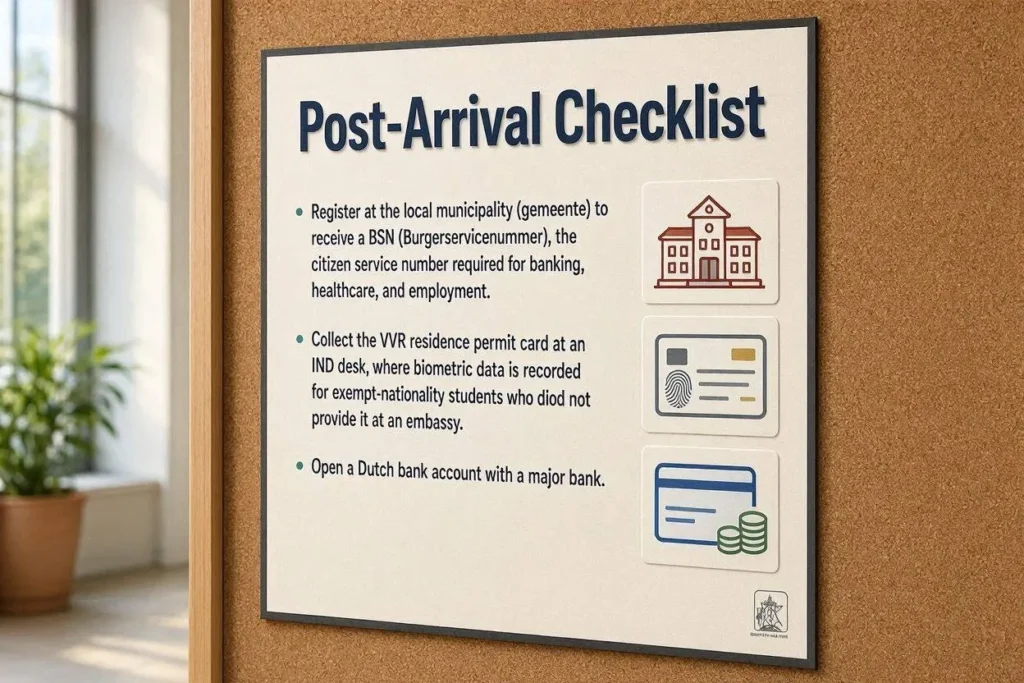
Within the first two weeks after arrival, students must complete several administrative steps:
- Register at the local municipality (gemeente) to receive a BSN (Burgerservicenummer), the citizen service number required for banking, healthcare, and employment.
- Collect the VVR residence permit card at an IND desk, where biometric data is recorded for exempt-nationality students who did not provide it at an embassy.
- Open a Dutch bank account with a major bank such as ING, ABN AMRO, or Rabobank.
- Activate health insurance coverage appropriate to employment status.
- Complete a TB (tuberculosis) test, when required based on nationality, generally within three months of arrival.
Two administrative tools rarely appear in competitor guides but matter immediately on arrival: DigiD, the digital identity credential needed for tax filings, IND correspondence, and government services, and Studielink, the national enrollment portal that most Dutch institutions require before the university can even begin the residence permit file.
Orientation Year (Zoekjaar) After Graduation
Graduates of a recognized Dutch institution can apply for a zoekjaar (orientation year) permit within three years of completing their degree, granting 12 months of unrestricted work rights while searching for employment or launching a business. During this period, no separate work permit applies, and any job found does not need to match the student’s field of study. This pathway applies equally to exempt and non-exempt nationalities once a Dutch degree has been earned.
Once employment starts, graduates can transition to a highly skilled migrant (HSM) permit, often at a reduced salary threshold compared to standard HSM applicants. This bridge functions as one of the strongest post-study pathways for international graduates weighing whether to build a long-term career in the Netherlands.
Common Rejection Reasons and How to Avoid Them
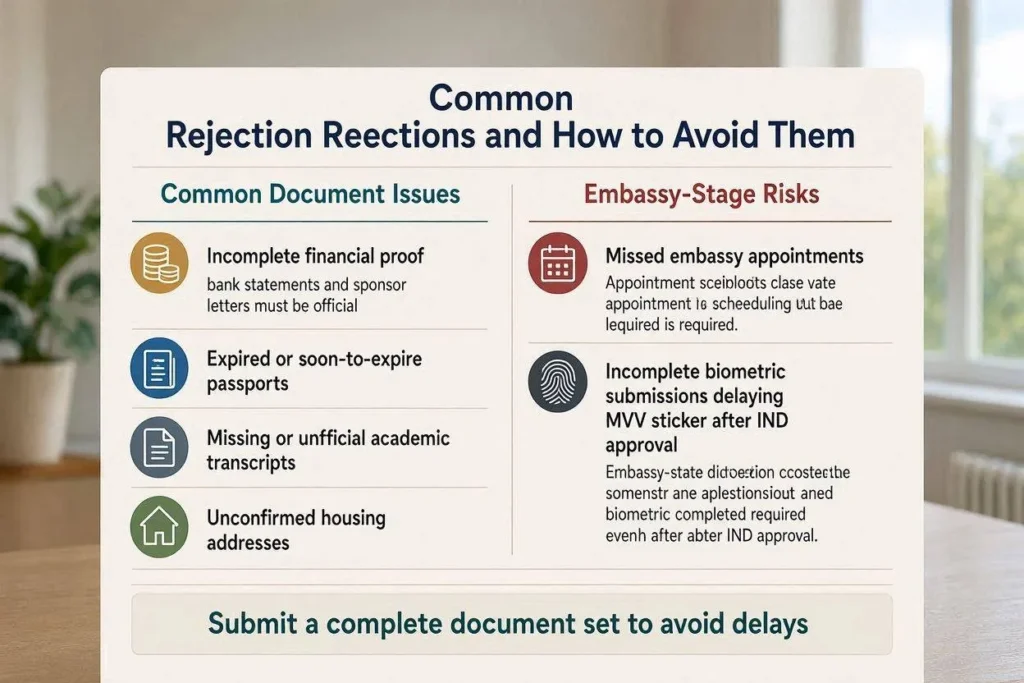
Applications typically fail for a small set of avoidable reasons: incomplete financial proof, expired or soon-to-expire passports, missing or unofficial academic transcripts, and unconfirmed housing addresses. Non-exempt applicants add a further risk point at the embassy stage, where missed appointments or incomplete biometric submissions can delay the MVV sticker even after IND approval.
Submitting a complete document set to the university’s international office well before internal deadlines, rather than waiting until the final week, removes most of the risk that causes delays or denials. Students whose applications face rejection generally retain the right to appeal within a set window, and universities can often advise on the specific grounds and timeline for a given case, since appeal procedures vary by permit category.
Conclusion
The Netherlands student visa process splits into two clear routes based on nationality. Applicants from the United States, Canada, Japan, Australia, New Zealand, South Korea, Monaco, and across Europe skip the MVV entirely and handle everything through the university’s TEV filing and an in-country IND appointment after arrival. Applicants from China, Taiwan, the Middle East, and the rest of Asia add an embassy visit and MVV sticker collection before departure, though the underlying residence permit requirement, financial threshold, and document list stay identical across both routes.
The 2026 figures that matter most are the €1,130.77 monthly study norm, a residence permit fee between €210 and €254, and a processing window of 2 to 4 weeks for complete, university-sponsored applications. Non-exempt applicants should build in additional time for the embassy appointment stage. Students who confirm current figures with their institution, secure documented housing early, and submit complete files well ahead of deadlines consistently avoid the delays that trip up rushed applications, regardless of which route their passport puts them on.
Figures in this guide reflect IND data verified as of July 2026. Confirm current amounts directly with your university’s international office before submitting payment, since income requirements and fees adjust twice yearly.
FAQs

Michael Reynolds
Michael Reynolds leads immigration content at ImmigrationWin, covering visa requirements, application and relocation pathways. He researches immigration policies and official government guidance to explain changing rules clearly. His guides help students, families, and professionals make informed decisions about moving abroad.
Related Posts