Australian Visa Types in 2026: The Complete Guide
Australia issues over 100 australian visa types across 6 broad categories: visitor, skilled worker, student, working holiday, family, and business and investment.
No visa labels appear in passports. Since 1 September 2015, Australia records all visas digitally. You verify your current visa status through the Visa Entitlement Verification Online (VEVO) system at any time.
How Many Australian Visa Types Exist in 2026?
Australia currently offers over 100 distinct visa subclasses, each identified by a unique number such as Subclass 189 or Subclass 500. The Department of Home Affairs publishes the full visa listing at immi.homeaffairs.gov.au.
Australian visa types divide into 2 broad categories: temporary visas, which grant a limited period of stay with specific conditions, and permanent visas, which grant indefinite residence rights and a pathway to citizenship.
Costs range from AUD $0 for the eVisitor (Subclass 651) to AUD $14,670 (approximately USD $10,264 / £7,453) for the Significant Investor stream of the Business Innovation and Investment visa (Subclass 188). Processing times span from 1 day for some ETA applications to over 2 years for contributory parent visas.
Australian Visitor Visa Types: ETA, eVisitor, and Subclass 600

Australia offers 3 main visitor visa types: the Electronic Travel Authority (ETA), the eVisitor (Subclass 651), and the Visitor Visa (Subclass 600). All 3 allow short-term stays for tourism, family visits, or business activities, but they differ by nationality eligibility, cost, and application method.
ETA (Subclass 601) vs eVisitor (Subclass 651) vs Visitor Visa (Subclass 600)
To choose between these 3 visitor options, match the visa to your passport country.
- ETA (Subclass 601): available to nationals of approximately 30 countries and territories, including the United States, Canada, Japan, Singapore, Malaysia, and South Korea. The ETA allows multiple visits to Australia for up to 3 months per visit within a 12-month period. The application service fee is AUD $20. You apply exclusively through the Australian ETA app, and a live facial image is required at application time.
- eVisitor (Subclass 651): free of charge for eligible European passport holders, including nationals of all EU member states, Norway, Switzerland, and Iceland. The eVisitor allows multiple visits for up to 3 months at a time within a 12-month period for tourism or business. This visa cannot be extended.
- Visitor Visa (Subclass 600): open to all nationalities not eligible for the ETA or eVisitor. The Subclass 600 costs approximately AUD $200. It generally grants a stay of up to 3 months but may allow up to 12 months in certain circumstances. Applicants must demonstrate genuine intent to visit temporarily and sufficient financial means.
ImmigrationWin’s Schengen visa types guide provides useful context for applicants simultaneously planning European travel alongside their Australian visit.
Australian Skilled Visa Types: Points-Tested and Employer-Sponsored
3 streams exist within Australian skilled visa types: points-tested, employer-sponsored, and skilled regional.
Points-Tested Skilled Visa Types (Subclasses 189 and 190)
To qualify for a points-tested skilled visa, you score a minimum of 65 points on Australia’s points test, which assesses age, English language proficiency, skilled employment experience, qualifications, and other factors.
- Skilled Independent visa (Subclass 189): a permanent visa for points-tested workers who do not need state or employer sponsorship. Applicants must have an occupation on the Skilled Occupation List and achieve a score that clears the invitation cutoff for their occupation. No state nomination is required.
- Skilled Nominated visa (Subclass 190): a permanent visa for workers nominated by an Australian state or territory government. A successful nomination adds 5 points to your SkillSelect score. You must live and work in the nominating state or territory for 2 years after the visa is granted.
Employer-Sponsored Skilled Visa Types (Subclasses 482 and 186)
To access employer-sponsored skilled visa types, you first secure a job offer from an approved Australian sponsor.
- Temporary Skill Shortage visa (Subclass 482 (TSS)): a temporary visa granted for up to 4 years. The TSS allows your Australian employer to fill a skilled position that cannot be filled by an Australian worker. From 2025, the qualifying period for permanent residency from a 482 visa reduced from 3 years to 2 years of full-time sponsored work.
- Employer Nomination Scheme (Subclass 186 (ENS)): a permanent visa for workers nominated by their employer. The ENS includes 3 streams: the Direct Entry stream for overseas applicants, the Temporary Residence Transition stream for 482 holders who have worked for 2 years with their nominating employer, and the Labour Agreement stream for employers with a formal agreement with the DHA.
Skilled Regional Visa Types (Subclasses 491 and 191)
- Skilled Work Regional (Subclass 491): a 5-year provisional visa for workers nominated by a state or territory or sponsored by an eligible relative in a regional area. The 491 adds 15 points to your SkillSelect score. After 3 years of living and working in a regional area, you can apply for the Subclass 191.
- Permanent Residence (Skilled Regional) (Subclass 191): converts your 491 into a permanent visa after you complete 3 years in a regional area and meet a minimum income threshold.
Australian Student Visa Types: Subclass 500 and Post-Study Options
Student Visa (Subclass 500) Rules in 2026
To apply for a Subclass 500 student visa, you must receive a Confirmation of Enrolment (CoE) from a registered Australian institution, meet health and character requirements, and demonstrate sufficient financial resources.
The Subclass 500 costs approximately AUD $2,000. It allows you to work up to 48 hours per fortnight (approximately 2 weeks) during study periods and unlimited hours during scheduled course breaks.
From November 2025, Ministerial Direction 115 introduced a traffic-light processing model. Applications go to institutions in the Green Zone (below 80% of their approved enrolment cap) fastest, Amber Zone (80% to 115%) at standard speed, and Red Zone (above 115%) slowest. Applications from visitors or Temporary Graduate visa holders inside Australia must now go offshore. You cannot switch to a student visa from within Australia.
ImmigrationWin’s Canada visa types guide compares the Subclass 500 pathway with Canadian student visa options for applicants evaluating both destinations.
Temporary Graduate Visa (Subclass 485) After 2025 Restructure
From 2025, the Subclass 485 restructured into 3 renamed streams.
- Post-Higher Education Work Stream: for graduates of bachelor’s, master’s, or doctoral degrees from a registered Australian institution. This stream replaced the former Post-Study Work Stream.
- Post-Vocational Education Work Stream: for graduates of vocational education and training (VET) courses related to an occupation on the Skilled Occupation List. This stream replaced the Graduate Work Stream.
- Second Post-Higher Education Work Stream: for eligible graduates who studied in a designated regional area and wish to extend their stay. This stream replaced the Second Post-Study Work Stream.
The age limit for Subclass 485 applications dropped to 35 years in 2025, reduced from the previous limit of 50 years. English language applicants now need a minimum IELTS score of 6.5 overall, with at least 5.5 in each band.
Australian Working Holiday Visa Types: Subclass 417 and 462
- Working Holiday visa (Subclass 417): for nationals of the United Kingdom, Ireland, Canada, Germany, France, Italy, South Korea, Japan, and most of Western Europe, among others. Applicants must be aged 18 to 30 (35 for some countries). The application charge is AUD $670.
- Work and Holiday visa (Subclass 462): for nationals of the United States, China, India, Indonesia, Malaysia, Thailand, and parts of South America. Some 462 countries require proof of tertiary education or functional English. The 462 carries the same 12-month duration and AUD $670 fee as the 417.
Both working holiday visa types extend beyond the initial 12 months through regional work. Completing 88 days (3 months) of specified work in a designated regional area during Year 1 unlocks a second 12-month visa. Completing 6 months of specified regional work during Year 2 unlocks a third 12-month visa.
Australian Family Visa Types: Partner, Parent, and Child
Australia’s family visa types cover partner, parent, child, and other relative categories. Family visas generally carry higher fees and longer processing times than other visa categories.
- Partner visa (Subclasses 309/100 and 820/801): for spouses and de facto partners of Australian citizens, permanent residents, or eligible New Zealand citizens. The minimum government fee is AUD $9,365. Offshore applicants use Subclasses 309/100; onshore applicants use 820/801. Both provide a two-stage pathway: a temporary grant followed by permanent residence.
- Prospective Marriage visa (Subclass 300): for partners who plan to marry an Australian citizen or permanent resident within 9 months of arriving in Australia. After the marriage, the applicant applies for a Partner visa to obtain permanent residence.
- Parent visa (Subclasses 103, 143, 173, 870): allows parents of Australian citizens, permanent residents, or eligible New Zealand citizens to live in Australia. Contributory parent visas (Subclass 143) cost between AUD $4,765 and AUD $47,945 depending on the stream. Non-contributory parent visas (Subclass 103) have lower fees but queue times often exceed 30 years.
- Child visa (Subclasses 101, 102): for biological, adopted, and stepchildren of Australian citizens or permanent residents. The child must be under 25 years of age in most circumstances or have a disability that prevents the child from working full-time.
Australian Business Visa Types: Subclass 188 and 888
Australia’s business and investment visa stream targets entrepreneurs, investors, and business owners. The Business Innovation and Investment visa (Subclass 188) is the primary temporary pathway, and the Business Innovation and Investment (Permanent) visa (Subclass 888) provides the permanent residence pathway.
The Subclass 188 operates across 5 streams.
- Business Innovation stream: for business owners with an annual turnover of at least AUD $750,000 and an ownership interest in a business with a net value of at least AUD $1.25 million.
- Investor stream: requires a designated investment of at least AUD $2.5 million in an Australian state or territory.
- Significant Investor stream: requires a complying investment of AUD $5 million. This is the highest-fee stream, with a government application charge of AUD $14,670.
- Premium Investor stream: requires a complying investment of AUD $15 million. Nominations come directly from Austrade, not state or territory governments.
- Entrepreneur stream: for individuals with a funding agreement of at least AUD $200,000 from an approved venture capital or private equity firm, or a government-endorsed entrepreneurial activity agreement.
Quick-Reference Table: Australian Visa Types, Fees, and Processing Times (2026)
| Visa Type | Subclass | Approx. Fee (AUD) | Permitted Stay | Typical Processing |
| ETA | 601 | $20 (service fee) | 3 months per visit / 12 months | Minutes to 1 day |
| eVisitor | 651 | $0 | 3 months per visit / 12 months | 1 to 7 days |
| Visitor Visa | 600 | ~$200 | 3 to 12 months | Days to weeks |
| Student Visa | 500 | ~$2,000 | Duration of course | Weeks (traffic-light model) |
| Temporary Graduate | 485 | ~$2,015 | 2 to 5 years | 2 to 4 months |
| Working Holiday | 417 / 462 | $670 | 12 months (extendable to 36) | Weeks |
| Temporary Skill Shortage | 482 | ~$3,115 | Up to 4 years | 1 to 6 months |
| Employer Nomination (Permanent) | 186 | ~$4,770 | Permanent | Up to 24 months |
| Skilled Independent (Permanent) | 189 | ~$4,770 | Permanent | Up to 24 months |
| Skilled Nominated (Permanent) | 190 | ~$4,770 | Permanent | Up to 36 months |
| Partner Visa | 309/100 or 820/801 | From $9,365 | Temporary → Permanent | 18 to 48 months |
| Parent Visa (Contributory) | 143 | Up to $47,945 | Permanent | Up to 8 years |
| Business Innovation & Investment | 188 | From $5,295 to $14,670 | Up to 4 years | 12 to 24 months |
How to Apply for Australian Visa Types Through ImmiAccount
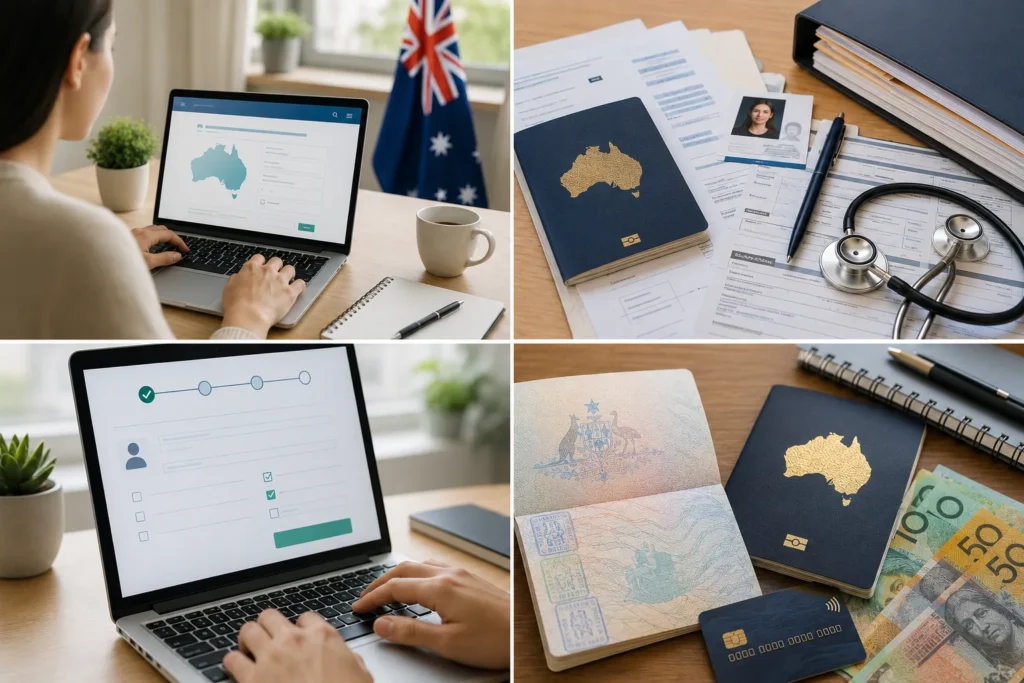
To apply for most Australian visa types, create an account at ImmiAccount through the DHA website. ImmiAccount is the only official government portal. Third-party websites that charge additional fees to submit your application on your behalf are not affiliated with the DHA.
The application process follows 4 stages for most Australian visa types.
- Select your visa: use the DHA’s Visa Finder tool to confirm your subclass. For skilled visas, submit an Expression of Interest (EOI) through SkillSelect first and wait for an invitation.
- Gather documents: collect your passport (valid for the duration of your intended stay), evidence of purpose (enrolment, employment, sponsorship, relationship), financial proof, health examination results from a DHA-approved panel physician, and police certificates from every country you have lived in for 12 months or more in the past 10 years.
- Submit and pay: lodge your application online via ImmiAccount, attach all documents, and pay the government fee. The DHA does not offer refunds, even if the application is refused.
Registered migration agents regulated by the OMARA (Office of the Migration Agents Registration Authority) can advise you, manage your application, and represent you in appeals. Contact ImmigrationWin for a free visa consultation to identify the correct subclass for your circumstances and receive a complete document checklist before you apply.
Start Your Australian Visa Application with the Right Guidance
Australia’s 100+ australian visa types give you a precise pathway no matter your circumstances, whether you visit for 3 months or seek permanent residence. Choosing the wrong subclass means wasted fees, lost time, and a refusal on record.
ImmigrationWin’s immigration specialists identify the correct Australian visa type for your profile, prepare your documentation, and manage your ImmiAccount application from start to decision. Book your free visa consultation today and receive a clear action plan within 48 hours.
Frequently Asked Questions

Michael Reynolds
Michael Reynolds leads immigration content at ImmigrationWin, covering visa requirements, application and relocation pathways. He researches immigration policies and official government guidance to explain changing rules clearly. His guides help students, families, and professionals make informed decisions about moving abroad.
Related Posts