
Canada Work Visa Types: The Complete 2026 Guide to Every Work Permit Option
Sarah, a marketing manager from Chicago, spent three weeks comparing Canada work visa types before she realized her CUSMA (Canada-United States-Mexico Agreement) eligibility skipped the entire Labour Market Impact Assessment process. That one detail cut her timeline from five months to six weeks. Most applicants never find that shortcut, because Canada splits work authorization into more than a dozen overlapping categories, each with its own rules, fees, and processing path.
This guide walks through every major Canada work visa type available in 2026. For each one, you’ll find who it actually fits, what it costs, and how long it takes.
What Is a Canada Work Visa?
A Canada work visa, more accurately called a work permit, is a document issued by Immigration, Refugees and Citizenship Canada (IRCC) that authorizes a foreign national to work legally in the country for a set period. People use “work visa” and “work permit” interchangeably, but they’re not the same document. A visa is a travel authorization, usually a stamp or sticker in a passport, that lets someone enter Canada. A work permit is the separate authorization that lets that same person hold a job once they’re inside the country.
Citizens of visa-exempt countries, including the United States, don’t need a separate travel visa to enter Canada. They still need a work permit before starting any job. Australians and other visa-required nationals typically get both a temporary resident visa and a work permit at once, issued together after IRCC approves the application.
Every Canada work visa falls into one of two structural categories: open or closed. Everything else, from CUSMA permits to the Post-Graduation Work Permit, is really just a subtype sitting inside one of those two branches.
How Many Canada Work Visa Types Exist?
Canada runs two core work permit structures, open and closed, but more than 15 named programs sit underneath them. IRCC groups these into two administrative streams: the Temporary Foreign Worker Program (TFWP), which requires employer approval through the LMIA process, and the International Mobility Program (IMP), which doesn’t. Knowing which stream a program falls under tells you whether an employer needs government sign-off before extending a job offer.
A tech worker recruited through the Global Talent Stream can get a decision in as little as two weeks, because that stream sits inside the IMP and skips the standard LMIA advertising requirement. A restaurant worker hired through the standard TFWP low-wage stream faces a much longer road, since the employer has to advertise the position to Canadians first before applying for an LMIA at all.
Open Work Permit vs. Closed Work Permit
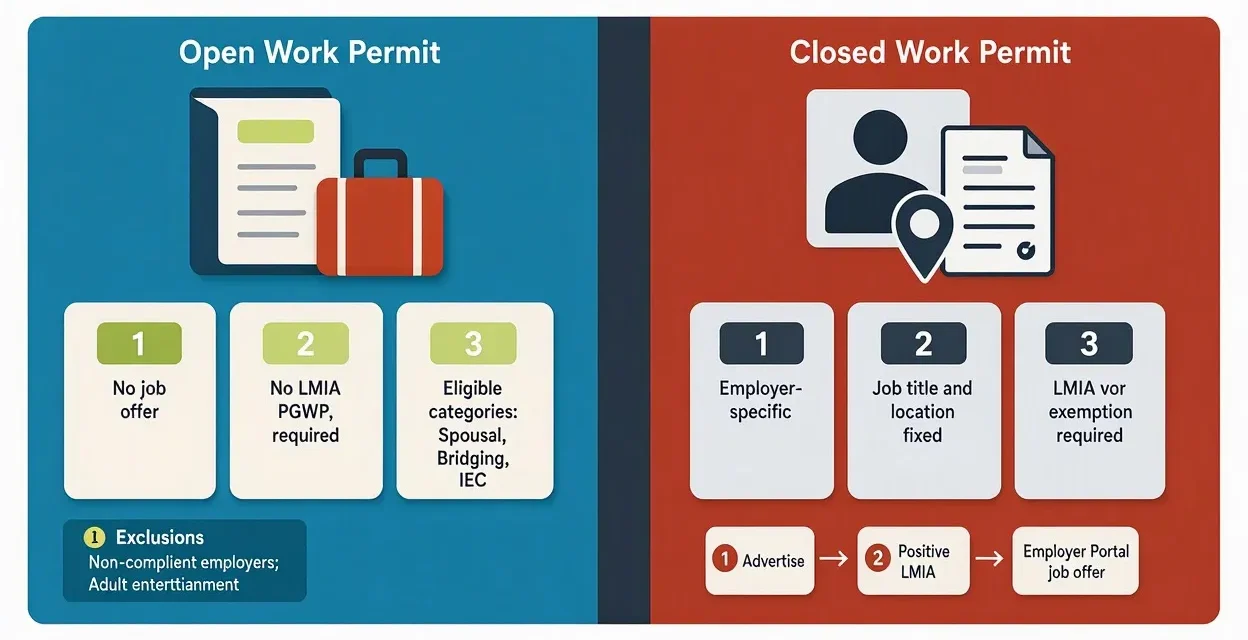
An open work permit lets the holder work for almost any employer in Canada. A closed work permit restricts them to one specific employer, job, and location. That distinction shapes everything else about the application, from required documents to processing fees.
Open Work Permits
Open work permits don’t require a job offer, an LMIA, or a specific employer to sponsor the application. If the applicant qualifies under one of the eligible categories, they can apply first and look for work after they land. Common categories include the Post-Graduation Work Permit, the Spousal Open Work Permit, the Bridging Open Work Permit, and International Experience Canada.
Restrictions still apply, though. Open work permit holders can’t work for an employer on Canada’s non-compliant employer list, and they can’t work in businesses offering adult entertainment services. Outside of those two exclusions, holders can change jobs, switch industries, or move provinces without reapplying.
Closed (Employer-Specific) Work Permits
Closed work permits tie the applicant to one employer, one job title, and often one work location. Changing employers means submitting an entirely new application, not just updating the existing one. Most closed permits require either a positive LMIA or an LMIA exemption, plus a formal job offer submitted through the Employer Portal.
Take a software engineer from Bangalore hired by a Toronto fintech company. If the company can’t claim an LMIA exemption, it has to advertise the position, get a positive LMIA from Employment and Social Development Canada (ESDC), and only then can the engineer apply for the closed permit tied specifically to that employer and role.
What Is an LMIA and When Do You Need One?
A Labour Market Impact Assessment (LMIA) is a government document confirming that hiring a foreign worker won’t hurt the Canadian job market. ESDC issues LMIAs, not IRCC, and the employer applies for one, not the worker. A positive LMIA proves the employer tried to recruit a Canadian citizen or permanent resident first and couldn’t fill the role.
The LMIA fee runs $1,000 CAD (roughly $730 USD) per position, and Canadian law prohibits employers from passing that cost onto the worker. Processing typically takes two to six months depending on the stream and province. Quebec adds another layer: employers there also need a Quebec Acceptance Certificate (CAQ), with its own fee, on top of the federal LMIA.
Not every closed work permit needs an LMIA, though. Dozens of exemption categories exist just to skip this step, and they matter more now than they did five years ago. LMIA approval rates dropped by 37% after the 2026 Temporary Foreign Worker Program cuts, so more applicants and employers have been leaning on LMIA-exempt pathways instead.
LMIA-Exempt Work Permit Categories

Six categories account for most LMIA-exempt applications processed each year, and each one serves a different kind of applicant, from returning graduates to corporate transferees.
CUSMA Work Permits (US and Mexican Citizens)
US and Mexican citizens working in one of roughly 60 designated professional occupations can apply for a CUSMA work permit without an LMIA. The agreement, formerly known as NAFTA, covers professionals like engineers, accountants, scientists, and management consultants. Applicants can apply directly at the port of entry if they’re arriving by land or air from the US, which often means walking away with the permit the same day.
An accountant from Detroit taking a job in Windsor, Ontario, can drive across the border, hand over the job offer letter and proof of credentials at the port of entry, and leave with an approved work permit within hours.
Intra-Company Transfers
Employees of multinational companies who’ve worked at least one continuous year for the same employer outside Canada, in an executive, managerial, or specialized knowledge role, qualify for this permit type. No LMIA applies, since the position already exists inside the same corporate structure. Duration typically runs one to three years, renewable up to a maximum tied to the specific role classification.
Post-Graduation Work Permit (PGWP)
This lets international students who completed an eligible program at a Designated Learning Institution (DLI) work for any employer in Canada after graduating. The program has to run at least eight months full-time, and applicants must apply within 180 days of getting their final marks. Permit duration matches the length of study, up to three years, and most applicants only get this permit once.
Since November 2024, PGWP eligibility for college graduates depends heavily on field of study. Graduates in STEM, healthcare, and skilled trades programs keep broader eligibility, while other fields face tighter restrictions than they used to.
International Experience Canada (IEC)
Young adults between 18 and 35, depending on their home country’s specific agreement with Canada, can apply through IEC for a working holiday, a young professionals placement, or an international co-op internship. Australia, the UK, France, and roughly 30 other countries participate. Applicants enter a pool system, get invitations in rounds throughout the year, and need to show at least $2,500 CAD (around $1,825 USD) in savings before departure. Permits run one to two years depending on the country agreement.
Spousal Open Work Permit
Spouses and common-law partners of skilled workers or international students can apply for an open permit tied to the principal applicant’s status. Eligibility tightened sharply starting January 2025: spouses of workers in TEER (Training, Education, Experience, and Responsibilities) 3 or lower occupations generally no longer qualify, and spouses of most undergraduate international students lost automatic eligibility too. Spouses of workers in TEER 0 or 1 roles, or select TEER 2/3 trades, transport, natural resources, and agriculture positions, are still generally eligible.
Bridging Open Work Permit
Workers with a valid work permit who’ve submitted a complete permanent residence application and received an Acknowledgment of Receipt letter can apply for a Bridging Open Work Permit (BOWP) to keep working while IRCC processes that application. The BOWP typically runs 24 months, with 12-month extensions available if the permanent residence decision takes longer than expected.
Can You Work in Canada Without a Work Permit?
Yes, actually. Several categories let foreign nationals work legally in Canada without applying for any work permit at all. Business visitors attending meetings, negotiations, or conferences don’t need one, as long as their pay and employer stay based outside Canada. Full-time international students can work up to 20 hours a week during the academic term without a separate permit, since their study permit already covers it.
Truck drivers and bus operators on international routes, foreign athletes and coaches competing in Canadian events, and performing artists appearing for a limited engagement also fall under these exemptions. Highly skilled workers entering under the Global Skills Strategy can work up to 15 consecutive days once every six months, or 30 consecutive days once every 12 months, without a permit, though they still need a Temporary Resident Visa or Electronic Travel Authorization if their citizenship requires one.
How Much Does a Canada Work Visa Cost in 2026?
A standard closed work permit costs $155 CAD ($113 USD) in base processing fees, plus $85 CAD ($62 USD) for biometrics. That’s $240 CAD total for most applicants. Open work permit applicants pay an additional $100 CAD holder fee, which brings their total to $255 CAD before biometrics, or $340 CAD ($248 USD) once biometrics are included.
IEC Working Holiday applicants pay a further $172 CAD participation fee on top of the standard open permit costs, bringing their combined total closer to $427 CAD. Anyone restoring expired status pays a restoration fee of $229 CAD on top of the regular work permit fee. Families applying together should budget for each member separately, since biometrics and processing fees apply per person, not per household.
And those figures only cover government fees. Medical exams run $200 to $450 CAD depending on the clinic and country, and police certificates range from free to $150 CAD per country of prior residence. Someone who’s lived in three countries over the past decade could end up paying $450 CAD in police certificate fees alone, on top of everything else.
How Long Does It Take to Get a Canada Work Visa?
It depends entirely on which type you’re using, and the range is huge: same-day approval at the border on one end, six months or longer for LMIA-based applications on the other. CUSMA and other port-of-entry-eligible permits often wrap up in hours. Global Talent Stream applications, which fall under the LMIA-exempt IMP category, target a two-week decision window. Standard LMIA-based closed work permits typically take two to six months once the LMIA itself is factored in, since the employer’s LMIA has to clear ESDC before the worker can even submit their own application.
Applying from inside Canada versus outside also changes the timeline. Applicants already in Canada on valid status can often keep working under maintained status while their extension or new permit processes, as long as they applied before their current permit expired.
How Do You Apply for a Canada Work Permit?
The process breaks down into four steps: choosing the right permit category, confirming eligibility, gathering documents, and submitting the application online through IRCC. The specifics vary by category, but the core sequence stays roughly the same across almost every pathway.
- Select the permit type that matches your situation, whether that’s employer-specific, open, or one of the LMIA-exempt categories.
- Confirm general eligibility: proof you intend to leave Canada when the permit expires, sufficient funds for the stay, a clean criminal record, and good health.
- Gather your documents: a valid passport, job offer letter or LMIA copy, employment contract, proof of funds, and a medical exam if the job involves healthcare, childcare, or education.
- Submit the completed application through the IRCC online portal, pay the fees, and complete biometrics if required.
A rejected application doesn’t end things for good. Applicants who get a refusal can usually reapply with corrected documentation, though repeated refusals on the same grounds can raise scrutiny on future attempts. Reading the refusal letter carefully before resubmitting saves both time and the non-refundable application fee.
Which Canada Work Visa Type Should You Choose?
It comes down to three things: whether you already have a job offer, your citizenship, and your long-term goal in Canada. If you have a confirmed job offer, figure out first whether that employer can claim an LMIA exemption, since exemptions cut both cost and processing time substantially. US and Mexican citizens in eligible professional occupations should check CUSMA eligibility before looking at anything else, given how much faster it is at the border.
If you don’t have a job offer yet, your options narrow but they’re still workable. Young Australians and other IEC-eligible nationals under 35 can apply through the working holiday pool without needing an employer at all. Recent graduates from Canadian institutions should apply for the PGWP within the 180-day window rather than exploring other categories first, since missing that deadline forfeits the option entirely.
Can a Work Permit Lead to Permanent Residency?

Yes. Work permits themselves don’t grant permanent residence, but Canadian work experience gained under nearly any permit type can qualify a worker for the Canadian Experience Class (CEC) through Express Entry. Eligibility requires 12 months of full-time work, or the part-time equivalent, in a TEER 0, 1, 2, or 3 occupation within the three years before applying. IRCC recognizes “dual intent,” meaning applicants can hold a temporary work permit while pursuing permanent residence at the same time, without one status jeopardizing the other.
Provincial Nominee Programs offer a second route. A software developer working in Alberta for eight months, for instance, could get a provincial nomination before even hitting the one-year CEC threshold, since PNP requirements often run shorter and focus on specific in-demand occupations within that province.
Conclusion
Canada work visa types split cleanly into two structures, open and closed, but the real differences show up between CUSMA permits, the PGWP, IEC, and standard LMIA-based permits, and they determine everything from processing time to total cost. A US professional in an eligible occupation can walk across the border with an approved permit in hours. A standard LMIA-based application, meanwhile, can take six months and cost employers well over $1,000 CAD before the worker even submits their own paperwork. Matching your citizenship, job offer status, and long-term goal to the right category before you file anything is what separates a six-week approval from a six-month wait.
FAQs

Michael Reynolds
Michael Reynolds leads immigration content at ImmigrationWin, covering visa requirements, application and relocation pathways. He researches immigration policies and official government guidance to explain changing rules clearly. His guides help students, families, and professionals make informed decisions about moving abroad.
Related Posts