Companies That Sponsor Work Visas: Full List and How to Find Them
Roughly 85,000 H-1B petitions get approved by USCIS every year. Most of those come from a small, repeat group of employers, not a random cross-section of American business. Some companies file thousands of petitions annually. Others sponsor exactly one employee, once, for a role they genuinely couldn’t fill locally. If you’re job hunting from outside the United States, or you’re already here on OPT, CPT, or another temporary status, that difference matters more than any single ranked list. This guide covers which companies sponsor work visas most often, what each visa type actually requires, and how to verify sponsorship before you sink weeks into an application.
What Does It Mean When a Company Sponsors a Work Visa?
A company sponsors a work visa by filing a legal petition with United States Citizenship and Immigration Services (USCIS) and paying the government fees required to employ a foreign national inside the United States. It isn’t a favor, and it isn’t a formality. The employer becomes the legal petitioner on record, and its name shows up on every government filing tied to that employee’s status.
Take a software engineer hired from India on an H-1B visa. The employer files Form I-129, pays the base filing fee plus any applicable fraud prevention and training fees, and commits to paying the employee at least the prevailing wage for that role and location. If the company lays the employee off, the visa status ends within a set grace period, unless another employer picks up sponsorship. That’s the trade at the center of this: legal and financial responsibility, in exchange for access to talent a company can’t fill domestically.
Which Companies Sponsor the Most Work Visas?
Large technology firms and global IT consulting companies file the highest volume of work visa petitions each year. Infosys, Amazon, Tesla, Nvidia, Oracle, IBM, and Accenture consistently rank among the top filers. According to MyVisaJobs’ 2025 employer rankings, Infosys reported 5,791 sponsored positions, Tesla reported 4,323, Amazon Web Services reported 4,175, and Nvidia reported 4,034.
| Employer | Headquarters | Reported Sponsored Positions |
| Infosys | Richardson, TX | 5,791 |
| Tesla | Austin, TX | 4,323 |
| Amazon Web Services | Seattle, WA | 4,175 |
| Nvidia | Santa Clara, CA | 4,034 |
| Oracle America | Austin, TX | 4,003 |
| IBM | Durham, NC | 3,635 |
| Accenture | Chicago, IL | 3,538 |
These numbers shift year to year, since sponsorship volume tracks hiring needs, visa caps, and government fee changes. A ranking from three years ago won’t match this year’s filings. Treat any single list as a starting point, not a permanent record. Consulting firms and staffing agencies like Infosys, Cognizant, and Tata Consultancy Services tend to post the highest raw numbers because they place workers across dozens of client companies. Product companies like Nvidia and Tesla file fewer total petitions, but they often sponsor at higher salary bands.
What Types of Work Visas Do U.S. Employers Sponsor?

U.S. employers sponsor several distinct visa categories, and the right one depends on the worker’s nationality, job type, and length of stay. No single visa fits every hire. That’s why immigration attorneys match the category to the role before filing anything.
H-1B Visa
Covers specialty occupations that require at least a bachelor’s degree: software development, engineering, finance. USCIS caps new H-1B petitions at 65,000 per year, plus an additional 20,000 for applicants holding a U.S. master’s degree or higher. The visa runs for three years initially and can extend to six years total.
L-1 Visa
Lets multinational companies transfer employees from a foreign office to a U.S. office, provided the worker has been employed abroad for at least one continuous year within the prior three. Unlike the H-1B, it has no annual cap, which makes it a common route for large corporations moving executives or specialized staff into American offices.
O-1 Visa
For individuals with extraordinary ability in fields like science, business, education, or the arts. No annual cap, no wage floor tied to a prevailing wage survey, but the evidentiary bar is high. Applicants typically need major awards, published work, or a track record of leading projects at a national or international level.
TN Visa
Exists under the United States-Mexico-Canada Agreement (USMCA) and applies exclusively to Canadian and Mexican citizens working in specific listed professions, including engineers, scientists, and accountants. Processing moves faster than most other categories, since Canadian citizens can often apply directly at the border.
E-3 Visa
Reserved for Australian citizens working in specialty occupations. Shares the same educational requirements as the H-1B, but operates under a separate 10,500-visa annual allocation that rarely fills up, which makes it one of the more accessible options for the nationality it covers.
J-1 Visa
Covers interns, trainees, researchers, and physicians participating in structured exchange programs. Many J-1 holders face a two-year home residency requirement after their program ends, so sponsors and applicants both need to confirm this rule before accepting a placement.
How Does Green Card Sponsorship Differ From Work Visa Sponsorship?
A work visa grants temporary permission to work for a specific employer. Green card sponsorship leads to permanent residency that isn’t tied to any single job. An H-1B holder loses status the moment their sponsoring employer stops the petition. A green card holder can change jobs freely once the card is issued.
Employment-based green cards fall into preference categories: EB-1 for extraordinary ability or outstanding researchers, EB-2 for advanced degree holders (including the National Interest Waiver route, which skips labor certification), and EB-3 for skilled workers and professionals. Most EB-2 and EB-3 cases require PERM labor certification first, a Department of Labor (DOL) process proving no qualified U.S. worker is available for the role. That step alone can take 8 to 14 months, before the employer even files the immigrant petition. Companies that sponsor work visas don’t automatically sponsor green cards, so candidates should confirm both intentions during salary negotiations, not after accepting the offer.
Which Industries Sponsor the Most Work Visas?
Technology, healthcare, IT consulting, and higher education account for the largest share of U.S. work visa sponsorships each year. Software engineering, data science, and cloud infrastructure roles dominate H-1B filings, driven by companies like Google, Meta, Microsoft, and Apple, alongside consulting firms that place contractors across multiple clients.
Healthcare runs a close second. Hospitals and staffing agencies sponsor registered nurses, physicians, and physical therapists, often through direct employer sponsorship rather than a consulting middleman. ADEX Medical Staffing, for example, positions itself as a direct green card sponsor for nurses, covering legal fees and offering a travel stipend during relocation. It’s a model built around the nationwide nursing shortage. Universities and research institutions round out the top sponsors, largely because they qualify for cap-exempt H-1B status. They can file petitions year-round instead of competing in the annual lottery.
How Can You Find Companies That Sponsor Work Visas?
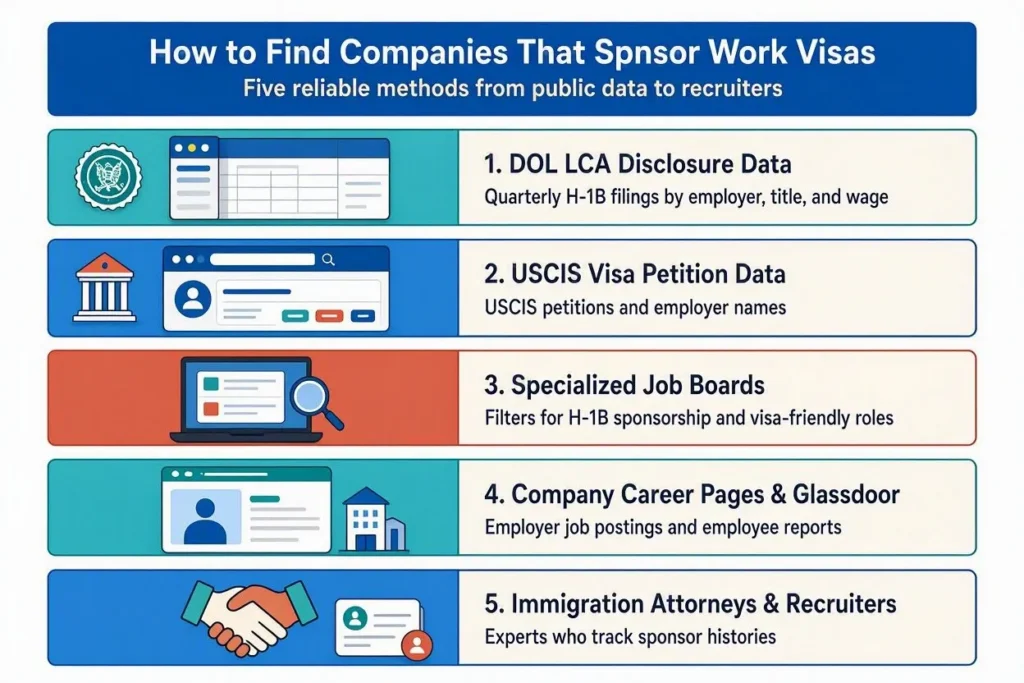
The most reliable way to find companies that sponsor work visas is to search public Department of Labor and USCIS disclosure data, which lists every employer that has filed a visa petition by name, job title, and wage. Five methods work well, depending on how much detail you need.
- Labor Condition Application (LCA) disclosure data. The DOL publishes every H-1B LCA filing quarterly, including employer name, job title, wage offered, and worksite location. Most third-party databases pull from this.
- Sponsor databases. Platforms like MyVisaJobs and Ellis aggregate years of DOL and USCIS filings into searchable tools. Ellis’s database alone indexes more than 180,000 H-1B sponsor records, and you can filter by company, occupation, or city.
- Job boards with sponsorship filters. Sites like MyVisaJobs list H-1B-specific job postings separately from general listings, which cuts out roles where sponsorship was never on the table.
- Company career pages. Many large employers state their sponsorship policy directly on the careers site or in the job posting, often under a line like “visa sponsorship available for this role.”
- Immigration attorneys and recruiters. Attorneys who specialize in employment-based immigration often know which regional employers sponsor consistently, information that can take months to show up in a public database.
Cross-check two or three of these and you’ll catch gaps that any single tool misses on its own. A company might appear in DOL data from two years ago but have quietly stopped sponsoring new hires since then. Recency matters as much as the raw list.
Do Small Companies Sponsor Work Visas?
Yes. Less frequently than large corporations, since filing costs and legal fees make up a bigger share of a small employer’s budget, but a 15-person startup can sponsor an H-1B just as legally as Amazon can, provided it meets the same wage and documentation requirements. The barrier isn’t legal eligibility. It’s cost tolerance and internal familiarity with the process.
Startups that do sponsor tend to cluster around specialized technical roles where the founder already tried and failed to fill the position domestically. A 2023 survey by the National Foundation for American Policy found that immigrant-founded companies account for a disproportionate share of America’s billion-dollar startups, and a lot of those same companies go on to sponsor their own early technical hires once they raise enough funding. If a small company hasn’t sponsored before, expect a longer internal decision process. The founder or HR lead usually needs to consult outside counsel before committing to that first petition.
What Does the Work Visa Sponsorship Process Involve?
The process moves through four stages: job offer, wage and labor certification, petition filing, and government adjudication. Timelines vary by visa type, but the sequence stays largely the same across categories.
- Job offer and role classification. The employer confirms the position qualifies for the intended visa category and gathers documentation on the candidate’s education and experience.
- Prevailing wage determination. For H-1B and most PERM cases, the employer requests a prevailing wage from the DOL to confirm the offered salary meets or exceeds the local market rate for that occupation.
- Petition filing. The employer files Form I-129 for nonimmigrant visas like H-1B, L-1, and O-1, or Form I-140 for employment-based immigrant petitions. USCIS processing runs 2 to 8 months for standard review, or roughly 15 calendar days with premium processing, an optional expedite service that costs an additional fee.
- Approval and status activation. Once USCIS approves the petition, the employee either adjusts status from within the United States or completes consular processing abroad before entering on the new visa.
If the candidate is already in the United States on another valid status, the employer can often request a change of status alongside the petition. That avoids a trip abroad entirely.
How Much Does It Cost a Company to Sponsor a Work Visa?
Sponsoring a work visa typically costs a company between $2,500 and $15,000 per employee, depending on the visa category, attorney fees, and government filing costs. Published pricing from immigration platform Ellis lists flat attorney fees of $3,000 for H-1B, $2,500 for TN, $10,000 for L-1, $12,000 for O-1, and $15,000 for EB-1A green card sponsorship. Those figures sit on top of separate government filing fees.
Government fees add a second layer. The base I-129 filing fee, the American Competitiveness and Workforce Improvement Act (ACWIA) training fee, and the fraud prevention and detection fee together typically run $1,500 to $3,000 for H-1B cases at companies with more than 25 employees. Premium processing adds a separate government fee for employers who need a faster decision. Companies budgeting for their first sponsorship should plan for the attorney fee, the government filing fees, and a buffer for Requests for Evidence (RFEs), since USCIS review can add months and additional attorney hours if the initial filing lacks sufficient documentation.
What Changed for Work Visa Sponsorship Recently?
Several federal changes have reshaped work visa sponsorship this year. USCIS moved to a wage-weighted selection process for the H-1B lottery, a court fight over a proposed $100,000 filing fee is still working its way through appeals, and new versions of two commonly used forms take effect this September.
The $100,000 Fee Fight
A federal judge in Massachusetts vacated the $100,000 H-1B fee on June 8, 2026, ruling that the administration exceeded its authority. The government briefly got the fee reinstated through an administrative stay, but the First Circuit Court of Appeals denied the government’s request to keep that stay in place on July 24, 2026, so the fee currently isn’t being collected while the appeal continues. The underlying presidential proclamation that created the fee is also set to expire September 20, 2026 unless the administration renews it. Employers should check directly with USCIS before budgeting around any specific number here, since this one has already flipped more than once.
The New Wage-Weighted Selection Process
USCIS replaced the traditional random H-1B lottery with a wage-weighted process for the first time this year, under a final rule that took effect February 27, 2026. Registrations tied to higher-paying job offers now get more entries in the selection pool, which shifts the odds toward higher-salary positions. The FY2027 registration period already closed. It ran March 4 through March 19, 2026, and USCIS confirmed it had received enough registrations to hit the cap by the end of that month. The next cycle, for FY2028, would be expected to open around March 2027 following the same general pattern, though USCIS hasn’t announced exact dates yet.
New Form I-539 and I-765 Editions
USCIS will require new editions of Form I-539 and Form I-765 starting September 15, 2026, with no grace period for the older versions. The revisions implement a separate rule replacing “duration of status” with a fixed admission period for F and J nonimmigrants, so students, exchange visitors, and their dependents filing either form should pull a fresh copy from the USCIS site right before submitting rather than relying on one prepared in advance.
Conclusion
Finding companies that sponsor work visas comes down to checking the right data sources instead of guessing from job titles alone. DOL disclosure records, sponsor databases like MyVisaJobs and Ellis, and direct career-page statements each fill a different gap, and combining two or three of them catches employers a single search would miss. Visa category matters as much as company choice: an H-1B fits a specialty occupation candidate, an L-1 fits an internal transfer, and a TN moves faster for Canadian and Mexican applicants than either. Costs run from roughly $2,500 to $15,000 per sponsorship depending on visa type and firm size, and recent federal changes, including the blocked $100,000 fee proposal and new e-filing mandates, mean the numbers and rules from even a year ago no longer apply. Candidates who verify a company’s current sponsorship activity, rather than relying on last year’s list, are the ones who land offers that actually convert into approved petitions.
Frequently Asked Questions

Michael Reynolds
Michael Reynolds leads immigration content at ImmigrationWin, covering visa requirements, application and relocation pathways. He researches immigration policies and official government guidance to explain changing rules clearly. His guides help students, families, and professionals make informed decisions about moving abroad.
Related Posts