Dubai Work Visa: Types, Cost, Eligibility & How to Apply
A Dubai work visa lets a foreign national live and work in the city under the sponsorship of a UAE-based employer. It’s usually valid for two years and renewable after that. You’ll also need a linked UAE residence visa and an Emirates ID before you can legally start work.
There are five main types: the standard employer-sponsored visa, the Green Visa, the freelance permit, the Virtual Work Visa, and the long-term Golden Visa. Costs run from AED 300 to AED 5,700 (roughly USD 82 to USD 1,553) depending on your job category, and most applications clear in 5 to 15 working days.
What Is a Dubai Work Visa?
It’s the official document authorizing a foreign national to take up employment in Dubai under a UAE employer’s sponsorship. The Ministry of Human Resources and Emiratisation (MOHRE) issues the underlying work permit. The General Directorate of Residency and Foreigners Affairs (GDRFA) in Dubai handles the residence visa stamping that actually lets you live there.
These are two separate approvals working together: the work permit authorizes employment, the residence visa authorizes your stay. And no, you can’t legally work in Dubai on a tourist or visit visa, no matter what your employer tells you.
What Are the Types of Dubai Work Visa?
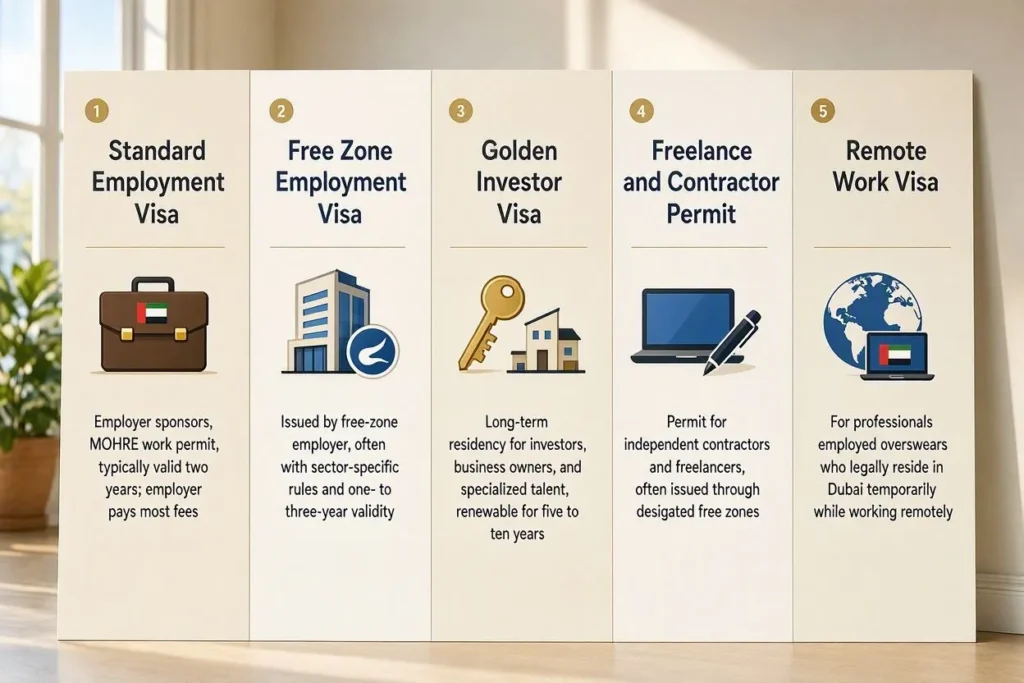
Five types exist, each suited to a different kind of work situation, from a straightforward company job to fully remote work for an employer overseas.
Standard Employment Visa. This is what most workers end up on. A UAE employer sponsors the application, applies for the work permit through MOHRE, and covers most or all of the fees. Valid for two years, renewable as long as the job continues. A software engineer hired by a Dubai-based bank would fall under this category.
Green Visa. No employer sponsorship required here, which is the whole point for eligible skilled professionals. Valid for five years, and holders can sponsor themselves instead of depending on one company. You’ll need a minimum monthly salary and a bachelor’s degree, or an equivalent skill classification, to qualify.
Freelance Permit. For independent professionals in media, technology, education, and design. Free zones like Dubai Development Authority (DDA) and Dubai Media City issue most of these, and they typically run for one year.
Virtual Work Visa. This one lets you live in Dubai while working remotely for a company based outside the UAE, no local sponsor, no local job offer needed. Valid for one year, renewable. It’s the right fit if your employer sits in London, New York, or Karachi but you want a Dubai address.
Golden Visa. A long-term residency option, valid for ten years, built for highly skilled professionals, investors, and specialists rather than entry-level workers. Doctors, scientists, executives, and creatives with recognized achievements can apply directly, no employer sponsorship, provided they clear the salary and qualification thresholds set by the Federal Authority for Identity, Citizenship, Customs and Port Security (ICP).
Who Is Eligible for a Dubai Work Visa?
Eligibility comes down to age, health, qualifications, and having an actual job offer. There’s general eligibility that applies to everyone, and job-based requirements tied to your specific role.
General eligibility:
- Minimum age of 18, upper limit generally around 60 (extendable to 65 in specific cases)
- Passport valid for at least 6 months from your date of entry
- A confirmed job offer from a Dubai-based employer
- A clean criminal record, no history of immigration violations in the UAE
Job-based requirements:
- Attested education certificates that match the role (an engineering degree for an engineering position, not a stretch of the imagination)
- Relevant work experience, often 2 to 5 years depending on seniority
- A salary meeting the minimum threshold MOHRE sets for that skill category
Applicants from India and Pakistan without a UAE residence history usually apply through their home country’s visa process before entering. Those already inside the UAE on another visa type can sometimes convert status without leaving.
What Documents Do You Need for a Dubai Work Visa?
Eight core documents: a valid passport, passport-size photos, your CV, an employment contract, a copy of the company’s trade license, attested degree certificates, a medical fitness certificate, and a police clearance certificate where required.
The passport photo spec trips people up more than anything else: 51 x 51 mm (about 2 x 2 inches), white background, no headwear except for religious reasons. Miss that and your application bounces back for resubmission.
By category:
- Personal: passport, passport-size photographs, updated CV
- Employment: signed offer letter or contract, employer’s trade license copy
- Educational: degree or diploma certificate, attestation from the UAE embassy in your home country
- Legal and medical: fitness test results, police clearance certificate if your employer or free zone requires one
Any document not in English or Arabic needs a certified translation before you submit.
How Do You Apply for a Dubai Work Visa?
Six steps, start to finish: job offer, work permit approval, entry permit issuance, medical test, Emirates ID registration, and residence visa stamping.
- Job offer. It starts with your employer, who issues you a signed offer letter or contract.
- Work permit approval. From there your documents go to MOHRE through your employer, and MOHRE issues initial approval.
- Entry permit issuance. Next comes an entry permit, good for 60 days, which is what actually lets you travel into Dubai legally.
- Medical test. Once you land, expect a blood test and a chest X-ray at a government-approved medical center.
- Emirates ID registration. They’ll take your biometric data here, fingerprints and a photo, for the Emirates ID card.
- Residence visa stamping. Last step: GDRFA stamps the residence visa into your passport, and you’re done.
Since June 2024, MOHRE’s Work Bundle platform has cut this timeline down considerably for companies using it: work permit and visa issuance in as little as 5 days, the document count down from 16 to 5, and only 2 in-person visits required (one for the medical test, one for Emirates ID biometrics).
How Much Does a Dubai Work Visa Cost?
Between AED 300 and AED 5,700 (roughly USD 82 to USD 1,553), depending on your job category and whether you’re applying from inside or outside the UAE. Employers cover most or all of this in the majority of cases, so out-of-pocket cost for the applicant is often minimal.
By component:
- Work permit fee: AED 250 to AED 3,450 (about USD 68 to USD 940), based on MOHRE’s three-tier company classification
- Medical fitness test: AED 250 to AED 500 (about USD 68 to USD 136)
- Emirates ID issuance: AED 370 to AED 570 (about USD 101 to USD 155)
- Residence visa stamping: AED 500 to AED 1,000 (about USD 136 to USD 272)
Company classification drives most of the difference. Category A companies (large, established firms with strong Emiratisation records) pay the lowest fees. Category C companies, typically smaller or newer, pay significantly more, sometimes over AED 3,000 (about USD 817) for the work permit alone.
How Long Does a Dubai Work Visa Take to Process?
5 to 15 working days on average, though complex cases can stretch to 3 or 4 weeks. Companies on MOHRE’s Work Bundle platform move fastest, sometimes wrapping the entire permit and visa cycle in 5 days flat.
Delays usually trace back to one of three things: incomplete document attestation, a mismatch between your job title and your qualifications, or a backlog at the medical testing center during peak hiring season (typically September through November).
What Is the Unemployment Insurance Requirement for Work Visa Holders?
Most Dubai work visa holders are required to carry unemployment insurance, a piece of the Involuntary Loss of Employment (ILOE) scheme that’s been running since January 1, 2023. The deal is simple: a small monthly premium in exchange for compensation if you’re let go for reasons out of your hands, like redundancy.
Two premium categories:
- Category A (salary of AED 16,000 or below): AED 5 per month plus VAT, compensation up to AED 10,000 monthly for 3 months
- Category B (salary above AED 16,000): AED 10 per month plus VAT, compensation up to AED 20,000 monthly for 3 months
You only become eligible for a payout after 12 consecutive months of subscription before the job loss. Investors, domestic workers, and employees under 18 don’t need to subscribe, though nearly every standard work visa holder does.
How Do You Renew a Dubai Work Visa?
Renewal falls to your employer, who files through MOHRE before the current visa runs out, typically kicking things off about 30 days early. Whatever validity period you started with carries over: 2 years again for a standard visa, 5 for a Green Visa.
MOHRE gives a 60-day grace period after expiry before penalties kick in. Miss even that, and companies face a fine of AED 200 per month (about USD 54), capped at AED 2,000 (about USD 545) per work permit. Renewal paperwork generally matches the original application, minus the entry permit step since you’re already in the country.
What Happens If You Lose Your Job on a Dubai Work Visa?
You get 30 days to find a new job, change your visa status, or leave the UAE after your work visa is cancelled. Your residence status stays technically valid during this window, though you can’t legally work for a new employer until the transfer paperwork clears.
Miss that 30-day window without securing new sponsorship or exiting the country, and overstay fines start accruing at AED 50 per day (about USD 14). Workers who’ve been subscribed to the ILOE scheme for at least 12 months can file an unemployment insurance claim during this period too, which pays out within 2 weeks of submission.
Can You Sponsor Family on a Dubai Work Visa?
You can bring over a spouse, children, and in some cases parents, as long as your salary clears MOHRE’s minimum income threshold. That number usually lands around AED 4,000 (about USD 1,090) a month, though it climbs higher for certain job categories and free zones.
The paperwork side means an attested marriage certificate, birth certificates for any children, and proof you’ve got suitable housing, a tenancy contract usually does it. Parents are a different story: sponsoring them adds an extra income requirement plus mandatory health insurance, since the UAE simply treats that category more strictly than a spouse or child.
Dubai Work Visa for Indian, Pakistani, UK, and US Applicants
The application steps stay largely the same across nationalities. What varies is where you submit documents and how long attestation takes.
Indian applicants typically route paperwork through the Ministry of External Affairs (MEA) apostille process before UAE embassy attestation, a step that can tack on 5 to 10 working days if degree certificates need apostille first. Pakistani applicants generally face additional security clearance checks, and Pakistani nationals are barred from certain restricted UAE visa categories tied to other bilateral arrangements, so it’s worth confirming eligibility for your specific job classification before applying. UK and US applicants usually move fastest through attestation, since their degree certificates and police clearance certificates are more commonly pre-recognized by UAE authorities, though everyone still goes through the standard medical test and Emirates ID steps once in Dubai.
Whatever your nationality, the end goal is the same: an approved work permit from MOHRE and a stamped residence visa from GDRFA-Dubai.
Dubai Work Visa vs Golden Visa: What Is the Difference?
Sponsorship and duration are the two big differences. A standard work visa needs an employer sponsor and lasts 2 years. The Golden Visa needs no sponsor and lasts 10.
| Factor | Standard Work Visa | Golden Visa |
| Sponsorship | Employer required | Self-sponsored |
| Validity | 2 years | 10 years |
| Eligibility | Job offer plus qualifications | High salary, specialist skill, or investment |
| Job change | Requires new sponsor approval | No employer tie |
| Family sponsorship | Yes, income-based | Yes, more flexible terms |
Most professionals start out on the standard visa early in their Dubai career, then move to the Golden Visa once they clear the salary and experience thresholds, commonly a monthly salary of AED 30,000 (about USD 8,175) or higher for the skilled-professional category.
Common Reasons Dubai Work Visa Applications Get Rejected
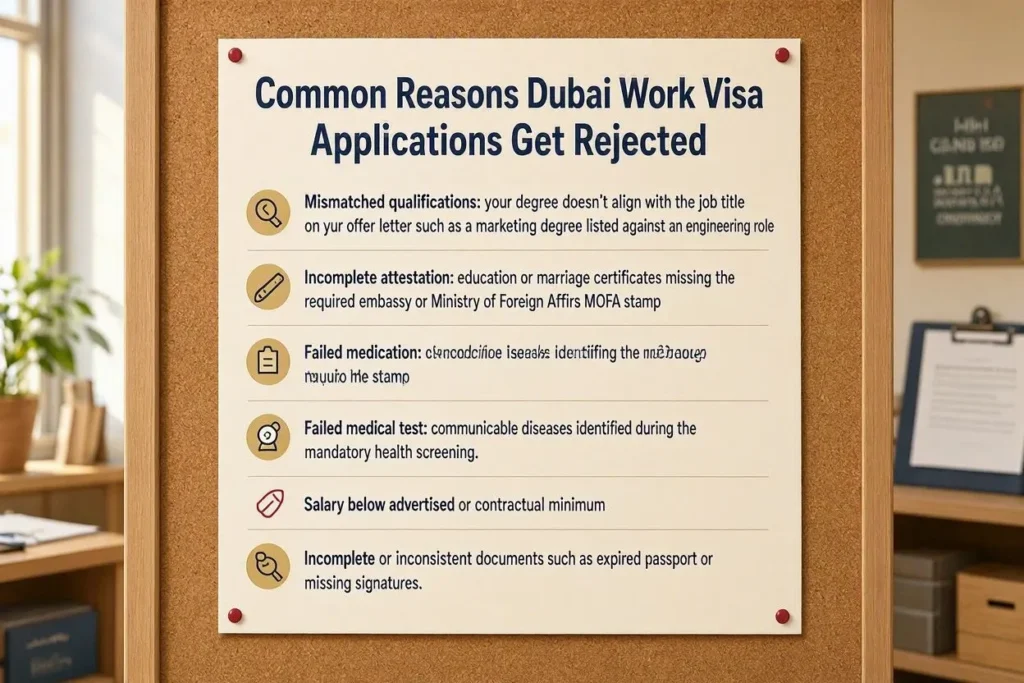
Five reasons cover most rejections:
- Mismatched qualifications: your degree doesn’t align with the job title on your offer letter (a marketing degree listed against an engineering role, say)
- Incomplete attestation: education or marriage certificates missing the required embassy or Ministry of Foreign Affairs (MOFA) stamp
- Failed medical test: communicable diseases identified during the mandatory health screening
- Salary below threshold: your offered salary doesn’t meet MOHRE’s minimum for your skill category
- Prior violations: unpaid fines, previous visa overstays, or a cancelled visa with unresolved penalties
Most rejections are fixable. If the reason was documentation-based rather than eligibility-based, you resubmit with corrected paperwork rather than starting from scratch.
Conclusion
A Dubai work visa gets you legally working and living in one of the world’s fastest-growing job markets, with tax-free income and a renewal path that’s straightforward once you’re in the system. Pick the visa type that actually matches your situation: a software developer with a confirmed job offer needs the standard employment visa, while a consultant working for a New York firm out of a Dubai apartment needs the Virtual Work Visa instead. Getting that choice right from the start saves you weeks of paperwork later.
Every document has to match exactly, down to the 51 x 51 mm passport photo and the salary figure on your offer letter lining up with what MOHRE has on file for your role. Most rejections trace back to a mismatch somewhere in the paperwork, not to the applicant being unqualified. Check your documents against MOHRE’s current checklist before you submit, and you’ll clear the process in the standard 5 to 15 working days most applicants see.
FAQs

Michael Reynolds
Michael Reynolds leads immigration content at ImmigrationWin, covering visa requirements, application and relocation pathways. He researches immigration policies and official government guidance to explain changing rules clearly. His guides help students, families, and professionals make informed decisions about moving abroad.
Related Posts