
H1B Visa Requirements: Eligibility, Wages, and Process Explained
The H1B visa requirements come down to five things: a job offer in a specialty occupation, a bachelor’s degree or equivalent tied to that job, an employer willing to sponsor you, a certified Labor Condition Application (LCA), and wages that meet or beat the prevailing rate for the role. Miss any one of these, and United States Citizenship and Immigration Services (USCIS) will reject or deny the petition. The rules apply the same way whether the applicant is in Mumbai, Manila, Toronto, London, or Kathmandu. What changes by country is the consular process after approval, not the underlying eligibility test.
This guide breaks down every requirement step by step: who qualifies, what employers must do, how much the visa actually costs in 2026, and what trips up otherwise-strong applications.
What Is the H-1B Visa?
The H-1B is a temporary work visa that lets U.S. employers hire foreign professionals for jobs requiring specialized knowledge and at least a bachelor’s degree. Congress created the category in 1990, and it remains the primary route for skilled foreign workers in fields like engineering, computer science, finance, medicine, and architecture. A person cannot apply for an H-1B on their own. The employer files the petition, which makes the visa “employer-sponsored” by design.
Three sub-categories exist under the H-1B umbrella. H-1B covers standard specialty occupations. H-1B2 applies to Department of Defense (DOD) cooperative research workers. H-1B3 applies to fashion models of distinguished merit. Nearly all applicants fall into the first group.
Who Qualifies for an H-1B Visa? (Eligibility Requirements)
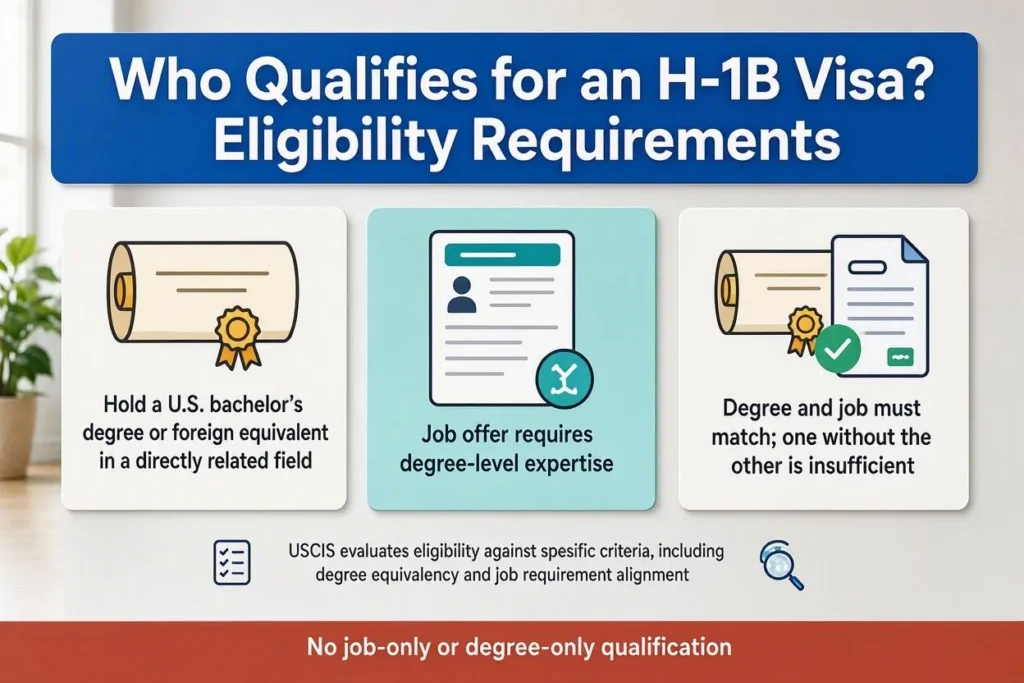
Yes, you qualify for an H-1B visa if you hold a U.S. bachelor’s degree or its foreign equivalent in a field directly related to a job offer that itself requires that degree. A job offer alone doesn’t help if the role doesn’t actually demand degree-level expertise, and a degree alone doesn’t help without a matching job.
USCIS checks eligibility against six specific criteria:
- A bachelor’s degree or higher (or its equivalent) is the standard minimum requirement for entry into the occupation
- The specific job duties are so specialized and complex that only someone with that degree could perform them
- The employer normally requires a degree for this exact position, based on past hiring patterns
- The degree requirement is common across the industry for parallel roles at similar organizations
- Foreign degree holders must submit a credential evaluation proving equivalence to a U.S. bachelor’s degree
- Applicants without a degree can sometimes qualify through progressively responsible work experience, generally calculated at three years of experience per year of missing college education
A computer science graduate offered a software engineering role at a mid-sized firm meets the standard easily. A marketing coordinator role without a defined degree requirement often doesn’t, which is why sales and generalist positions get flagged more often during review.
What Are the Employer Requirements for H-1B Sponsorship?
An employer must file a certified Labor Condition Application (LCA) with the Department of Labor (DOL) before submitting any H-1B petition to USCIS. The LCA is a legal attestation, not a formality. The employer swears, under penalty of perjury, that hiring the foreign worker won’t harm the wages or working conditions of similarly employed U.S. workers.
Beyond the LCA, employers must meet four additional obligations:
- Post a notice of the intended H-1B hire in the workplace for at least ten business days, or notify the relevant union if one exists
- Pay the required wage, meaning whichever is higher between the prevailing wage for the role and region, or the actual wage paid to similarly qualified employees at the company
- Confirm no active strike or lockout exists in the occupation at the worksite
- Maintain a public access file documenting compliance, available for DOL inspection
If the employer changes the worker’s job duties, work location, or salary in a way that departs materially from the original petition, it must file an amended petition. Skipping that step is one of the more common compliance failures the DOL’s 2025 enforcement initiative, Project Firewall, was built to catch.
What Is the H-1B Wage Requirement?
H-1B employers must pay the higher of two figures: the prevailing wage for the occupation in that geographic area, or the actual wage the company pays other employees with similar experience in the same role. The prevailing wage comes from DOL wage data tied to occupation code, skill level, and location, so a software engineer role in San Francisco carries a different prevailing wage than the same title in Boise.
The data backs up the claim that H-1B wages run well above the national median. In 2021, the median H-1B salary reached $108,000, compared to $45,760 for U.S. workers overall. Between 2003 and 2021, H-1B wages grew 52%, outpacing the 39% wage growth for all U.S. workers over the same period. In FY2019, 78% of employers who hired H-1B workers paid above the prevailing wage benchmark set by DOL, not just at it.
Employers who underpay face real consequences. Willful violators land on the DOL’s public debarment list and can lose H-1B sponsorship privileges for years.
What Documents Do You Need for an H-1B Visa?
You need six core documents to apply for H-1B status: a certified LCA, the employer’s Form I-129 petition, proof of your degree or its equivalent, a valid passport, the USCIS approval notice (Form I-797), and a completed visa application form for consular processing. Missing paperwork is one of the most preventable causes of delay.
The full document checklist typically includes:
- Form I-797, Notice of Action, the official approval notice for the H-1B petition, issued by USCIS
- Copy of the certified Labor Condition Application, showing DOL approval of the wage attestation
- Educational credentials, including transcripts, diplomas, or a foreign credential evaluation report if the degree was earned outside the United States
- Current employment offer letter, printed on company letterhead, specifying job title, duties, and salary
- Valid passport, with at least six months’ validity beyond the intended entry date
- DS-160 visa application confirmation page, completed online before the consular interview
Applicants renewing or extending status inside the U.S. should also keep pay stubs from the prior two months if they were previously employed on H-1B status. Consular officers ask for this to confirm continuous, lawful employment.
How Does H-1B Registration and the Lottery Work?
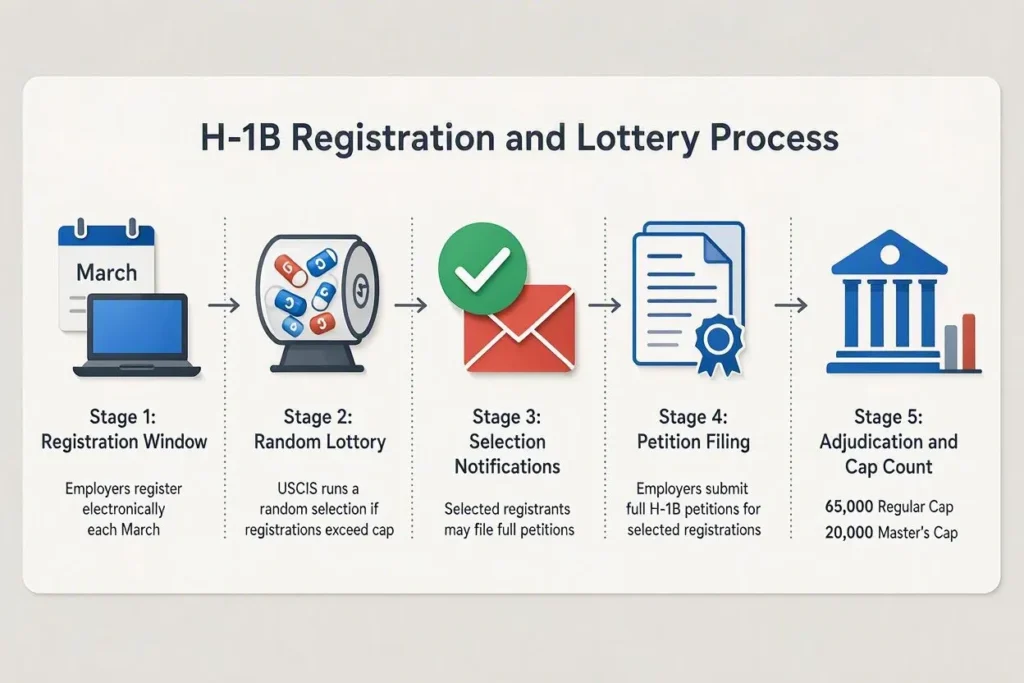
Employers register electronically with USCIS every March, and if registrations exceed the annual cap, USCIS runs a random lottery to select who can file a full petition. This system replaced the old first-come, first-served petition filing in 2020, cutting the paperwork burden for employers who might not even get selected.
The process runs in five stages:
- USCIS opens the registration window, typically for a two-to-three week period in March, requiring a $215 fee per unique beneficiary
- USCIS runs the lottery if registrations exceed available visa numbers, selecting the standard 65,000 general-cap slots first, then the 20,000 U.S. master’s degree exemption slots
- Selected employers receive notification through their USCIS online account, then have a 90-day window to file the complete petition
- The petitioner submits Form I-129 along with supporting evidence, the certified LCA, and the required filing fees
- USCIS adjudicates the petition, approving, denying, or issuing a Request for Evidence (RFE) if documentation looks incomplete
For FY2026, USCIS selected 118,660 unique beneficiaries out of roughly 339,000 eligible registrations, a 26.9% drop from the prior year. That decline reflects the shift to a beneficiary-centric registration model, which now counts each individual once instead of counting duplicate employer registrations for the same person.
A new weighted selection rule takes effect starting with the FY2027 cap season, on February 27, 2026. Under this rule, higher-paid, higher-skilled roles get better odds in the lottery, a shift away from the pure random draw used in prior years.
What Does an H-1B Visa Cost?
The base H-1B costs range from $215 for registration to several thousand dollars in combined filing and legal fees, plus a mandatory $100,000 government fee for new petitions filed on or after September 21, 2025. That $100,000 figure is the single biggest cost change to the program since its creation, and it applies specifically to new H-1B petitions within a defined window, not to extensions or existing H-1B holders.
A typical cost breakdown looks like this:
- $215 registration fee, paid per beneficiary during the March registration window
- USCIS Form I-129 filing fee, which varies by employer size and petition type
- $2,500 premium processing fee, optional, guarantees a response within 15 calendar days instead of several months
- $100,000 proclamation fee, applies to new petitions filed after September 21, 2025, with exceptions available where the hire is deemed in the national interest or poses no security concern
- Attorney fees, typically several thousand dollars depending on case complexity and firm
Existing H-1B holders extending their status or transferring between employers are generally not subject to the $100,000 fee. Several lawsuits currently challenge the fee’s legality, since it was implemented through presidential proclamation rather than congressional legislation, so its long-term status remains unresolved.
How Long Does an H-1B Visa Last?
An H-1B visa lasts three years initially and can be extended once for a maximum total stay of six years. After six years, the worker must leave the U.S. for at least one year before becoming eligible for another H-1B period, unless a pending green card application qualifies them for extensions beyond the six-year cap.
Workers with an approved I-140 immigrant petition, the first step toward a green card, can extend H-1B status in one-year increments past the six-year limit while their green card case moves through the system. This provision matters most for applicants from India and China, where employment-based green card backlogs regularly run into years or decades due to per-country visa limits.
Can H-1B Workers Bring Their Family?
Yes, spouses and unmarried children under 21 can accompany an H-1B worker on H-4 dependent visas. H-4 holders cannot work in most cases, though one specific exception applies.
If the H-1B worker has an approved I-140 immigrant petition, the H-4 spouse becomes eligible to apply for an Employment Authorization Document (EAD), granting the right to work in the United States. Without that approved I-140, the H-4 spouse remains restricted to non-working status, even while legally residing in the country.
What Are the Most Common Reasons H-1B Petitions Get Denied?
The five most common denial reasons are an unqualified specialty occupation, insufficient applicant credentials, wage levels below the prevailing wage, exceeding the six-year cap, and unresolved home-country residency requirements for former J-1 exchange visitors. Denial rates have swung significantly over the past decade: six percent in FY2015, up to 24% in FY2018, then dropping to just two percent in both FY2021 and FY2022, the two lowest rates on record.
Applicants run into trouble in these specific scenarios:
- The offered position lacks a clearly defined degree requirement, common in sales, generalist, or loosely defined administrative roles
- The applicant’s coursework or prior experience doesn’t align closely enough with the job’s specialty field
- The company’s proposed wage falls below the DOL-determined prevailing wage for that occupation and location
- The worker has already used the full six years of H-1B status without an approved I-140 to extend further
- A former J-1 exchange visitor remains subject to the two-year home-country physical presence requirement and hasn’t obtained a waiver
An RFE doesn’t automatically mean denial. It means USCIS wants clarification or additional evidence before making a final decision, and many RFE responses succeed when handled with proper documentation.
How Do H-1B Requirements Differ by Country?
The core eligibility requirements stay identical across every country, but the consular processing step and wait times vary based on where the applicant applies for the visa stamp. Indian and Chinese nationals face the longest green card backlogs due to per-country annual limits, even though H-1B eligibility itself doesn’t discriminate by nationality.
A few country-specific notes matter for applicants:
- Canadian citizens are exempt from the H-1B visa stamp requirement at ports of entry, though they still need an approved petition
- Applicants from Iran, North Korea, Cuba, and Syria must complete an in-person interview with a consular officer as a standard security step
- Indian and Filipino applicants, who represent two of the largest H-1B beneficiary populations, should expect longer green card wait times after H-1B approval due to per-country caps under U.S. immigration law
- UK, European, and Nepali applicants generally see shorter green card wait times once sponsored, since demand from these countries falls well under the per-country limit
Wherever the applicant is from, the visa stamp itself must be obtained at a U.S. embassy or consulate outside the United States. Status cannot be converted to an H-1B visa stamp from within U.S. borders.
Can an H-1B Visa Lead to a Green Card?
Yes, H-1B status is one of the most common pathways to a U.S. green card, and H-1B holders can pursue permanent residency without it counting against their nonimmigrant status. Unlike some other visa categories, H-1B applicants aren’t required to prove they intend to return to their home country, which makes the visa compatible with long-term immigration plans from day one.
The typical pathway runs through employer sponsorship of a PERM labor certification, followed by an I-140 immigrant petition, and finally an I-485 adjustment of status application once a visa number becomes available. Processing time depends heavily on the applicant’s country of birth and green card category, with backlogs for India-born applicants in particular extending well beyond a decade in some employment categories.
What Are the Alternatives If You Don’t Get an H-1B?

If the H-1B lottery doesn’t select your registration, four main alternative visa categories exist: O-1 for extraordinary ability, L-1 for intracompany transfers, TN for Canadian and Mexican citizens, and E-3 exclusively for Australian citizens. Each carries its own eligibility bar, and none uses a lottery system.
- O-1 visa requires demonstrated extraordinary ability in the field, backed by awards, publications, or recognized achievements
- L-1 visa applies to employees transferring within the same multinational company to a U.S. office, requiring at least one year of prior employment abroad
- TN visa is available only to Canadian and Mexican citizens under trade agreement provisions, with a streamlined application process
- E-3 visa functions similarly to H-1B but applies exclusively to Australian citizens under a bilateral treaty
Some employers file cap-exempt H-1B petitions instead, available for jobs at universities, nonprofit research organizations, and government research institutions, none of which count against the 65,000-visa annual cap.
Conclusion
Meeting the H1B visa requirements means checking five boxes at once: a qualifying degree, a matching job offer, an employer willing to sponsor, wage compliance, and a completed LCA before petition filing. Get selected in the lottery, and the process moves from registration to petition to visa stamp over several months. Miss the cap this year, and options like the O-1, L-1, or a cap-exempt employer remain open. The rules haven’t gotten simpler since the 2025 fee changes and the new weighted selection process, but they remain fully navigable with the right documentation and timing.
FAQs

Michael Reynolds
Michael Reynolds leads immigration content at ImmigrationWin, covering visa requirements, application and relocation pathways. He researches immigration policies and official government guidance to explain changing rules clearly. His guides help students, families, and professionals make informed decisions about moving abroad.
Related Posts