How Do Employers Sponsor Work Visas? A Complete Employer Guide
Employers sponsor work visas by filing a petition with the U.S. Citizenship and Immigration Services (USCIS) on behalf of a foreign worker, after clearing any required labor certification with the Department of Labor (DOL). A restaurant group hiring a specialty chef under an H-1B faces a very different cost structure and timeline than a software company sponsoring an engineer for a green card through PERM labor certification. The process breaks down into five stages: choosing a visa category, clearing labor certification where it’s required, filing with USCIS, waiting for a decision, and then supporting the worker’s visa application abroad or status adjustment inside the country. This guide walks through each stage, along with realistic costs, processing times, and the compliance work that comes with sponsoring foreign talent.
What Does It Mean to Sponsor a Work Visa?
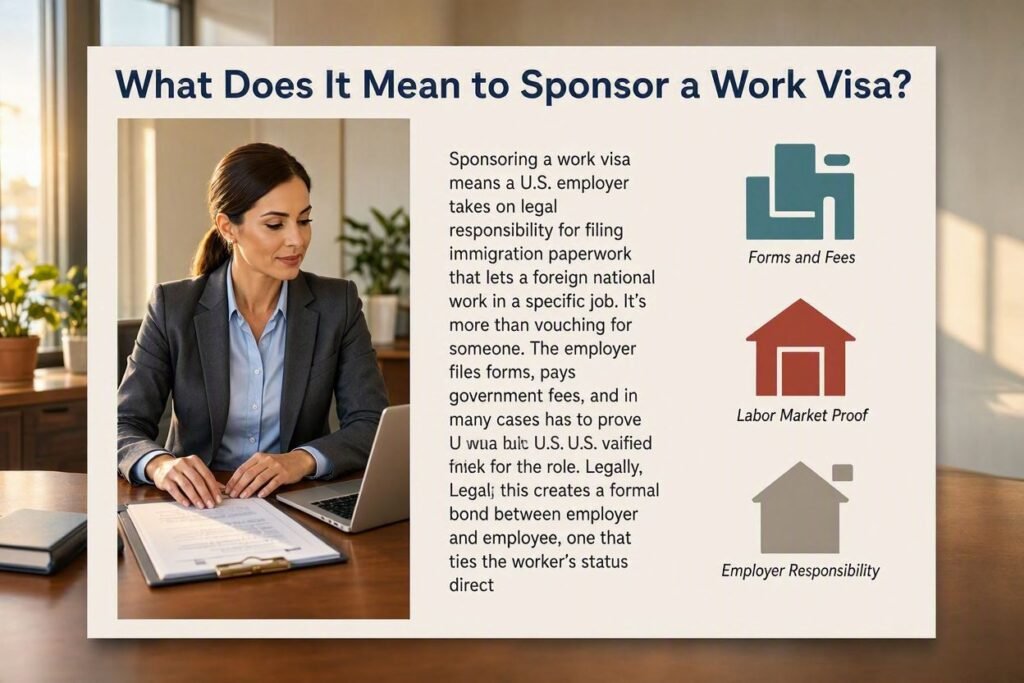
Sponsoring a work visa means a U.S. employer takes on legal responsibility for filing immigration paperwork that lets a foreign national work in a specific job. It’s more than vouching for someone. The employer files forms, pays government fees, and in many cases has to prove no qualified U.S. worker was available for the role. Legally, this creates a formal bond between employer and employee, one that ties the worker’s status directly to the company that filed for them. Lose the job, and in most cases the clock starts running on the visa too. There’s usually a grace period to find a new sponsor or switch classifications, but it’s not indefinite.
Which Employers Can Sponsor a Work Visa?
Any U.S. employer with an active federal tax ID, a genuine job opening, and the ability to pay the required wage can sponsor a work visa. This isn’t reserved for large corporations. A 12-person marketing agency in Austin can sponsor an H-1B candidate under the same core rules as a Fortune 500 company, as long as it meets wage and documentation standards.
What USCIS Checks Before Approving a Sponsorship Petition
- A bona fide, full-time or qualifying part-time position
- At least the prevailing wage for the occupation and geographic area
- A genuine employer-employee relationship, including the right to direct and control the worker’s tasks
- Compliance with federal labor and immigration recordkeeping requirements
- A Public Access File (PAF) ready for Department of Labor audits, covering wage data and recruitment records
What the Foreign Worker Needs to Meet
- The required degree, license, or work experience for the position
- A clean background and admissibility screening
- Documentation supporting education, employment history, and, for some categories, extraordinary ability
- Qualification under the specific visa classification the petition names
The Step-by-Step Process
Employers sponsor work visas through five stages: selecting the visa category, completing labor certification, filing the petition with USCIS, waiting for adjudication, and supporting the employee’s visa application. A lot of the delays companies run into come down to skipping a step or filing forms out of order.
Step 1: Determine the Right Visa Category
This comes down to matching the job and the candidate’s background against what each classification actually allows. Take a hospital recruiting a nurse from the Philippines: that’s probably an EB-3 green card case. A bank transferring a manager over from its London office is a different animal entirely, and it’ll use an L-1.
Step 2: File the Labor Condition Application or Labor Certification
Most temporary visa categories require a Labor Condition Application (LCA) filed with the DOL, attesting that the employer will pay the prevailing wage and that the hire won’t harm working conditions for U.S. employees. Permanent, employment-based sponsorship generally requires PERM labor certification instead, which can take 6 to 12 months and includes mandatory recruitment of U.S. workers before the employer can show none were qualified or available.
Step 3: File the Petition with USCIS
That means Form I-129 (Petition for Nonimmigrant Worker) for temporary visas, or Form I-140 (Immigrant Petition for Alien Worker) for green cards, once labor certification clears (if it applies to that category). USCIS charges a base filing fee of $780 for Form I-129, plus additional fees for fraud prevention, and for certain H-1B employers, an annual supplemental fee of $4,000 or $4,500 tied to company size.
Step 4: Wait for Adjudication
USCIS reviews the petition for eligibility, wage compliance, and supporting evidence. Standard processing runs 2 to 8 months depending on the visa category and service center. Employers who don’t want to wait can pay for premium processing with Form I-907, which guarantees a decision within 15 calendar days.
Step 5: The Employee Applies for the Visa
Once USCIS approves the petition, the employee applies for the visa stamp at a U.S. embassy or consulate abroad, or adjusts status from within the U.S. if already present on a valid visa. Consular processing typically adds another 2 to 6 weeks, though wait times vary a lot by country and embassy workload.
The Most Common Work Visas Employers Sponsor
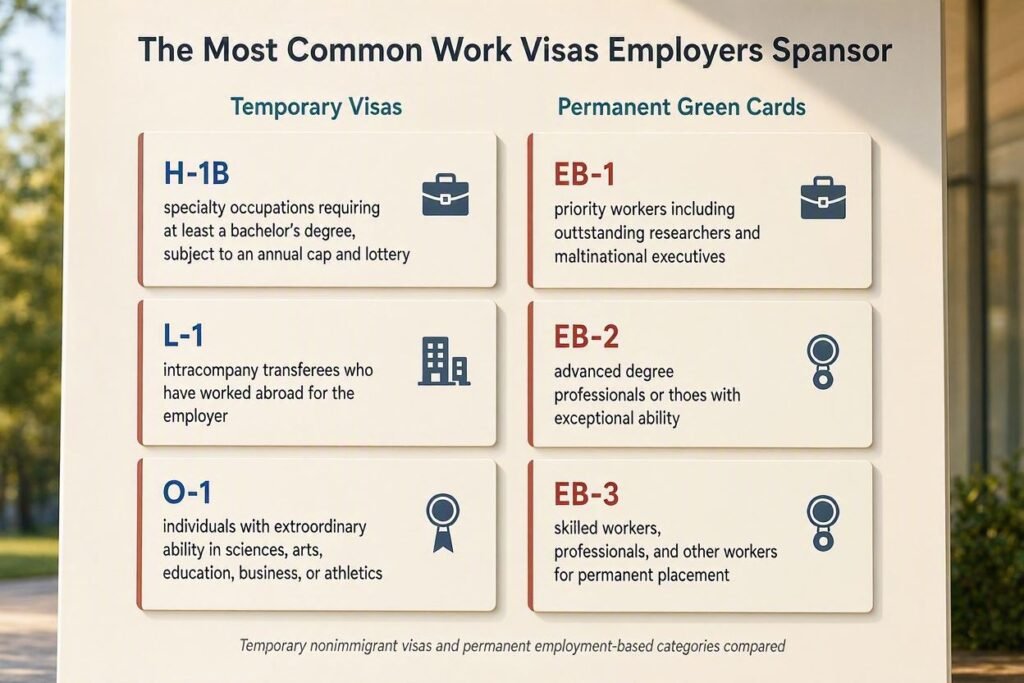
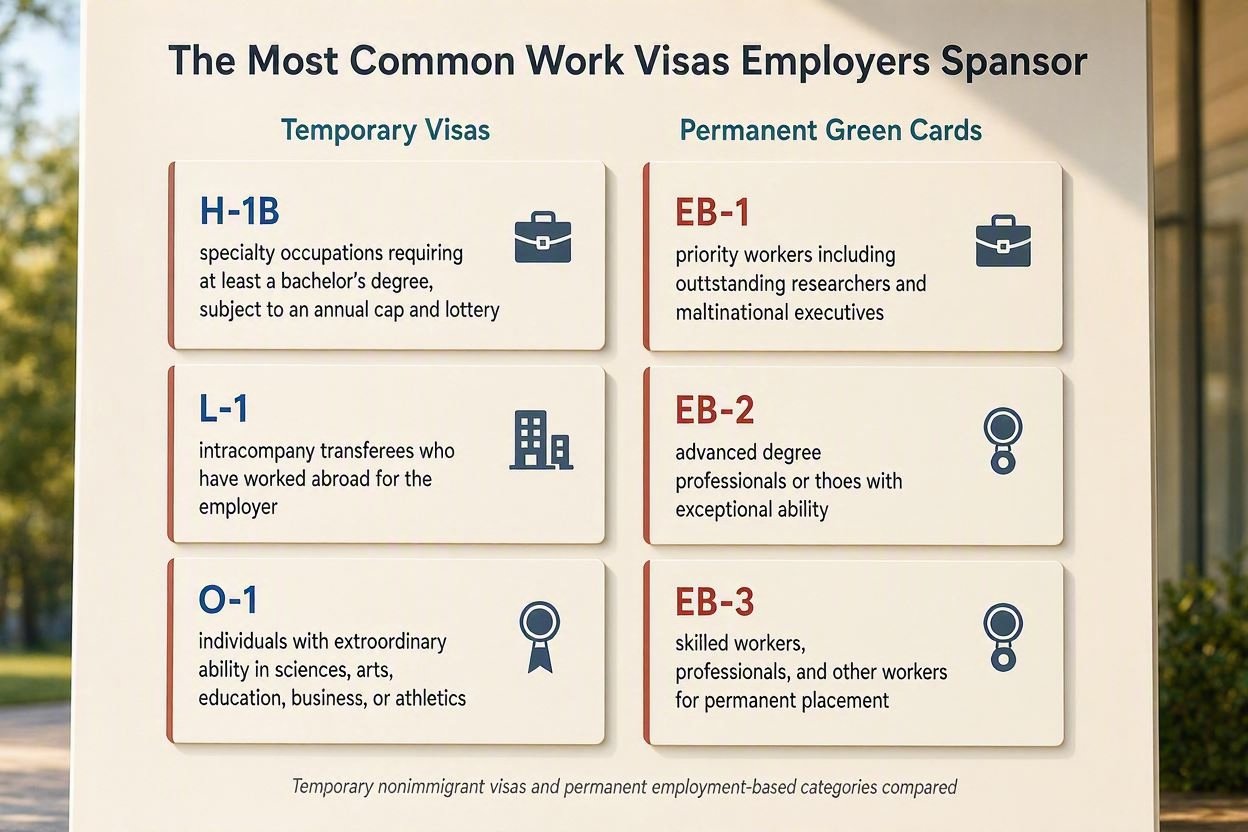
Employers most often sponsor H-1B, L-1, and O-1 temporary visas, alongside EB-1, EB-2, and EB-3 permanent green cards. Each fits a different hiring scenario, from specialty occupations to intracompany transfers to permanent placements.
Temporary (Nonimmigrant) Visas
- H-1B – specialty occupations requiring at least a bachelor’s degree, subject to an annual cap and lottery
- L-1 – intracompany transferees who worked abroad for the same employer for at least a year within the prior three
- O-1 – individuals with extraordinary ability in the sciences, business, education, arts, or athletics
- TN – professionals from Canada or Mexico under the USMCA
- E-2 – treaty investors and their essential employees from qualifying treaty countries
Both the H-1B and L-1 carry “dual intent,” meaning the worker can pursue a green card while still holding the temporary visa without jeopardizing their status.
Permanent (Employment-Based Green Card) Visas
- EB-1 – priority workers: outstanding researchers, multinational executives, people with extraordinary ability
- EB-2 – professionals with advanced degrees or exceptional ability, getting 28.6% of the yearly worldwide employment-based visa limit
- EB-3 – skilled workers, professionals, and other workers, also allotted 28.6% of the annual limit
- EB-4 – certain special immigrants, such as religious workers
- EB-5 – immigrant investors who commit qualifying capital to a new commercial enterprise
According to Department of State data, roughly 140,000 employment-based immigrant visas become available each fiscal year across all five preference categories.
How Much Does It Cost to Sponsor a Work Visa?
Sponsoring a work visa runs employers $2,000 to $10,000 per employee for temporary visas, and $5,000 to $15,000 or more for green card sponsorship, once government fees and attorney costs are added up. Premium processing tacks on another $2,965 if the company wants a faster decision (that fee rose from $2,805 in March 2026, a reminder that these numbers are worth double-checking before you budget around them).
One cost that doesn’t fit the usual range: under a September 2025 presidential proclamation still in effect, H-1B petitions filed for a beneficiary who is outside the U.S. and doesn’t already hold a valid H-1B visa carry an additional one-time $100,000 fee. It doesn’t apply to extensions, amendments, or change-of-status petitions for someone already working in the U.S., so most transfers and renewals are unaffected, but it’s a major factor for anyone hiring a new H-1B worker from abroad.
Add it up for a mid-size manufacturing firm sponsoring an H-1B engineer: $780 for the I-129 filing fee, $500 for fraud prevention, $1,500 to $4,500 in attorney fees, and the $4,000 supplemental fee that applies to larger employers. That’s already past $7,000 before the worker starts. Green card sponsorship stacks PERM recruitment advertising costs on top of all that, typically $1,000 to $3,000, plus I-140 filing fees and legal representation.
How Long Does Work Visa Sponsorship Take?
Timelines range from 2 to 3 months for straightforward temporary visas to 2 to 3 years for employment-based green cards facing backlogged priority dates. Country of birth matters more than almost anything else here. The Visa Bulletin, published monthly by the Department of State, sets separate waiting lines for countries with high demand, including India and China.
An EB-2 petition for an employee born in Germany might clear within 12 to 18 months from filing to approval. The same category for someone born in India can mean a wait of 5 to 10 years or longer under current Visa Bulletin backlogs, because per-country visa allocations cap each nation at 7% of the annual worldwide total, regardless of how many petitions get filed.
What Is the H-1B Cap and Selection Process?
The H-1B cap limits new visas to 65,000 per year, plus another 20,000 for applicants with a U.S. master’s degree or higher. Demand exceeds supply nearly every year, and selection is no longer a straight coin flip: starting with the FY2027 cycle, USCIS replaced the old random lottery with a wage-weighted selection process, where registrants offered higher wages (measured against Department of Labor prevailing-wage levels) have better odds of being picked. Employers still register candidates online each March, paying a $215 registration fee per beneficiary well before filing the full petition.
For the FY2027 cap, USCIS reported roughly 211,600 properly submitted registrations, down sharply from 343,981 the year before, and still enough to fill all 85,000 slots. Employers who miss selection have to wait until the following fiscal year, unless the candidate qualifies for a cap-exempt employer (a university or nonprofit research organization, for example) or holds Optional Practical Training status with a pending cap-gap extension tied to a prior registration.
What Are the Employer’s Compliance Obligations?
Accurate wage records, posted labor notices, documentation ready for a federal audit at any time: that’s the baseline. The DOL can request a company’s Public Access File at any point during an LCA-based visa’s validity period. Fail to produce accurate records and the fines start at $1,000 per violation, climbing well into the tens of thousands for willful violations.
A staffing agency caught underpaying H-1B workers below the certified prevailing wage can face back-wage orders covering the full violation period, plus debarment from filing future petitions for up to three years. And beyond wage compliance, employers must complete Form I-9 verification for every employee, sponsored or not, and retain those records for the legally required period after hire or termination.
Can Employees Bring Family Members Under Sponsorship?
Yes. Most work visa categories allow spouses and unmarried children under 21 to accompany the sponsored employee, though the employer doesn’t file separate paperwork for them. Dependents typically get a corresponding visa classification, like H-4 for H-1B dependents or L-2 for L-1 dependents. Some categories, including H-4 and L-2, let the spouse apply separately for employment authorization.
Do Employers Need an Immigration Attorney?
Not legally, no. But most companies use one anyway, because filing errors are a common cause of delays and denials. A small business filing its first H-1B petition without legal guidance risks incomplete wage documentation or a missed deadline that pushes the start date back by months. Large companies with in-house immigration counsel handle high-volume sponsorship very differently than a five-person startup filing its first petition, even though the underlying government requirements are identical either way.
What Happens if a Visa Petition Is Denied?

A denied petition comes back to the employer with a written explanation, and the company can refile with corrected evidence, appeal, or request reconsideration depending on why it was denied. USCIS issues a Request for Evidence (RFE) before most denials, which gives employers a chance to submit more documentation. Immigration attorneys commonly cite a 60% to 70% approval rate for properly answered RFEs, though USCIS doesn’t publish that figure directly, so treat it as a rule of thumb rather than an official statistic.
A tech startup that gets an RFE questioning whether a role qualifies as a “specialty occupation” can respond with a detailed job description, an organizational chart, and evidence tying the position to a specific degree requirement. Petitions denied outright, without an RFE, can sometimes go to the Administrative Appeals Office, though appeals add six months or more to the timeline.
Conclusion
If you’re evaluating a sponsorship case for the first time, the best place to start is mapping the job requirements against the rules for the specific visa category, before you commit to the hire. The process, the cost, and the timeline all hinge on that fit.
FAQs

Michael Reynolds
Michael Reynolds leads immigration content at ImmigrationWin, covering visa requirements, application and relocation pathways. He researches immigration policies and official government guidance to explain changing rules clearly. His guides help students, families, and professionals make informed decisions about moving abroad.
Related Posts