
How to Renew a Work Visa: Step-by-Step Guide for US Workers
Renewing a work visa means filing Form I-765, Application for Employment Authorization, with United States Citizenship and Immigration Services (USCIS) before your current card expires, paying the correct fee, and waiting for a new Employment Authorization Document (EAD), also called Form I-766. The process changed in a real way on October 30, 2025, when USCIS ended automatic extensions for most renewal filers. Workers get caught off guard by that change constantly. Knowing how to renew a work visa correctly, and on the right timeline, matters a lot more than it did two years ago.
This guide walks through the filing steps, current fees, category-specific rules for H-1B, L-1, and E visa holders, and the mistakes that stall a case at USCIS for six months or longer.
What Does It Mean to Renew a Work Visa?
“Renewing a work visa” almost always refers to renewing an Employment Authorization Document, not a visa stamp in a passport. A visa stamp gets you into the country. An EAD is the card that proves you’re allowed to work once you’re here. Workers on H-1B or L-1 status don’t need a separate EAD; their status itself authorizes employment. Workers on OPT (Optional Practical Training), DACA (Deferred Action for Childhood Arrivals), TPS (Temporary Protected Status), or a pending green card application do need one, and it’s that card people mean when they ask how to renew a work visa.
Confusing the two documents causes real problems. A worker on F-1 OPT status renews an EAD; she never had a separate work visa to renew in the first place. An L-1B specialist at a manufacturing firm, by contrast, renews his underlying visa status through Form I-129, not Form I-765. The correct form depends entirely on which category applies.
When Should You File Your Work Visa Renewal?
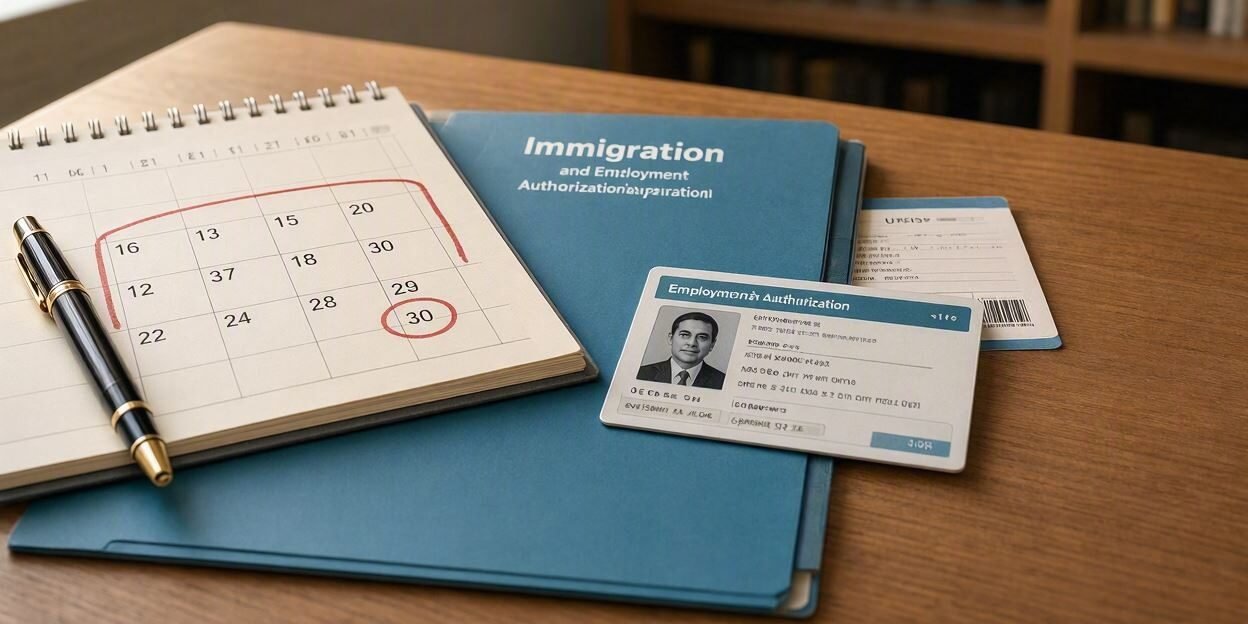
File your renewal up to 180 days before your current EAD or visa status expires. Filing earlier inside that window lowers your risk of a gap in authorization, and USCIS itself points to the 180-day mark as the outer limit for renewal filings. Waiting until 30 or 60 days before expiration used to be survivable, thanks to the old automatic extension rule. It isn’t anymore.
Here’s why timing matters more now. Processing times for Form I-765 renewals commonly run 3 to 6 months in 2026, and some categories stretch past 8 months during backlog periods. A worker who files 90 days before expiration, expecting a 4-month wait, ends up with an unauthorized gap of at least 30 days if USCIS doesn’t move faster than average. Filing at the 180-day mark absorbs that delay without a lapse.
How to Renew a Work Visa: Step-by-Step Process
Renewing a work visa involves six steps: confirming eligibility, gathering documents, filing Form I-765, paying the correct fee, attending biometrics if required, and tracking your case through decision. Each step below breaks down what USCIS actually checks.
Step 1: Confirm Your Eligibility Category
Your eligibility category, a two-letter, two-number code like (c)(3)(B) or (a)(12), determines your fee, your required evidence, and whether automatic extension protection applies to you. Look at Item 27 on your current EAD or your prior I-765 receipt notice to find your code. A DACA recipient files under (c)(33). An asylum applicant files under (c)(8). A pending green card applicant filing concurrently uses (c)(9). Filing under the wrong code triggers a rejection, and a rejection resets your place in line entirely.
Step 2: Gather Required Documents
Every renewal package needs a completed Form I-765, a copy of your current or most recently expired EAD (front and back), and two passport-style photos taken within 30 days of filing. Beyond that baseline, categories require additional proof: a marriage certificate for a dependent spouse, an approval notice for an underlying petition, or a school-issued I-20 for OPT applicants. A dependent spouse on an H-4 or L-2 EAD renewal, for instance, must also include the principal visa holder’s current I-797 approval notice showing their status remains valid. Missing that one document is one of the most common reasons USCIS issues a Request for Evidence (RFE).
Step 3: File Form I-765
File online through your myUSCIS account or by mail to the correct lockbox address listed for your eligibility category. The address differs by category, and mailing to the wrong lockbox delays receipt processing by weeks. The current form edition is dated 08/21/25; USCIS rejects outdated editions automatically. Online filing produces an immediate receipt number and generally costs less than paper filing.
Step 4: Pay the Correct Fee
Pay by credit card if filing online, or by check, money order, or Form G-1450 credit card authorization if filing by mail. The exact amount depends on your category and filing method, covered in detail below. An unsigned check or an outdated fee amount is grounds for rejection, so double-check the current fee schedule on USCIS.gov before submitting.
Step 5: Attend Your Biometrics Appointment
Most renewal categories no longer require a separate biometrics appointment, since USCIS folded that cost into the base filing fee in April 2024. Temporary Protected Status applicants remain an exception and still pay a reduced biometric services charge. If USCIS reuses your biometrics on file from a prior filing, you’ll receive a notice confirming that instead of a new appointment.
Step 6: Track Your Case and Respond to USCIS Requests
Check your case status through your myUSCIS account or the USCIS Case Status Online tool using your 13-character receipt number, and respond to any Request for Evidence within the deadline stated on the notice, typically 87 days. A missed RFE deadline results in denial, not a second chance. Set a calendar reminder the day the receipt notice arrives, not the day the RFE letter shows up.
How Much Does It Cost to Renew a Work Visa?
The standard Form I-765 renewal fee is $470 for online filing and $520 for paper filing in 2026, though several categories pay different amounts. A pending green card applicant who filed Form I-485 after April 1, 2024, pays a reduced fee of $260 for each EAD renewal while that application remains open. Asylum and TPS renewal applicants pay $280. Premium processing, available for select categories through Form I-907, costs $1,780 for F-1 OPT and STEM OPT filers and up to $2,965 for other eligible categories, guaranteeing a decision within 30 business days.
| Category | Filing Method | Fee |
| Standard I-765 renewal | Online | $470 |
| Standard I-765 renewal | Paper | $520 |
| Pending green card (Form I-485 filed on or after 4/1/2024) | Online or paper | $260 |
| Pending green card (Form I-485 filed before 4/1/2024, fee already paid) | Online or paper | $0 |
| Asylum / TPS renewal | Online or paper | $280 |
| Premium processing, F-1 OPT / STEM OPT | Form I-907 | $1,780 |
| Premium processing, other eligible categories | Form I-907 | $2,965 |
Three cost mistakes come up again and again. Applicants send the fee amount from a prior renewal, unaware that USCIS raised it. Applicants combine two separate forms into a single check, which USCIS now rejects outright since April 2022; each form needs its own payment instrument. And applicants skip the fee-waiver option (Form I-912) that certain humanitarian categories, including some asylees, refugees, and VAWA self-petitioners, qualify for automatically.
Does Automatic Extension Still Apply If You File Late?
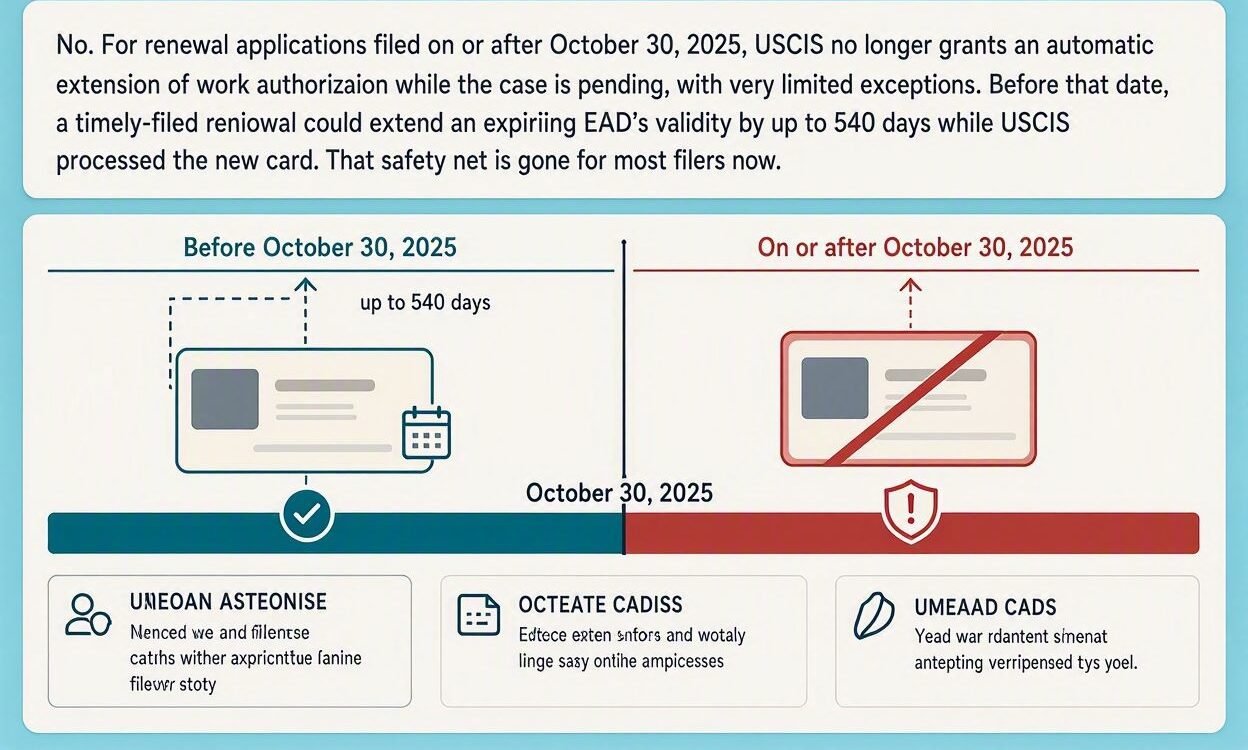
No. For renewal applications filed on or after October 30, 2025, USCIS no longer grants an automatic extension of work authorization while the case is pending, with very limited exceptions. Before that date, a timely-filed renewal could extend an expiring EAD’s validity by up to 540 days while USCIS processed the new card. That safety net is gone for most filers now.
This change reshapes the entire renewal calculation. Under the old rule, filing 60 days before expiration was risky but survivable, since the automatic extension bridged the gap. Under the current rule, a worker whose EAD expires while a renewal is still pending has no legal authorization to work at all, and the employer faces real I-9 compliance exposure for allowing continued employment. The 180-day filing window isn’t a suggestion anymore. It’s the only real buffer left.
How Long Does Work Visa Renewal Take?
Form I-765 renewals typically take 3 to 6 months to process in 2026, though specific categories and service centers can push that timeline past 8 months during backlog periods. Processing time varies by eligibility category, by which USCIS service center handles the case, and by whether the application arrives complete on the first submission. A clean, accurate filing with no RFE moves faster than one that requires a follow-up response, sometimes by 60 days or more.
Premium processing shortens the wait dramatically for eligible categories, guaranteeing action within 30 business days for a fee of $1,780 to $2,965. Not every category qualifies, so check eligibility before assuming the option is available to you.
How to Renew Specific Work Visa Types
Different visa categories carry different caps, forms, and renewal mechanics. A one-size answer to “how to renew a work visa” doesn’t hold up once you compare H-1B rules against L-1 or E-visa rules side by side.
H-1B Visa Renewal
H-1B extensions are filed in increments of up to three years, capped at a total of six years, unless the worker qualifies for an exception tied to an employment-based green card process under AC21 (American Competitiveness in the 21st Century Act). The employer files Form I-129 on the worker’s behalf, not the worker directly, and USCIS recommends filing at least six months before the current status expires. A software engineer three years into an initial H-1B term, with an employer-sponsored I-140 petition approved, can extend beyond the six-year cap in one-year increments under AC21. Without that approved I-140, the cap applies strictly.
L-1 Visa Renewal
L-1A intracompany transferee executives and managers can extend their status up to a maximum of 7 years total, while L-1B specialized-knowledge employees cap out at 5 years total. The employer files Form I-129 with evidence of the qualifying relationship between the U.S. and foreign entity, plus proof the employee continues in a qualifying role. Extensions typically come in two-year increments after the initial term.
E-1 and E-2 Visa Renewal
E-1 treaty trader and E-2 treaty investor visas renew in increments tied to the underlying treaty, with no fixed maximum number of extensions, as long as the qualifying trade or investment activity continues. Because there’s no hard year cap, an E-2 investor who maintains an active, operating business can renew indefinitely, filing Form I-129 (or applying at a US consulate for a new visa stamp) each time the current period nears its end.
DACA and TPS Work Permit Renewal
DACA recipients and TPS beneficiaries renew their EADs using Form I-765 under their specific eligibility codes, (c)(33) for DACA and (a)(12) or (c)(19) for TPS, following the same 180-day filing window as other renewal categories, without the automatic extension protection that ended in October 2025. DACA renewal guidance historically recommended filing 120 to 150 days ahead. Given the end of automatic extensions, filing at the full 180-day mark now cuts your risk by a wide margin.
What Happens If You Work With an Expired Work Visa?
Working with an expired EAD or expired visa status is unauthorized employment, and it can jeopardize current immigration status, future green card eligibility, and reentry into the United States. Employers who knowingly continue employing a worker without valid authorization face civil penalties that scale with violation count and, for repeat or willful violations, potential criminal liability under federal law.
A single lapse rarely ends someone’s immigration case outright, but it builds a record. USCIS and other agencies review unauthorized employment periods during green card adjustment interviews, and gaps that once got smoothed over through automatic extension now show up as unexplained unauthorized work, a red flag reviewers didn’t have to weigh as heavily before October 2025.
Common Mistakes That Delay Work Visa Renewal
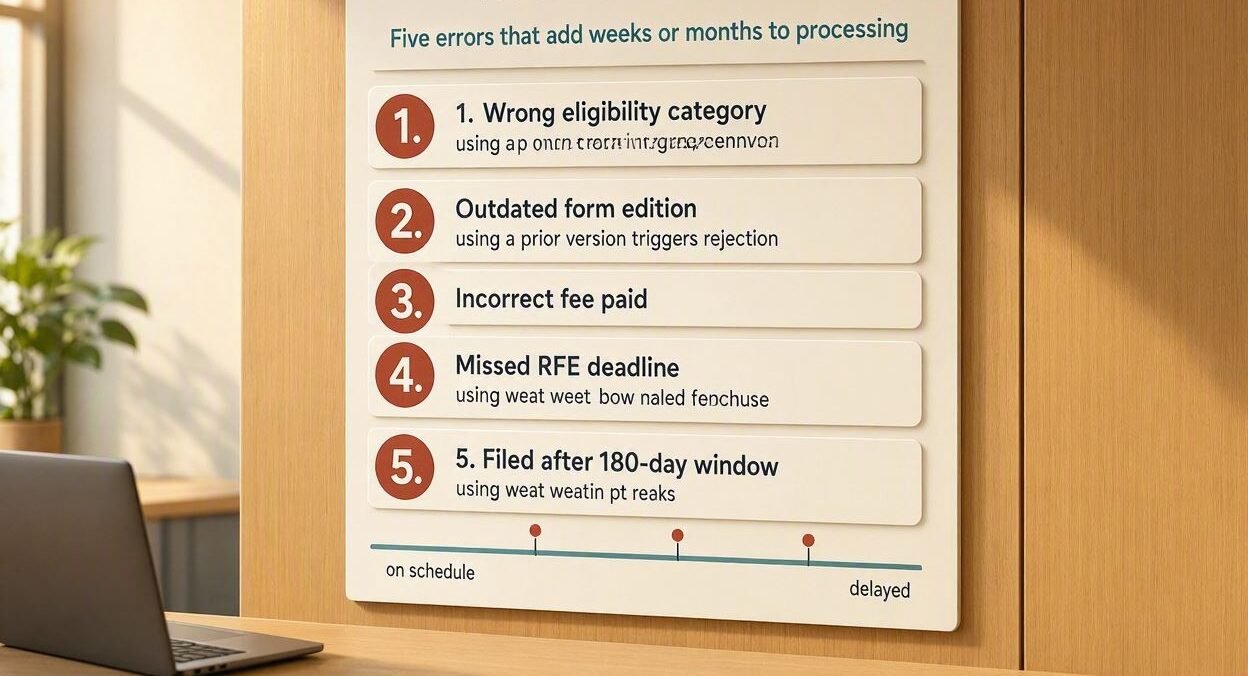
The five most common renewal mistakes are filing under the wrong eligibility category, submitting an outdated form edition, paying the incorrect fee, missing an RFE deadline, and waiting past the 180-day window to file. Each one adds weeks or months to a case that otherwise would have processed on schedule.
- Filing under the wrong eligibility category, which triggers rejection and restarts the receipt date
- Submitting the outdated 05/31/22 form edition instead of the current 08/21/25 version
- Paying last year’s fee amount instead of the current $470/$520 structure
- Missing the 87-day RFE response deadline, resulting in automatic denial
- Waiting until 60 or 90 days before expiration to file, losing the buffer that once existed through automatic extension
Any one mistake on this list rarely sinks a case permanently, but two or three compounding together often mean months of unauthorized status, exactly the outcome the 180-day filing rule exists to prevent.
Conclusion
Renewing a work visa in 2026 comes down to one number: 180. File Form I-765 within 180 days of your card’s expiration date, confirm the correct eligibility category before submitting, and pay the current fee, $470 online or $520 by paper for most categories. The automatic extension that once forgave late filings ended on October 30, 2025. USCIS processing now runs 3 to 6 months for most renewal categories, and a worker who files at the 90-day mark instead of the 180-day mark is gambling with a gap in legal employment that didn’t exist as a real risk two years ago.
FAQs

Michael Reynolds
Michael Reynolds leads ImmigrationWin’s immigration, visa, and global mobility content division. He specializes in researching immigration policies, visa requirements, application processes, and international relocation pathways for individuals, families, students, and professionals. With extensive experience analyzing immigration regulations and official government guidance, Michael brings a research-driven approach to complex immigration topics and changing visa policies. He is the primary author of ImmigrationWin’s visa guides, immigration resources, and country-specific content, helping readers better understand their options and make informed decisions about their international journey.
Related Posts