

L-1 Visa Requirements: Complete Eligibility Checklist for Employers and Employees
L-1 visa requirements fall into two groups. The employee has to show one continuous year of qualifying overseas employment within the last three years, and the sponsoring company has to prove a qualifying relationship with a related foreign entity. Both sides of the petition carry separate evidentiary burdens, and missing either one is the fastest way to draw a Request for Evidence (RFE) from U.S. Citizenship and Immigration Services (USCIS). This guide breaks down every requirement by category, for both employee and employer, so a petition holds up the first time it’s filed.
What Is an L-1 Visa?
An L-1 visa lets a U.S. employer transfer an employee from a related foreign office into an executive, managerial, or specialized knowledge role in the United States. The classification splits into two subtypes: L-1A for executives and managers, L-1B for specialized knowledge workers. A foreign company with no existing U.S. office can also use the L-1 to send someone over to establish one.
The employee doesn’t file this petition alone. USCIS requires the U.S. employer to submit Form I-129, Petition for a Nonimmigrant Worker, on the employee’s behalf. Self-petitioning isn’t an option here. Sections 101(a)(15)(L) and 214(c)(2) of the Immigration and Nationality Act (INA) set the statutory framework, and 8 Code of Federal Regulations (CFR) § 214.2(l) fills in the operational detail USCIS actually adjudicates against.
L-1A vs. L-1B: Two Categories, Different Requirements
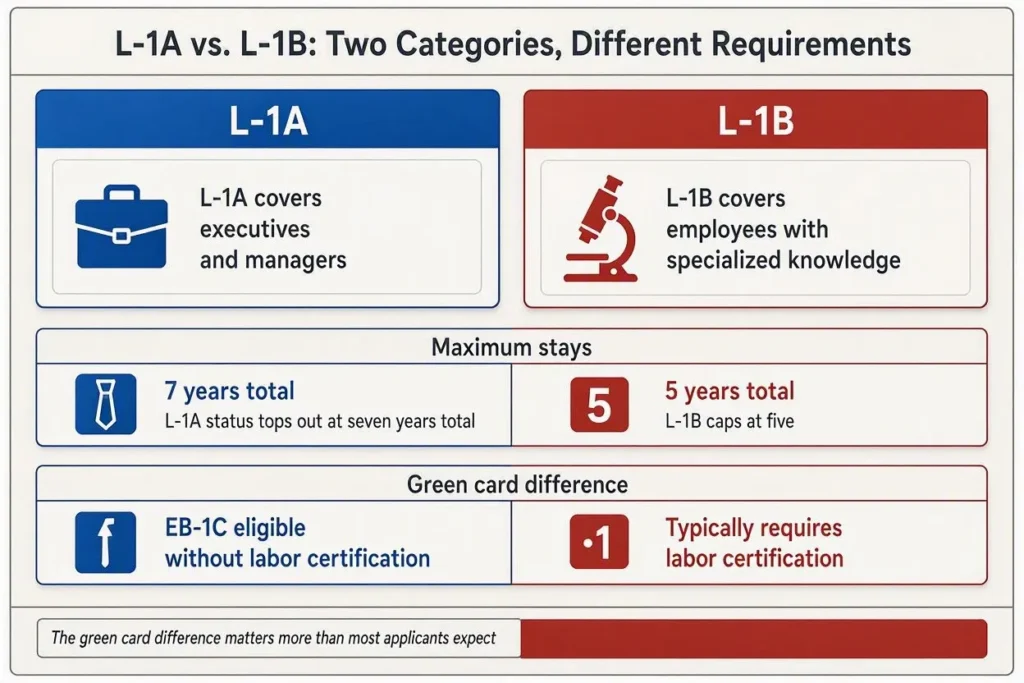
L-1A covers executives and managers. L-1B covers employees with specialized knowledge. The two tracks lead to different maximum stays and different green card paths. L-1A status tops out at seven years total; L-1B caps at five.
The green card difference matters more than most applicants expect. L-1A holders can pursue EB-1C (Employment-Based First Preference, Category C) status without a labor certification through the Department of Labor’s PERM (Program Electronic Review Management) process. L-1B holders generally can’t skip that step. They route through EB-2 or EB-3, both of which require PERM labor certification first. So a manager transferring from a 400-person manufacturing subsidiary in Vietnam has a materially faster path to permanent residence than a specialized-knowledge engineer transferring under the same corporate umbrella.
Employee-Side L-1 Visa Requirements
The employee has to satisfy two conditions: one continuous year of qualifying employment abroad within the three years before the transfer, and a job role that fits executive, managerial, or specialized knowledge capacity. Neither requirement bends for a strong resume or unrelated seniority. USCIS checks both against the specific regulatory language in 8 CFR § 214.2(l)(3).
The One-Year Employment Rule
The employee must have worked full-time for the foreign qualifying organization for one continuous year within the three years immediately before the petition filing date. Part-time work doesn’t count, even stretched across several years. And if the employee already holds a different U.S. nonimmigrant status, the three-year lookback window shifts to the three years before their original admission date, not the three years before the current filing.
Business trips to the United States don’t break continuity, but those days do get subtracted from the qualifying year. The requirement demands physical presence abroad, not just employment abroad. Take a Filipino operations director who spent three weeks in the U.S. on a business visa during her qualifying year: she still needs to show 365 days of physical overseas employment, so USCIS simply extends the three-year lookback window by those three weeks to compensate.
Executive, Managerial, or Specialized Knowledge Capacity
The role abroad and the proposed U.S. role both have to fall into executive, managerial, or specialized knowledge capacity, though the two roles don’t need to match exactly. Someone managerial abroad can transfer into a specialized knowledge role in the U.S., and the reverse works too.
Executive capacity means directing the organization or a major component of it, setting goals and policy, and answering only to higher executives or a board, with wide decision-making latitude and limited oversight. Managerial capacity means supervising other professional employees, managing a department or function, and holding real authority over hiring and firing decisions. Specialized knowledge means advanced, company-specific expertise in products, processes, or systems that isn’t readily available in the general U.S. labor market.
This is where USCIS rejects the largest share of L-1B petitions. The agency treats “individual contributor” roles doing routine technical work as disqualifying, even when the employee’s knowledge genuinely exceeds a typical hire’s. A software architect who built a proprietary inventory system used only inside one company qualifies. A developer working in a widely taught programming language, with no company-specific process knowledge layered on top, usually doesn’t.
Company-Side L-1 Visa Requirements
Two conditions apply to the employer: a qualifying relationship has to exist between the U.S. entity and the foreign entity, and both entities have to be actively doing business for the duration of the employee’s stay. USCIS treats these as independent tests. Satisfying one doesn’t substitute for the other.
Qualifying Relationship Between Companies
A qualifying relationship exists when the U.S. company and the foreign company connect as a parent, branch, subsidiary, or affiliate. Majority ownership isn’t the deciding factor here; effective control is. A U.S. company that owns 50% of a foreign entity but controls its management and policy decisions still satisfies this requirement, a standard the Administrative Appeals Office confirmed in Matter of Hughes.
Joint ventures qualify under the same control-based logic, and two subsidiaries owned by the same parent company or the same individual count as affiliates of each other. Contractual relationships alone, a licensing deal or a distribution agreement, generally fall short of the ownership-and-control standard USCIS applies here.
The “Doing Business” Requirement
Both the U.S. entity and the foreign entity have to be doing business (engaging in the regular, systematic, and continuous provision of goods or services) for the full duration of the employee’s L-1 stay. A single office lease or a lone agent physically present in a country doesn’t clear that bar on its own.
International trade isn’t required, but the totality of business activity is what USCIS weighs. A South African logistics firm that maintains only a mailing address in Johannesburg, with no staff, no clients, and no invoiced revenue, fails the doing-business test even if the ownership paperwork is flawless.
L-1 Visa Requirements for New Offices
A company opening its first U.S. office under L-1 status has to prove it’s secured adequate physical office space and present a credible one-year business plan showing the office will support a managerial or executive position within twelve months. Initial approval for new-office petitions runs one year, shorter than the standard three-year grant given to established companies.
If the employee is transferring specifically to open that office, they also have to meet the standard one-year employment and executive/managerial/specialized knowledge tests. USCIS scrutinizes new-office petitions harder than any other L-1 subtype, mostly because the business hasn’t generated a track record yet. Renewal petitions get reviewed against real staffing numbers, revenue, and customer activity, and a business plan that projected five hires in year one but produced zero is a common trigger for denial at the extension stage.
Required Documentation for an L-1 Petition
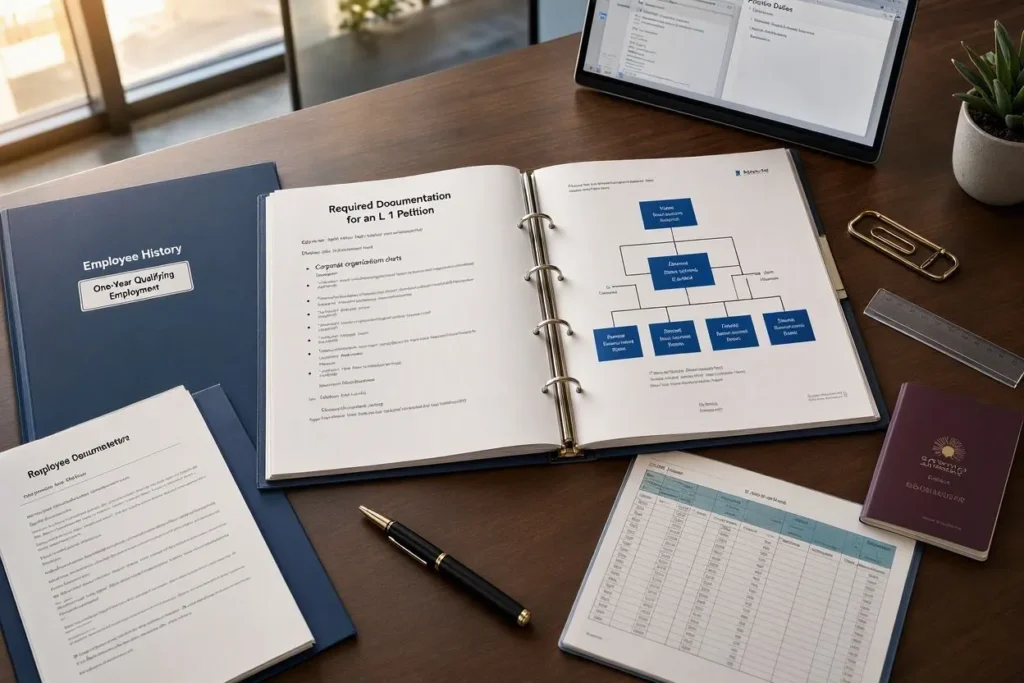
A complete L-1 petition documents four things: the corporate relationship between entities, the employee’s one-year qualifying employment abroad, the specific duties of both the foreign and U.S. roles, and evidence that the U.S. entity is operationally viable. Missing any one of these four categories is the single most common reason USCIS issues an RFE.
The documentation package typically includes:
- Corporate organizational charts showing ownership percentages and reporting lines
- Articles of incorporation, stock certificates, or equivalent ownership records for both entities
- Payroll records, tax filings, or employment letters proving the employee’s one-year tenure
- A detailed job description for both the foreign role and the proposed U.S. role
- Financial statements, tax returns, or bank records showing active business operations
- A lease agreement or deed for new-office petitions
Weak documentation doesn’t always mean missing documentation. A petition that submits an organizational chart showing five departments, but a job description listing only routine data-entry tasks for the “department head” position, creates an internal contradiction that USCIS adjudicators are trained to flag.
L-1 Visa Costs and Fees
Filing an individual L-1 petition costs at least $1,885 in required government fees before attorney costs, and can reach $9,350 for companies subject to the 50/50 fee plus premium processing. The base filing fee runs $1,385. A $500 fraud prevention and detection fee applies to any employer filing for a given employee for the first time.
Additional fees apply under specific conditions:
- Employers with 50 or more U.S. employees, where more than half hold H-1B or L-1 status, owe an extra $4,500 “50/50” fee
- Premium processing, optional and available for both L-1A and L-1B petitions, costs $2,965 and guarantees a USCIS decision within 15 business days
- Blanket L petitions carry a $500 fraud fee and a separate consular Machine-Readable Visa (MRV) fee of $205 per employee, rather than the individual base filing fee
Attorney fees vary by firm and case complexity, and sit outside these government charges entirely.
Common Reasons L-1 Petitions Get Denied
USCIS denies L-1 petitions most often for four reasons: an inadequately documented qualifying relationship, job duties that read as individual-contributor work rather than executive or managerial function, specialized knowledge that isn’t proven to be company-specific, and a new-office business plan that fails to show the position will exist within one year. Each traces back to a documentation gap rather than an outright eligibility failure.
Inconsistent evidence causes as much damage as missing evidence. A petition describing the beneficiary as “Vice President of Operations” while attaching a resume that lists day-to-day scheduling and inventory-counting tasks sends a mixed signal, and that regularly triggers an RFE, sometimes escalating to denial if the response doesn’t resolve the contradiction. Once USCIS denies a petition, there’s no amendment process. The employer has to file an entirely new petition and restart the timeline.
L-1 Blanket Petition Requirements
A blanket L petition lets a qualifying company skip the individual USCIS petition step for future transferees, sending employees directly to a consular interview instead. To qualify, the petitioner needs at least three domestic and foreign branches, subsidiaries, or affiliates, plus one of the following: 10 or more approved individual L-1 petitions in the prior 12 months, combined annual sales of at least $25 million, or a U.S. workforce of at least 1,000 employees.
Once USCIS approves the blanket petition, individual employees still have to meet every standard L-1 eligibility requirement. The blanket approval streamlines the process, not the substantive standard. Nonprofit organizations can file individual L-1 petitions but can’t use the blanket process at all. Consular processing under an approved blanket typically takes one to three weeks from interview to visa issuance, though security-related administrative processing under Section 221(g) can extend that timeline by several months in individual cases.
L-1 Visa Duration and Extensions
L-1A status allows a maximum stay of seven years; L-1B caps at five. Both categories start with an initial approval period of three years for established businesses, or one year for new offices, and extend in two-year increments after that.
Physical time spent outside the United States can be “recaptured,” extending the seven- or five-year cap beyond its standard length. Employees who spend fewer than 180 days a year in the United States may also qualify as intermittent L-1 workers, a status that allows indefinite two-year extensions as long as primary employment stays with the foreign entity and the qualifying corporate relationship remains intact. Extension petitions need fresh evidence that the corporate relationship, business activity, and job role still satisfy L-1 standards. Approval three years ago doesn’t carry forward automatically.
L-1 Visa vs. H-1B: Which One Fits
The L-1 visa suits multinational companies transferring existing employees. The H-1B suits U.S. employers hiring new talent, whether from abroad or already inside the country. The L-1 carries no annual cap and no lottery, while H-1B selection depends on winning a randomized lottery with a limited number of slots each fiscal year.
The cost structure diverges sharply too. H-1B petitions filed in the current fee environment can include a $100,000 supplemental fee for new petitions, a cost the L-1 category doesn’t carry at all. A German engineering firm transferring a plant manager who’s worked at the parent company for two years avoids the H-1B lottery entirely by using the L-1A category instead, provided the manager meets the one-year employment and executive capacity tests outlined above.
L-1 Dependents and Family Members

Spouses and unmarried children under 21 qualify for L-2 dependent status, and L-2 spouses receive automatic work authorization without filing a separate application. Since late 2021, spouses who receive an I-94 arrival record marked “L-2S” gain employment authorization incident to status; no separate Employment Authorization Document (EAD) application is required.
Children holding L-2 status, sometimes marked “L-2Y” on their I-94, don’t get this same work authorization regardless of age within the qualifying range. Both spouses and children can study in the U.S. under L-2 status. If an I-94 arrives without the correct “L-2S” notation, a common processing error at some ports of entry, the spouse can request a correction through deferred inspection with U.S. Customs and Border Protection rather than filing a new petition.
Conclusion
L-1 visa requirements split cleanly into two tracks that both have to clear at the same time: the employee’s one year of qualifying overseas work in an executive, managerial, or specialized knowledge role, and the employer’s proof of a qualifying corporate relationship backed by active business operations on both sides of the border. Petitions fail less often on outright ineligibility and more often on documentation that doesn’t match the job titles it’s meant to support. A petition built around consistent job descriptions, verifiable payroll records, and a business plan the company can actually execute clears USCIS review the first time. No RFE, no restart, no lost year.
FAQs

Michael Reynolds
Michael Reynolds leads immigration content at ImmigrationWin, covering visa requirements, application and relocation pathways. He researches immigration policies and official government guidance to explain changing rules clearly. His guides help students, families, and professionals make informed decisions about moving abroad.
Related Posts