Passport Renewal by Mail: Step-by-Step Guide With Fees
Yes, U.S. citizens can renew an eligible passport by mail using Form DS-82, and most applicants never have to set foot in a passport office to do it. The process costs $130 for a passport book, $30 for a card, or $160 for both, and routine applications currently take 4 to 6 weeks to process once they reach a passport agency. Mailing time adds roughly two weeks each way, so the realistic door-to-door wait runs closer to 8 to 10 weeks. Not everyone qualifies, though. Six specific requirements decide whether you can skip the appointment altogether, and this guide walks through every one of them along with the exact forms, fees, addresses, and mistakes that trip people up.
Who Qualifies for Passport Renewal by Mail
You qualify for passport renewal by mail if your current passport meets six specific conditions, and you’ll need to apply in person if even one of them doesn’t hold true.
| # | Requirement | Detail |
| 1 | In your possession | You submit the physical passport with your application; it can’t be en route from somewhere else. |
| 2 | Never reported lost or stolen | Once a passport is reported lost or stolen, mail-in renewal is off the table permanently for that document. |
| 3 | Undamaged | Normal wear and tear is fine; torn pages, water damage, or a cracked cover are not. |
| 4 | Issued at age 16 or older | Passports issued to applicants under 16 don’t qualify, since minors’ passports work differently. |
| 5 | Issued within the last 15 years | Even a few months past this window forces an in-person application instead. |
| 6 | Valid for the full 10-year period | A limited-validity passport, issued for less than 10 years, has separate eligibility rules of its own. |
Meet all six, and the current passport carries your legal name, or you attach a certified name change document such as a marriage certificate, divorce decree, or court order, and Form DS-82 is the only form you’ll ever touch for this renewal.
A limited-validity passport adds an extra layer worth naming here. It can still qualify for mail-in renewal, but only if the previous document behind it was valid for the standard 10 years, and it wasn’t shortened because of multiple lost or damaged passports on file. Miss that nuance, and the application gets kicked back for an in-person visit instead.
Families renewing together face one wrinkle too. A child under 16 can never renew by mail, regardless of how the parent’s application goes. Their passport isn’t a renewal at all; it’s a brand-new application filed in person on Form DS-11, since minors’ passports expire after five years rather than ten.
Documents You Need Before Starting Passport Renewal by Mail
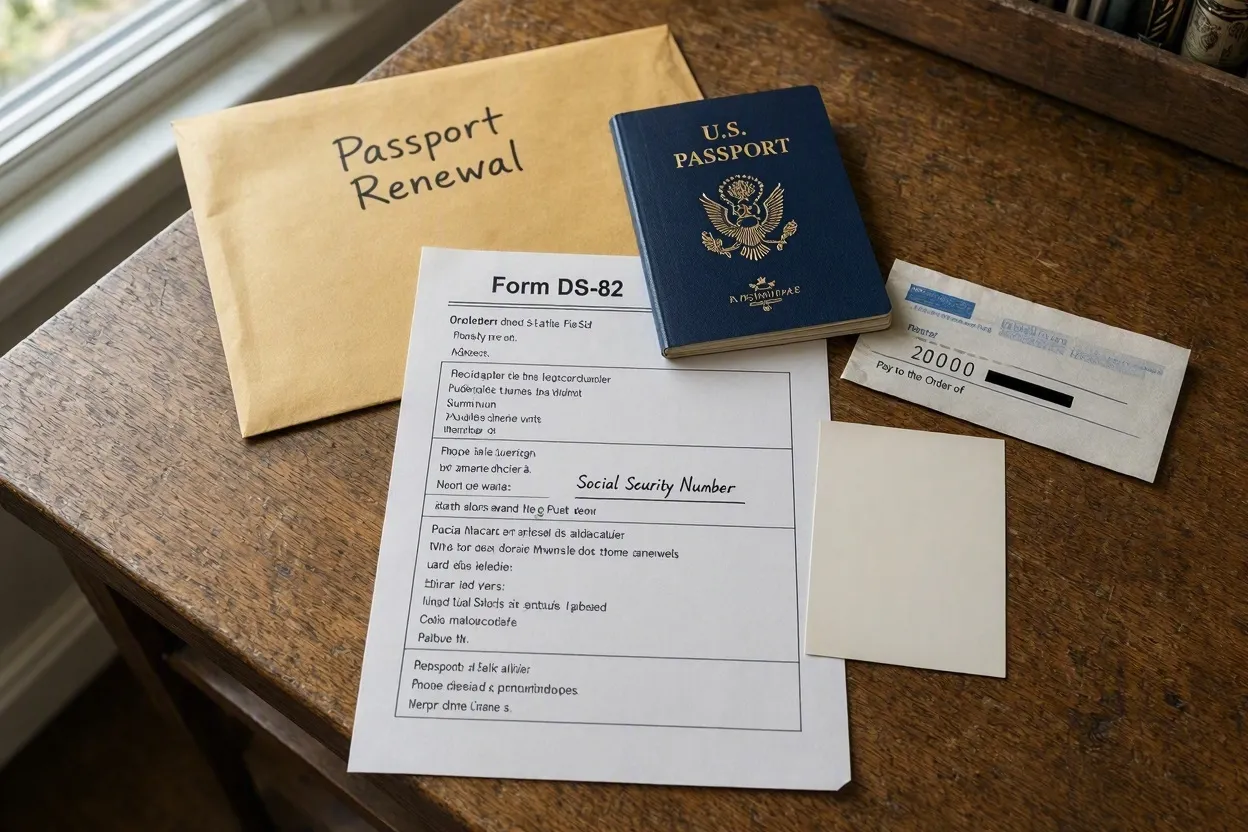
Passport renewal by mail requires four items in the envelope: a completed DS-82 form, your most recent passport, one passport photo, and payment for the applicable fee.
- Form DS-82 — complete it with the State Department’s online Form Filler tool or by hand in black ink, then print it single-sided; the State Department rejects double-sided printouts outright. It asks for your Social Security number (SSN) and details from your previous passport. Sign it in ink, and date it the same day you mail it, not earlier.
- Your most recent passport book or card — even the expired kind, as long as it fits the eligibility window covered above. The State Department returns it separately by first-class mail, sometimes arriving up to four weeks after your new passport does. If you’re switching between a book and a card for the first time, submit whichever document you currently hold.
- One passport photo — 2×2 inches (5.1 x 5.1 cm), taken within the last six months, against a plain white or off-white background. Glasses, hats, and headphones are out unless a signed doctor’s note or a documented religious exemption applies. Staple it to the application using four vertical staples in the corners; don’t bend it, and don’t use tape or glue.
- Payment for the applicable fee — a personal check or money order made out to “U.S. Department of State,” with the applicant’s full name and date of birth written on the front.
- A certified name change document (if applicable) — a marriage certificate, divorce decree, or court order, not a photocopy. The State Department returns this in its own separate mailing too, so expect three pieces of mail coming back to you in total across a few weeks.
Two less common items catch applicants off guard. Anyone who can’t produce proof of citizenship because their original passport record predates 1994 may owe an additional $150 file search fee on top of the standard renewal cost. And applicants mailing from a military, fleet, or diplomatic post office address can still use mail-in renewal, though that same address disqualifies them from the online renewal option covered later in this guide.
How to Complete Passport Renewal by Mail in 7 Steps
To complete passport renewal by mail, work through seven steps in order: confirm eligibility, fill out DS-82, attach a photo, gather supporting documents, calculate fees, choose your envelope and address, then submit and track.
Step 1: Confirm Your Eligibility
Check the six requirements against your current passport before anything else. Skipping this step wastes weeks if the State Department bounces your application back for an in-person requirement you missed.
Step 2: Complete Form DS-82
Use the State Department’s online Form Filler tool, since it catches common data-entry errors before you print. Enter your birth date and prior passport issue date carefully; small typos here are a leading cause of rejected forms. Print one copy, sign it, date it, and stop there. Don’t submit a second signed copy or a photocopy of your signature.
Step 3: Attach Your Passport Photo
Staple the photo to the printed application exactly where the form instructs, using the four-corner vertical method described earlier. A crooked or bent photo sometimes triggers a rejection letter on its own, even when the image itself meets every technical requirement.
Step 4: Gather Your Supporting Documents
Pull together your old passport, plus a certified name change document if your legal name has changed since your last renewal. Set them aside with the form and photo so nothing gets left off the kitchen table on mailing day.
Step 5: Calculate and Pay Your Fees
Pay with a personal check or money order made out to “U.S. Department of State.” Write the applicant’s full name and date of birth on the front of the check. Credit cards, debit cards, and cash are not accepted for this fee, no exceptions.
Step 6: Choose the Right Envelope and Mailing Address
Pick an envelope large enough to hold the application flat, without folding it. A Priority Mail Flat Rate envelope works well and often ships free with tracked postage. Your mailing address depends on your state of residence and whether you’re paying for expedited service, covered in detail two sections down.
Step 7: Submit and Track Your Application
Drop the package at USPS, since the National Passport Processing Center uses PO Box addresses that only USPS can deliver to; FedEx, UPS, and DHL packages sent to these boxes get returned undelivered. Once it’s in the mail, tracking becomes your best friend for the next several weeks.
Passport Renewal by Mail Cost: Fees Breakdown
Passport renewal by mail costs $130 for a book, $30 for a card, or $160 for both, with optional add-ons for faster service.
| Item | Fee |
| Passport book | $130 |
| Passport card | $30 |
| Book and card together | $160 |
| Expedited processing (optional) | $60 |
| 1-2 day return shipping (optional) | $22.05 |
These application fees stay the same whether you renew by mail or online, and they’re non-refundable even if the State Department denies your application. Expedited service and fast return shipping are optional add-ons, not requirements, and you can mix and match them depending on how soon you’re traveling. A family of four renewing together, for instance, can combine all four applications and payments into a single check, provided the math on the total adds up correctly. Send cash, and the envelope goes right back to you.
Passport Renewal by Mail Processing Time
Passport renewal by mail currently takes 4 to 6 weeks for routine processing or 2 to 3 weeks for expedited service, not counting mailing time in either direction.
Add roughly two weeks for your application to arrive at a passport agency, then another two weeks for your new passport to reach your mailbox after it ships. That brings routine renewal to about 8 to 10 weeks door to door, while expedited renewal typically lands somewhere around 6 to 7 weeks total. These figures shift with seasonal demand; applications submitted in October through December generally move faster than those filed during the busy spring and summer travel season.
Status tracking starts slower than most applicants expect. You won’t see any update for roughly two weeks after mailing, since that’s how long it takes your envelope to reach a processing center and get logged into the system. Once it shows “In Process,” the Online Passport Status System updates automatically, and email notifications arrive at the address listed on your DS-82 form. Errors on the application, missing signatures, or a rejected photo will pause your timeline entirely until you respond to a follow-up letter, so accuracy on the first submission matters more than speed.
Passport Renewal by Mail vs Online Renewal vs In-Person Renewal
Mail-in renewal is required if you need expedited service or don’t meet online eligibility, while online renewal works only for routine service under narrower age and timing rules.
Online renewal skips the physical mailing step entirely, but it comes with stricter conditions: applicants must be 25 or older, not traveling within six weeks of submission, and not changing their name or gender marker. It also only supports routine processing; anyone needing a faster turnaround has to switch to mail. In-person renewal applies only when the six mail-in eligibility requirements aren’t met, such as a damaged passport, an issuance date older than 15 years, or a passport reported lost or stolen. That path uses Form DS-11 instead of DS-82 and requires an appointment at a post office or passport acceptance facility.
Picking the right path comes down to three questions: are you eligible for mail-in renewal at all, do you need it faster than routine speed, and does your age or travel timeline rule out the online option. Answer those, and the correct method becomes obvious almost immediately.
Common Mistakes That Delay Passport Renewal by Mail
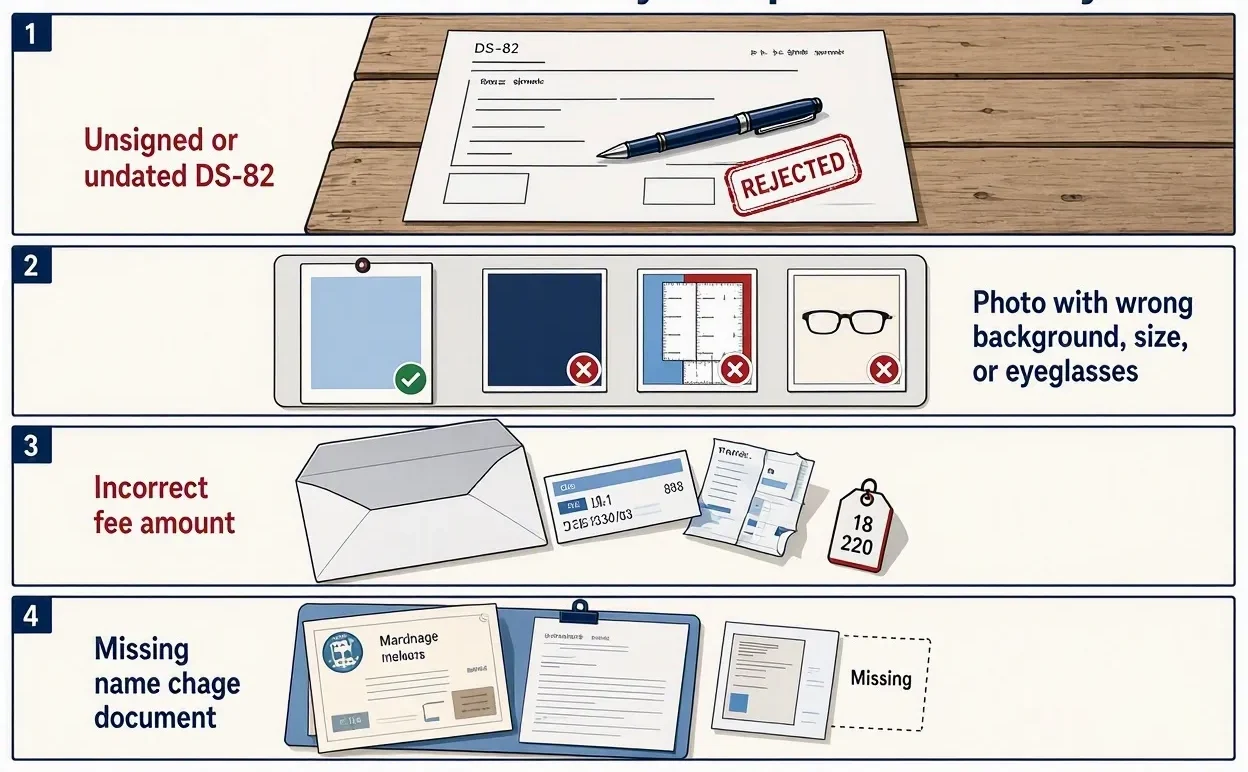
The most common mistakes that delay mail-in passport renewal are an unsigned form, a rejected photo, an incorrect fee, and a missing name change document.
An unsigned or undated DS-82 form gets flagged before anyone even reviews the rest of your application. So does a photo with the wrong background color, wrong size, or visible eyeglasses without a medical exception attached. Sending the wrong fee amount, whether it’s short by a few dollars or paid with a credit card instead of a check, stops processing cold until the State Department mails you a request for correction. Applicants changing their name sometimes forget the certified document entirely, assuming the marriage certificate they mentioned on the form is enough on its own; it isn’t, and the physical certified copy has to travel with the application.
A few less obvious errors show up often enough to name specifically. Folding the application to fit a smaller envelope can crack the barcode the State Department scans on arrival. Mailing a passport application to the wrong address, using the routine PO Box when you paid for expedited service, adds delay even though your payment cleared correctly. And shipping through a private courier instead of USPS means your envelope never reaches the PO Box destination at all; it bounces back to your address weeks later with nothing accomplished.
Renewing a Passport by Mail From Overseas
Yes, renewing a passport by mail from overseas is possible in specific countries, though the process runs through the nearest U.S. embassy or consulate rather than directly to the domestic processing centers.
Canada has a dedicated mail-in renewal pathway that mirrors the domestic process closely. Several other countries, including Mexico, France, Spain, Poland, and Greece, offer similar mail-based options through their local embassies, even though this isn’t uniformly advertised on every country’s page. Anyone living abroad should confirm the exact requirements with their nearest embassy or consulate before mailing anything, since instructions and accepted payment methods vary by location. U.S. dollar checks or money orders drawn from a U.S. bank are typically required, and expedited service usually isn’t available for applicants renewing from outside the United States.
What Happens If Your Mail-In Passport Renewal Gets Rejected
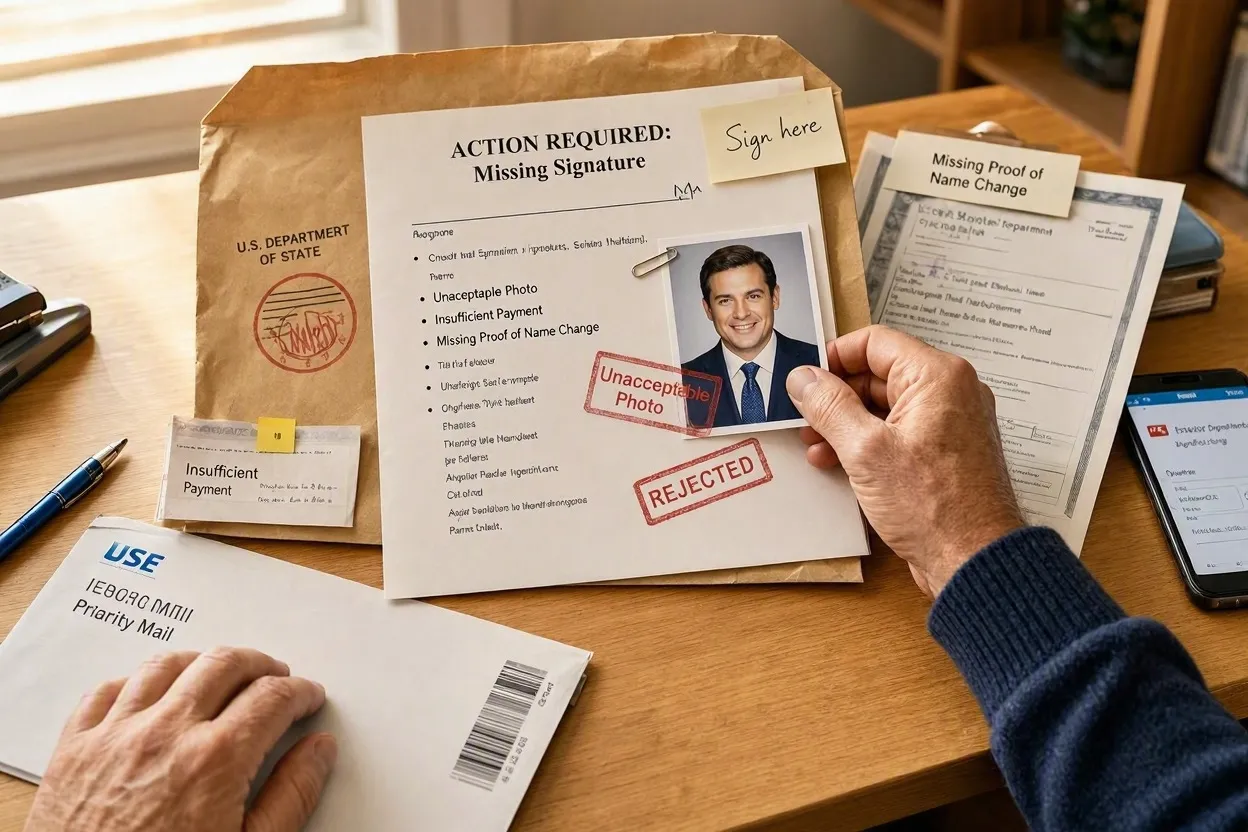
If your mail-in passport renewal gets rejected, the State Department mails a letter explaining the specific problem, and you correct and resubmit only the flagged item rather than the entire application.
Common rejection letters cite a missing signature, an unacceptable photo, insufficient payment, or missing proof of a name change. The letter includes instructions for what to send back and where to send it, and you generally don’t need to refile the whole DS-82 form from scratch. Respond promptly, since your application sits paused, not moving forward at all, until the State Department receives your correction. Applicants who ignore the letter for too long risk their file aging out of the system entirely, which then forces a completely new submission from step one.
Conclusion
Passport renewal by mail works for most adults holding an undamaged passport issued within the last 15 years, and the entire process fits into a single envelope: Form DS-82, a photo, your old passport, and a check. Costs stay fixed at $130 for a book, $30 for a card, or $160 for both, regardless of whether processing runs routine or expedited. Timing depends heavily on accuracy the first time around; a signed, correctly photographed, correctly paid application moves through in roughly 8 to 10 weeks door to door, while a single missing signature can add a month or more. Check the six eligibility rules against your current passport before you fill out anything, mail through USPS to the correct address for your state, and track your status online starting about two weeks after you drop the envelope in the mail.
FAQs

Michael Reynolds
Michael Reynolds leads immigration content at ImmigrationWin, covering visa requirements, application and relocation pathways. He researches immigration policies and official government guidance to explain changing rules clearly. His guides help students, families, and professionals make informed decisions about moving abroad.
Related Posts