

Schengen Visa Types: Full 2026 Guide to A, C & D
The Schengen Area recognises 4 main schengen visa types: the Type A Airport Transit Visa, the Type C Short-Stay Visa, the Limited Territorial Validity (LTV) Visa, and the Type D National Long-Stay Visa.
In 2024 alone, consulates across the 29 Schengen member states issued over 11.7 million Schengen visas, with approval rates of 85% to 90% depending on nationality and destination country. Understanding exactly which type applies to your situation prevents rejection and wasted processing time.
What Are the Schengen Visa Types?

- Type A — Airport Transit Visa (ATV): permits transit through the international zone of a Schengen airport without entering the Schengen Area.
- Type C — Short-Stay Visa: allows stays of up to 90 days within any 180-day period across all 29 Schengen countries.
- Limited Territorial Validity (LTV) Visa: a restricted variant of the Type C visa that limits travel to named Schengen member states only.
- Type D — National Long-Stay Visa: permits stays exceeding 90 days in a specific Schengen country for work, study, or family reunification.
The Type A and Type C visas form the Uniform Schengen Visa (USV). The Type D visa operates under national law of each individual Schengen country, not the common Visa Code.
The standard Schengen visa fee is €80 for adults and €40 for children aged 6 to 12. Children under 6 pay no fee. Each consulate may add a service charge through authorised visa application centres such as VFS Global.
What Is the Type A Schengen Visa (Airport Transit Visa)?
The Type A Airport Transit Visa (ATV) is the most limited of all schengen visa types. The ATV permits you to wait in the international transit area of a Schengen airport while changing flights to a destination outside the Schengen Area.
Which Nationalities Need a Type A Visa?
To determine ATV eligibility, check whether your nationality appears on the European Commission’s common list. As of 2026, nationals of 12 countries require an ATV when transiting through any Schengen airport. These countries include Afghanistan, Bangladesh, Democratic Republic of Congo, Eritrea, Ethiopia, Ghana, Iran, Iraq, Nigeria, Pakistan, Somalia, and Sri Lanka.
Individual Schengen countries can apply additional ATV requirements to nationals of countries not on the common list. France, Germany, and the Netherlands each maintain country-specific ATV lists beyond the EU-wide 12. You must verify the ATV rules of every Schengen airport your itinerary includes, not just your final destination.
Certain categories of travellers are exempt from the ATV requirement under Article 3(5) of the Visa Code. Exemptions apply to holders of a valid Schengen visa, holders of a valid US, Canadian, or UK visa, and holders of a valid residence permit from a Schengen country or the UK, US, Canada, or Japan.
How Long Is a Type A Visa Valid?
A Type A Airport Transit Visa is valid for a single transit event of up to 24 hours.
The ATV covers exactly one transit through the airport. If your connection requires 2 Schengen stopovers on the same journey, you request a double-entry ATV. Each transit must stay within the international zone of the airport without crossing through border control at any point.
What Is the Type C Schengen Visa (Short-Stay Visa)?
The Type C Short-Stay Visa is the most widely issued of all schengen visa types and covers tourism, business trips, family visits, cultural events, medical treatment, and short-term courses.
A Type C visa allows you to stay in the Schengen Area for a maximum of 90 days within any 180-day rolling period. The 180-day period does not reset on a calendar basis — it rolls continuously from your first entry date.
Single-Entry, Double-Entry, and Multiple-Entry Type C Visas
To understand entry conditions, the Type C visa issues in 3 formats based on travel frequency.
- Single-entry: you enter the Schengen Area once. Your visa expires automatically when you exit, even if days or months of validity remain.
- Double-entry: you enter and exit the Schengen Area twice. After the second exit, the visa expires regardless of remaining days.
- Multiple-entry: you enter and exit as many times as you wish while the visa remains valid. Your total stay across all entries must not exceed 90 days in any 180-day period.
Multiple-entry Type C visas carry validity windows of 6 months, 1 year, 2 years, or 5 years. A consular officer grants a longer validity period based on your travel history, prior Schengen visas, and the purpose of your visits. Applicants with a strong compliance record—no overstays, prior Schengen entries, and a credible travel purpose—typically receive the longer windows.
What Is a Circulation Visa Under Type C?
A circulation visa is a 5-year multiple-entry Type C visa issued to travellers who demonstrate frequent, legitimate travel needs to the Schengen Area.
To qualify for a circulation visa, you show a documented pattern of repeated Schengen visits, a stable professional or personal reason for regular travel, and a clean compliance record. France and several other Schengen members use this designation for business travellers, frequent family visitors, and cultural professionals.
ImmigrationWin’s US visa types guide provides a useful parallel for readers who hold multiple destination visas and need to understand how different entry systems interact.
What Is the Limited Territorial Validity (LTV) Visa?
A Limited Territorial Validity (LTV) visa is a restricted Type C visa that authorises travel only within named Schengen member states, not across the full 29-country area.
An LTV visa is not the standard option — it is granted in exceptional circumstances. 3 situations produce an LTV visa:
- Humanitarian grounds: the applicant needs urgent access to medical care or faces a documented emergency in a specific Schengen country.
- National interest: a Schengen country grants an LTV visa for diplomatic, cultural, or national interest reasons that do not meet the standard visa conditions.
- International obligation: treaty or convention obligations require a member state to grant travel permission despite the applicant not satisfying standard visa requirements.
Your LTV visa sticker lists the permitted countries by name. Entering a Schengen country not listed on your LTV sticker constitutes a visa violation, even though Schengen countries generally have no internal border checks. Border officers at airports may verify your visa conditions when you transit between Schengen states on international itineraries.
What Is the Type D Schengen Visa (National Long-Stay Visa)?
The Type D National Long-Stay Visa is a country-specific permit for stays exceeding 90 days in a single Schengen member state. The Type D falls outside the Uniform Schengen Visa framework and is governed by the national law of the issuing country, not the EU Visa Code.
A Type D visa issued by one country also lets you travel within the broader Schengen Area for short periods. Under Article 21 of the Schengen Convention, a valid Type D visa gives you up to 90 days of travel across other Schengen states within any 180-day period, in addition to your stay in the issuing country.
When You Need a Type D Visa Instead of Type C
To determine whether Type D applies, check whether your planned stay exceeds 90 days or requires authorised work, study, or residence.
- Work: you take up paid employment in a Schengen country. Every Schengen state issues a specific national work visa under the Type D category.
- Study: you enrol in a degree programme, language course longer than 90 days, or vocational training in a Schengen country. Universities in France, Germany, Spain, and the Netherlands process thousands of student Type D applications each year.
- Family reunification: you join a spouse, partner, or dependent family member who holds legal residence in a Schengen country.
- Long-term residence: you seek a residence permit, retirement visa, or passive income visa in a specific Schengen state.
You apply for a Type D visa at the consulate of the specific country where you plan to live, not the country you enter first. Processing times for Type D visas range from 15 to 90 days depending on the country and category. The ImmigrationWin China visa types guide offers a useful comparison for readers navigating multi-country visa systems simultaneously.
Quick-Reference Table: Schengen Visa Types at a Glance
The table below shows each of the 4 schengen visa types with their permitted stay, applicable purpose, entry format, and relative application difficulty.
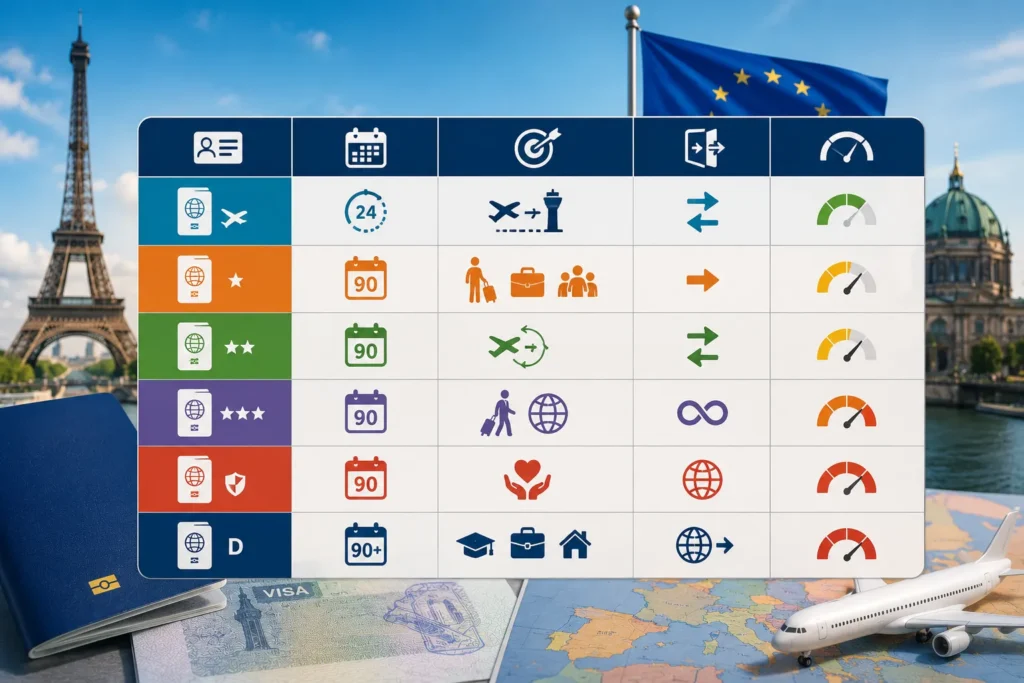
| Visa Type | Max. Stay | Purpose | Entry Format | Difficulty |
| Type A — Airport Transit | 24 hours in transit zone | Changing flights at Schengen airport — no entry to Schengen territory | Single or double transit | Low |
| Type C — Single-Entry | Up to 90 days / 180-day period | Tourism, business, family visit, medical treatment, short courses | 1 entry only; visa expires on exit | Moderate |
| Type C — Double-Entry | Up to 90 days / 180-day period | Return trip requiring 2 Schengen entries | 2 entries; expires after 2nd exit | Moderate |
| Type C — Multiple-Entry | Up to 90 days per 180-day period | Frequent travellers; validity 6 months to 5 years | Unlimited entries within validity | Moderate–High |
| LTV Visa | Up to 90 days | Humanitarian, national interest, or treaty obligation only | Restricted to named states | High (exceptional cases) |
| Type D — National Visa | Over 90 days | Work, study, family reunification, long-term residence | Entry to issuing country + 90-day Schengen travel | High |
How to Choose the Right Schengen Visa Type for Your Trip
You select the correct schengen visa type by answering 3 questions: Why are you travelling? How long will you stay? Do you need to enter more than once?
Selecting the Right Visa for Tourism or a Short Business Trip
To select the right visa for a short trip, apply for a Type C Short-Stay Visa.
First-time Schengen applicants typically receive a single-entry or double-entry Type C visa. Travellers with 2 or more prior Schengen visas and no overstays often receive a 1-year or 2-year multiple-entry visa automatically.
Selecting the Right Visa for Work, Study, or Family Reunification
To select the right visa for an extended stay, apply for a Type D National Long-Stay Visa from the consulate of the specific Schengen country where you will live.
You do not use a Type C visa for employment in a Schengen country, even if your contract is shorter than 90 days. Working on a tourist visa violates EU Visa Code conditions and results in visa cancellation and an entry ban.
How the 90/180-Day Rule Applies to All Schengen Visa Types
The 90/180-day rule limits all Type C and LTV visa holders to a maximum stay of 90 days within any rolling 180-day window.
Overstaying your permitted days triggers automatic penalties. Schengen border records, now updated through the EU’s Entry/Exit System (EES) launched in October 2025, capture your exact entry and exit dates at every external Schengen border. Overstay records remain in the Schengen Information System (SIS) and the Visa Information System (VIS) and affect future visa applications across all 29 member states.
A Type D visa holder in France, for example, can also travel within the Schengen Area for up to 90 days in any 180-day period without a separate Type C visa. These 90 days are counted separately from the Type D holder’s right to remain in France.
What Changes in 2026 Affect Schengen Visa Types?
3 major developments affect schengen visa types and Schengen travel in 2026.

- Entry/Exit System (EES): launched on October 12, 2025. EES records fingerprints, facial images, passport data, and entry/exit timestamps for all third-country nationals at every external Schengen border. EES replaces manual passport stamping. Overstays are now detected automatically. EES applies to Type A, C, and D visa holders.
- ETIAS (European Travel Information and Authorisation System): scheduled to launch in late 2026 for visa-exempt nationalities such as US, UK, Canadian, and Australian citizens. ETIAS costs €7, lasts 3 years or until passport expiry, and does not affect visa-required nationals. Nationals who need a Schengen visa continue to apply through consulates as before — ETIAS does not replace their visa.
- EU Visa Strategy 2026: adopted by the European Commission in January 2026. The strategy targets full digital visa applications by 2027 and introduces a pilot programme for online biometric collection in selected countries. Digital applications aim to cut processing times and reduce document errors.
The EES system directly affects how consulates track prior visa compliance. A history of clean entries and exits, now documented digitally in EES records, strengthens your case for a multiple-entry or long-validity Type C visa on your next application.
Apply for the Correct Schengen Visa with Expert Support
The 4 schengen visa types each serve a different travel purpose, carry distinct entry rules, and require separate documentation. Choosing the wrong type delays your travel, costs you application fees, and can affect future visa approvals.
ImmigrationWin’s certified consultants assess your case, identify the correct visa category, and prepare a complete application package that maximises your approval chances. Contact the team through the ImmigrationWin free consultation page to start your Schengen visa application today.
Frequently Asked Questions

Michael Reynolds
Michael Reynolds leads immigration content at ImmigrationWin, covering visa requirements, application and relocation pathways. He researches immigration policies and official government guidance to explain changing rules clearly. His guides help students, families, and professionals make informed decisions about moving abroad.
Related Posts