United States Student Visa 2026: F-1, M-1, J-1 Requirements, Costs & New DHS Rule
A United States student visa is a nonimmigrant visa that allows a foreign national to enter the country to study at an approved school. Three categories exist: F-1 for academic students, M-1 for vocational students, and J-1 for exchange visitors. Each one carries its own eligibility rules, work restrictions, and application steps, and a rule finalized in July 2026 is changing how long students can stay in the country without reapplying.
This guide breaks down every part of the process, from choosing the right visa category to surviving the consular interview, using the exact figures and forms that apply in 2026.
What Is a United States Student Visa?
A United States student visa is the legal document required to travel to the country for the purpose of full-time study at a school certified by the Student and Exchange Visitor Program (SEVP). A visitor visa or the Visa Waiver Program (VWP) does not cover credit-bearing study, even for a single semester. Students who try to study on a tourist visa risk denial at the port of entry and possible bans on future travel.
Three agencies handle different pieces of the process. The Department of State issues the visa itself through embassies and consulates abroad. U.S. Citizenship and Immigration Services (USCIS) handles in-country status changes and work authorization. U.S. Immigration and Customs Enforcement (ICE), through SEVP, manages school certification and the SEVIS database that tracks every student from acceptance to graduation.
Types of United States Student Visas
Three visa categories cover almost every international student. Picking the wrong one delays enrollment and sometimes forces a student to restart the entire application.
- F-1 visa: for full-time academic students attending a university, college, high school, private elementary school, seminary, conservatory, or another academic institution, including language training programs.
- M-1 visa: for full-time vocational or technical students at institutions such as flight schools or culinary programs.
- J-1 visa: for exchange visitors participating in work-and-study programs, including visiting scholars, camp counselors, au pairs, and research assistants.
A student enrolling in a four-year computer science degree at a state university needs an F-1 visa. A student enrolling in a nine-month aviation maintenance certificate needs an M-1 visa instead. The distinction matters because M-1 students face tighter transfer rules and cannot switch to F-1 status after arrival in most cases.
The 2026 Rule Change: Duration of Status Ends
Yes, the rule ending “duration of status” for student visas is real, and it changes how long F-1, J-1, and I-classification visa holders can remain in the country without government re-approval.
The Department of Homeland Security (DHS) published a final rule on July 17, 2026, eliminating a framework that had been in place since 1978. Under the old system, students could remain in the United States indefinitely as long as they stayed enrolled and in good standing, with no fixed expiration date on their Form I-94 arrival record.
The new rule sets a fixed admission period instead. F-1 and J-1 visa holders are admitted for the length of their program, capped at four years per admission, regardless of how long the actual degree takes. I-classification visa holders, who cover foreign media representatives, are admitted for up to 240 days per entry. DHS Secretary Markwayne Mullin framed the change as a way to close a gap that let some students remain in the country for years without routine review.
The rule takes effect approximately 60 days after Federal Register publication, placing the effective date around September 18, 2026. Students already enrolled, and students planning a program change, degree-level jump, or transfer after that date, need to confirm with their Designated School Official (DSO) whether the change now requires government approval instead of only a school-level update. A near-identical rule was proposed in 2020 and withdrawn in 2021, so legal challenges to the 2026 version remain possible.
Step-by-Step Application Process
The United States student visa application follows six steps, starting with school acceptance and ending with the visa interview. Skipping or reordering these steps causes most of the delays students run into.
- Get accepted at a SEVP-certified school
Search the official school list through Study in the States before applying anywhere, since acceptance at a non-certified institution cannot lead to a visa. - Pay the SEVIS I-901 fee and receive Form I-20.
The school enters the student’s information into SEVIS once the fee clears, generating the Form I-20 (Certificate of Eligibility) that both student and school official must sign. - Complete Form DS-160.
This is the online nonimmigrant visa application, submitted through the Consular Electronic Application Center (CEAC), followed by printing the confirmation page for the interview. - Pay the visa application fee.
The current fee is $185, payable before scheduling the interview in most consular districts. - Schedule and attend the visa interview.
Wait times vary by embassy and by season, so applying early matters more than applying perfectly. - Wait for issuance or administrative processing.
Most decisions arrive the same day, though some applications require additional review that can add weeks.
New students can receive a visa up to 365 days before their program start date, but entry into the country isn’t permitted more than 30 days before that date. Continuing students already enrolled and in good SEVIS standing face no such window and can enter at any time before classes begin.
Documents Required for a United States Student Visa
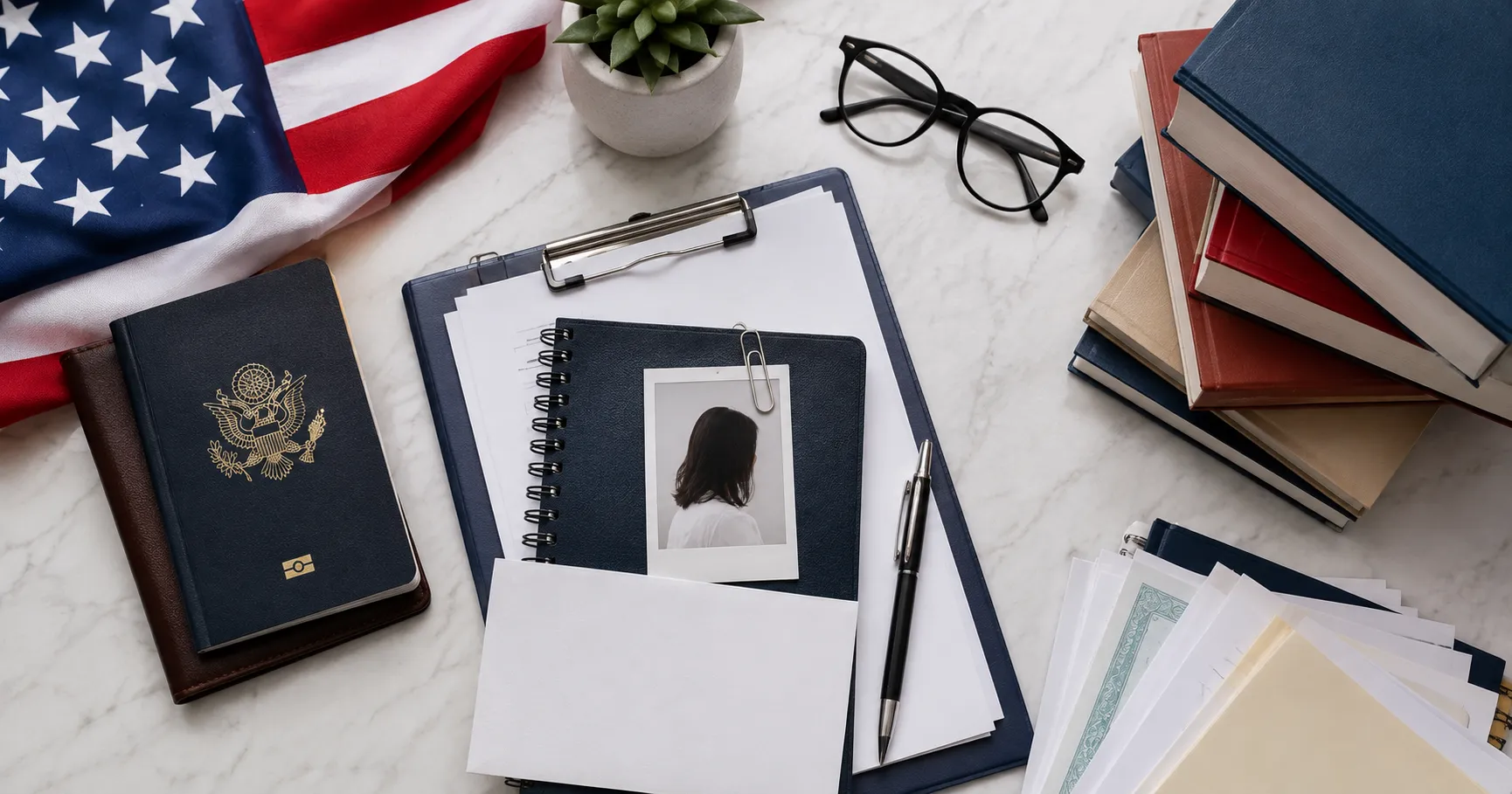
A complete United States student visa application requires seven core documents at minimum. Missing even one of these typically means rescheduling the interview.
- Passport valid for at least six months beyond the intended stay
- Form DS-160 confirmation page
- Application fee payment receipt
- One photo meeting the Department of State’s photograph requirements
- Form I-20, signed by both the student and the school official
- Academic records, including transcripts, diplomas, and standardized test scores where required
- Financial evidence proving the ability to cover tuition, living costs, and travel for the length of the program
Financial evidence causes the most confusion among applicants. A bank statement alone often isn’t enough; consular officers frequently ask for a sponsor letter, an affidavit of support, or scholarship documentation showing exactly how tuition and living expenses will be covered for each year of study, not just the first one.
Visa Fees and Costs
The base nonimmigrant visa application fee for F-1, M-1, and J-1 categories is $185, separate from the SEVIS I-901 fee and any visa issuance fee. Costs stack up across three separate payments, and applicants from certain countries face a fourth.
| Fee Type | Amount | When Paid |
| SEVIS I-901 Fee | Varies by visa type (F-1/M-1: $350; J-1: $220 as of 2025 rates) | Before applying for the visa |
| Visa Application Fee (MRV fee) | $185 | Before or at the interview |
| Visa Issuance Fee | Varies by nationality, based on reciprocity agreements | After approval, if applicable |
| Visa Integrity Fee | Newly introduced, amount and rollout vary by consulate | At interview, where applicable |
Reciprocity-based issuance fees can add anywhere from $0 to over $300 depending on the applicant’s home country, since the United States charges what a given country charges American citizens for a comparable visa. Applicants should check their specific embassy’s fee schedule rather than assume the $185 figure covers the total cost.
What Happens at the Visa Interview
A consular officer conducts every United States student visa interview to confirm that the applicant qualifies under U.S. law, and interviews average 2 to 5 minutes for straightforward cases. The officer isn’t reviewing every document in the folder line by line; the officer is testing whether the applicant’s answers match the paperwork already submitted.
Three areas get tested most heavily during the exchange:
- Academic preparation and intent. The officer wants a clear, specific answer about the chosen program and school, not a rehearsed script.
- Ties to the home country. Evidence of family, property, a job offer waiting after graduation, or enrollment plans back home all support an intent to depart after study ends.
- Financial capacity. Applicants should be ready to explain, in their own words, who is paying for the degree and how, since a memorized number without context raises red flags.
A digital fingerprint scan happens during most interviews, though the exact process depends on location. If the officer requests administrative processing after the interview, the applicant will be told directly and should expect a wait of days to several weeks before a final decision.
Can Students Work on a United States Student Visa?
Yes, F-1 students can work in five specific categories, but none of them permit off-campus employment during the first academic year. Unauthorized work is one of the fastest ways to lose student status.
- On-campus employment: available from day one, limited to 20 hours per week while school is in session.
- Curricular Practical Training (CPT): internship or cooperative work tied directly to the student’s course of study, requiring DSO authorization before starting.
- Optional Practical Training (OPT): up to 12 months of work authorization related to the student’s major, requiring an Employment Authorization Document (EAD) from USCIS.
- STEM Optional Practical Training (STEM OPT) Extension: an additional 24 months for students with qualifying Science, Technology, Engineering, and Mathematics (STEM) degrees, bringing total OPT eligibility to 36 months.
- Severe economic hardship employment: available in limited, documented cases of unforeseen financial need.
A computer science graduate on 12 months of standard OPT can extend into 24 additional months of STEM OPT if the employer is enrolled in E-Verify and the student files Form I-983 with their DSO before the initial OPT period ends. Missing that filing window forces the student to stop working immediately once the first 12 months expire.
Dependent Visas for Spouses and Children (F-2/M-2)
Spouses and unmarried minor children of F-1 and M-1 students qualify for F-2 or M-2 dependent visas, but dependents cannot accept employment under either category. Each dependent needs an individual Form I-20 from the school, though dependents don’t pay the SEVIS fee themselves.
F-2 and M-2 children can enroll in kindergarten through 12th grade full-time. F-2 spouses, by contrast, face tighter limits: they may study, but only on a part-time, recreational basis, not toward a degree or certificate. A spouse who wants to pursue a full degree program needs to apply for a separate F-1 visa rather than relying on F-2 status.
Common Reasons for Visa Denial
Consular officers deny United States student visa applications under Section 214(b) of the Immigration and Nationality Act most often when the applicant fails to demonstrate strong ties to their home country. A 214(b) denial isn’t permanent, and applicants can reapply once circumstances change or new evidence becomes available.
Four issues account for most denials:
- Insufficient or vague financial documentation that doesn’t cover the full program length
- Weak or unclear ties to the home country, such as no family, property, or job prospects waiting after graduation
- Inconsistent answers between the DS-160 form and the interview
- Enrollment at a school not certified by SEVP, which results in automatic ineligibility rather than a discretionary denial
Denial rates vary significantly by consular post and by applicant’s country of origin, though the Department of State does not publish a single official denial-rate figure broken down by nationality for student visas specifically.
Maintaining Status After Arrival
Students maintain F-1 or M-1 status by staying enrolled full-time, keeping SEVIS records current, and reporting any address or program changes to their DSO within 10 days. Falling out of status voids the visa automatically under Section 222(g) of the Immigration and Nationality Act, and any multi-entry visa affected this way stops working for future travel even if the expiration date hasn’t passed.
F visa holders must depart the United States within 60 days after the program end date listed on Form I-20, including any authorized OPT period. Under the new 2026 fixed-admission-period rule, students approaching their four-year cap need to file for an extension well before the admission period ends, since the automatic buffer that duration of status used to provide no longer applies. A biology major admitted in September 2026 under a four-year fixed period, for example, needs a completion plan or an extension request filed before the visa itself expires, not just before the academic program ends.
Change of status to another category, such as switching to an H-1B work visa after a job offer, goes through USCIS while the student remains in the country. That process doesn’t require a new visa stamp until the student departs and needs to re-enter under the new category.
Conclusion
A United States student visa in 2026 requires more than picking F-1, M-1, or J-1 and filling out a form. The July 2026 DHS rule ending duration of status means every student now works against a fixed clock, capped at four years for F-1 and J-1 categories, with extensions that demand advance planning rather than the open-ended flexibility the old system allowed. Getting the visa type right, the documentation complete, and the post-arrival compliance timeline tracked from day one determines whether a student finishes their degree without a status interruption.
FAQs

Michael Reynolds
Michael Reynolds leads ImmigrationWin’s immigration, visa, and global mobility content division. He specializes in researching immigration policies, visa requirements, application processes, and international relocation pathways for individuals, families, students, and professionals. With extensive experience analyzing immigration regulations and official government guidance, Michael brings a research-driven approach to complex immigration topics and changing visa policies. He is the primary author of ImmigrationWin’s visa guides, immigration resources, and country-specific content, helping readers better understand their options and make informed decisions about their international journey.
Related Posts