
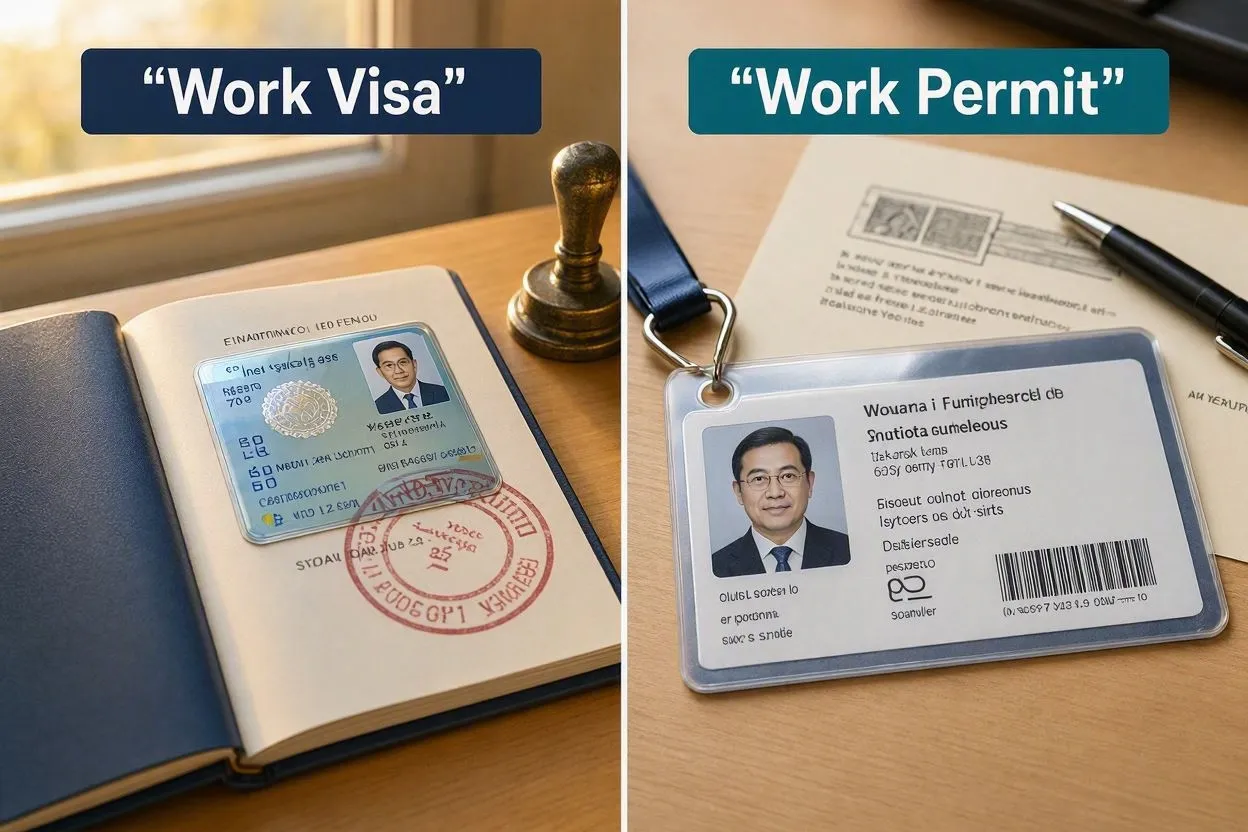
Work Visa vs. Work Permit: The Difference Explained
Immigration paperwork rarely announces its own rules, and these two terms cause more mix-ups than almost any other pair in U.S. employment law. An HR coordinator might call an EAD a “visa” in casual conversation, and a job candidate might do the same on a resume, but USCIS and the Department of State treat them as separate documents, with separate applications and separate issuing agencies.
This guide walks through what each one authorizes, where the two overlap, and what changed in late 2025 that makes the distinction matter more than it used to.
What is the difference between a work visa and a work permit?

A work visa grants entry into the United States for a specific employment purpose, while a work permit, officially called an Employment Authorization Document (EAD), grants the legal right to work once someone is already inside the country. Confuse the two, and a hiring manager can end up filing the wrong paperwork or missing a renewal deadline entirely. Take a software engineer holding an H-1B visa: she never needs a separate EAD to work for the company that sponsored her, because the visa status itself carries that authorization. A green card applicant, on the other hand, usually needs an EAD even while holding a different underlying visa status. The table below breaks down the six areas where the two documents diverge.
| Feature | Work Visa | Work Permit (EAD) |
| Issuing Authority | U.S. Department of State | U.S. Citizenship and Immigration Services (USCIS) |
| Physical Form | Stamp or sticker in passport | Plastic card (Form I-766) |
| Purpose | Entry and stay for a defined reason | Authorization to work, independent of entry status |
| Employer Tie | Usually tied to one sponsoring employer | Usually valid for any employer |
| Timing | Obtained before entering the U.S. | Obtained after entering the U.S., in most cases |
| Job-Change Rule | New employer files a new petition | No new petition required in most categories |
This distinction shapes which form gets filed and how long a job change takes to work through.
What is a work visa?
A work visa is a passport endorsement, issued by a U.S. embassy or consulate, that lets a foreign national enter the United States to work in a specific job. Border officers check for it at the port of entry. Most work visas carry a built-in right to work for the sponsoring employer, a rule known as “incident to status,” so the holder doesn’t need any paperwork beyond the visa itself. An L-1 visa holder transferring within her company, for example, starts working the day she arrives; the visa alone authorizes it, and that authorization holds until the visa expires or gets revoked.
Common categories of U.S. work visas include:
- H-1B: for specialty occupation workers with a bachelor’s degree or higher, capped at 65,000 new visas per fiscal year plus 20,000 for advanced-degree holders
- L-1: for intracompany transferees, including managers, executives, and specialized-knowledge employees
- O-1: for individuals with extraordinary ability in their field, such as sciences, arts, education, business, or athletics
- TN: for Canadian and Mexican professionals under the United States-Mexico-Canada Agreement (USMCA)
Each category carries its own eligibility rules, wage requirements, and sponsorship obligations. None of them function the way an EAD does, and mixing up the paperwork for one with the paperwork for another causes most of the compliance headaches employers report to immigration counsel.
What is a work permit (Employment Authorization Document)?
A work permit is a physical card, issued directly by U.S. Citizenship and Immigration Services (USCIS), that authorizes a foreign national to work in the United States regardless of visa status. USCIS issues it after reviewing Form I-765, Application for Employment Authorization, a form the agency processes hundreds of thousands of times per year across dozens of eligibility categories. Unlike most work visas, an EAD generally allows the holder to work for any employer, not just one sponsor. Consider a green card applicant with a pending Form I-485: she can file for an EAD and switch employers freely while her case moves through USCIS, something an H-1B holder cannot do without triggering a brand-new petition from the new employer.
People eligible for an Employment Authorization Document include:
- Pending adjustment-of-status (green card) applicants, filed on Form I-485
- Asylum applicants, asylees, and refugees
- H-4 dependents of H-1B visa holders
- F-1 students on Optional Practical Training (OPT) or STEM OPT extensions
- Deferred Action for Childhood Arrivals (DACA) recipients
- Temporary Protected Status (TPS) holders
Not every immigration category qualifies for an EAD. Someone on a tourist visa, for instance, has no path to one at all; tourist status and employment authorization simply don’t intersect under current USCIS rules.
7 key differences between a work visa and a work permit
Every distinction below traces back to one core fact: a visa governs entry into the country, and a permit governs the right to work once inside it.
| # | Category | Work Visa | Work Permit (EAD) |
| 1 | Issuing authority | U.S. Department of State | USCIS |
| 2 | Physical form | Passport stamp | Plastic card |
| 3 | Employer flexibility | Single employer | Any employer |
| 4 | Timing of application | Before entry | After entry |
| 5 | Job-change process | New petition required | No new petition required |
| 6 | Validity period | Tied to visa category | 1 to 2 years |
| 7 | Renewal trigger | Status extension | New Form I-765 filing |
Two people can hold the same job title at the same company and still face entirely different renewal timelines, depending on which side of this table their authorization sits on.
Why people confuse work visas and work permits

Most confusion around work visa vs. work permit terminology comes from casual, everyday usage rather than any real overlap in legal meaning. People say “I’m on a work visa” when they mean they have general permission to work, without distinguishing between visa status and a separate EAD. A friend or colleague might describe a green card holder’s spouse as having a “work visa” when, legally, that spouse holds an H-4 EAD and no work visa at all. News coverage doesn’t help either: headlines routinely use “work permit” and “work visa” interchangeably when reporting on immigration policy, even though the two agencies treat them as distinct legal instruments with their own application processes. State-level minor work permits add another layer of confusion; a 16-year-old applying for a summer job permit through a state labor department has nothing to do with federal immigration law, yet the search terms overlap constantly.
How automatic EAD extension rules changed on October 30, 2025
Automatic extensions for expiring Employment Authorization Documents ended on October 30, 2025, which means EAD holders can no longer assume continued work authorization just because a renewal application is sitting with USCIS. Before that date, many categories received up to 180 days of automatic extension while a renewal processed in the background. Picture a nurse whose EAD expires while her renewal application waits in the USCIS queue: under the old rule, she kept working; under the current rule, she could face a real gap in legal work authorization if the renewal doesn’t clear before the card expires. USCIS recommends filing a renewal 180 days before the current card expires, not 90 days and not “sometime before it runs out.” Anyone relying on an EAD for continued employment should check current USCIS processing times directly, since assuming the old extension rules still apply is now a compliance risk rather than a safe default.
What happens if you change jobs on a work visa vs. a work permit?
Job changes work differently depending on which document authorizes the underlying employment. A worker on an H-1B visa who accepts an offer from a new employer needs that employer to file a new Form I-129 petition before starting the new role. There’s no way around this step, and starting early is common practice among immigration attorneys. An EAD holder generally doesn’t face that requirement at all. Someone with a pending green card application and a valid EAD can switch employers under the 180-day portability rule, established by the American Competitiveness in the Twenty-First Century Act (AC21), as long as the new position falls in the same or a similar occupational classification. Two workers with identical job titles at the same company can end up on completely different timelines for the exact same career move, purely because one relies on visa status and the other relies on an EAD.
Common mistakes employers make with work visas and work permits

The most frequent compliance error involves treating visa status and EAD eligibility as interchangeable during I-9 verification, when federal law requires employers to check the actual authorizing document, not assume one exists because the other does. A hiring manager who sees an expired visa stamp in a passport might reject a candidate outright, without realizing the candidate holds a separate, still-valid EAD that authorizes the job regardless of visa status. Conversely, an HR team might assume an H-1B employee needs to reapply for work authorization every time the visa nears expiration, when in reality only the visa itself, not a separate work permit, needs renewal in most H-1B cases. Smaller companies without dedicated immigration counsel run into this most often, since large enterprises typically have compliance teams trained specifically on Form I-9 documentation rules. Filing the wrong renewal, or filing for the wrong document altogether, routinely adds three to six months of delay to what should have been a straightforward process.
Conclusion
A work visa and a work permit solve different legal problems: one covers entry into the United States, the other covers the right to work once someone is already here. Getting this distinction right determines which form gets filed, how a job change unfolds, and how much lead time a renewal needs, especially now that automatic EAD extensions no longer apply. Anyone unsure which document fits their situation should check their specific immigration category against USCIS’s current classification list before filing anything. The wrong form costs months, not days.
Frequently asked questions

Michael Reynolds
Michael Reynolds leads immigration content at ImmigrationWin, covering visa requirements, application and relocation pathways. He researches immigration policies and official government guidance to explain changing rules clearly. His guides help students, families, and professionals make informed decisions about moving abroad.
Related Posts