
Portugal Student Visa 2026: Requirements, Fees & How to Apply
Tuition at a Portuguese public university can cost less than a single semester at many American or British institutions. Add year-round mild weather, English-taught degrees at schools like the University of Lisbon and NOVA, and a legal pathway that can eventually lead to EU citizenship, and it becomes obvious why students from the US, UK, Canada, Australia, India, and the Gulf are applying in record numbers.
Getting there, though, requires paperwork — and the process changed more between 2023 and 2026 than in the previous decade. SEF, the old immigration agency, no longer exists. Fees went up. Biometric border systems launched. Much of what ranks online is quietly out of date.
This guide walks through the entire Portugal student visa journey as it works right now: who needs one, what documents to gather, exact 2026 fees, how the process differs depending on where you apply from, and what happens after you arrive.
Do You Actually Need a Visa to Study in Portugal?
Your nationality and course length decide everything here.
Citizens of the EU, EEA, and Switzerland can skip the visa entirely. If your program runs longer than 90 days, you simply register at the local town hall (câmara municipal) after arriving and collect a registration certificate. That’s the whole process.
Everyone else — Americans, Brits, Canadians, Australians, Indians, Pakistanis, Nigerians, Emiratis, and all other non-EU nationals — needs a long-stay national visa for any study program exceeding 90 days. A full semester, a bachelor’s degree, a master’s, a PhD, or an intensive language course all fall into this category.
One useful exception: passport holders from visa-exempt countries (including the US, UK, Canada, and Australia) may enter Portugal without any visa for up to 90 days within a 180-day window. Short summer schools and brief language programs fit comfortably inside that limit. The moment your course crosses the 90-day line, however, a visa becomes mandatory — and it must be obtained before you travel, not after.
Types of Portugal Student Visas Explained
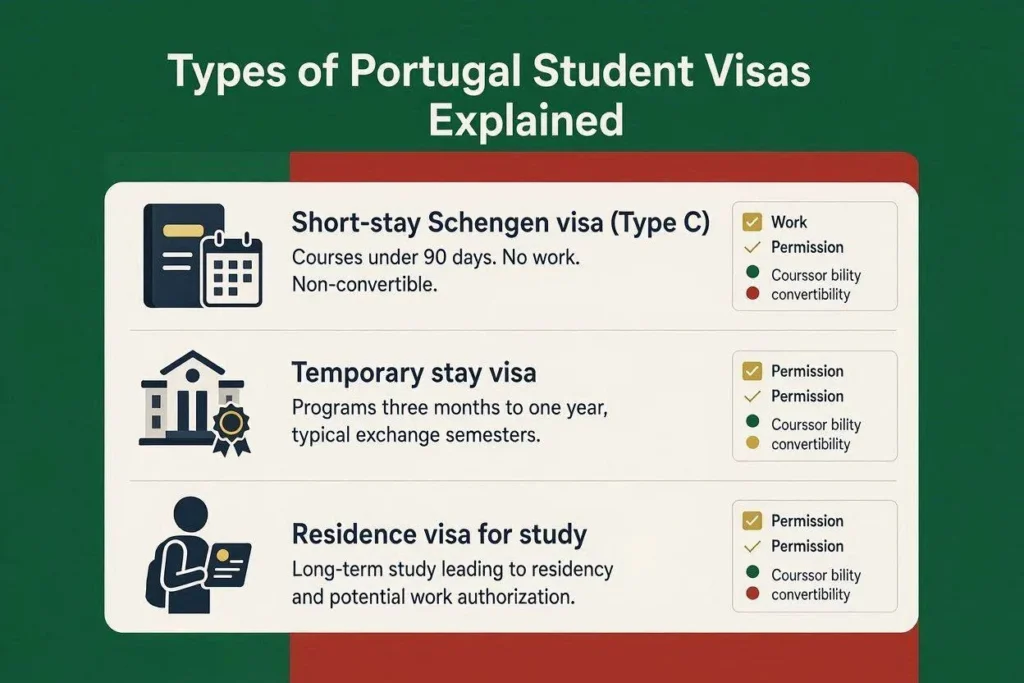
Portugal issues three distinct documents to studying foreigners, and applicants regularly confuse them.
Short-stay Schengen visa (Type C). For courses under 90 days, and only for nationalities that need a Schengen visa to enter Portugal in the first place. It does not permit work and cannot be converted into residency.
Temporary stay visa. Designed for programs lasting between three months and one year — think exchange semesters or vocational training. It covers the duration of your course but does not lead to a residence permit.
Residence visa for study (Type D). The main route, often called the D4 or student residence visa. It suits bachelor’s, master’s, PhD, and other multi-year programs. Here’s the part many applicants misunderstand: the Type D visa itself is only valid for four months and allows two entries. Its real purpose is to get you into Portugal legally so you can apply for a residence permit — the document that actually covers your years of study.
Throughout the rest of this guide, “Portugal student visa” refers to the Type D route, since that’s what the overwhelming majority of degree-seeking students need.
Portugal Student Visa Requirements (Document Checklist)
Consulates vary slightly in what they ask for, but the core file looks the same everywhere:
- Completed and signed national visa application form
- Passport valid at least three months beyond your planned stay, with two blank pages
- Two recent passport photos meeting Schengen specifications
- Official acceptance letter (carta de aceitação) from a recognized Portuguese institution
- Proof of tuition payment or a scholarship award letter
- Proof of accommodation — rental contract, university housing confirmation, or a host declaration
- Proof of sufficient financial means (details below)
- Travel and health insurance valid in the Schengen area for the initial visa period
- Criminal record certificate from your home country, apostilled or legalized
- Signed authorization allowing Portuguese authorities to check your criminal record locally
- Receipt for the visa fee
Nothing moves forward without the acceptance letter. Apply to your university first — public institutions such as Lisbon, Porto, Coimbra, and NOVA, or accredited private ones like Católica — and only start the visa file once admission is confirmed.
Proof of Financial Means
Consulates benchmark your funds against the Portuguese national minimum wage, which sits at €920 per month in 2026, or against the Social Support Index (IAS), updated to €537.13 this year. In practice, plan to demonstrate roughly €11,000 available for a twelve-month stay, on top of tuition.
Acceptable evidence includes three to six months of bank statements in your own name, a scholarship confirmation, or a notarized sponsorship affidavit from a parent or guardian. Families funding a student from abroad should prepare that affidavit carefully — a vague letter saying “I will support my child” gets rejected; a notarized declaration backed by the sponsor’s bank statements gets approved. Showing the bare minimum is risky. Applications with a comfortable margin above the threshold sail through far more often.
Health Insurance Rules
Standard travel insurance frequently gets refused. What consulates want is Schengen-valid medical coverage spanning the entire four-month initial visa window, with adequate emergency and repatriation cover. After you receive your residence permit and register locally, you gain access to Portugal’s public health service (SNS), though many students keep inexpensive private policies alongside it.
Criminal Record Certificate
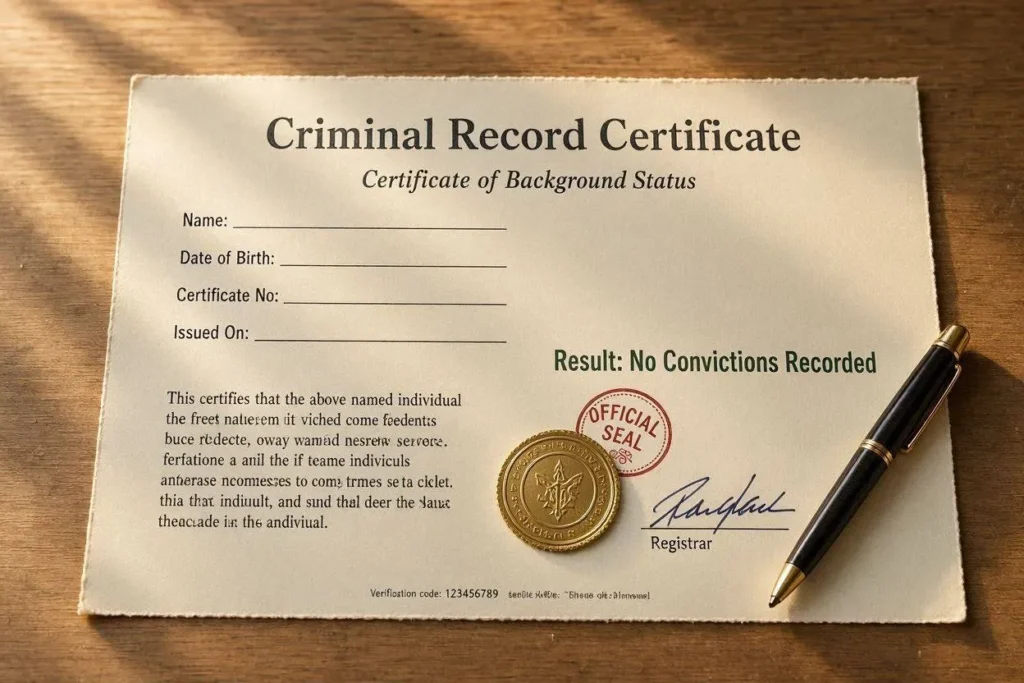
This document trips up more applicants than any other because it takes the longest and the format differs by country. Americans need an FBI Identity History Summary, then an apostille from the US Department of State — a combined process that routinely eats 6 to 10 weeks. British applicants use an ACRO Police Certificate. Indians and Pakistanis obtain a Police Clearance Certificate (PCC) through their passport offices. Whatever the source, the certificate usually must be issued within the last three to six months and apostilled under the Hague Convention.
Order it the day you decide to apply. Seriously.
How to Apply for a Portugal Student Visa: Step by Step
Step 1 — Secure admission. Everything hinges on the acceptance letter, so treat university deadlines as your true starting gun.
Step 2 — Identify where you must apply. Portugal outsources visa intake in many countries to VFS Global, while others still route applications directly through the embassy or consulate. Jurisdiction matters: you apply where you legally reside, not wherever is convenient.
Step 3 — Book your appointment early. Slots evaporate between June and October, right when the September intake crowd arrives. Booking two to three months ahead is standard advice from the consulates themselves.
Step 4 — Assemble and legalize documents. Start the criminal record and apostille process immediately, gather bank statements, confirm your insurance dates cover the full initial period, and get certified translations where required.
Step 5 — Attend in person. You’ll submit the file, give biometrics, pay the fees, and possibly answer a few questions about your study plans. Your passport stays with the consulate during processing.
Step 6 — Wait for the decision. The official window is 60 days. Outside peak season it often resolves faster; during summer, budget the full two months.
Step 7 — Travel and register with AIMA. Once the visa is stamped, you have four months to enter Portugal and file for your residence permit — covered in detail further down.
Counting backward, the safe planning horizon from first document to boarding a plane is four to six months.
Portugal Student Visa Fees and Processing Times in 2026
| Item | 2026 Figure |
| National D visa fee | €110 |
| VFS Global service fee (varies by country) | ~€40–45 equivalent |
| AIMA residence permit fee (post-March 2026 revision) | €70–€160 |
| Consulate decision target | Up to 60 days |
| Total realistic timeline (documents to arrival) | 4–6 months |
| Financial proof benchmark | ~€920/month (minimum wage basis) |
Older articles still quote the €90 visa fee. That figure died in 2025 when Portugal raised the national D visa to €110, where it remains. Budget extra for apostilles, certified translations, courier charges, and insurance premiums — these side costs commonly add €200–400.
Applying from Your Country: What Changes
The legal requirements are identical worldwide, yet the practical steps differ enough that region-specific preparation saves weeks.
United States
All Portuguese visa applications in the US now flow through VFS Global centers, operating on behalf of the embassy in Washington DC and consulates in Boston, New York, Newark, San Francisco, and New Bedford. Your state of residence dictates which post handles your file. The slow item is the FBI background check plus State Department apostille — start there. Illinois residents needing short-stay Schengen visas are unusually routed through Lithuania’s consulate in Chicago, though student residence visas follow the normal Portuguese channels.
United Kingdom
Post-Brexit, British students count as non-EU nationals and need the full Type D process for any course over 90 days. The ACRO Police Certificate replaces the FBI check, and UK-issued documents require an apostille from the Foreign, Commonwealth & Development Office. Applications go through the Portuguese consular network in London or Manchester, depending on where you live.
Canada and Australia
Both nationalities enjoy 90-day visa-free entry, which covers short courses, but degree students apply through the Portuguese embassies in Ottawa and Canberra (or their consulates in Toronto, Vancouver, and Sydney). Canadians obtain an RCMP criminal record check; Australians use an AFP National Police Check. Appointment availability tends to be better than in the US, but courier distances mean passport return can add a week or two — factor that into flight bookings.
India, Pakistan, and the Rest of Asia
VFS Global handles Portuguese visa intake across major South Asian cities, including Delhi, Mumbai, Islamabad, and Karachi. Processing from India typically runs 4 to 8 weeks, stretching toward 90 days at peak. The Police Clearance Certificate comes from the regional passport office, and academic transcripts generally need apostilles from the Ministry of External Affairs (or Foreign Office in Pakistan). Consulates in this region scrutinize financial documents closely, so sponsored students should over-prepare: sponsor bank statements, income proof, and a notarized affidavit rather than a simple letter.
Middle East (UAE, Saudi Arabia, GCC)
Expats residing in the Gulf apply where they hold legal residence — not in their passport country. VFS centers in Dubai, Abu Dhabi, and Riyadh process Portuguese national visas for UAE and Saudi residents. Two extra wrinkles apply: your criminal certificate may be needed from both your home country and your Gulf country of residence if you’ve lived there over a year, and Gulf-issued documents often require attestation through the Ministry of Foreign Affairs before Portugal accepts them.
EU, Brazil, and CPLP Countries
EU/EEA/Swiss students register locally after arrival — no visa needed. Students already holding a study permit in another EU member state get a further shortcut: under EU mobility rules, you can study (and work) in Portugal for up to 360 days by notifying the authorities 30 days in advance and paying a €25 fee, without a fresh visa. Brazilians and citizens of other CPLP countries (the Portuguese-language community) benefit from a simplified residence pathway under bilateral agreements, generally with lighter documentation — one of the least-known advantages in the entire system.
After You Land: Getting Your AIMA Residence Permit
Here’s where guides written before 2023 will steer you wrong. SEF, the agency every older article mentions, was dissolved and replaced by AIMA — the Agency for Integration, Migration, and Asylum. AIMA now handles every residence matter for students.
Within your visa’s four-month validity, you must attend an AIMA appointment (many are pre-booked and printed on the visa itself) and present essentially the same file again: passport, enrollment confirmation, proof of funds, accommodation, and insurance. The permit you receive is valid for one year and renewable for the length of your program.
Two practical realities deserve honesty. First, AIMA inherited a backlog measured in the hundreds of thousands of cases, so appointment waits can be long — never let your window lapse while waiting; documented attempts to book protect your legal status. Second, renewals became dramatically easier when AIMA launched its digital renewal portal in July 2025. Most students now renew online instead of queueing, which few competing guides have caught up with.
While settling in, grab your NIF (tax number) and NISS (social security number), open a Portuguese bank account, and register your address at the câmara municipal. Each takes an afternoon and unlocks everything from phone contracts to part-time payroll.
Working While You Study
Holders of a student residence permit may work up to 20 hours per week during term time and full-time during official academic breaks — no separate work permit required. You’ll need the NIF and NISS mentioned above before any employer can put you on payroll.
Student-friendly sectors in Lisbon and Porto include tutoring, hospitality, retail, and multilingual call centers, with pay anchored around the €920 monthly minimum wage for full-time equivalents. EU students face no hour restrictions at all. One caveat: anyone on a short-stay Schengen visa cannot legally work, period.
Earnings are taxable. Spend more than 183 days a year in Portugal and you become a tax resident, meaning Portuguese-source income falls under IRS (personal income tax). Employers withhold automatically, and most part-time students owe little or nothing after filing.
How Much Does Student Life in Portugal Cost?
Public university tuition for international students generally lands between €2,500 and €4,500 per year for bachelor’s programs and €3,000 to €7,000 for master’s degrees — a fraction of US or UK pricing.
Living costs depend heavily on the city. A room in a shared Lisbon apartment runs €450–700 monthly in 2026, while Porto sits roughly 15–25% cheaper and Coimbra — the country’s historic university town — cheaper still, with single rooms often under €400. Add €150–250 for food, €30–40 for transport passes with student discounts, and utilities split among flatmates. A realistic all-in monthly budget: €750–1,100 in Lisbon, noticeably less elsewhere.
Housing is the pressure point. Landlords sometimes hesitate to sign leases with applicants who lack a residence permit — the classic chicken-and-egg problem — so university accommodation offices and student housing platforms are worth contacting the moment you’re admitted.
From Student Visa to Permanent Residency and Citizenship
Plenty of students choose Portugal precisely because studying can become staying. The honest picture:
Time spent on a student residence permit counts toward the five-year residency requirement for permanent residence and citizenship — but only at half value. Two years of study equals one year of qualifying residence. Nationality rules have been under active reform recently, so verify the current law before building life plans around a specific date.
After graduation, Portugal allows status changes from inside the country. Graduates can apply for a job-seeking permit, switch to a work residence permit with an employment contract, or move to categories like the D8 digital nomad visa if they earn remote income. Nobody is forced to fly home and restart from scratch — a genuine advantage over several other European systems.
Why Portugal Student Visas Get Rejected (and How to Avoid It)
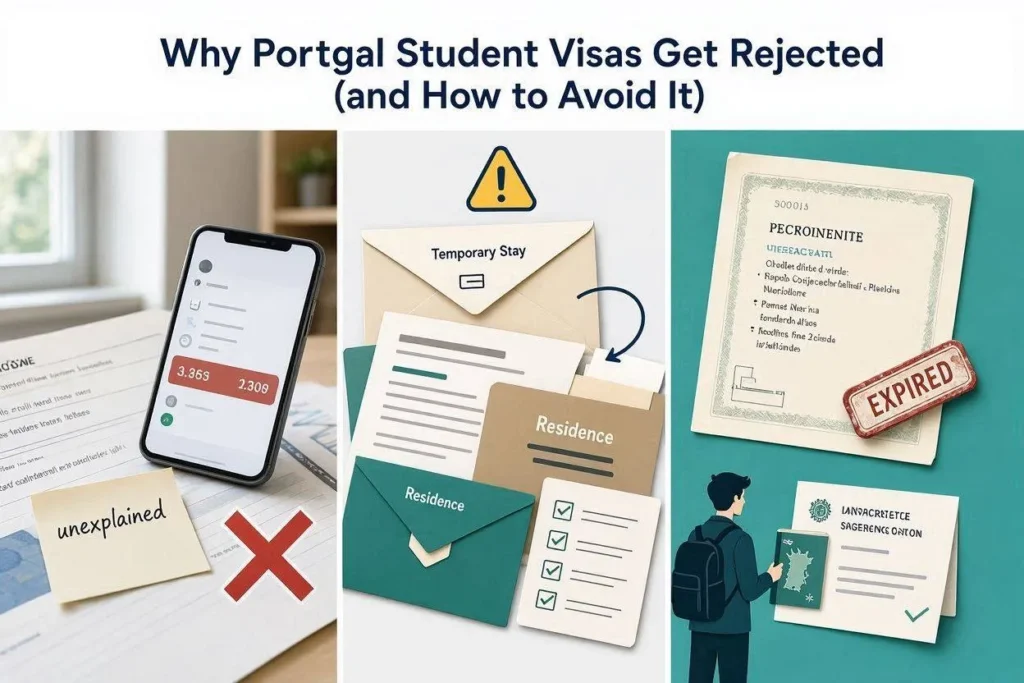
Approval rates hover around 70–80%, and the rejections cluster around predictable mistakes:
- Thin financial proof — statements showing exactly the minimum, unexplained large deposits, or sponsor letters without supporting bank evidence.
- Wrong visa category — applying for a temporary stay visa when the program demands a residence visa, or vice versa.
- Expired or missing apostilles — criminal certificates older than six months, or FBI checks submitted without State Department legalization.
- Insurance gaps — policies that lapse before the four-month visa window closes.
- Incomplete accommodation proof — a hotel booking for one week does not demonstrate where you’ll live for a year.
- Schengen system flags — prior overstays or an entry in the Schengen Information System.
Refusals arrive with written reasons, and you may appeal within 15 days to the issuing consulate. Prevention beats appeal every time: triple-check dates, show generous funds, and mirror the consulate’s own checklist item by item.
EES and ETIAS: New Border Rules You Should Know
Europe’s border technology shifted under everyone’s feet recently. The Entry/Exit System (EES) went live in October 2025, so expect fingerprints and a facial scan the first time you cross into the Schengen area — a one-time enrollment, not a recurring hassle.
ETIAS, the €20 travel authorization for visa-free short visits, is scheduled to launch in late 2026. It will not affect you as a D visa holder, but it will apply to your parents or friends visiting from visa-exempt countries like the US, UK, Canada, or Australia. Worth mentioning in the family group chat before graduation ceremonies.
Final Thoughts
Strip away the bureaucratic vocabulary and the Portugal student visa follows a clean sequence: get admitted, prove you can support yourself, hand over a clean criminal record, receive a four-month Type D visa, then convert it into an AIMA residence permit after landing. Give yourself four to six months, order the criminal certificate first, show more money than the minimum, and use official sources — the Portuguese Ministry of Foreign Affairs visa portal, your consulate’s checklist, and AIMA — as the final word whenever a blog and a government page disagree.
Lisbon’s tiled streets, Porto’s riverside, and Coimbra’s medieval lecture halls have welcomed foreign students for centuries. The paperwork is the price of entry; measured against what’s waiting on the other side, most graduates call it a bargain.
FAQs

Michael Reynolds
Michael Reynolds leads ImmigrationWin’s immigration, visa, and global mobility content division. He specializes in researching immigration policies, visa requirements, application processes, and international relocation pathways for individuals, families, students, and professionals. With extensive experience analyzing immigration regulations and official government guidance, Michael brings a research-driven approach to complex immigration topics and changing visa policies. He is the primary author of ImmigrationWin’s visa guides, immigration resources, and country-specific content, helping readers better understand their options and make informed decisions about their international journey.
Related Posts