Canada Student Visa: The Complete Study Permit Guide for 2026
Canada has issued study permits to hundreds of thousands of international students in recent years, and the application process trips up a large share of first-time applicants, not because the steps are hidden but because “Canada student visa” and “study permit” get used interchangeably online while meaning different things on paper.
This guide gives general information about applying for a Canadian student visa. It isn’t immigration legal advice. Requirements change based on your country of citizenship and residence, so confirm current details on the Immigration, Refugees, and Citizenship Canada (IRCC) website or with a licensed immigration professional before applying.
What Is a Canadian Student Visa?
A Canadian student visa is the common name for a study permit, the document Immigration, Refugees and Citizenship Canada (IRCC) issues to allow international students to study at a designated learning institution (DLI) in Canada. The study permit itself isn’t a visa. Most applicants also receive a Temporary Resident Visa (TRV) or an Electronic Travel Authorization (eTA) alongside it, and that second document is what actually lets them board a flight and enter the country. A study permit holder from a visa-required country gets a TRV; a student from a visa-exempt country typically gets an eTA instead.
Yes, if your program of study runs longer than 6 months, you need a study permit. Programs shorter than 6 months don’t require one, but a student who wants to continue into a second program after finishing the first one needs a permit regardless of the original program’s length. A student enrolling in an 8-week language course, for example, doesn’t need a study permit for that course alone but does need one before starting a follow-on 2-year diploma program at the same school.
Requirements
What Documents Do You Need for a Canadian Student Visa?
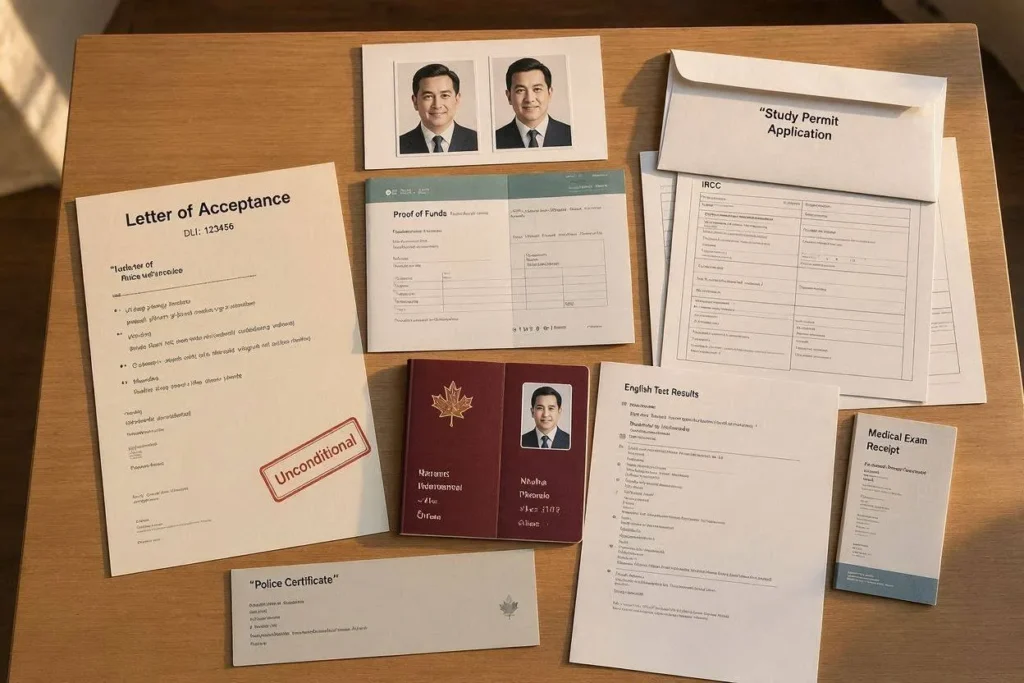
Letter of Acceptance. An unconditional letter of acceptance from a designated learning institution forms the foundation of the application. Some students receive a conditional acceptance letter first, pending an English or French test score or a prerequisite course, and IRCC generally requires the unconditional version before approving the permit. Every school carries a DLI number, and applicants enter that number directly into the application. Concordia University’s, for instance, is O19359011007, with a capital letter ‘O’ rather than a zero.
Provincial Attestation Letter (PAL). Yes, most applicants need a Provincial Attestation Letter confirming their spot counts within their province’s national intake cap. Every province except Quebec issues a PAL directly; Quebec issues a Quebec Acceptance Certificate (CAQ) instead, which serves as the PAL equivalent if it contains a specific attestation statement. A handful of exemptions apply to primary and secondary school students and some doctoral and exchange program students, among others, so check the current exemption list before assuming a PAL applies.
Proof of Financial Support. Applicants need to show they can cover a full year of tuition plus living expenses for themselves and for any family members joining them. Acceptable proof includes a Guaranteed Investment Certificate (GIC) from a participating Canadian financial institution, 4 months of bank statements, a student loan letter, or a funding letter from a sponsor.
Proof of Identity. A valid passport covering the full planned stay is required, along with two passport-style photos in most application streams. Some applicants also submit biometric fingerprints and a photo, a step covered in the application walkthrough below.
How Much Money Do You Need for a Canadian Student Visa?
A single applicant studying outside Quebec needs to show CAD $20,635 (roughly USD $15,000) in addition to first-year tuition and travel costs, based on IRCC’s most recent published threshold. An accompanying spouse adds CAD $4,000, and each accompanying child adds CAD $3,000. Quebec has its own separate cost-of-living calculation, so applicants heading to a Quebec institution should check the province’s specific figures rather than the national number. These thresholds change periodically, so confirm the current amount on IRCC’s website before submitting financial documents.
Do You Need a Separate Travel Visa or eTA?
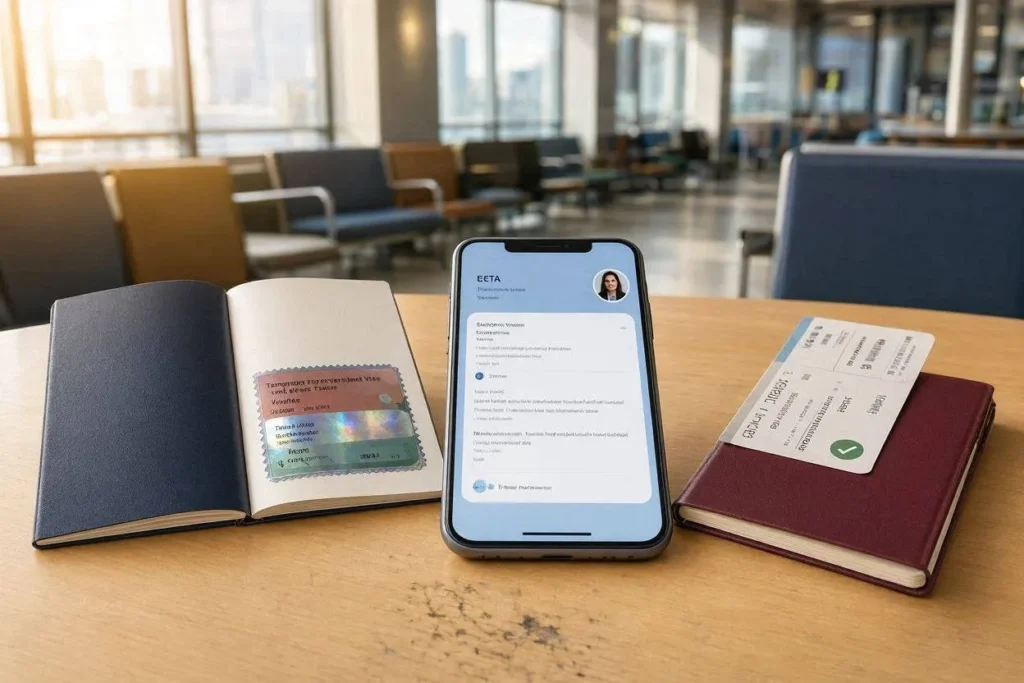
Yes, in most cases, and which one you need depends entirely on your country of citizenship. A citizen of a visa-required country receives a Temporary Resident Visa (TRV) placed in their passport once their study permit is approved. A citizen of a visa-exempt country traveling by air instead receives an Electronic Travel Authorization (eTA), an online travel document, with American citizens exempt from needing either since a valid passport covers entry from the United States. IRCC’s website lists which category applies to each country.
Process
How Do You Apply for a Canadian Student Visa?
Step 1: Get Your Letter of Acceptance. Apply to a designated learning institution and receive an unconditional letter of acceptance before starting the study permit application. Most schools list their DLI number directly on the acceptance letter or on their international admissions page.
Step 2: Get Your Provincial Attestation Letter. Request a PAL from your province of study, or a CAQ if the institution sits in Quebec. Processing this document can take several weeks, so request it as soon as the acceptance letter arrives rather than waiting.
Step 3: Submit Your Online Application. Submit the study permit application through the IRCC website. The form asks for personal details, the DLI number, and proof of financial support, and it generates a personalized document checklist based on the applicant’s answers.
Step 4: Pay Your Fees. The study permit application fee is CAD $150. Applicants required to give biometrics pay an additional CAD $85 for one person or CAD $170 for a family. Both fees are non-refundable once submitted, so double-check the application for accuracy before paying.
Step 5: Give Your Biometrics. Most applicants must provide fingerprints and a photo at a local visa application centre after IRCC sends booking instructions. Biometrics stay valid for 10 years, so a returning applicant who gave biometrics recently may not need to repeat the step. US citizens are exempt from this requirement.
Step 6: Complete a Medical Exam (If Required). A medical exam is required if the applicant plans to stay longer than 6 months and has lived in certain countries for 6 consecutive months within the past year, or if the applicant will work with children, the elderly, or vulnerable populations. IRCC’s website lists which countries trigger this requirement and which physicians are authorized to conduct it.
Step 7: Wait for a Decision. IRCC reviews the application and may request additional documents or, in some cases, an interview at a local consulate or embassy. Processing time varies substantially by country of application, covered in more detail below.
Step 8: Receive Your Study Permit at the Border. No, approval doesn’t mean the study permit is issued immediately—it means IRCC sends a Letter of Introduction (also called a Port of Entry Letter) instead. The actual study permit gets issued by a Canada Border Services Agency (CBSA) officer when the student physically arrives in Canada. Applicants must bring the letter, passport, acceptance letter, and proof of funds to present at the border and should never travel to Canada without the Letter of Introduction in hand.
What Happened to the Student Direct Stream?
No, the Student Direct Stream (SDS) no longer exists—IRCC discontinued the fast-track program in November 2024. Applicants from countries that previously qualified for SDS, including India, China, the Philippines, and Vietnam, now apply through the standard study permit process described above, with no expedited processing lane. Processing times for these applicants shifted closer to the general average as a result.
How Long Does It Take to Get a Canadian Student Visa?
Processing time depends heavily on the applicant’s country of residence and typically runs 4 to 12 weeks for a complete, straightforward application, though some countries see longer waits during peak intake periods in summer. IRCC publishes current, country-specific processing times on its website, and applicants should check that figure directly rather than rely on a single average, since it shifts throughout the year based on application volume.
Why Do Canada Student Visa Applications Get Refused?
A weak or illogical study plan is the most common refusal reason, occurring when an applicant’s chosen program doesn’t clearly connect to their previous education, work experience, or stated plans after graduation. Insufficient proof of funds ranks second, followed by a lack of travel history, which visa officers sometimes read as a risk factor for an applicant with no prior international travel. Unexpectedly, strong family ties within Canada can also count against an applicant, since officers may question whether the applicant intends to leave after finishing their studies. Additional grounds include incomplete or inauthentic-seeming documents, unclear financial sourcing, and, for older applicants, weak employment prospects back home.
What Should You Do If Your Study Permit Is Refused?
A refused applicant can reapply, addressing every reason listed in the refusal letter with stronger documentation and a clearer explanation the second time. Reapplying with a nearly identical application to the one already refused often produces a second refusal, since the same weaknesses remain unaddressed. An applicant who believes IRCC made a procedural error — failing to properly assess a well-documented application, for example — can request a judicial review, though this route only succeeds when the original application was genuinely strong and the refusal itself was flawed, not when the underlying application was weak.
What Happens When You Arrive in Canada?
A CBSA officer at the airport or land border reviews the Letter of Introduction, passport, and supporting documents, then issues the physical study permit on the spot. The student should check every detail on the printed permit before leaving the counter, including the program end date and any work eligibility notation, since an error at this stage is far easier to correct immediately than months later.
Fees & Application
What Does a Canada Student Visa Cost?
| Fee | Amount (CAD) |
| Study permit application fee | $150 |
| Biometrics (single applicant) | $85 |
| Biometrics (family) | $170 |
| Medical exam (if required) | Varies by country and physician, typically $100–$300 |
| Provincial Attestation Letter / CAQ | Free to CAD $126 depending on province |
Total government fees for a single applicant without a required medical exam usually land between CAD $235 and CAD $276, not including the funds an applicant must show as proof of financial support, which aren’t a fee but a balance requirement.
After Your Study Permit
Can You Work in Canada on a Student Visa?
Yes, most study permit holders can work in Canada, and eligibility appears directly on the study permit itself. Eligible students can work up to 24 hours per week off campus while classes are in session and full-time during scheduled breaks like summer or winter holidays. On-campus work isn’t subject to the same 24-hour cap in most cases. Students in a co-op or internship component of their program need a separate co-op work permit in addition to their study permit.
Can You Change Schools on Your Study Permit?
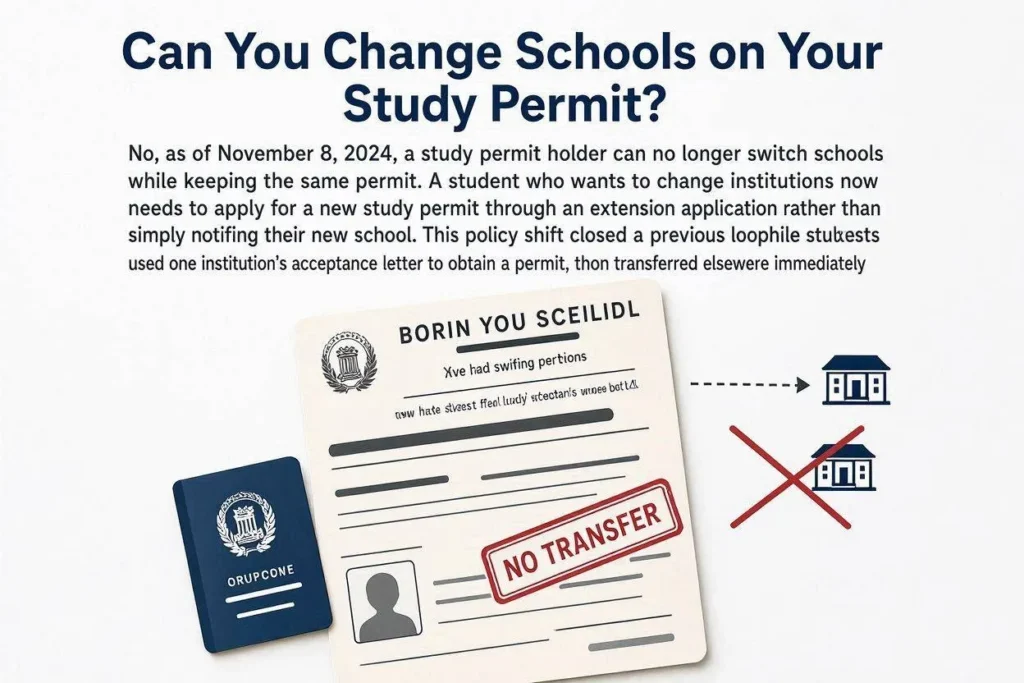
No, as of November 8, 2024, a study permit holder can no longer switch schools while keeping the same permit. A student who wants to change institutions now needs to apply for a new study permit through an extension application rather than simply notifying their new school. This policy shift closed a previous loophole where students used one institution’s acceptance letter to obtain a permit, then transferred elsewhere immediately after arrival.
What Happens After You Graduate?
Many graduates become eligible for a Post-Graduation Work Permit (PGWP), which allows them to work in Canada for a period tied to the length of their study program, up to 3 years for programs of 2 years or longer. A PGWP application must be submitted within 180 days of receiving final grades, and the permit itself opens a path toward permanent residency programs like Express Entry for graduates who qualify. Eligibility rules for PGWP have tightened in recent years, particularly around program type and institution, so a graduate should confirm their specific program still qualifies well before finishing their studies.
Conclusion
Getting your Canada student visa application right comes down to sequencing and documentation. Start with your unconditional acceptance letter; a conditional one won’t move your application forward. Apply for your Provincial Attestation Letter early since it can take several weeks to process and hold up everything after it. Back every financial claim with verifiable documents rather than round estimates, since vague or unsupported numbers are a common reason applications stall. Most refusals trace back to a study plan that doesn’t connect to your background, weak proof of funds, or unclear family ties, all of which are preventable with a specific, well-documented application. Finally, always check current fees, processing times, and PAL rules directly on IRCC’s website, since these figures shift throughout the year.
FAQs

Michael Reynolds
Michael Reynolds leads ImmigrationWin’s immigration, visa, and global mobility content division. He specializes in researching immigration policies, visa requirements, application processes, and international relocation pathways for individuals, families, students, and professionals. With extensive experience analyzing immigration regulations and official government guidance, Michael brings a research-driven approach to complex immigration topics and changing visa policies. He is the primary author of ImmigrationWin’s visa guides, immigration resources, and country-specific content, helping readers better understand their options and make informed decisions about their international journey.
Related Posts