
Ireland Visa Types: Complete 2026 Guide by Category
Ireland offers 2 primary visa categories — the Short Stay C visa (up to 90 days) and the Long Stay D visa (over 90 days) — with at least 8 distinct sub-types covering tourism, work, study, family, business, transit, investment, and retirement. Your correct Ireland visa type depends on your nationality, the purpose of your visit, and how long you plan to stay.
Ireland is not part of the Schengen Area, so a Schengen visa does not give you entry. The Irish visa system operates independently through Immigration Service Delivery (ISD), an office of the Department of Justice. This guide covers every Ireland visa type in 2026, explains the eligibility rules, and shows you exactly how to apply.
How the Ireland Visa Types System Works in 2026
The Irish visa system classifies all visas into 2 broad categories: Short Stay C visas for visits of up to 90 days and Long Stay D visas for stays of over 90 days. Within each category, Ireland issues purpose-specific sub-types — tourist, business, training, study, work, family, and transit.
A visa grants you pre-entry clearance to travel to Ireland. The visa does not guarantee entry. An Immigration Officer at your port of entry (e.g. Dublin Airport) makes the final decision. Always carry your original supporting documents when you travel.
EU/EEA nationals, UK citizens, and Swiss nationals do not need a visa to enter Ireland. Citizens of the United States, Canada, and Australia visit visa-free for up to 90 days but must apply for a visa if they plan a longer stay. Citizens of countries such as India, Pakistan, China, the Philippines, Nigeria, and South Africa require a visa for all visits.
Ireland Short Stay C Visa Types: 5 Categories for Visits Under 90 Days
The Short Stay C visa covers 5 purpose-specific sub-types: tourist, business, training, conference/event, and exam. All 5 allow a maximum stay of 90 days. The Short Stay C visa cannot be extended, except in exceptional circumstances such as a medical emergency.
1. Ireland Short Stay Tourist Visa
The Short Stay C Tourist visa permits tourism, family visits, short educational courses, medical treatment, and marriage ceremonies. You cannot work, volunteer, or access public health services on this visa. Apply for this visa if your visit lasts under 90 days and you have no paid employment purpose.
You must show: a valid passport with at least 6 months of remaining validity; proof of funds of approximately €40–€50 per day; a confirmed accommodation plan; and a return or onward travel ticket.
2. Ireland Short Stay Business Visa
The Short Stay C Business visa permits professional activities such as attending meetings, negotiating contracts, and working for up to 14 days. You cannot work for 15 days or more on this visa. You must provide an invitation letter from an Irish company and a letter from your own employer confirming the business purpose.
If you plan corporate activities lasting over 90 days or wish to set up a company, the business investor routes — the Immigrant Investor Programme or the Start-Up Entrepreneur Programme — apply instead (covered under Long Stay D visas).
3. Ireland Short Stay Training and Exam Visas
The Training visa applies to employer-organised short training courses in Ireland. The Exam visa covers professional or academic examinations such as the Pre-Registration Examination System (PRES) medical exams. Neither visa permits paid work or access to public health services.
A Conference/Event visa also exists as a 4th Short Stay sub-type for attendees of conferences, symposia, and similar events. The eligibility rules match the other Short Stay C visas — no paid work permitted outside the specific event.
Ireland Long Stay D Visa Types: 4 Routes for Stays Over 90 Days

The Long Stay D visa covers 4 main categories: employment, study, family reunification, and business/investment. Long Stay D visa holders who remain beyond 90 days must register with the ISD and obtain an Irish Residence Permit (IRP). The IRP is a physical card that confirms your immigration status in Ireland.
Ireland Long Stay Work Visa (Employment D Visa)
To work in Ireland for more than 90 days, you need 2 documents: an Employment Permit from the Department of Enterprise, Trade and Employment (DETE), and a Long Stay D Employment visa from the ISD.
You must secure the Employment Permit before you apply for the visa. Ireland issues 9 types of Employment Permits. The 2 most common are:
- Critical Skills Employment Permit (CSEP): for highly skilled workers in roles on the Critical Skills Occupation List paying at least €40,904 per year. After 2 years on a CSEP, you qualify for Stamp 4 residency, which allows unrestricted work.
- General Employment Permit (GEP): for roles not on the ineligible list, paying at least €36,605 per year from March 2026. GEP holders qualify for Stamp 4 after 57 months.
- Intra-Company Transfer Permit: for employees transferring between a multinational’s overseas office and its Irish branch. Valid for up to 2 years.
- Van der Elst Visa: for non-EU workers already legally employed in another EU country whose EU employer contracts work in Ireland.
Ireland’s work permit system does not currently include a digital nomad visa. Remote workers must apply through an existing category or hold the right nationality to enter without a permit.
Ireland Long Stay D Study Visa
The Long Stay D Study visa covers courses lasting over 90 days, including:
- English Language courses of at least 25 weeks duration.
- Higher education courses (undergraduate to postgraduate) at Level 6 to Level 10 on the Irish National Framework of Qualifications (NFQ).
- Foundation year programmes and professional award courses.
- Private fee-paying second-level schools (school fees must be paid before the student arrives in Ireland).
Students from outside the EU/EEA apply through the Schengen visa types guide parallel may find it useful to compare European study options, though Ireland uses its own national process via the AVATS online system.
After completing a qualifying Irish degree, graduates apply for the Third Level Graduate Programme (Stamp 1G), which grants up to 2 years of work authorisation — a gap most competitors do not cover.
Ireland Long Stay D Family Visa (Join Family Visa)
The Join Family visa allows non-EEA nationals to reunite with a qualifying family sponsor in Ireland. You fall into 1 of 3 applicant categories:
- Spouse or civil partner of an Irish citizen, UK citizen, or EU/EEA national.
- Dependent child under 18 years of age of a qualifying parent resident in Ireland.
- Dependent relative of a non-EEA worker who holds a Critical Skills Employment Permit or Stamp 4.
Spouses of Critical Skills Employment Permit holders receive a Stamp 1G on arrival, which allows them to work without needing a separate Employment Permit — a significant benefit not clearly explained in most competitor articles.
Ireland Business and Investor Visa Types for 2026
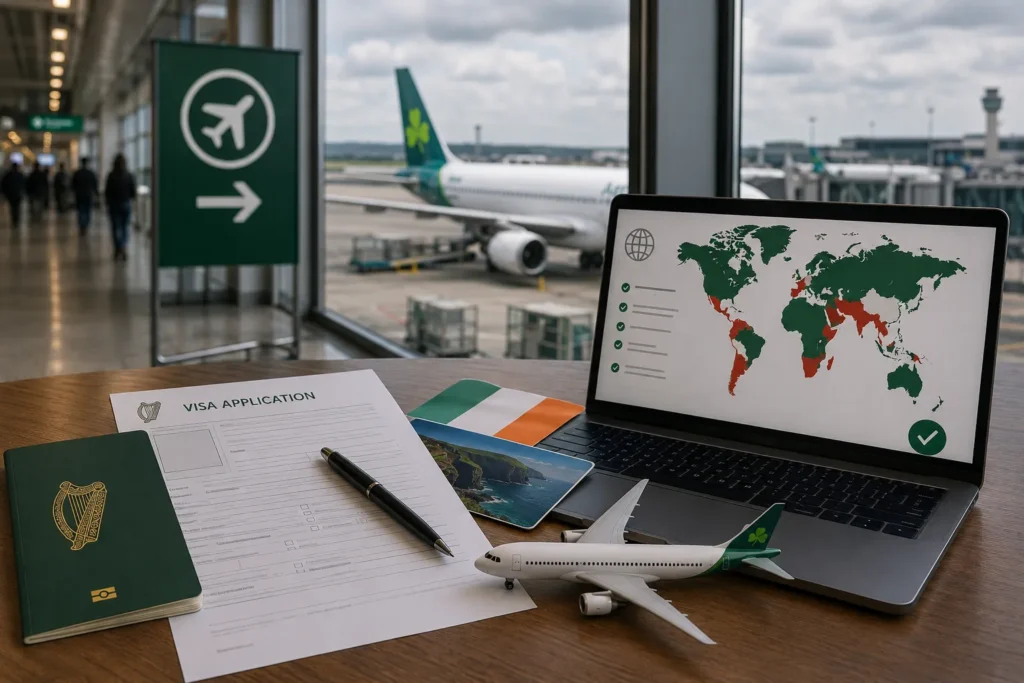
Ireland offers 2 long-stay routes for investors and entrepreneurs: the Immigrant Investor Programme (IIP) and the Start-Up Entrepreneur Programme (STEP)
Immigrant Investor Programme (IIP): Requires a minimum net worth of €2 million and a clean criminal record. 4 investment options exist:
- A minimum investment of €1 million in an Irish enterprise for at least 3 years.
- A minimum investment of €1 million in a regulated Irish investment fund for at least 3 years.
- A minimum investment of €2 million in an Irish REIT listed on the Irish Stock Exchange for at least 3 years.
- A philanthropic donation of at least €500,000 to an approved public benefit project in arts, sport, health, culture, or education.
Start-Up Entrepreneur Programme (STEP): Requires a minimum of €50,000 in funding and an innovative, scalable business proposal. Applicants must also have a clean criminal record and demonstrate good character.
Ireland’s business immigration does not have a standalone retirement visa category — the Retirement Visa operates under the Long Stay D visa framework with a Stamp 0, requiring proof of a personal income of at least €50,000 per year and private medical insurance.
Ireland Transit Visa: Who Needs One and How to Apply
An Irish Transit visa applies to travellers connecting to a third country through an Irish airport (Dublin, Cork, or Shannon). The transit visa does not allow you to leave the airport — it grants port-of-transit access only.
Citizens of approximately 25 countries require an Irish Transit visa, including nationals of Afghanistan, Cuba, Democratic Republic of Congo, Ethiopia, Ghana, Iran, Iraq, Lebanon, Nigeria, Somalia, South Africa, Sri Lanka, and Zimbabwe.
Exception: Ethiopian citizens travelling to the United States or Canada via Ireland do not require a Transit visa. Transit visa fee: €25. Apply through the AVATS system at least 8 weeks before travel.
2 Ireland Visa Waiver Schemes That Can Save You a Separate Application
Ireland operates 2 visa waiver schemes that allow eligible nationals to use a qualifying UK visa to travel to Ireland without a separate Irish visa:
Short Stay Visa Waiver Programme
This scheme applies to nationals of 22 countries including India, China, the Philippines, Turkey, Ukraine, Saudi Arabia, and Vietnam who hold a valid UK Standard Visitor visa. You can use the UK visa to enter Ireland for a short stay, provided your UK visa remains valid. UK Transit and Fiancé visas do not qualify. The programme is not reciprocal — an Irish visa cannot be used to enter the UK.
For travellers evaluating both countries, reading about UK visa types alongside this guide helps clarify which single UK visa application covers both destinations under the waiver.
British-Irish Visa Scheme (BIVS)
The British-Irish Visa Scheme (BIVS) applies exclusively to Chinese and Indian citizens living in China or India respectively. BIVS allows travel across the Common Travel Area (CTA) — both Ireland and the UK — on a single visa. The visa must carry the ‘BIVS’ endorsement. You must first enter the CTA through the country that issued the visa.
How to Apply for Any Ireland Visa Type: 5-Step AVATS Process
To apply for any Ireland visa type, follow this 5-step process using the AVATS (Application for a Visa to Travel to Ireland System) online portal at irishimmigration.ie:
Step 1: Complete the AVATS online application. Select your visa category based on your purpose of travel. The system assigns the correct visa sub-type automatically.
Step 2: Print and sign the Summary Application Form. The AVATS system generates this form automatically at the end of the online application. Print, sign, and date the form — it must accompany your documents.
Step 3: Submit your passport and supporting documents. Send originals to the Irish Embassy, Consulate, or Visa Application Centre in your country. Include 2 recent passport photographs (35 mm × 45 mm / 1.4 in × 1.8 in), proof of funds, travel itinerary, and purpose-specific documents.
Step 4: Track your application. Use your reference number on the ISD’s Visa Decision Weekly Listing for applications processed by the ISD directly. Applications at embassies and consulates are tracked through that specific office.
Step 5: Appeal if refused. A refusal letter states the specific reasons. You must submit a written appeal within 2 months of the refusal date to the Visa Appeals Officer. Address each refusal reason with new or stronger evidence.
ISD recommends applying at least 8 weeks before your intended travel date. Long Stay D visas — especially family and investor routes — require more processing time and longer lead times.
Quick-Reference Table: Ireland Visa Types, Fees, and Processing Time (2026)
The table below summarises all main Ireland visa types, their duration, application method, and 2026 fees:
| Ireland Visa Type | Duration | Key Purpose | Application Method | Typical Fee |
|---|---|---|---|---|
| Short Stay C Tourist | Up to 90 days | Tourism, family visits, short courses | AVATS online portal | €60 (single entry) |
| Short Stay C Business | Up to 90 days (work ≤14 days) | Meetings, contract signing | AVATS online portal | €60 (single entry) |
| Short Stay C Training | Up to 90 days | Employer-organised training course | AVATS online portal | €60 (single entry) |
| Short Stay C Exam | Up to 90 days | Professional/academic exams | AVATS online portal | €60 (single entry) |
| Long Stay D Study | Duration of course (>90 days) | University, English courses (≥25 weeks) | AVATS online portal | €100 (multiple entry) |
| Long Stay D Employment | Duration of permit (>90 days) | Skilled/general work with permit | AVATS online portal | €100 (multiple entry) |
| Long Stay D Join Family | Duration of permission (>90 days) | Spouse, partner, dependent child | AVATS online portal | €100 (multiple entry) |
| Transit Visa | Airport transit only | Connecting flight via Irish airport | AVATS online portal | €25 |
What Happens After You Arrive in Ireland on a Long Stay D Visa

Long Stay D visa holders who plan to stay beyond 90 days must register with the ISD and collect an Irish Residence Permit (IRP) card. Registration happens in person at a local Immigration Registration Office.
The IRP card confirms your registered immigration status. Children under 16 do not receive an IRP card. Children travelling with IRP-holding parents do not need a re-entry visa to return to Ireland after travel abroad.
Your immigration Stamp number determines your work rights. Stamp 1 requires an Employment Permit. Stamp 1G allows work without a permit (graduates and spouses of CSEP holders). Stamp 4 grants full work rights with no permit required. Stamp 5 grants permission to remain indefinitely.
After 5 years of lawful residence in Ireland, you become eligible to apply for Long-Term Residency (Stamp 4). After 5 years as a legal resident, you may also apply for Irish citizenship by naturalisation — a pathway none of the main competitor articles explain in the context of visa types.
Conclusion
Ireland operates a precise visa system — selecting the wrong category means delays, refusals, and wasted fees. The 2 core categories (Short Stay C and Long Stay D) branch into specific sub-types for tourism, work, study, family, investment, transit, and retirement. Each sub-type has its own document requirements, eligibility rules, and processing timeline.
Work out your correct visa type based on 3 factors: your nationality, your travel purpose, and your intended length of stay. Apply through the AVATS portal at least 8 weeks before travel. Register for an IRP card within 90 days of arrival if you hold a Long Stay D visa.
Frequently Asked Questions

Michael Reynolds
Michael Reynolds leads immigration content at ImmigrationWin, covering visa requirements, application and relocation pathways. He researches immigration policies and official government guidance to explain changing rules clearly. His guides help students, families, and professionals make informed decisions about moving abroad.
Related Posts