Canada Visa Types 2026: Complete Guide to All 5 Categories
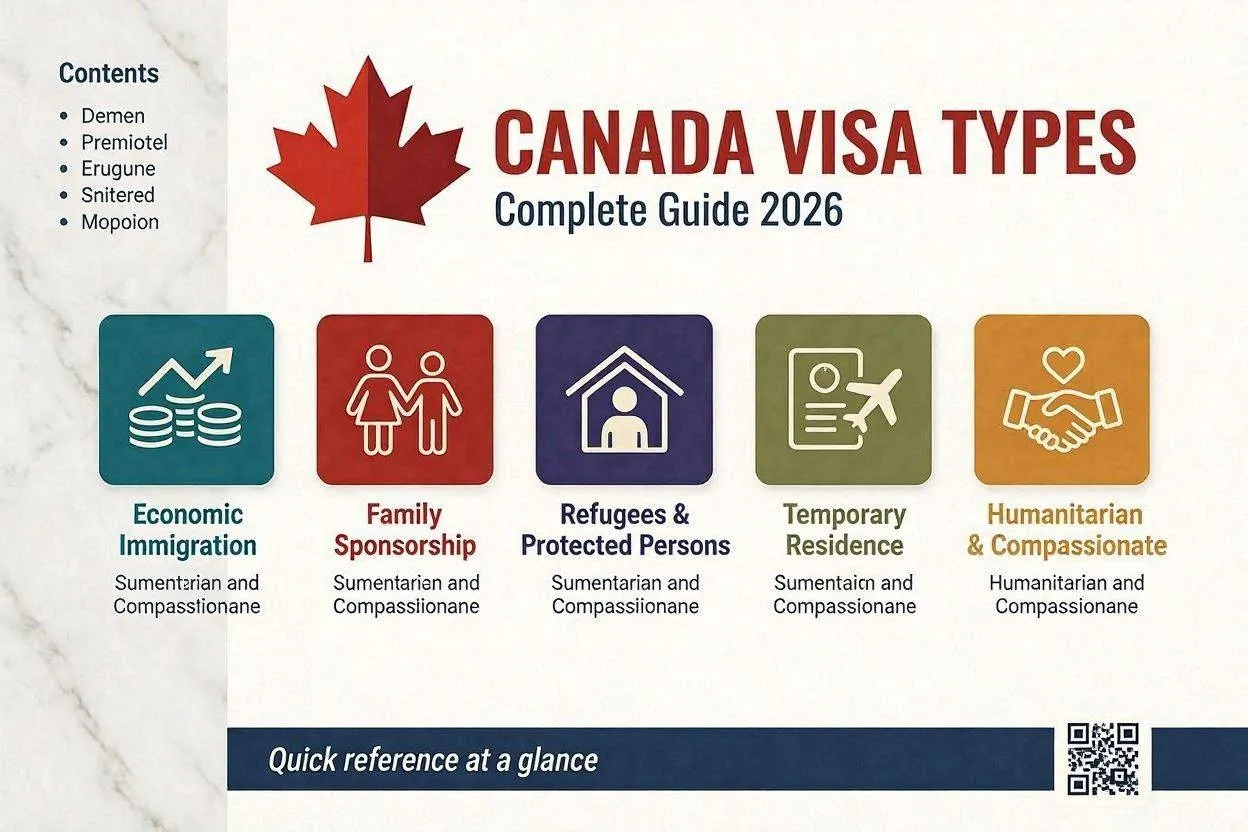
Canada offers 5 main canada visa types in 2026: the visitor visa, the work permit, the study permit, permanent residence programs, and the Electronic Travel Authorization (eTA). Each type serves a different purpose, from a 2-week vacation to a lifetime move.
You pick your visa based on your reason for travel, your planned length of stay, and your home country. Immigration, Refugees and Citizenship Canada (IRCC) issues and manages all 5 categories. This guide breaks down eligibility, costs, and processing times for each canada visa type, so you apply for the right one on your first try.
What Are the Main Canada Visa Types in 2026?
Canada groups its visa options into 5 categories: visitor visas, work permits, study permits, permanent residence programs, and the eTA. Each category carries its own cost, validity period, and application route.
Visitor visas cover tourism, family visits, and short business trips such as conferences and meetings. Work permits authorize paid employment for a fixed employer or for any employer, depending on the permit type. Study permits let international students attend accredited institutions such as the University of Toronto, McGill University, and the British Columbia Institute of Technology. Permanent residence programs, including Express Entry and the Provincial Nominee Program (PNP), grant indefinite status. The eTA screens visa-exempt travelers who arrive by air.
Temporary canada visa types, such as visitor visas, work permits, and study permits, expire on a fixed date. Permanent residence programs carry no expiry date for your status, though your PR card itself needs renewal every 5 years.
You need a valid passport for every canada visa type. Some categories also require biometrics, a medical exam, or proof of funds. The table later in this guide compares fees and timing side by side.
How Does a Canada Visitor Visa Work?
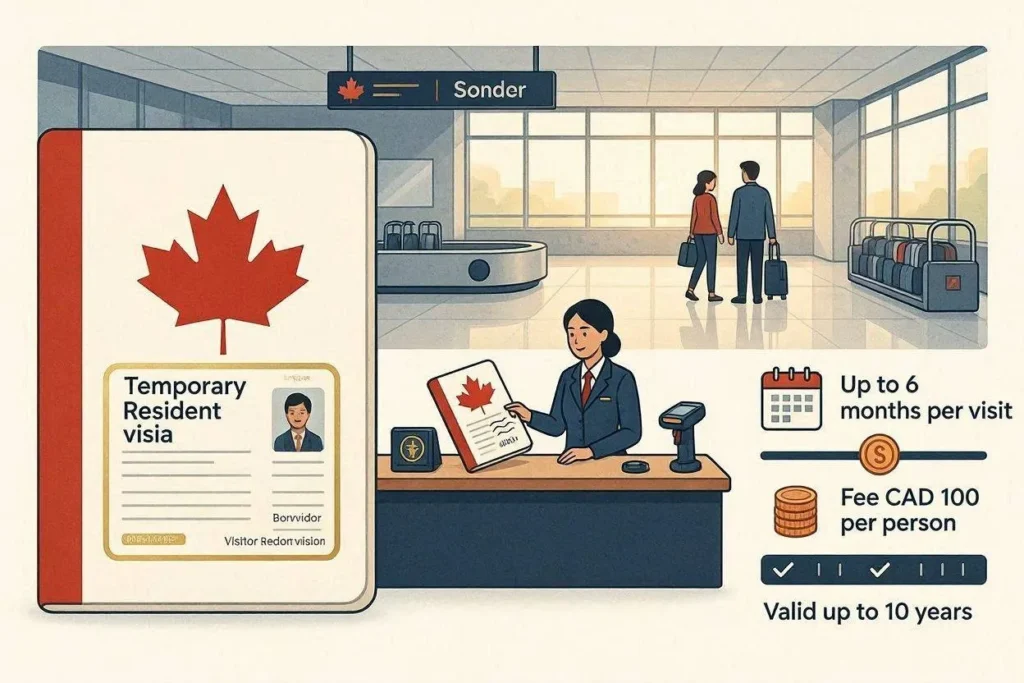
A Canada visitor visa, officially the Temporary Resident Visa (TRV), lets you enter the country for tourism, family visits, or short business activity. The visa costs CAD 100 per person and stays valid for up to 10 years.
You use a visitor visa for stays of up to 6 months, or 182 days, per visit. Officers at the Canada Border Services Agency (CBSA) confirm your permitted stay when you arrive, even if your visa remains valid for years. The visa does not permit paid work or enrollment in a program that needs a study permit. Short, non-credit courses and standard tourist activities remain allowed.
You need a valid passport, proof of sufficient funds, and evidence you plan to leave Canada after your visit, such as a return ticket, a job in your home country, or property ownership. If you plan to bring family members, each applicant, including children, needs a separate application. Processing takes 21 days or more, depending on your country of residence.
Single-Entry vs Multiple-Entry Visitor Visas
To compare entry types, single-entry visas allow one trip to Canada, while multiple-entry visas allow unlimited trips within the validity window. A visa officer decides which type you receive based on your travel history and application details.
Most applicants receive a multiple-entry visa automatically, even without requesting one. You receive a single-entry visa only in specific cases, such as a one-time event or a fee-exempt official visit. Both types expire on the date printed on the visa, the date your passport expires, or the date your biometrics expire, whichever comes first.
How to Apply for a Super Visa
To apply for a Super Visa, you need a Canadian citizen or permanent resident host, proof of income, and private medical insurance. The Super Visa allows parents and grandparents to stay in Canada for up to 5 years per entry, without renewal.
Your host must sign a letter of invitation and show they meet the minimum income requirement for their family size. You must also buy Canadian medical insurance worth at least CAD 100,000, valid for at least 1 year. Processing takes 15 days or more once IRCC receives a complete file.
What Work Permit Options Does Canada Offer?
Canada issues 2 main work permit categories: employer-specific work permits and open work permits. Both permits cost CAD 155 per application, including extensions.
An employer-specific permit ties you to 1 employer, 1 job, and often 1 location, as listed in the permit conditions. An open work permit lets you work for almost any employer in Canada, including small businesses, franchises, and multinational corporations. Work permits fall under 2 federal programs: the Temporary Foreign Worker Program (TFWP), which needs a Labour Market Impact Assessment (LMIA), and the International Mobility Program (IMP), which does not.
The 2026 to 2028 Immigration Levels Plan sets the IMP target at 170,000 permits and the TFWP target at 60,000 permits. This split means nearly 3 out of every 4 work permits skip the LMIA step entirely. Employers who qualify for an IMP exemption save CAD 1,000 in LMIA fees and cut 10 to 20 weeks from processing.
You renew a work permit 3 to 4 months before it expires to avoid a gap in your legal status.
Employer-Specific Work Permits Explained
To qualify for an employer-specific work permit, your Canadian employer must first prove no citizen or permanent resident can fill the role. This proof comes from a positive Labour Market Impact Assessment (LMIA), issued by Employment and Social Development Canada (ESDC).
Your employer advertises the position, collects a valid job offer, and gives you the LMIA letter and Annex A. You then submit your application, job offer, and LMIA documents to IRCC. Free trade agreements, such as the Canada-United States-Mexico Agreement (CUSMA), exempt some employers from the LMIA step entirely.
Open Work Permits Explained
To qualify for an open work permit, you typically fall into 1 of several groups: spouses of skilled workers, spouses of international students, or graduates with a Post-Graduation Work Permit (PGWP). You do not need a job offer or an LMIA for this permit type.
Other open work permit holders include International Experience Canada (IEC) participants, protected persons, and applicants who hold a bridging open work permit while awaiting a permanent residence decision. Spousal open work permit rules tightened in January 2025, narrowing eligibility to specific groups of spouses.
How Does the Canada Study Permit Work?
A Canada study permit lets international students attend a Designated Learning Institution (DLI) for the length of their program plus 90 days. The permit costs CAD 150 and requires proof of funds of at least CAD 22,895 for 1 year.
You need a Letter of Acceptance (LOA) from your DLI before you apply. Your program must last more than 6 months for a study permit to apply; shorter courses only need a visitor visa or an eTA. Most students can work up to 24 hours per week off campus during scheduled classes and full-time during scheduled breaks such as winter and summer holidays.
Graduates who complete an eligible program can apply for a Post-Graduation Work Permit (PGWP) for up to 3 years, which builds toward permanent residence through the Canadian Experience Class.
Designated Learning Institution Requirements
To confirm your school qualifies, check that your institution appears on the official DLI list published by each province or territory. Every elementary school, high school, and most colleges and universities in Canada hold DLI status automatically.
Some private colleges and career schools need separate DLI approval, so verify the listing before you pay tuition. Quebec applicants also need a Quebec Acceptance Certificate (CAQ) in addition to their study permit.
What Permanent Residence Programs Does Canada Offer?
Canada runs several permanent residence programs, including Express Entry, the Provincial Nominee Program (PNP), business immigration streams, and family sponsorship. These programs cost CAD 1,590 for most economic-class applicants, including the right of permanent residence fee.
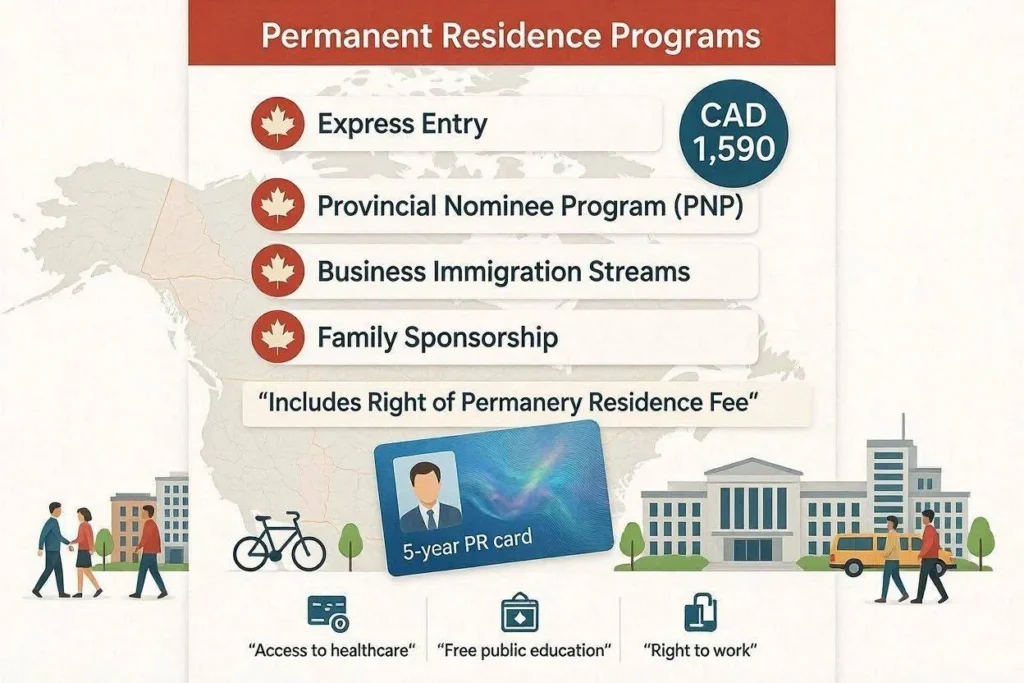
A permanent resident receives a 5-year PR card, renewable indefinitely, along with access to healthcare, free public education, and the right to sponsor eligible family members. Business immigration and self-employed persons programs cost CAD 2,495 and target entrepreneurs, investors, and self-employed applicants in cultural or athletic fields.
Family sponsorship lets permanent residents and citizens sponsor a spouse, common-law partner, dependent child, or parent. Processing for spousal sponsorship generally takes 12 months, while parent and grandparent sponsorship can take longer due to annual intake caps.
Express Entry Categories in 2026
To enter the Express Entry pool, you build a profile under 1 of 3 programs: the Canadian Experience Class, the Federal Skilled Worker Program, or the Federal Skilled Trades Program. IRCC ranks every profile using the Comprehensive Ranking System (CRS), a points-based formula.
As of February 2026, IRCC runs 10 active Express Entry categories, including healthcare, STEM, trades, French-language proficiency, physicians, senior managers, researchers, transport workers, and military recruits. Category-based draws let priority occupations receive invitations at lower CRS scores than general draws. Once invited, you have 60 days to submit your full application.
Provincial Nominee Program Streams
To apply through the Provincial Nominee Program, you target 1 of 11 participating provinces and territories, such as Ontario, British Columbia, and Manitoba. A provincial nomination adds 600 points to your CRS score, which guarantees an invitation in the next Express Entry draw.
Each province runs its own streams for skilled workers, international graduates, and entrepreneurs, based on local labour market needs. Quebec runs a separate selection system outside Express Entry, called the Quebec Skilled Worker Program.
Do You Need a Visa or an eTA to Enter Canada?
You need either a visitor visa or an eTA to enter Canada, depending on your citizenship and travel method. Citizens of visa-exempt countries flying to Canada need only an eTA, which costs CAD 7 and often processes within minutes.
Citizens of visa-required countries, such as India, Nigeria, and the Philippines, need a full visitor visa regardless of how they travel. US citizens need neither document; a valid US passport or Green Card covers entry for stays of up to 180 days. Travelers who already hold valid Canadian status, such as a work permit or study permit, skip the eTA when they re-enter after a short US trip.
The entry document you need depends on your passport, not your final destination. Even travelers who only transit through a Canadian airport on the way to another country often need a visa or an eTA for that stopover.
How to Apply for a Canada Visa Online
To apply for a canada visa type online, you first create an IRCC Secure Account and select the category that matches your purpose. Every visa type, except the eTA, routes through this same online account system.
You then upload your passport, proof of funds, and category-specific documents, such as a job offer for a work permit or a Letter of Acceptance for a study permit. Most applicants give biometrics, including fingerprints and a photo, at a Visa Application Centre (VAC), at a cost of CAD 85 per person. You pay your application fee, submit the file, and track your status online using the IRCC processing time tool.
Complete every field accurately, since a missing document or unclear photo can delay your file by several weeks. Respond to any request for extra information within the deadline IRCC provides.
Approval brings different proof depending on your category: a visa sticker for visitor visas, a port of entry letter for work and study permits, and a Confirmation of Permanent Residence (COPR) for economic-class programs.
How Much Does Each Canada Visa Type Cost in 2026?
Canada visa fees range from CAD 7 for an eTA to CAD 1,590 for most permanent residence applications. Biometrics add CAD 85 per person, or CAD 170 for a family of 2 or more.
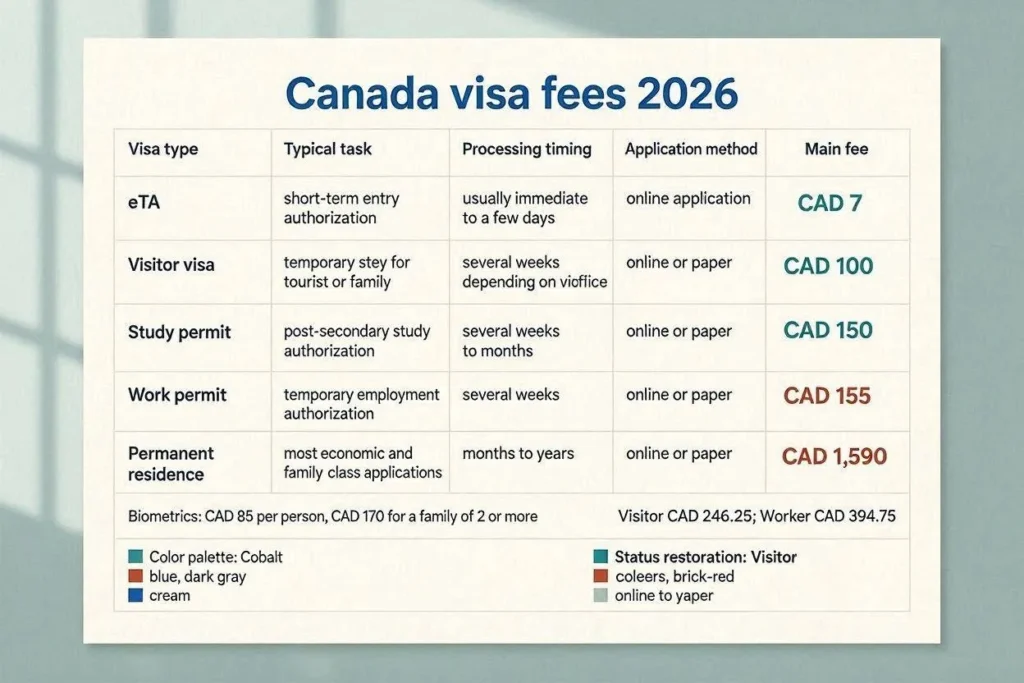
Extension and restoration fees add further cost if your status lapses. A visitor status restoration costs CAD 246.25, while a worker status restoration costs CAD 394.75. The table below compares the 5 main canada visa types by task, timing, method, and difficulty, so you can plan your application before you start.
| Task | Timing | Method | Difficulty |
|---|---|---|---|
| Apply for an eTA | 5 minutes to 72 hours | Online form at canada.ca | Easy |
| Apply for a visitor visa (TRV) | 21 days or more | IRCC Secure Account | Moderate |
| Apply for a study permit | 21 days or more | Online with Letter of Acceptance | Moderate |
| Apply for a work permit | 3 weeks or more | Online with job offer or LMIA | Moderate |
| Build an Express Entry profile | 6 months average after invitation | IRCC Secure Account | Hard |
| Give biometrics | Same day | Visa Application Centre visit | Easy |
| Renew or extend a permit | 3 to 4 months before expiry | Online extension application | Moderate |
Choosing the Right Canada Visa Type for Your Plans
Canada’s 5 visa types cover every reason for travel, from a 2-week visit to a lifetime move. You match your purpose, your budget, and your timeline to the right category before you submit any application. Review the eligibility rules for your chosen canada visa type carefully, gather your documents early, and apply through your IRCC Secure Account. For personalized guidance on your specific case, reach out to the immigration team at Immigration Win to review your options and strengthen your application.
Frequently Asked Questions

Michael Reynolds
Michael Reynolds leads ImmigrationWin’s immigration, visa, and global mobility content division. He specializes in researching immigration policies, visa requirements, application processes, and international relocation pathways for individuals, families, students, and professionals. With extensive experience analyzing immigration regulations and official government guidance, Michael brings a research-driven approach to complex immigration topics and changing visa policies. He is the primary author of ImmigrationWin’s visa guides, immigration resources, and country-specific content, helping readers better understand their options and make informed decisions about their international journey.
Related Posts