Spain Visa Types: Complete Legal Guide for Expats [2026]
Spain categorizes authorization pathways into short-stay options, transit permits, and long-term national visas based on your length of stay and your specific purpose of travel. Non-European Union [non-EU] citizens must select a pathway that matches their professional, educational, or investment objectives before entering the country.
The entry regulations depend on your country of citizenship, your financial resources, and your planned economic activities. Short-term permissions allow you to remain in the Schengen Area for a maximum of 90 days within any rolling 180-day period. Long-term pathways allow you to establish a temporary or permanent residence after satisfying specific structural requirements. Understanding these distinct frameworks prevents application rejections at the consulate.
What Are the Specific Short-Stay Options and Schengen Visa Requirements Spain Mandates?
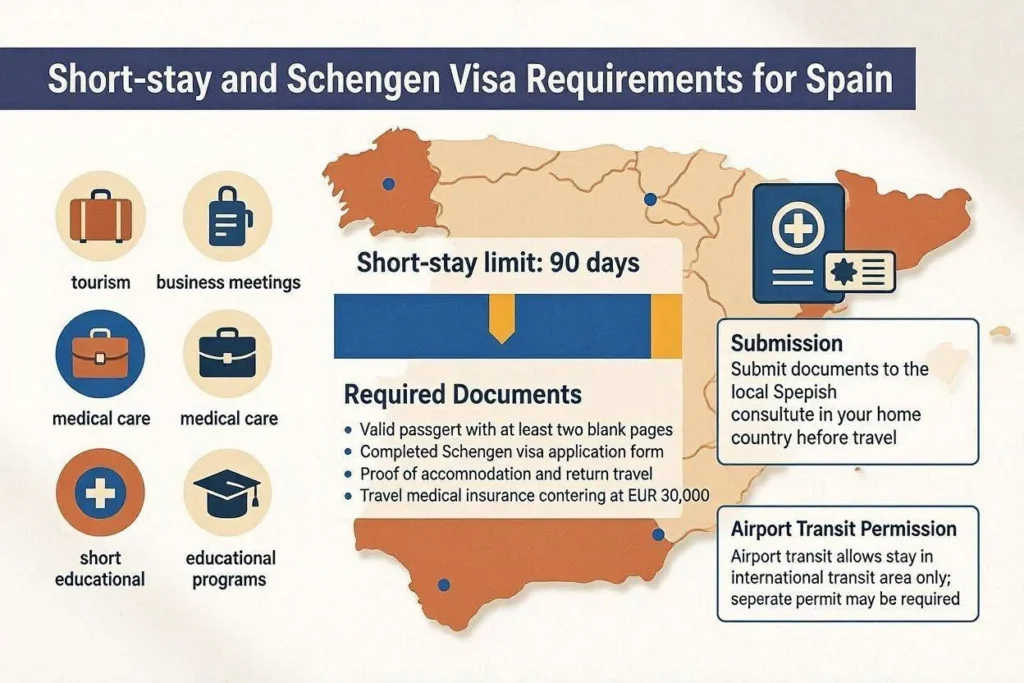
Short-stay permissions regulate short visits that do not exceed 90 days for tourism, business meetings, medical care, or short educational programs. You must submit your documentation to the local Spanish Consulate in your home country before you travel.
Understanding the Transit and Tourist Stay Limitations
The airport transit permission allows you to stay in the international transit area of a Spanish airport during an active flight connection. You cannot enter the national territory or leave the restricted airport zone with this document. The standard tourist visa allows you to travel across the entire Schengen Zone for vacations or family visits. You cannot engage in any paid professional work while holding a tourist permit. The authorities enforce strict financial checks during the border entry process.
Collecting Your Required Application Documents
To apply for a short-stay permit, you must present a valid passport with at least 6 months of validity remaining. Your passport must contain at least 2 blank pages to receive the physical entry stamp. You must provide a confirmed return flight ticket and explicit proof of accommodation. Accommodation proof includes a confirmed hotel booking or a formal invitation letter from a legal resident. You must secure specialized travel health insurance that provides a minimum coverage of 30,000 Euros [EUR]. This insurance policy must cover emergency medical expenses and medical repatriation across all member states.
Demonstrating Financial Sufficiency at the Border
You must prove that you possess enough money to sustain your lifestyle during your entire short stay. The Spanish government updates the minimum daily financial requirement every calendar year based on the national minimum wage. Travelers must prove they hold at least 113 EUR per day of stay in the country. Your total funds cannot drop below a minimum baseline of 1,017 EUR per individual applicant. You satisfy this requirement by presenting official bank statements from the last 3 months. The statements must feature an original stamp from your banking institution.
How to Apply for Spanish Residency Options via Non-Lucrative Pathways
To apply for a residency pathway without working, you must submit your application directly to the Spanish diplomatic mission in your current country of legal residence.
Meeting the Non-Lucrative Financial Thresholds
You must demonstrate a reliable stream of regular passive income to secure a non-lucrative residence permission. The government calculates the necessary financial amounts using the Public Multiple Effects Income Indicator [IPREM]. The main applicant must prove a monthly income equal to 400% of the current IPREM value. This structural requirement translates to a personal baseline of 2,400 EUR per month. You must prove an additional 100% of the IPREM for every dependent family member you include. This additional rule requires an extra 600 EUR monthly per person. You can also satisfy this requirement by holding a total lump sum of 28,800 EUR in a liquid bank account.
Sourcing Your Acceptable Passive Income Channels
The evaluation authorities accept specific forms of revenue to confirm your long-term financial self-sufficiency. Acceptable revenue varieties include official state pensions, regular investment dividends, corporate rental revenues, and life annuity payments. You cannot use salary from remote employment or active business profits to meet this target. You must show that these specific funds arrive automatically without requiring your physical or digital labor. All financial records must undergo official translation into the Spanish language by an approved certified translator.
Arranging Medical Care and Criminal History Clearances
You must buy an expansive private health insurance policy from a licensed insurance company operating inside Spain. The contract must offer complete coverage equivalent to the national public health system. The policy cannot include any co-payments or deductibles for consultations or surgeries. You must also supply a clean criminal record certificate covering the last 5 years of your life. This document must come from every country where you maintained legal residency. The certificate must carry an official Apostille stamp to confirm its international legality.
Which Work Permit Regulations Apply to Employees and Freelancers?
Spain maintains strict regulatory frameworks for non-EU nationals who want to access the local job market. Employers must prove that no qualified Spanish or EU citizen can fill the vacant role before hiring a foreign worker.
Securing a Traditional Employment Contract
Your future employer must initiate the initial work permit request through the Ministry of Employment inside Spain. The company must show an official certificate from the State Employment Public Service [SEPE] confirming a lack of local applicants. The position must remain listed on the national employment registry for at least 15 days without success. Once the Ministry approves this initial request, you can apply for your physical entry visa at the consulate. You must bring the signed employment contract showing a salary that matches national collective bargaining agreements.
Launching an Independent Enterprise as a Freelancer
To launch an independent enterprise, you must submit a highly detailed business plan to an approved professional organization in Spain. Specific organizations like the Self-Employed Workers Association [ATA] must review and certify your economic project. Your plan must describe your core business model, your marketing strategies, and your projected multi-year financial earnings. You must prove that you possess sufficient investment capital to launch the venture successfully. You must also show that you hold enough personal funds to support your daily life separate from business capital. The plan must project the creation of new employment opportunities for local citizens within 3 years.
What Are the New Digital Nomad Application Pathways for Remote Workers?
The Spanish government introduced dedicated remote work frameworks through the historic Startup Law to attract global technical talent and entrepreneurs. This framework provides specific tax advantages under a modified version of the famous Beckham Law.
Confirming Employer Approvals and Business Longevity
To access the remote worker pathway, you must prove that your employer has operated continuously for at least 12 months. You must submit an official certificate from the corporate registry showing the date of incorporation. Your employer must provide a formal letter authorizing you to execute your duties remotely from Spanish territory. This document must state your exact job title, your monthly salary details, and the length of your employment contract. You must prove a continuous professional relationship with the company for a minimum of 3 months before your application date.
Proving Your Advanced Professional Credentials
Applicants must hold an undergraduate university degree from a fully accredited higher education institution. Alternatively, you can demonstrate at least 3 years of direct, high-level experience in your specific professional sector. You provide this proof by submitting detailed employment reference letters, past work contracts, and verifiable portfolio links. The authorities cross-reference these documents to verify your specialist status. If you operate as an independent freelancer, you can earn a maximum of 20% of your total income from local companies located inside Spain.
Navigating the Social Security Registration Framework
You must maintain active social security coverage throughout your entire period of residence in Spain. If your home country shares a bilateral social security agreement with Spain, you must request a certificate of coverage. The certificate proves you remain registered in your home nation while living abroad. The United Kingdom and the United States issue these specific certificates for remote workers. If your home country does not maintain this specific agreement, your employer must register directly with the Spanish social security treasury. The company must pay monthly contributions according to standard national rates.
How do Student Visa Conditions Regulate Education and Work Rights?
Foreign students who get accepted into certified educational institutions can secure a long-term study permission to live in Spain. This pathway requires regular renewals aligned with your academic program.
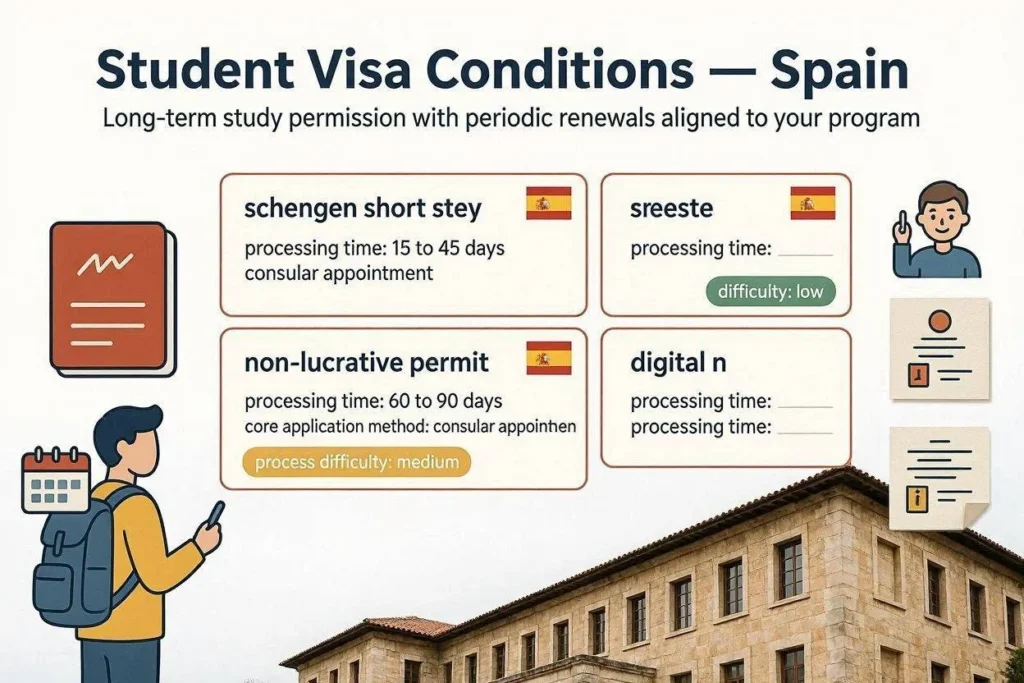
| Visa Category | Processing Time | Core Application Method | Process Difficulty |
| Schengen Short Stay | 15 to 45 Days | Consular Appointment | Low |
| Non-Lucrative Permit | 60 to 90 Days | Consular Appointment | Medium |
| Digital Nomad Status | 20 Working Days | Online UGE Portal | Medium |
| General Work Permit | 90 to 120 Days | Employer Driven | High |
Enrolling in Accredited Higher Education Institutions
To meet the legal student visa conditions, you must enroll in an authorized educational center. The institution must hold official registration with the Ministry of Education or the Universities Council. Your course must lead to a recognized degree, a professional certificate, or a formal postgraduate qualification. The program must require a minimum of 20 hours of classroom instruction per week. You must present an official letter of acceptance showing your full name, the specific course title, and the precise start and end dates.
Managing Financial Targets and Living Budgets
Students must prove they possess sufficient capital to cover all tuition fees and monthly living costs. You must show that you hold 100% of the monthly IPREM value for your personal upkeep. This target requires proving a minimum of 600 EUR for every month of your academic year. You can satisfy this obligation by presenting personal bank accounts or notarized financial sponsorship letters from your parents. If you receive a full academic scholarship, you must present the official award letter showing the total grant amount.
Accessing Part-Time Employment Markets Legally
International students can work part-time to gain experience and support their living budgets. You can work for a maximum of 30 hours per week under current immigration regulations. The work schedule must never conflict with your regular university lectures or seminar times. The employer must apply for work authorization through the local immigration office before you begin your employment. The earnings you make from this part-time employment cannot serve as your primary source of financial support for your visa application.
How to Navigate the Golden Visa and Family Reunification Processes
Spain offers streamlined residency routes for high-net-worth investors and immediate relatives of legal residents. These pathways reduce waiting times and offer flexible physical stay requirements.
Investing in the Spanish Real Estate Market
To qualify for the strategic investor pathway, you must purchase real estate with a minimum value of 500,000 EUR. You must purchase the property free of any mortgages or liens for the first 500,000 EUR of the investment. You prove this purchase by submitting a certificate from the Land Registry issued within the last 90 days. You can also qualify by placing 1,000,000 EUR into Spanish bank deposits or buying 2,000,000 EUR in government bonds. This investor status allows you to live and work anywhere in Spain without a traditional employment sponsor.
Reuniting with Your Immediate Family Members
Legal residents who lived in Spain for at least 1 year can sponsor their close family relatives. You can sponsor your legal spouse, your registered common-law partner, and your children under 18 years of age. You must prove your family ties by submitting official marriage and birth certificates. You must show that you possess adequate housing that meets local structural standards. The local town hall inspects your home and issues an official report confirming the property size and layout. You must also prove that your monthly income is sufficient to support all your family dependents.
Step-by-Step Guide: How to Apply for a Long-Term National Visa
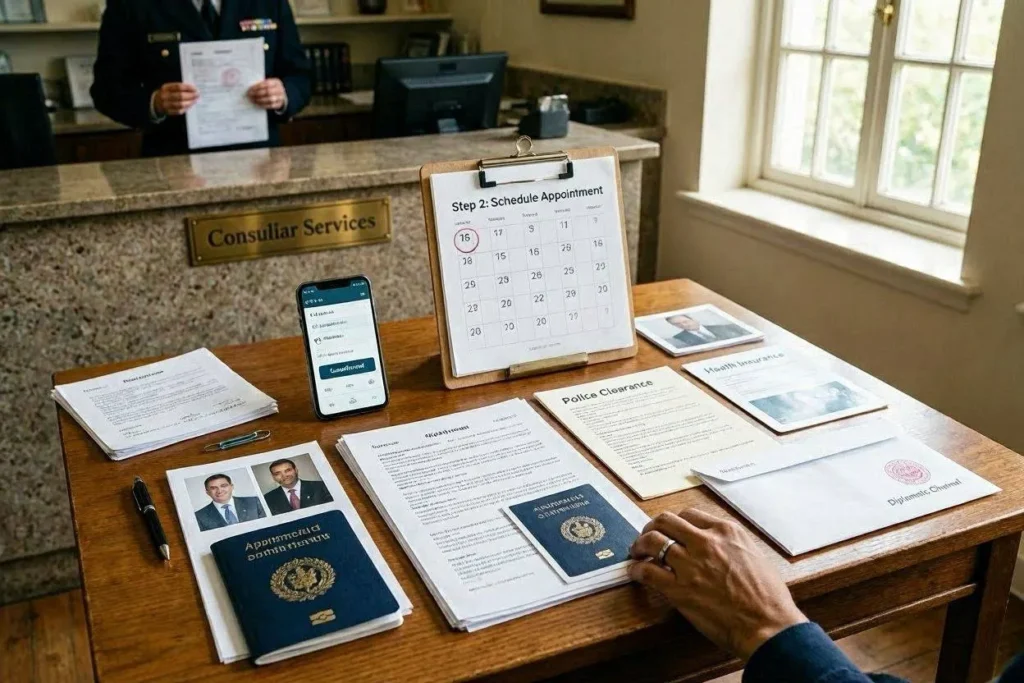
To apply for a long-term national visa, you must organize your supporting documents and secure an official appointment slot. You must execute this entire process through the diplomatic channels in your current country.
- 1. Gather Your Core Documents: Collect your biometric passport, your clean criminal background records, and your comprehensive private health insurance certificates. Print every application page on standard paper measuring 8.5 by 11 inches (21.59cm by 27.94cm).
- 2. Translate and Legalize Your Certificates: Submit your foreign public documents to a certified translator to get them translated into official Spanish. Secure an international Apostille stamp for every official birth, marriage, and criminal history record.
- 3. Secure an Official Appointment Slot: Access the online booking portal of the Spanish Consulate that manages your geographic region. Select an open appointment date that occurs at least 2 months before your planned travel date.
- 4. Attend the Interview and Pay Fees: Present your physical application bundle in person at the consulate office and submit your biometric data. Pay the mandatory visa processing fee using cash or a verified money order.
To convert your visa into local residency after arriving in Spain, you must visit the local police station. You must request your unique Foreigner Identity Number [NIE] to open local bank accounts and sign lease agreements. You must apply for your physical TIE card within 30 days of entering the country. The physical card measures 3.37 inches by 2.13 inches (8.56cm by 5.40cm) and serves as your official identity document.
Selecting the right pathway ensures a smooth transition to your new life in Southern Europe. If you need professional assistance to review your eligibility or organize your documents, you can contact our immigration team. You should analyze the explicit rules for Spanish residency options to find the most secure path for your family. If your primary goal involves professional employment, you must review the detailed work permit regulations before contacting Spanish companies. If you operate as a remote worker, our legal experts can assist you with digital nomad application pathways to secure your legal residency fast.
Frequently Asked Questions

Michael Reynolds
Michael Reynolds leads ImmigrationWin’s immigration, visa, and global mobility content division. He specializes in researching immigration policies, visa requirements, application processes, and international relocation pathways for individuals, families, students, and professionals. With extensive experience analyzing immigration regulations and official government guidance, Michael brings a research-driven approach to complex immigration topics and changing visa policies. He is the primary author of ImmigrationWin’s visa guides, immigration resources, and country-specific content, helping readers better understand their options and make informed decisions about their international journey.
Related Posts