
EB2 vs EB3 Visa: Which Green Card Category Fits You
The EB2 visa fits professionals with a master’s degree or higher, a bachelor’s degree plus five years of progressive experience, or exceptional ability in their field; the EB3 visa fits skilled workers, degree-holding professionals, and other workers with less formal training. Both categories need an employer sponsor and, in most cases, a labor certification (PERM) from the Department of Labor (DOL).
Speed decides the real EB2 vs EB3 visa question for most applicants, not eligibility on paper. EB2 usually processes faster.
EB3 pulls ahead for India and China in certain months of the Visa Bulletin, though, flipping the usual order entirely. Match the job’s stated requirements first, then match the worker’s qualifications to that job second.
What Is the EB2 Visa
The EB2 visa is the second-preference employment-based green card category, built for advanced degree holders and applicants with exceptional ability. USCIS recognizes three paths into this category: an advanced-degree professional filing, an exceptional-ability filing, and a National Interest Waiver (NIW) filing that skips the job offer entirely.
A master’s degree qualifies on its own. A bachelor’s degree only counts if it’s paired with five years of progressive, post-graduation experience in the same field.
Employers filing a standard EB2 case must complete PERM labor certification first, proving no qualified U.S. worker wants the role. Exceptional ability requires meeting at least three criteria set by USCIS, a high salary, industry awards, or ten years of documented experience among them.
Research roles, medical positions, and technology jobs tend to produce the strongest exceptional-ability arguments, since those fields generate the clearest paper trail of recognition.
The NIW branch changes the math completely. Physicians serving underserved areas, researchers running national-impact projects, and startup founders creating U.S. jobs often use this path, since it allows self-petition without any employer involved.
Waiving PERM alone can save well over a year of processing time, given how backed up DOL’s labor certification queue currently runs.
What Is the EB3 Visa
The EB3 visa is the third-preference employment-based green card category, covering skilled workers, degree-holding professionals, and other workers with under two years of training. Three subcategories exist here.
Skilled workers need two years of experience or training but no degree. Professionals need a bachelor’s degree, or its foreign equivalent, in a field the job genuinely requires.
Other workers, sometimes labeled EB3C, fill permanent, full-time roles requiring minimal training, caregiving and hospitality jobs among them.
Every EB3 filing needs a job offer and PERM labor certification, without exception. There’s no NIW-style shortcut in this category, not for any occupation.
That single fact drives much of the EB2 vs EB3 visa debate: EB3 offers no self-petition option at all, so an employer stays engaged through the entire multi-year process from start to finish.
A three-year foreign bachelor’s degree rarely satisfies EB3 professional requirements. USCIS treats it as equivalent to two to three years of U.S. undergraduate study, not a full four-year degree, based on evaluations run through the Electronic Database for Global Education (EDGE).
Combining that degree with additional coursework sometimes helps. Approval still isn’t guaranteed, even then.
EB2 vs EB3 Visa: Key Differences at a Glance
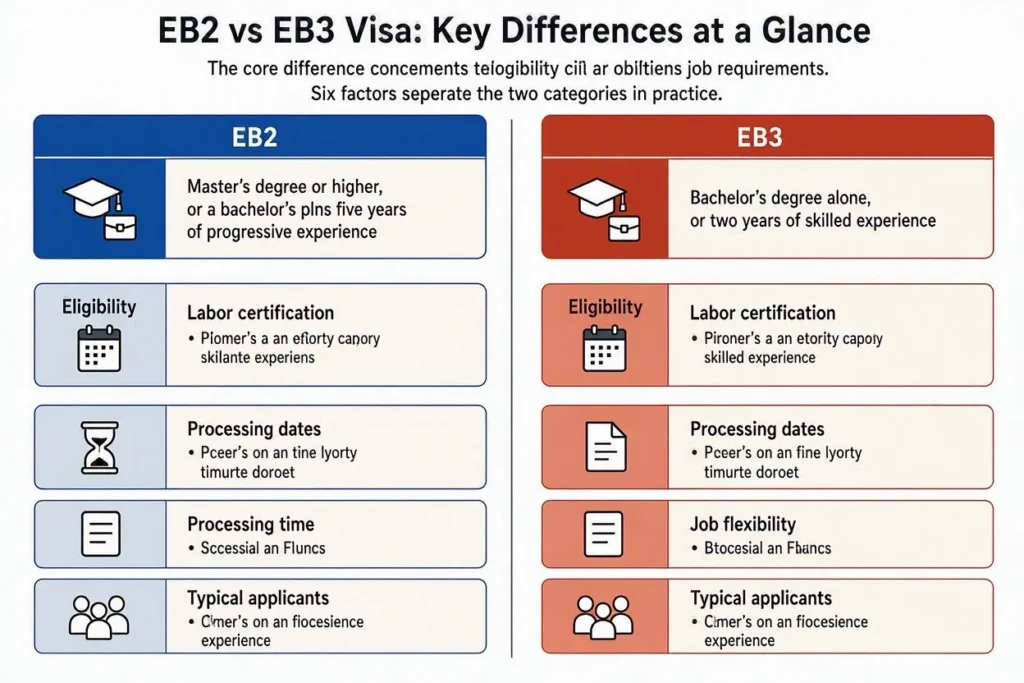
The core EB2 vs EB3 visa difference comes down to job requirements: EB2 needs an advanced degree or exceptional ability, while EB3 needs a bachelor’s degree, two years of experience, or neither. Six factors separate the two categories in practice.
| Factor | EB2 | EB3 |
| Eligibility | Master’s degree or higher, or a bachelor’s plus five years of progressive experience | Bachelor’s degree alone, or two years of skilled experience |
| Labor certification | Required, unless the applicant qualifies for NIW or Schedule A | Required, unless an employer secures Schedule A designation |
| Self-petition | Available through EB2 NIW | Not available under any circumstance |
| Processing speed | Typically faster | Typically slower, though this reverses for certain countries in certain months |
| Priority dates | Usually ahead of EB3 on the Visa Bulletin | Sometimes ahead of EB2, especially for India and China |
| Evidence burden | Award letters, salary data, professional licenses | Employer letters, degree transcripts |
A position requiring a master’s degree can’t get filed as EB3. A position requiring only a bachelor’s degree can’t get filed as EB2, regardless of what degree the worker actually holds.
USCIS checks the job’s stated minimum requirements against the PERM filing, not just the candidate’s resume, and that mismatch alone denies more petitions than any other single issue.
How Priority Dates Change the EB2 vs EB3 Visa Decision
Priority dates, not category prestige, decide which visa moves faster in most EB2 vs EB3 visa cases. The Department of State publishes the Visa Bulletin monthly, listing cutoff dates by category and country of chargeability.
The case can move forward when an applicant’s priority date falls before the published cutoff; it stalls if the date falls after.
For most countries, this comparison barely matters. Both categories run current or close to current, so processing speed depends more on how fast PERM and I-140 stages move than on category choice.
India and China face a different reality entirely. The September 2026 Visa Bulletin, for instance, showed EB2 India holding current while EB3 India continued to lag behind, reversing a pattern seen just months earlier.
Retrogression, meaning a cutoff date moving backward instead of forward, can strike either category without warning, erasing a full year of apparent progress overnight.
Three data points matter most when reading the bulletin.
| Term | What It Controls |
| Final Action Date | Final green card approval |
| Dates for Filing | I-485 submission, when USCIS permits that chart |
| Priority date | Ties to the PERM filing, or to the I-140 filing itself for NIW cases |
When Does EB3 Move Faster Than EB2
Yes, EB3 moves faster than EB2 in specific months, mostly for applicants from India and China where EB2 demand outpaces supply. This isn’t the norm, but it happens often enough that immigration attorneys track it closely for backlogged countries every filing season.
One scenario plays out repeatedly. An Indian applicant holds an approved EB2 I-140, yet the EB2 final action date sits years behind the EB3 date for the same month.
Filing a downgrade, meaning a new EB3 I-140 tied to the same underlying job and PERM, lets that applicant potentially retain the earlier EB2 priority date while riding the faster-moving EB3 line. The downgrade petition can draw scrutiny or denial if the job’s stated requirements don’t genuinely support an EB3 classification, though.
Rest-of-world applicants rarely need this analysis, since both categories tend to run current for them at the same time. Country of chargeability, not nationality at birth, determines which bulletin line applies, a detail that trips up applicants born in one country but chargeable to another through a spouse.
What Is the EB2 NIW and Who Qualifies
The EB2 National Interest Waiver (NIW) lets qualified professionals self-petition for a green card without an employer or PERM labor certification. Three conditions must all hold under the legal standard USCIS applies, commonly called the Dhanasar test.
The proposed work must carry substantial merit and national importance. The applicant must sit in a well-positioned spot to advance that work.
Waiving the job offer and labor certification must benefit the United States more than enforcing them would.
Researchers publishing in high-impact journals, physicians committing to underserved-area service, and founders creating measurable U.S. jobs make up the bulk of successful NIW filers. Employment gaps don’t automatically sink a case, either.
USCIS doesn’t impose strict recency rules on a record of achievement, so a two-year gap for caregiving or a career pivot needs explanation, not concealment.
Processing differs sharply from standard EB2 filings.
| Filing Type | Premium Processing Time | PERM Required |
| EB2 NIW I-140 | 45 business days (about 9 weeks) | No |
| Standard EB2 or EB3 I-140 | 15 business days (about 3 weeks) | Yes |
Skipping PERM more than makes up for the longer I-140 wait, though. DOL’s average PERM adjudication time alone now runs around 501 calendar days, near 16.5 months, before even counting prevailing wage determination and recruitment.
Can You Switch Between EB2 and EB3
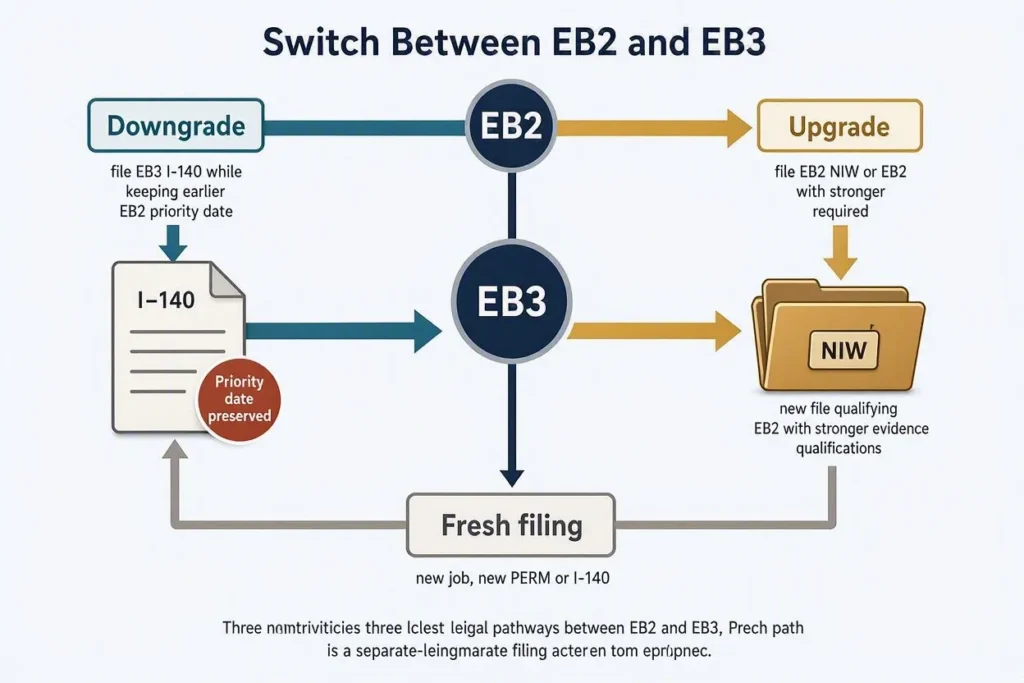
Yes, applicants can switch between EB2 and EB3, through a downgrade, an upgrade, or a fresh filing tied to a new job. Three paths exist for making that switch, and none of them count as a simple form update.
- Downgrade: files a new EB3 I-140 while trying to preserve an earlier EB2 priority date, useful if EB3 is moving faster for that applicant’s country.
- Upgrade: runs the opposite direction, most often through EB2 NIW, and requires three conditions before the earlier priority date carries over: the underlying labor certification must be DOL-approved, the EB3 I-140 must get filed within that certification’s 180-day validity window, and the EB3 I-140 itself must reach approval before the NIW petition can inherit its date.
- New job filing: a job change, internal or external, can trigger a fresh PERM and I-140 landing in a different category entirely, since classification depends on the new position’s stated requirements rather than any prior filing history.
None of these moves happen automatically. Each requires a new I-140 petition, continued employer cooperation in most cases, and evidence that stays internally consistent with whatever category the new filing claims.
Can You File EB2 and EB3 at the Same Time
Yes, applicants can file EB2 and EB3 petitions at the same time, provided they genuinely qualify for both categories. Dual filing works as a hedge, not a shortcut.
An employer runs two separate PERM applications, or ties two I-140 filings to one approved PERM if the job requirements support both classifications, then waits to see which priority date moves first on the Visa Bulletin.
Cost climbs fast with this approach. Two PERM filings mean two prevailing wage determinations, two recruitment cycles, and two sets of attorney fees, doubling upfront costs compared to a single filing in most cases.
Applicants from backlogged countries sometimes justify that expense, since a six-month or one-year head start on either category can matter more than the extra spend. Rest-of-world applicants, where both categories usually run current, rarely see enough upside to bother.
How Schedule A Changes the EB2 vs EB3 Visa Timeline
Schedule A designation removes the PERM labor certification requirement entirely for a short list of occupations with documented, government-recognized worker shortages. Registered nurses and physical therapists make up the largest share of Schedule A filings.
Certain performing-arts and academic professionals with exceptional ability qualify too, under a separate branch of the same list.
Skipping PERM cuts out the single longest stage of either EB2 or EB3 processing, the 501-day average DOL window, plus prevailing wage and recruitment time layered on top of that. A nurse filing under Schedule A can move straight to Form I-140 once an employer offers a qualifying position, bypassing months of mandatory recruitment advertising.
Schedule A works within EB2 or EB3, not as a separate category on its own. It changes the process length.
It doesn’t touch the underlying eligibility test at all.
How Prior H-1B or F-1 Status Affects an EB2 or EB3 Filing
Prior H-1B or F-1 status does not change EB2 or EB3 eligibility, since USCIS evaluates the job and the applicant’s credentials, not the visa status currently held. Timing, though, works differently for each group.
H-1B holders often already work for the sponsoring employer, so the PERM recruitment stage tests the actual job they’re performing daily, which strengthens the case when duties match the labor certification exactly. AC21 portability rules let H-1B holders change jobs once their I-485 has been pending 180 days, without restarting the green card process from zero, a detail that matters most for applicants stuck in multi-year EB2 or EB3 backlogs.
F-1 students on Optional Practical Training (OPT) or STEM OPT face a tighter runway, since their status expires long before PERM plus I-140 plus the priority-date wait typically completes. Most students need an H-1B transition first.
Sponsorship and work history line up only after that step.
EB2 vs EB3 Visa: Which Should You File
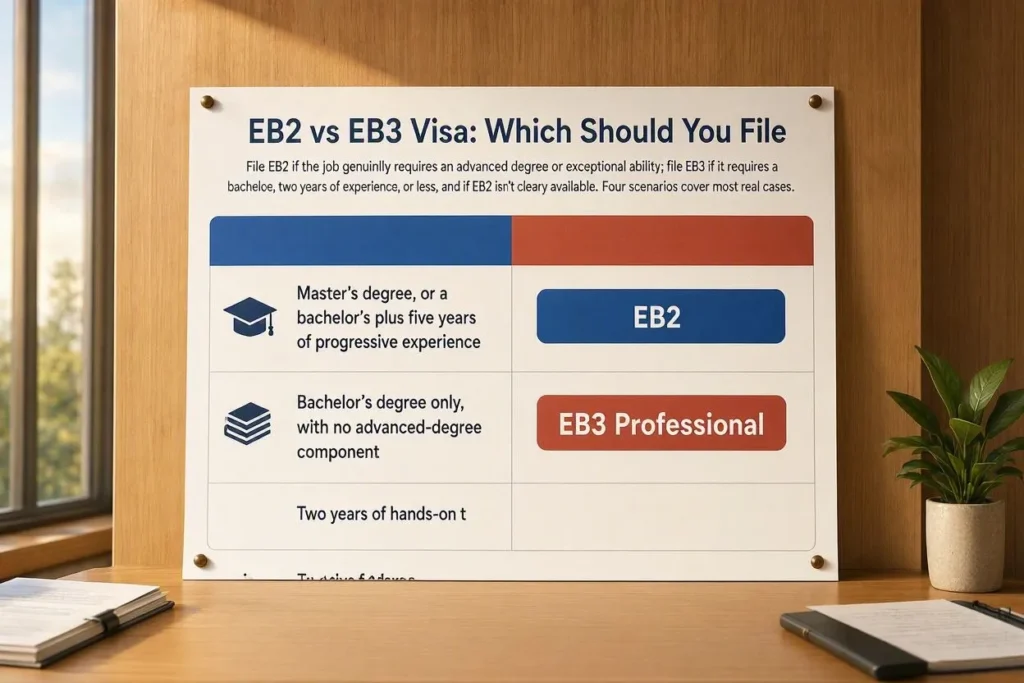
File EB2 if the job genuinely requires an advanced degree or exceptional ability; file EB3 if it requires a bachelor’s degree, two years of experience, or less, and if EB2 isn’t clearly available. Four scenarios cover most real cases.
| Job Requirement | Category to File |
| Master’s degree, or a bachelor’s plus five years of progressive experience | EB2 |
| Bachelor’s degree only, with no advanced-degree component | EB3 Professional |
| Two years of hands-on training or experience, no degree | EB3 Skilled Worker |
| EB2 fully retrogressed but EB3 showing forward movement | Downgrade evaluation |
Employers shouldn’t inflate a job’s requirements just to chase EB2’s category prestige. Doing so creates PERM risk immediately and I-140 risk later, since USCIS actively looks for job descriptions written around one specific candidate rather than actual business needs.
The safest EB2 vs EB3 visa strategy starts with the real position, checks the worker’s genuine qualifications against it, then tests timing against the current Visa Bulletin, in exactly that order.
Conclusion
The EB2 vs EB3 visa decision starts with the job, not the applicant’s ambitions. A position requiring a master’s degree supports EB2.
A position requiring a bachelor’s degree or two years of experience supports EB3, no matter how advanced the worker’s actual background happens to be. Priority dates then decide the timeline, and that timeline shifts month to month for India and China in particular.
Schedule A, the NIW, and downgrade or upgrade strategies all offer real ways to change that timeline once eligibility is settled. Check the current Visa Bulletin, confirm the job’s genuine requirements, then file the category that matches both.
FAQs

Michael Reynolds
Michael Reynolds leads ImmigrationWin’s immigration, visa, and global mobility content division. He specializes in researching immigration policies, visa requirements, application processes, and international relocation pathways for individuals, families, students, and professionals. With extensive experience analyzing immigration regulations and official government guidance, Michael brings a research-driven approach to complex immigration topics and changing visa policies. He is the primary author of ImmigrationWin’s visa guides, immigration resources, and country-specific content, helping readers better understand their options and make informed decisions about their international journey.
Related Posts