How to Replace a Lost Passport: Forms, Fees, and Timelines
Replacing a lost passport takes two separate actions: reporting the loss on Form DS-64, then applying in person for a new passport on Form DS-11. Reporting alone cancels the old book and gets you nothing to travel with. The U.S. Department of State states the distinction plainly on its own lost-and-stolen page, yet the confusion sends thousands of travelers to the airport every year holding a confirmation email instead of a passport.
What follows covers the domestic process, the abroad process, current fees, current processing windows, and the edge cases that most guides skip entirely: a lost passport card, a child’s lost book, and valid foreign visas that vanished with the passport.
Last updated September 2026. Fees, facility counts, agency counts, and processing windows below were checked against U.S. Department of State sources at that time. All of these change: fees by Federal Register notice, facility and agency counts as locations open or close. Confirm current figures at travel.state.gov before mailing payment or booking an appointment.
Before you file anything, rule out one thing: if the State Department mailed your passport and it simply never arrived, that is not a “lost passport” in the DS-64 sense. See A Passport Lost in the Mail below before you report it as lost. Filing DS-64 on a passport that’s actually just delayed in the mail costs you money you don’t need to spend.
Reporting a Lost Passport and Replacing a Lost Passport Are Two Separate Actions
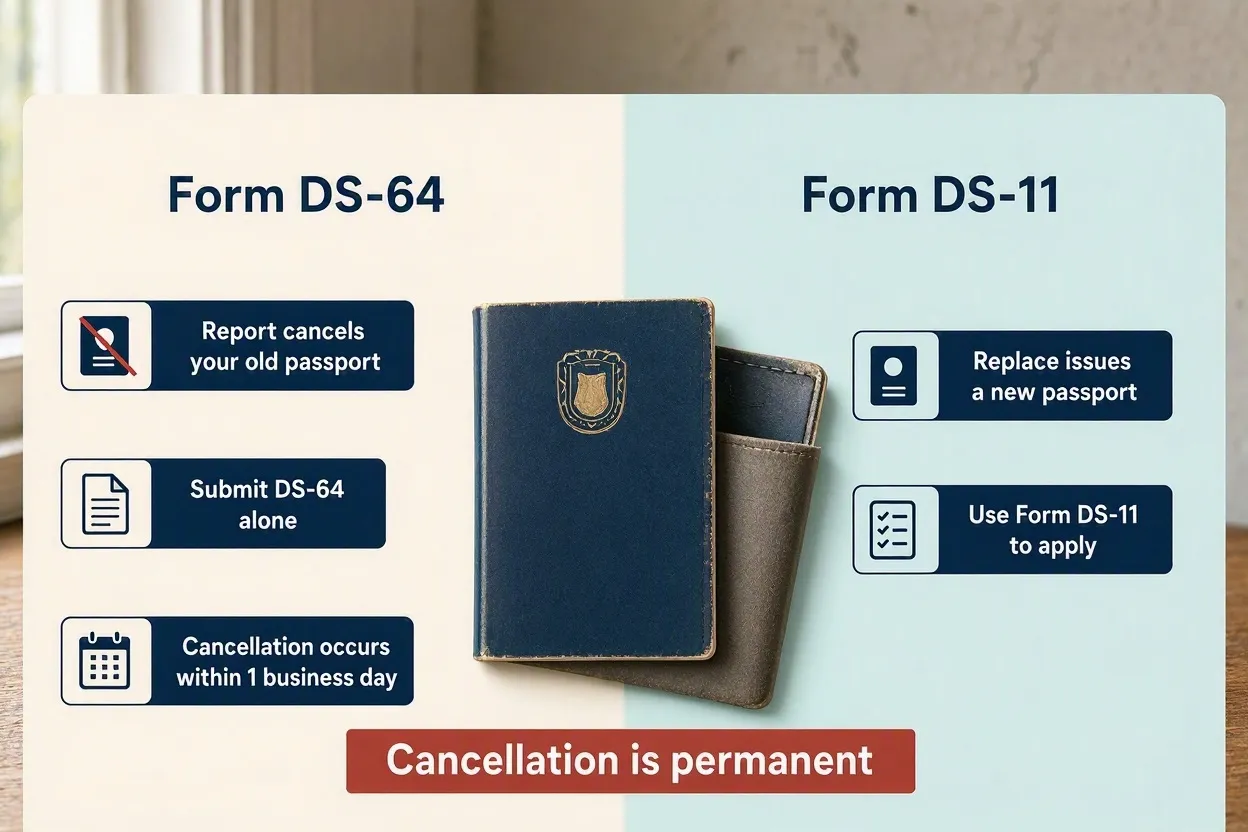
Reporting cancels your old passport; replacing issues a new one, and the two steps use different forms. Form DS-64 is the report and Form DS-11 is the application. Submit Form DS-64 alone and the State Department cancels the book within 1 business day, leaving you with no valid travel document. Cancellation is permanent. Finding the passport in a coat pocket three days later changes nothing, because the passport number stays dead in the system, and border officers at your destination can deny entry to anyone presenting a canceled passport.
Order of the two filings matters less than speed. You can file Form DS-64 first, or report the loss inside the Form DS-11 application, though the timing differs sharply: online reporting cancels the passport within 1 business day, while reporting through Form DS-11 takes several weeks to process. Weeks of delay leave a wider window for identity theft and misuse of the lost passport.
How Do You Replace a Lost Passport in the United States?
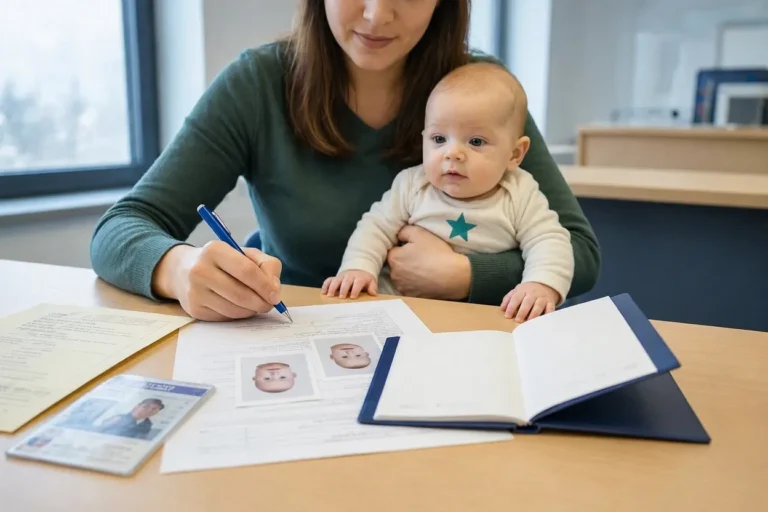
Replacing a lost passport inside the United States requires an in-person application at a passport acceptance facility or passport agency, and no exception exists for mail-in or online replacement. Online renewal and renewal by mail are closed to you entirely, since both routes require you to physically submit the previous passport.
Flying within 14 days? The steps below assume routine timing. If you have a booked trip departing soon, skip ahead to Which Replacement Route Fits Your Travel Date first, since a passport agency appointment moves much faster than the standard acceptance-facility path.
Step 1: Report the Passport Lost or Stolen With Form DS-64
File Form DS-64 through the State Department’s Online Form Filler at pptform.state.gov. Cancellation lands within 1 business day and a confirmation email follows.
Mailing the form instead works, though the delay runs long. Print Form DS-64, sign it, attach a photocopy of the front and back of a photo ID such as a driver’s license, and mail the package to the address printed on the form. The State Department warns that receipt and cancellation can take several weeks by mail.
Step 2: Complete Form DS-11 but Leave It Unsigned
Fill out Form DS-11 in full, then stop. The acceptance agent must witness your signature, so signing at home voids the form and forces you to complete a replacement on the spot.
Form DS-11 asks for details about the lost passport: where and when the loss or theft happened. Attach a copy of the police report if you filed one, and add a separate sheet if the space provided runs short. Incomplete details give the State Department grounds to pause the application and request Form DS-64 separately, which adds weeks to an already slow process.
Step 3: Gather Proof of Citizenship, Photo Identification, and a Passport Photo
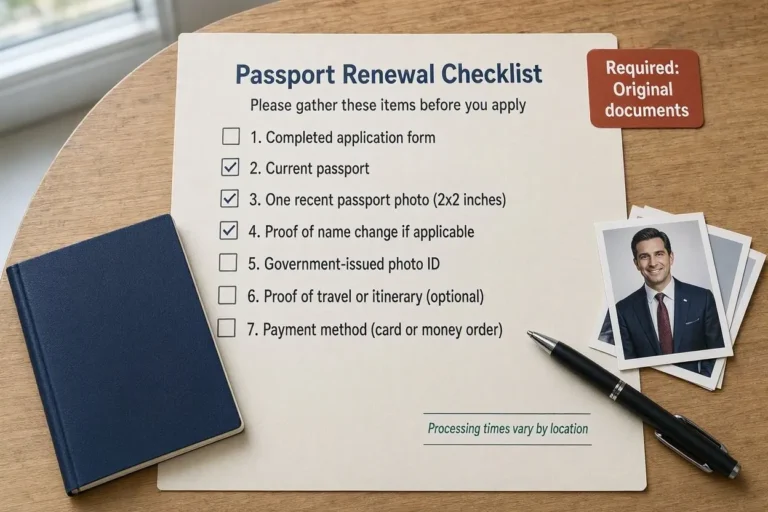
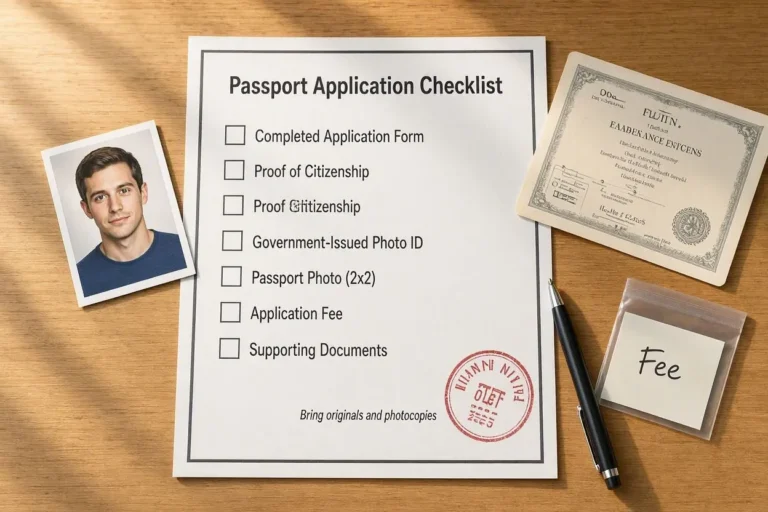
Bring four categories of documents to the appointment:
- Evidence of U.S. citizenship: a certified birth certificate with both parents listed, a Certificate of Naturalization, a Certificate of Citizenship, or a Consular Report of Birth Abroad
- A photocopy of that evidence: front and back, on plain white 8.5″ × 11″ (216 mm × 279 mm) paper, single-sided
- Valid photo identification: a driver’s license, a military ID, or a government employee ID, plus a photocopy of the front and back
- One color passport photo: 2″ × 2″ (51 mm × 51 mm), taken within the last 6 months, against a plain white or off-white background, with no glasses and a neutral expression
Certified copies are non-negotiable for citizenship evidence. Hospital souvenir certificates, photocopies, and notarized copies all get rejected, and the acceptance agent will turn you away at the counter rather than forward a defective application.
Missing citizenship evidence entirely doesn’t end the process, though the cost climbs steeply. Submit Form DS-11 with a written request for a file search and pay the $150 file search fee, and the State Department will look for the record of your previously issued passport.
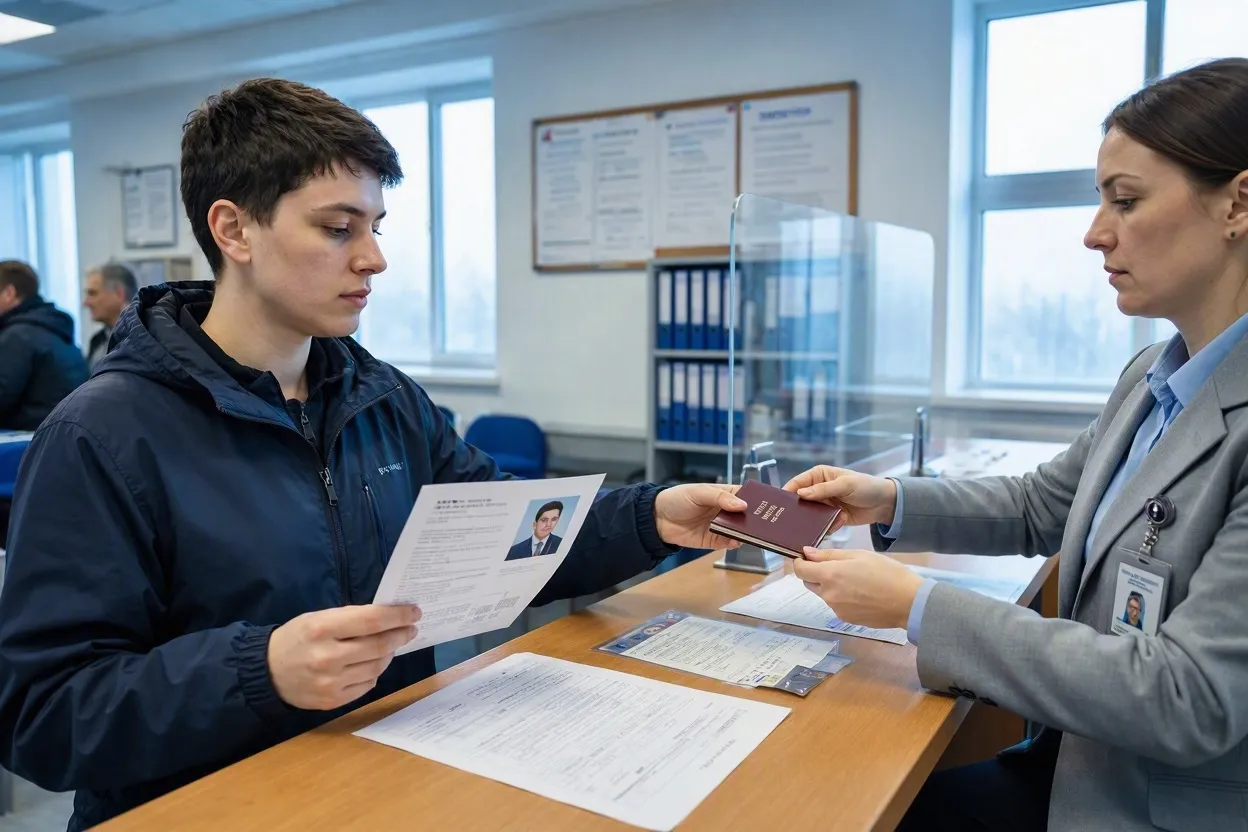
Step 4: Apply in Person at an Acceptance Facility or Passport Agency
Locate a facility through the State Department’s directory at iafdb.travel.state.gov. Acceptance facilities number in the thousands nationwide (check the directory for the current count), most of them inside post offices, county clerk offices, and public libraries.
Appointment policies vary by location. Post office appointment availability can tighten considerably during spring and summer, so check several facilities rather than assuming the nearest one has the shortest wait. Walk-in service still exists at some county clerk offices.
Step 5: Pay Both Fees Separately
Two payments go to two different recipients, and combining them gets the application rejected. The application fee goes to the U.S. Department of State by check or money order, since acceptance facilities cannot take cash or cards for that portion. The $35 execution fee goes to the facility itself, which usually accepts cash, check, or money order.
With the paperwork and fees settled, the route you choose next depends entirely on when you’re flying.
Which Replacement Route Fits Your Travel Date?
Your departure date determines your route, and choosing wrong costs either money or the trip. Four paths exist, each with a different eligibility threshold.
| Travel date | Route | Processing time | Extra cost |
| Within 14 calendar days | Passport agency appointment | Same day to 14 days | $60 |
| Life-or-death emergency within 3 business days | Passport agency, emergency appointment | Under 3 business days | $60 expedite fee |
| 3 to 8 weeks out | Expedited service at an acceptance facility | 2–3 weeks plus mailing | $60 expedite fee |
| No travel booked, or 10+ weeks out | Routine service at an acceptance facility | 4–6 weeks plus mailing | None |
Travel Within 14 Calendar Days: Passport Agency Appointment
Yes, you can still make a trip that departs within 14 days, if you secure an appointment at one of the U.S. passport agencies (26 as of this writing; confirm the current count and locations at travel.state.gov) and prove the travel. Agencies reserve appointments for applicants with international travel within 14 calendar days, and proof means a booked itinerary, a ticket, or a confirmed reservation, not a plan.
Book through the Online Passport Appointment System or by calling the National Passport Information Center at 1-877-487-2778 (TDD/TTY 1-888-874-7793). Appointment slots release on a rolling basis and disappear quickly, especially at the largest agencies in major metro areas. Check for the current pace at your nearest location rather than assuming.
Travel in 3 to 8 Weeks: Expedited Service
Pay the $60 expedite fee at an acceptance facility and the State Department targets 2 to 3 weeks of processing. Mailing time sits outside that window entirely, so add up to 2 weeks for the application to reach the processing center and up to 2 weeks for the finished passport to reach you.
Total door-to-door time for expedited service runs 4 to 7 weeks. Paying an additional fee (verify the current amount at travel.state.gov) for 1–2 day return delivery trims the back end, though the service covers passport books only and does nothing for passport cards.
No Travel Booked: Routine Service
Routine processing takes 4 to 6 weeks from the day the State Department receives your application, with a total elapsed time of 6 to 10 weeks once mailing is included. Apply between October and December if your timeline allows. The State Department identifies late winter through summer as its typically busier stretch, with processing times extending during those months.
Life-or-Death Emergency: Same-Day or Next-Day Issuance
Qualifying emergencies cover the serious illness, injury, or death of an immediate family member abroad. Documentation is mandatory: a death certificate, a signed letter from a hospital or mortuary on letterhead, or equivalent medical records. Call the National Passport Information Center, which handles emergency appointments outside standard booking hours.
How Much Does It Cost to Replace a Lost Passport?
Replacing a lost adult passport book costs $165 total: a $130 application fee to the State Department plus a $35 execution fee to the acceptance facility. Replacement always uses Form DS-11 and always carries the execution fee, which is why a replacement costs more than a routine renewal.
| What you’re replacing | Application fee | Execution fee | Total |
| Adult passport book (16+) | $130 | $35 | $165 |
| Adult passport card (16+) | $30 | $35 | $65 |
| Adult book and card together | $160 | $35 | $195 |
| Minor passport book (under 16) | $100 | $35 | $135 |
| Minor book and card together | $115 | $35 | $150 |
Optional fees stack on top of those totals:
- Expedited processing: $60 per application
- 1–2 day return delivery: fee varies (confirm current amount); books only, U.S. mailing addresses only
- File search: $150, charged if you cannot produce citizenship evidence
All figures above should be re-verified at travel.state.gov before you pay, since government fees change by Federal Register notice.
Refund rules are narrow. The State Department keeps the application fee and the execution fee by law whether or not a passport is issued, and the $60 expedite fee becomes refundable only if the department misses its own published processing window.
How Long Does It Take to Replace a Lost Passport?
Replacing a lost passport takes 4 to 6 weeks with routine service or 2 to 3 weeks with expedited service, plus up to 2 weeks of mailing in each direction. Processing clocks start the day your application arrives at a passport agency or center, not the day you hand it to an acceptance agent.
Realistic door-to-door windows:
- Routine service: 6 to 10 weeks total
- Expedited service: 4 to 7 weeks total
- Expedited plus 1–2 day return delivery: 3 to 6 weeks total
- Passport agency appointment: same day to 14 days
- Life-or-death emergency appointment: under 3 business days
Track the application at passportstatus.state.gov once 2 weeks have passed since submission. Status updates arrive by email at the address printed on Form DS-11, and a request for additional information stops the clock until you respond.
How Do You Replace a Lost Passport Abroad?
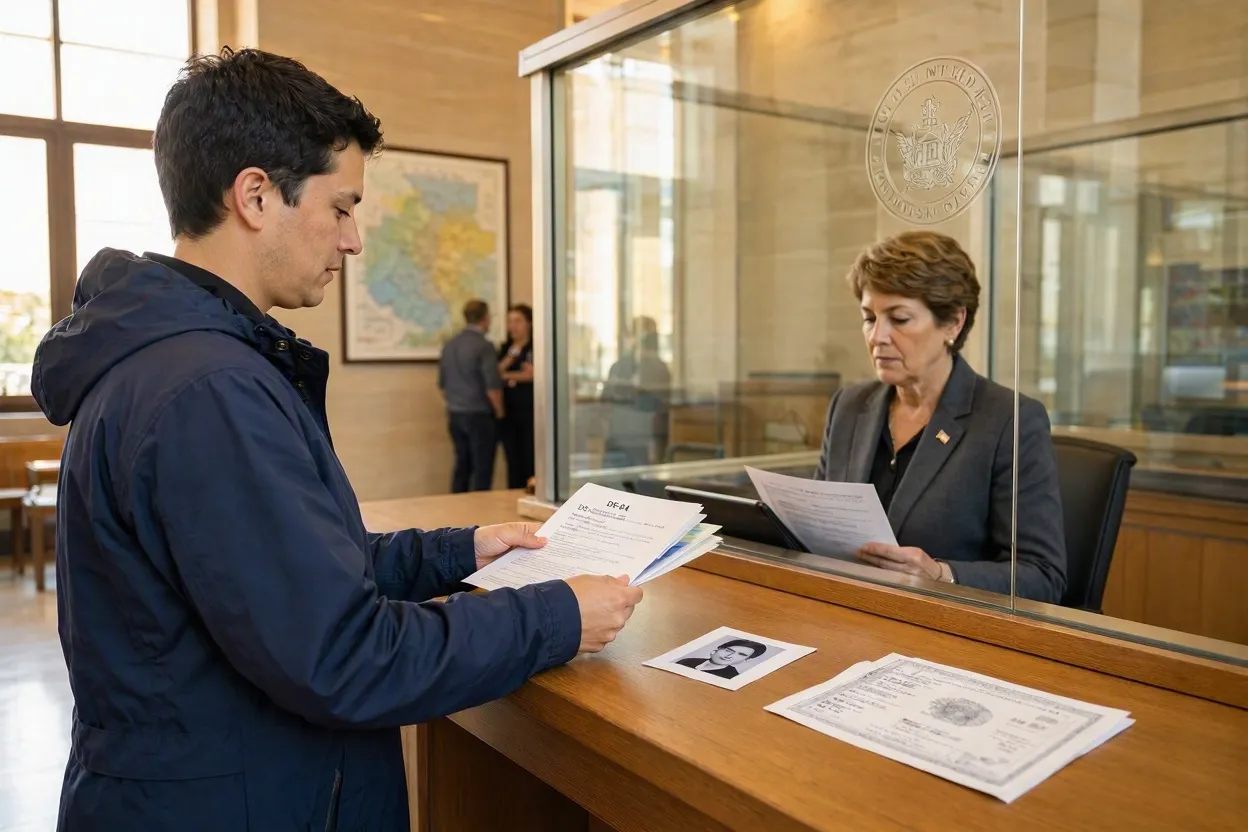
Losing a passport abroad means visiting the nearest U.S. embassy or consulate in person. No overseas replacement happens by mail or online. Contact the consular section first, request an appointment, and describe the situation as urgent if you have onward travel booked.
Bring whatever you can assemble:
- A completed Form DS-64 and a completed Form DS-11, both unsigned
- A passport photo
- Evidence of U.S. citizenship, including a photocopy of the lost passport if you kept one
- Photo identification
- Your travel itinerary
- A police report, if you filed one locally
Incomplete documentation won’t stop the process; consular officers work with what applicants can produce and can verify citizenship against State Department records directly. Urgent onward travel gets you a limited-validity emergency passport, often within one business day, valid for up to 1 year rather than the standard 10 years for adults or 5 years for applicants under 16. Exchange the limited book for a full-validity passport after returning home, and check the specific embassy’s website at usembassy.gov for fees, which vary by post.
What Happens to the Visas, Stamps, and Memberships Tied to the Lost Book?
Everything printed inside the lost passport goes with it: foreign visas stop working and entry/exit stamps can’t be reissued. Trusted traveler membership is the one thing that survives intact, since Global Entry attaches to you rather than the document, and your Known Traveler Number stays the same, but update the passport number in your Trusted Traveler Programs account once the replacement arrives, or kiosks and airline systems will flag the mismatch and route you to a CBP officer instead of the expedited lane.
Foreign visas cannot transfer to a replacement passport; each one must be reapplied for through the issuing country’s embassy or consulate, starting from scratch regardless of the remaining validity printed on the visa. Costs and timelines belong to the issuing country, not the State Department, which is a strong argument for reporting the loss and starting replacement the same day rather than waiting to see whether the passport turns up. Entry and exit stamps have no replacement process at all, though U.S. arrival and departure records stay retrievable through the CBP I-94 website.
Can You Fly Domestically Without Your Passport?
Yes. A REAL ID-compliant driver’s license, enhanced driver’s license, military ID, permanent resident card, or DHS trusted traveler card all satisfy TSA’s identity requirement for domestic flights. Without any of those, TSA’s identity verification process can still clear you (expect extra time), but international flights are a different matter: airlines deny boarding on international routes without a valid passport, no exceptions.
Special Situations Most Guides Skip
Replacing a Lost Passport Card
Replacing a lost passport card follows the same two-form process as a book and costs $65 for adults. File Form DS-64, complete Form DS-11, and apply in person.
Card validity is narrower than many owners realize. The passport card works only for land and sea entry from Canada, Mexico, Bermuda, and the Caribbean, so losing the card while holding a valid book leaves your international air travel unaffected.
Replacing a Child’s Lost Passport
Applicants under 16 need both parents or legal guardians present at the appointment, along with evidence of the parental relationship: a birth certificate naming both parents, or an adoption decree. One parent appearing alone must bring Form DS-3053, a notarized statement of consent from the absent parent, signed within the previous 3 months.
Children’s passports carry 5-year validity and cannot be renewed by mail or online at any age under 16. Every application is an in-person DS-11 application, whether the previous passport was lost, expired, or damaged.
A Passport Lost in the Mail
A passport that the State Department mailed but never arrived is not a lost passport in the DS-64 sense, and reporting it that way costs you money unnecessarily. Check passportstatus.state.gov first to confirm the mailing date and tracking number.
Call 1-877-487-2778 if more than 2 weeks have passed since the mailing date. Staff will walk you through Form DS-86, which confirms non-receipt and triggers a replacement at no cost. Filing deadline is 120 days from the issuance date. Miss it and the law requires you to reapply and pay every fee again.
A Passport Lost in a Declared Disaster
Passports lost in a federally declared major disaster may qualify for no-fee replacement, if the State Department has authorized replacement for that specific disaster. Authorized disasters appear on a list published at travel.state.gov.
Applicants who held a valid passport lost in an authorized disaster use Form DS-5504 with Form DS-64 and a new photograph. The file search fee gets waived for anyone submitting a signed statement that the disaster destroyed their citizenship evidence.
Finding the Passport After Reporting It
A found passport remains canceled permanently and cannot be reinstated. Destroy the book or return it to the Consular Lost and Stolen Passport Unit, since continuing to carry a canceled passport risks detention at a border crossing.
Return the book to: U.S. Department of State, Consular Lost and Stolen Passport Unit (CLASP), 44132 Mercure Circle, PO Box 1227, Sterling, VA 20166-1227.
The same address handles passports belonging to other people. Mailing a stranger’s found passport to CLASP in a sturdy envelope gets the document back into the system and protects its owner from misuse.
Losing More Than One Passport
Repeat losses trigger scrutiny. The State Department may issue a limited-validity passport rather than a full 10-year book to applicants who have reported multiple passports lost or stolen, and the limited book typically carries 1 to 2 years of validity. Additional documentation requests are common in these cases, which extends processing beyond the standard windows.
How Do You Protect Yourself From Identity Theft After Losing a Passport?
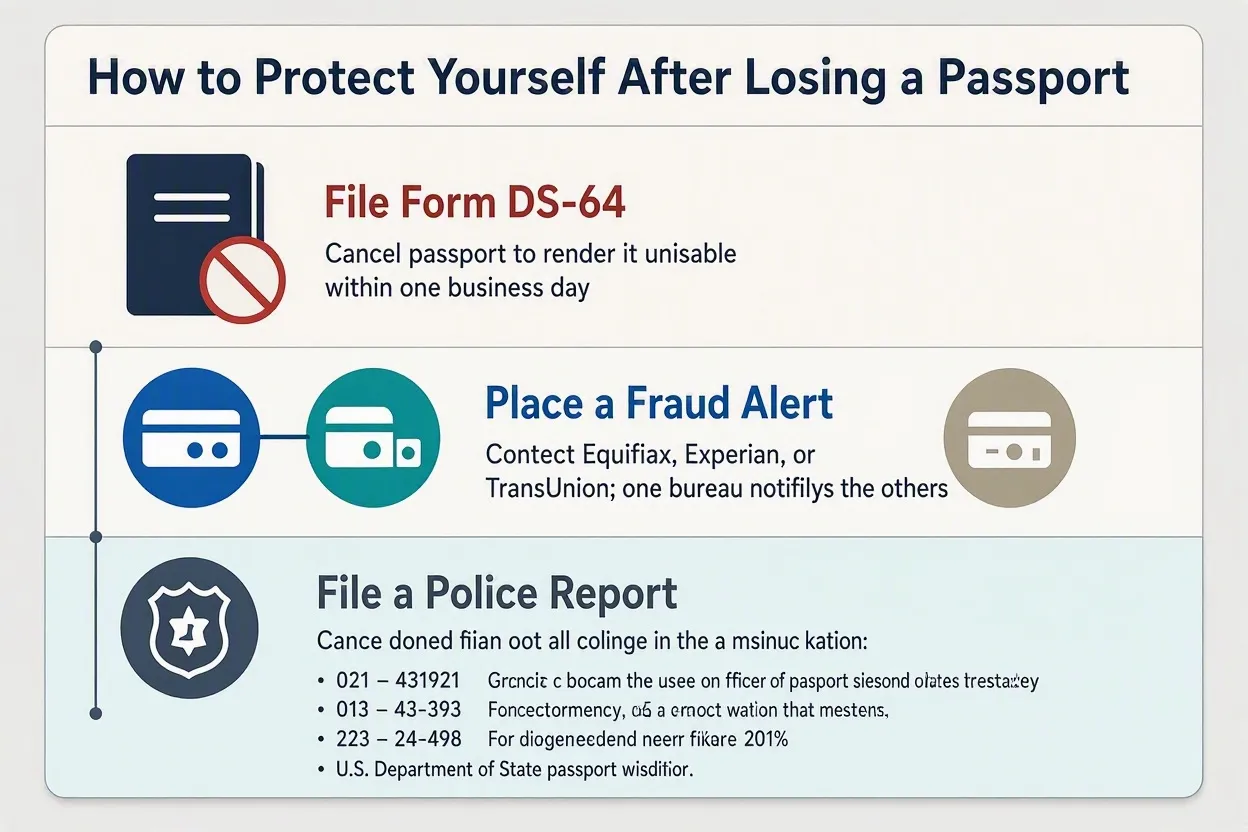
Filing Form DS-64 is the single most protective step, since cancellation renders the document useless for travel within 1 business day. Three additional actions close the remaining exposure:
- Place a fraud alert with Equifax, Experian, or TransUnion; one bureau notifies the other two (confirm the current alert duration on the bureau’s site, as this has changed by federal law in the past)
- File a police report with local law enforcement, which creates a record if the passport surfaces in a fraud investigation
- Report to the Federal Trade Commission (FTC) at IdentityTheft.gov, which generates a personalized recovery plan and an official identity theft report
Exposure of a passport number alone carries less risk than most people fear. The State Department confirms that no one can travel on a passport number without the physical document, and U.S. passport books and cards carry layered security features that defeat counterfeiting attempts.
Conclusion
Knowing how to replace a lost passport comes down to three moves: file Form DS-64 today, match your route to your departure date, and carry certified citizenship evidence rather than a photocopy into the acceptance facility. Routine service puts a new passport in your hands in 6 to 10 weeks, expedited service in 4 to 7 weeks once you pay the $60 expedite fee, and a passport agency appointment covers anyone flying inside 14 calendar days with a printed itinerary. Photocopy the biographic page of the replacement the day it arrives, keep one copy at home and one in a separate bag, and save a photograph of the page to cloud storage.
Frequently Asked Questions

Michael Reynolds
Michael Reynolds leads ImmigrationWin’s immigration, visa, and global mobility content division. He specializes in researching immigration policies, visa requirements, application processes, and international relocation pathways for individuals, families, students, and professionals. With extensive experience analyzing immigration regulations and official government guidance, Michael brings a research-driven approach to complex immigration topics and changing visa policies. He is the primary author of ImmigrationWin’s visa guides, immigration resources, and country-specific content, helping readers better understand their options and make informed decisions about their international journey.
Related Posts