
How to Apply for H1B Visa: Step-by-Step Process, Fees and Deadlines
Every H-1B season runs on the same seven-stage sequence: an employer requests a wage determination, files an attestation with the Department of Labor, registers you electronically, and, if you’re selected, submits a full petition to USCIS. Here’s each step in order, with the exact fees, deadlines, and forms tied to the current FY2027 cycle.
The rules underneath that sequence keep shifting, though. A wage-weighted lottery replaced the random draw in February 2026, a $215 registration fee now applies where a simple form used to suffice, and a $100,000 supplemental fee has been struck down, temporarily reinstated, and struck down again in court (more on that in the fees section below).
What Is an H-1B Visa?
An H-1B visa is a nonimmigrant work visa that lets a U.S. employer hire a foreign national for a specialty occupation requiring at least a bachelor’s degree or its equivalent. Congress caps the program at 85,000 new visas per fiscal year: 65,000 under the regular cap and 20,000 reserved for applicants with a U.S. master’s degree or higher.
Software engineers, financial analysts, and mechanical engineers make up the bulk of H-1B petitions each year, but the category also covers accountants, architects, and physical therapists. Employers file the petition. Individual workers can’t self-petition for H-1B status, with a narrow exception for certain self-owned businesses that meet strict USCIS employer-employee relationship tests.
Who Qualifies for an H-1B Visa?

You qualify if you hold a job offer in a specialty occupation from a U.S. employer and meet the degree requirement for that role. The position itself has to require specialized knowledge in a specific field. A generic “manager” title won’t clear the bar, but “biomedical engineer” or “actuary” typically will. A bachelor’s degree in the relevant field satisfies the requirement in most cases, and equivalent work experience can substitute for a degree. USCIS generally credits three years of progressive, specialized experience for each year of missing college education.
Two eligibility paths run side by side. Cap-subject employers compete in the annual lottery described below. Cap-exempt employers, meaning universities, nonprofit research organizations affiliated with universities, and government research organizations, can file H-1B petitions year-round without entering the lottery at all. A researcher hired by a state university’s genomics lab, for example, skips registration and selection entirely and moves straight to filing the petition.
The Full Step-by-Step Process
The H-1B application moves through seven stages: prevailing wage request, Labor Condition Application (LCA), electronic registration, lottery selection, Form I-129 petition filing, USCIS adjudication, and visa stamping. Each stage has its own filing party, fee, and deadline. Skipping the order isn’t an option, and USCIS rejects petitions that arrive without a valid, selected registration behind them.
Step 1: Employer Requests a Prevailing Wage Determination
Before filing anything with USCIS, the employer requests a prevailing wage determination from the Department of Labor by filing Form ETA-9141 through the DOL’s Foreign Labor Application Gateway (FLAG) system. The National Prevailing Wage Center assigns the role a wage level from I through IV based on Occupational Employment and Wage Statistics data. That level now does double duty: it sets the wage floor for the job, and since February 27, 2026, it also determines how many entries the registration gets in the H-1B lottery. A software developer role benchmarked at Level IV wages earns more lottery entries under the new weighted system than the identical role posted at Level I.
Step 2: Employer Files the Labor Condition Application (LCA)
The employer files Form ETA-9035, the LCA, with the DOL, attesting to pay the prevailing or actual wage, whichever is higher. This protects both the H-1B worker and similarly situated U.S. employees from wage suppression. Processing usually takes about 7 calendar days once the DOL system accepts the filing. Employers also have to post notice of the LCA at the worksite, either physically or electronically, for 10 consecutive business days.
Step 3: Employer Registers You in the H-1B Electronic Registration System
The employer submits an electronic registration for you through a USCIS online account during the annual registration window, paying $215 per beneficiary. For the FY2027 cap season, that window ran from noon Eastern on March 4, 2026, to noon Eastern on March 19, 2026, just 14 calendar days. Registration only requires basic information: your name, passport or travel document number, and your employer’s identifying details. You’ll need a valid, unexpired passport at the time of registration; a lapsed document invalidates the entry. Each beneficiary gets one registration per employer per fiscal year. Submit two by accident and USCIS invalidates both.
Step 4: USCIS Runs the Weighted Selection Process
USCIS selects registrations using a wage-weighted lottery rather than a purely random draw, a change that took effect February 27, 2026. Under the new system, a Level IV wage offer earns four entries in the selection pool, Level III earns three, Level II earns two, and Level I earns one. A data scientist offered a Level IV salary has four times the statistical chance of selection as an identical role offered at Level I. USCIS notifies selected registrants through their online accounts, typically by March 31 for the FY2027 cycle. Once selected, the employer has a defined petition-filing window, 90 days for FY2027, running from April 1 through June 30, 2026, to submit the full petition.
Step 5: Employer Files Form I-129
The employer files Form I-129, Petition for a Nonimmigrant Worker, along with supporting evidence proving the position and your qualifications meet H-1B standards. That typically means your diploma or degree evaluation, transcripts, the certified LCA, a detailed job description, and evidence of work experience if a degree alone doesn’t satisfy the requirement. The petition must list a start date of October 1 or later for the relevant fiscal year, no later than six months from the receipt date. USCIS rejects any petition requesting an “ASAP” or undated start.
Step 6: USCIS Adjudicates the Petition (or Issues an RFE)
USCIS reviews the petition and either approves it, denies it, or issues a Request for Evidence asking for more documentation. Standard processing time varies by service center and caseload, often running several months. Premium processing, requested via Form I-907, compresses that to 15 business days for an added fee of $2,965 as of March 1, 2026. An RFE most commonly targets the specialty-occupation argument or the beneficiary’s degree equivalency. A common example: a petition for a “business analyst” role where USCIS questions whether the position truly requires a bachelor’s degree in a specific field, rather than just a general business background.
Step 7: Visa Stamping at a U.S. Consulate (If Outside the U.S.)
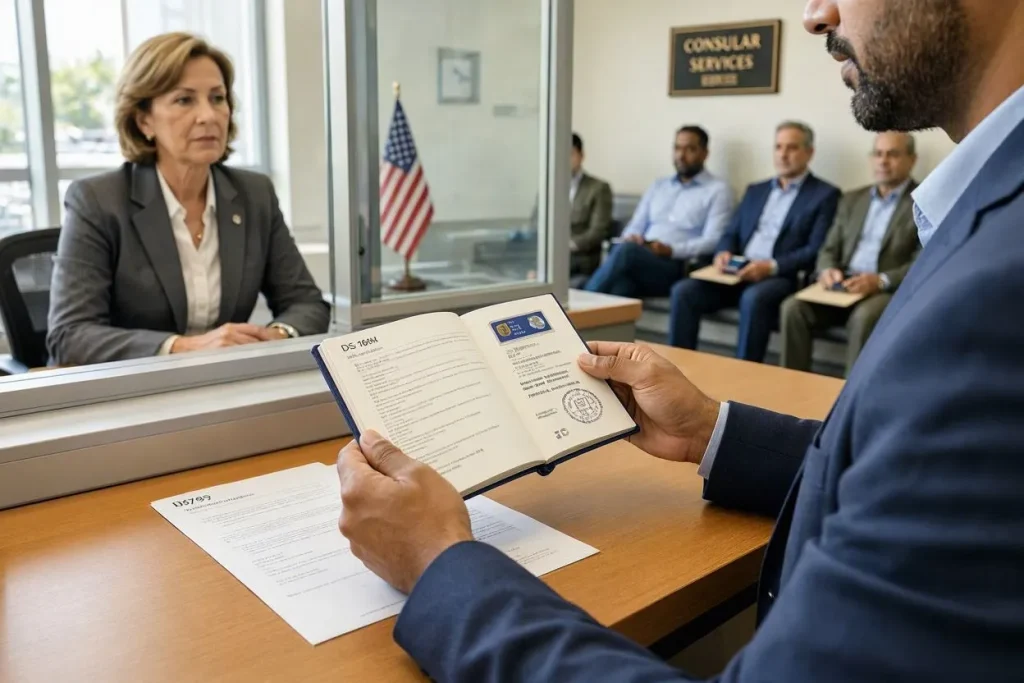
If you’re applying from outside the United States, you attend a visa interview and get an H-1B visa stamp at a U.S. consulate abroad. Applicants already in the U.S. on another valid status, like F-1 Optional Practical Training, can instead request a change of status without leaving the country. Consular applicants complete Form DS-160 online, pay the applicable visa application fee, and bring the approved I-797 approval notice, passport, and supporting petition documents to the interview.
How Much Does an H-1B Visa Application Cost?
A full H-1B application typically runs between $2,000 and $10,000 total, depending on premium processing, attorney fees, and the current litigation over the supplemental fee. Here’s the breakdown:
- LCA filing: no government fee
- H-1B registration: $215 per beneficiary
- Base I-129 filing fees: vary by employer size, generally $460 to $1,500 combined across the base fee, fraud prevention fee, and (for larger employers) the American Competitiveness and Workforce Improvement Act fee
- Premium processing (optional): $2,965
- Attorney fees: commonly $1,500 to $5,000, though many employers cover this themselves
- Consular visa application fee (if applicable): $205
The $100,000 supplemental fee mentioned earlier applied to certain new H-1B petitions filed for beneficiaries outside the United States. Per court filings covered by immigration law firms tracking the case, a federal judge vacated that fee on June 8, 2026, and the First Circuit Court of Appeals declined to reinstate it on July 24, 2026, so it’s not currently in effect. The underlying proclamation is set to expire on September 20, 2026 unless the administration renews it, and the government’s appeal is still pending. Check current USCIS guidance before assuming this fee doesn’t apply to your case, since that status could change again.
How Long Does the H-1B Process Take?
Start to finish, the H-1B process runs roughly seven months from registration to visa issuance under a typical cap-subject timeline, though premium processing shortens the petition-review stretch considerably. Registration closes in March, selection notices go out by the end of that month, and the 90-day petition-filing window runs from April through June. Standard I-129 adjudication then adds anywhere from two to eight months depending on the service center. A petition filed in April without premium processing might not get a decision until August or later; the same petition with premium processing gets one within 15 business days. Either way, the October 1 start date from Step 5 still applies, no matter how fast USCIS moves.
What Happens If Your H-1B Registration Isn’t Selected?
It doesn’t disappear. An unselected registration stays in “Submitted” status and remains eligible for any later selection round USCIS runs that fiscal year. USCIS sometimes conducts a second or third selection if it hasn’t hit the 85,000 cap after the first round. USCIS’s own FY2025 cap season data shows this happened that year, when a second selection round added 13,607 additional beneficiaries. If no further selection happens, your options are waiting for next year’s registration window or pursuing a different visa category you qualify for, such as an O-1 for extraordinary ability or an L-1 for intracompany transfers.
Can You Change Employers on an H-1B Visa?

Yes. It’s called an H-1B transfer, and it’s really just a new Form I-129 petition filed for a “change of employer.” The new employer files it on your behalf, and portability provisions under the American Competitiveness in the Twenty-First Century Act (AC21) let you start working for the new employer as soon as USCIS receives the properly filed petition. You don’t have to wait for approval. A software engineer moving from one tech company to another can start the new role the same week the transfer petition gets filed, as long as the receipt confirms timely submission.
How Long Can You Stay on an H-1B Visa?
Six years, typically issued in increments of up to three years at a time. Workers pursuing a green card through employment-based sponsorship can extend beyond that limit in one-year increments if a labor certification or I-140 petition has been pending for 365 days or more, or in three-year increments once an I-140 is approved but visa numbers aren’t yet available. A biomedical researcher whose employer filed a PERM labor certification in year five of H-1B status, for instance, can extend past the six-year cap in one-year blocks while the green card process continues.
Conclusion
Filing an H-1B petition means moving through a fixed sequence: prevailing wage request, LCA, registration, weighted lottery, Form I-129, adjudication, and consular processing where applicable. Miss a single deadline in that chain and the clock resets for the entire fiscal year. The FY2027 cycle already introduced wage-weighted selection and a $215 registration fee, and the $100,000 supplemental fee is still tied up in active litigation, with an expiration date of September 20, 2026 written into its own text. Confirm every fee amount and deadline against current USCIS and DOL guidance before filing. This program has changed materially in the past twelve months, and there’s no sign it’s settling into a fixed set of rules.
FAQs

Michael Reynolds
Michael Reynolds leads ImmigrationWin’s immigration, visa, and global mobility content division. He specializes in researching immigration policies, visa requirements, application processes, and international relocation pathways for individuals, families, students, and professionals. With extensive experience analyzing immigration regulations and official government guidance, Michael brings a research-driven approach to complex immigration topics and changing visa policies. He is the primary author of ImmigrationWin’s visa guides, immigration resources, and country-specific content, helping readers better understand their options and make informed decisions about their international journey.
Related Posts