New Zealand Student Visa 2026: Types, Costs & Requirements Guide
A New Zealand student visa is the legal permission international students need to study at a New Zealand school, university, or training institution for longer than three months. Immigration New Zealand (INZ) issues several versions of this visa depending on your age, course length, and study plan, and the rules changed on July 20, 2026, in ways that affect almost every applicant moving from secondary school into further study.
This guide walks through every visa type, the exact funds and fees you need, the application steps, and the 2026 Pathway Student Visa (PSV) update that most other guides still haven’t caught up with.
What Is a New Zealand Student Visa?
A New Zealand student visa lets a non-citizen study full-time in New Zealand for a course lasting more than three months. Courses shorter than three months don’t require this visa — a visitor visa or NZeTA covers those instead.
Australian citizens don’t need any visa to study in New Zealand. Everyone else needs one of four main pathways: a student visa, a Pathway Student Visa, a visitor visa or NZeTA for short courses, or a working holiday visa for casual study alongside travel. Each option carries different conditions on course length, work rights, and how many programmes you can complete before reapplying.
Types of Visas That Let You Study in New Zealand
New Zealand doesn’t offer one single “student visa.” It offers several visa categories, and picking the wrong one can mean reapplying halfway through a course.
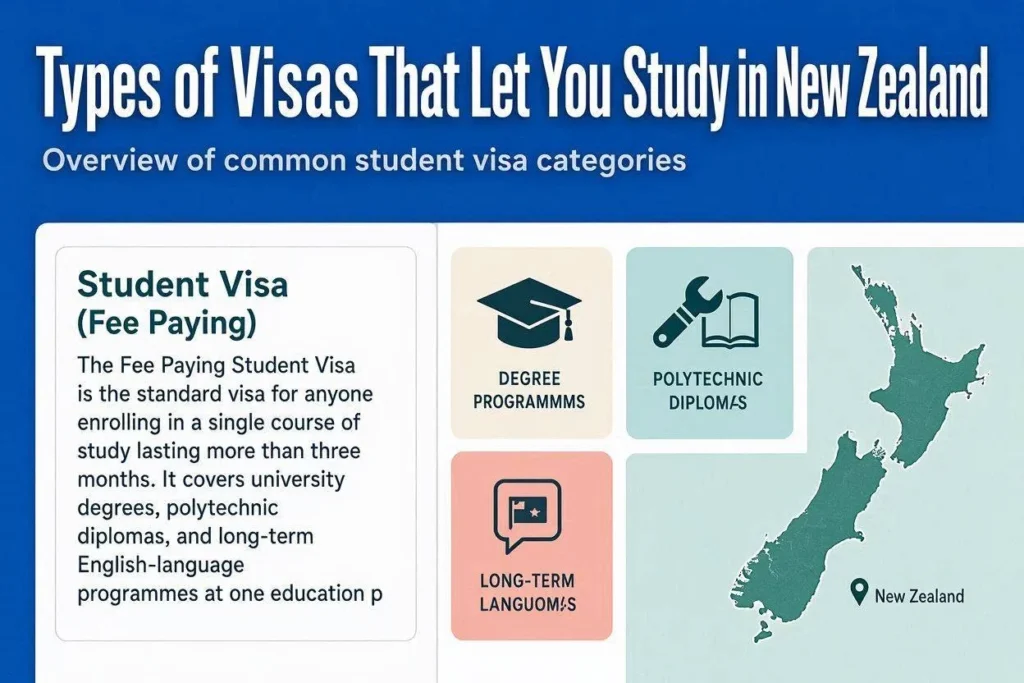
Student Visa (Fee Paying)
The Fee Paying Student Visa is the standard visa for anyone enrolling in a single course of study lasting more than three months. It covers university degrees, polytechnic diplomas, and long-term English-language programmes at one education provider.
This visa runs for the full length of your course if that course lasts up to twelve months. For longer programmes, INZ typically issues the visa in roughly twelve-month blocks, and you renew it through the online system as you progress. A student pursuing a three-year Bachelor of Science, for example, would apply for a fresh visa period near the end of each study year rather than receiving one visa that automatically spans all three years.
Pathway Student Visa (PSV)
The Pathway Student Visa lets a student complete up to three approved courses, one after another, on a single visa application. INZ designed the PSV for students who plan to progress — from English-language study into secondary school, or from a foundation programme into a bachelor’s degree — without filing a new visa application at each stage.
A student who enrols in an English-language course, then a foundation certificate, then a Bachelor of Arts at the same approved institution could use one Pathway Student Visa to cover all three stages. The visa conditions changed substantially in July 2026, covered in detail below.
Visitor Visa and New Zealand Electronic Travel Authority (NZeTA)
A visitor visa or NZeTA lets you study for up to three months in any twelve-month period without needing a student visa. School-aged children on a visitor visa can study for up to three months within a calendar year under the same rule.
If a child’s course runs longer than two weeks, the education provider must be a signatory to the Education (Pastoral Care of Tertiary and International Learners) Code of Practice 2021, a requirement that protects the wellbeing and safety of international learners under 18.
Working Holiday Visa
A working holiday visa allows study for up to six months, but only as a secondary activity to travel. Eligibility depends on age — 18 to 30 for most nationalities, extending to 18 to 35 for a small number of countries with expanded working holiday agreements with New Zealand.
INZ expects holiday to remain the primary purpose of the trip. A backpacker who enrols in a six-month cookery certificate while working seasonal jobs around New Zealand fits this category; a student whose sole purpose is completing a qualification does not, and should apply for a student visa instead.
Pathway Student Visa Changes From July 20, 2026
Yes, the Pathway Student Visa changed on July 20, 2026, and the update affects secondary school transitions, lower-level qualifications, and English-study time limits. INZ built these changes into its International Education Going for Growth initiative, aimed at making the visa easier to use and reducing paperwork every time a student’s study plan shifts.
Flexibility for Secondary School Students
Before July 20, PSV conditions listed both the qualification and the specific discipline a student intended to study — for example, “Bachelor of Science at University of Auckland.” Changing disciplines meant applying for an entirely new visa.
From July 20, 2026, conditions state only the qualification type and education provider, such as “Bachelor’s degree at University of Auckland.” A Year 13 student accepted into a science-focused bachelor’s programme can now switch into an arts programme at the same university, without a new visa application, as long as the provider approves the change.
Expanded Access to Lower-Level Study Pathways
The PSV now covers pathways that lead to, or move between, New Zealand Qualifications and Credentials Framework (NZQCF) Levels 1 through 4. That range includes English-language programmes, foundation studies, and vocational certificates — pathways the old PSV framework didn’t support.
A student progressing from a vocational certificate at Level 3 into a related Level 4 diploma can now stay on one Pathway Student Visa for both stages, rather than restarting the application process between them.
Extended English-Language Study Time
Some first-time PSV holders working toward NZQCF Levels 1 through 8 can now spend up to 30 weeks on English-language study before starting their next course, up from the previous 20-week limit. INZ made this change after recognizing that extra language preparation improves outcomes in the qualification that follows.
New Zealand Student Visa Requirements
A student visa application needs four core elements: an offer of place, proof of funds, health and character evidence, and a completed application form. Missing any one of these typically results in a request for further information or an outright decline.
Offer of Place
You need an offer of place from a New Zealand education provider before applying. The offer must be unconditional, or conditional only on securing the visa itself — a conditional offer that still depends on exam results or other outstanding steps won’t satisfy INZ.
Once accepted, the provider issues written confirmation stating the course name, duration, start date, and tuition fees. That document becomes the foundation of the visa application, so double-check every detail matches your actual enrolment before submitting.
Proof of Funds
You must show access to NZ$20,000 (roughly USD 12,000 or GBP 9,500 at mid-2026 exchange rates) per year for living costs, on top of paid or guaranteed tuition fees. Students in school years 1 through 13 face a lower threshold of NZ$17,000 per year, reflecting typically lower living costs for younger students often living with a guardian.
INZ accepts several forms of evidence: bank statements showing funds held for a reasonable period, a scholarship letter, or a financial undertaking completed by a parent or sponsor guaranteeing your living costs. The Funds Transfer Scheme (FTS) offers a fourth option for students from specific countries — it transfers living-cost funds into a secure New Zealand account before arrival, then releases the money to the student in monthly instalments once they’re in the country.
You also need evidence you can afford a return ticket home, separate from the living-cost funds. INZ treats sudden, unexplained deposits or unclear fund sources as a red flag, so keep a documented paper trail showing where the money came from.
Health and Character Requirements
Every applicant must meet INZ’s health requirements. A chest X-ray certificate becomes necessary if you’re a citizen of, or have spent three months or more in, a country without a low incidence of tuberculosis. An approved panel physician must conduct any required health check.
Character requirements apply too. If you intend to stay in New Zealand for more than 24 months, you’ll need police certificates from every country where you hold citizenship, plus certificates from any country where you’ve lived for five years or more since turning 17. INZ also recommends including a cover letter or statement of purpose explaining your study intentions — this helps establish you as a genuine student rather than someone using the visa route for other purposes.
How Much Does a New Zealand Student Visa Cost?
The standard online student visa application fee is approximately NZ$850, which includes the International Visitor Conservation and Tourism Levy (IVL) of around NZ$100. That figure converts to roughly USD 510 or GBP 405 at mid-2026 rates, though fees are set in New Zealand dollars and exchange rates fluctuate.
Visa fees change periodically, and third-party sources currently cite figures ranging from NZ$280 to NZ$850 depending on visa subtype, application method, and whether older figures have been updated. Confirm the exact current fee on immigration.govt.nz before paying, since the fee you’re quoted depends on your specific visa category and application channel.
Budget beyond the visa fee itself. Add the NZ$20,000 annual living-cost requirement, full tuition fees stated in your offer of place, return airfare, comprehensive health insurance for your entire stay, and any medical or police-certificate costs specific to your home country.
How to Apply for a New Zealand Student Visa
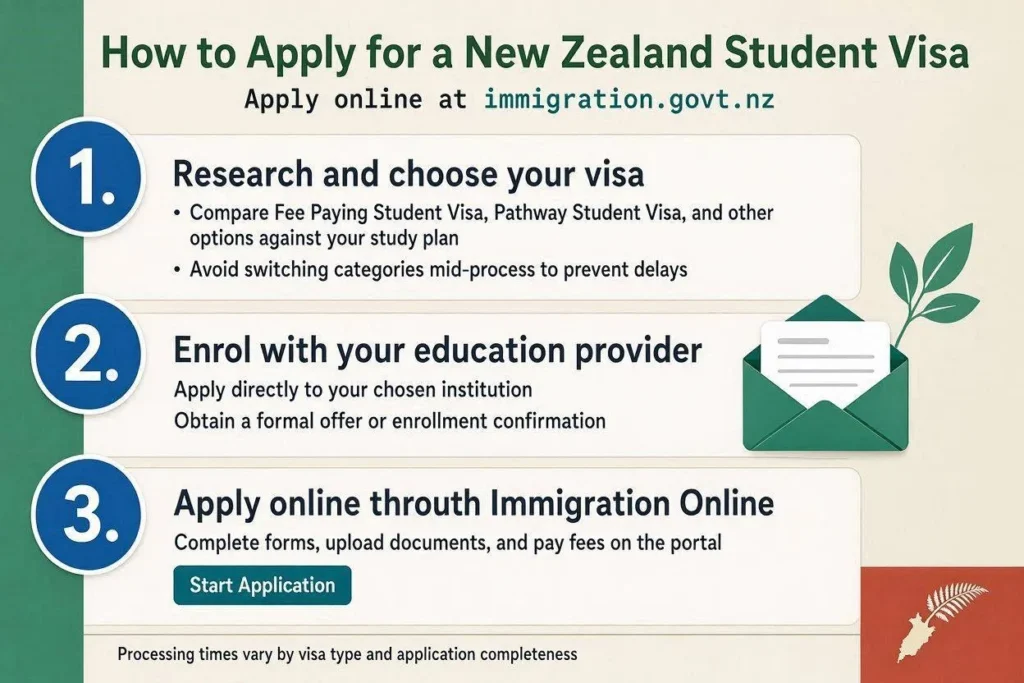
You apply for a New Zealand student visa online through the Immigration Online portal at immigration.govt.nz, following three main stages.
- Research and choose your visa. Compare the Fee Paying Student Visa, Pathway Student Visa, and other options against your study plan before applying, since switching categories mid-process adds delay.
- Enrol with your education provider. Apply directly to your chosen institution. Processing times for enrolment vary by provider, so check their website rather than assuming a standard timeline. Once accepted, the provider issues your offer of place.
- Submit your visa application. Create an account on the Immigration Online portal, complete the form, and upload every required document — offer of place, financial evidence, insurance certificate, and health or character documents where applicable. Pay the application fee to submit.
If someone helped you complete the form — an agent, adviser, or family member who translated or explained the process — you must declare this in your application. The person assisting you may also need to complete a Student Visa Declaration Form (INZ 1226). Only licensed immigration advisers, or education agents based outside New Zealand advising exclusively on student visas, are exempt from licensing requirements, though even exempt advisers must still be declared.
How Long Does a New Zealand Student Visa Take to Process?
INZ recommends allowing at least eight weeks for student visa processing, and applying three months before your intended travel date. Processing speed varies by season, application completeness, and how quickly you respond to any follow-up requests from INZ.
If you already hold a student visa and want to extend your stay for further study, apply at least four weeks before your current visa expires. Waiting until closer to the expiry date risks a gap in your legal status, which can complicate both your studies and any future visa applications.
Can You Work on a New Zealand Student Visa?
Yes, eligible tertiary students can work up to 25 hours per week during term time, a limit that rose from 20 hours in November 2025. Work rights depend on your specific visa conditions, so check your visa carefully rather than assuming the maximum hours apply automatically.
During scheduled course breaks, many student visa holders can work full-time rather than being capped at the term-time limit. Younger students on school-level courses typically face tighter restrictions than tertiary students, and some visa subtypes carry no work rights at all — confirm your specific conditions before accepting any job offer.
Why Student Visa Applications Get Declined
Applications get declined most often over unclear proof of funds, incomplete documentation, or doubts about whether the applicant is a genuine student. INZ assesses whether your study plan, financial situation, and personal circumstances add up to a credible, temporary reason for coming to New Zealand — not simply whether your paperwork is technically complete.
Unexplained bank deposits, funds sourced through unclear channels, or a study plan that doesn’t logically connect to your education or career background all raise questions during assessment. A strong statement of purpose that explains why this specific course, at this specific institution, fits your background and goals helps address this directly. Applicants who receive a request for further information should respond promptly and completely, since delayed or partial responses often lead straight to a decline rather than a second chance.
Visa Options for Family Members
Parents, legal guardians, and partners of a student visa holder can apply for their own visas to accompany the student in New Zealand, though eligibility depends on the student’s age and course level. Parents or legal guardians of students younger than 18 can apply for a Guardian Visitor Visa, which allows them to live in New Zealand while caring for their child.
Partners of some student visa holders may qualify for a work visa in their own right, and dependent children can apply for a student visa as international students rather than accompanying on a visitor visa. Eligibility rules shift depending on the principal student’s qualification level and course length, so check current conditions for your specific visa subtype before assuming a family member automatically qualifies.
Cost of Living for International Students by Region
Living costs for international students vary significantly by city, with Auckland and Wellington running well above the NZ$20,000 annual minimum INZ requires as proof of funds. That NZ$20,000 figure (about USD 12,000 or GBP 9,500) represents a compliance minimum for your visa application, not necessarily a realistic annual budget in New Zealand’s largest cities.
Smaller regional centres — Hamilton, Dunedin, and Christchurch among them — typically offer lower rent and everyday costs than Auckland or Wellington, which can make the INZ minimum closer to a workable budget rather than just a paperwork threshold. Students choosing between a big-city university and a regional campus should factor accommodation costs into that decision alongside academic reputation, since the difference between cities can affect weekly living expenses substantially.
After Your Course: Post-Study Work Visa Options
Graduates of eligible qualifications can apply for a Post-Study Work Visa, which grants open work rights for up to three years depending on qualification level. Bachelor’s degrees and higher qualifications typically unlock longer post-study work periods than lower-level certificates or diplomas.
From late 2026, eligibility extends to graduates who complete a Graduate Diploma at NZQCF Level 7, provided they studied full-time for the full duration of the qualification and hold a bachelor’s degree completed either in New Zealand or overseas, with no time limit on when that earlier degree was awarded. A shorter Short Term Graduate Work Visa also exists for graduates who don’t meet full Post-Study Work Visa criteria, though holders of this shorter visa face restrictions — they can’t support a partner for a work visa, can’t own a business, and must apply within three months of their student visa expiring.
Submit your post-study work visa application before your student visa expires, since a gap between visas can interrupt both your legal status and any job offer you’re relying on to support the application.
Choosing the Right Visa for Your Study Plan
Match your visa choice to your actual course length and study plan, not just the label that sounds closest to “student visa.” A three-month English course needs only a visitor visa or NZeTA. A single degree at one institution fits the Fee Paying Student Visa. Anyone progressing through multiple courses or qualification levels, including secondary school students who expect their subject interests to shift, gets more flexibility from the Pathway Student Visa under the July 2026 rules.
Get four things right before you apply: an unconditional offer of place, documented proof of NZ$20,000 per year in accessible funds, health and character evidence matched to your circumstances, and a clear statement of purpose that ties your course to your background. Applicants who prepare these four elements thoroughly, and apply at least three months ahead of their intended start date, face far fewer delays than those who submit partial documentation and wait for INZ to ask questions. Check immigration.govt.nz directly before you pay any fee, since visa costs and processing conditions shift throughout the year.
FAQs

Michael Reynolds
Michael Reynolds leads ImmigrationWin’s immigration, visa, and global mobility content division. He specializes in researching immigration policies, visa requirements, application processes, and international relocation pathways for individuals, families, students, and professionals. With extensive experience analyzing immigration regulations and official government guidance, Michael brings a research-driven approach to complex immigration topics and changing visa policies. He is the primary author of ImmigrationWin’s visa guides, immigration resources, and country-specific content, helping readers better understand their options and make informed decisions about their international journey.
Related Posts