Australia Student Visa 2026: Requirements, Fees & Process (Subclass 500)
Studying in Australia starts with one document: the student visa, officially known as subclass 500. This guide covers every requirement, fee, and step needed to apply in 2026, plus specific notes for applicants from the United States, the United Kingdom, Europe, Asia, and the Middle East.
What Is the Australia Student Visa (Subclass 500)?
The subclass 500 is the single visa category covering nearly all international students in Australia, regardless of course level or nationality. Introduced in 2016, it replaced the old system of separate visa subclasses for schools, vocational courses, and universities. One visa now covers English language courses, vocational education and training (VET), undergraduate degrees, postgraduate degrees, and doctoral research.
The visa ties your permitted stay to your enrolment. A three-year bachelor’s degree typically comes with a visa grant matching that three-year period, plus a short buffer afterward. A six-month diploma gets a shorter grant. Your Confirmation of Enrolment (CoE) — a document your education provider issues once you accept your offer and pay a deposit — sets that timeline.
Who Needs an Australia Student Visa?
Anyone studying a full-time course in Australia for longer than three months needs a subclass 500 visa, with no exceptions based on nationality or course type. A tourist visa or working holiday visa does not permit enrolment in a full academic program. Students on a working holiday visa get a slightly wider window — four months — before the student visa becomes mandatory.
Age matters here too. Applicants must be at least six years old. Anyone under 18 needs additional documents: parental consent, evidence of welfare arrangements in Australia, and confirmation of who will act as guardian during the course.
Australia Student Visa Requirements
Six core requirements apply to every subclass 500 application: enrolment evidence, the Genuine Student test, financial proof, English proficiency, health cover, and health and character checks. Each one gets assessed independently, and missing even one causes a refusal regardless of how strong the rest of the application looks.
Confirmation of Enrolment (CoE)
A Confirmation of Enrolment is the document your education provider issues after you accept your Letter of Offer and pay your deposit, and you cannot lodge a visa application without it. The CoE lists your course code, provider details, and enrolment dates, and the Department of Home Affairs checks these against your visa application for consistency.
Names and dates of birth on the CoE must match your passport exactly. A student from Seoul once had their CoE issued under a middle name that didn’t appear on their passport — the mismatch delayed their application by three weeks while the university reissued the document. Universities in Australia will no longer issue concurrent CoEs for the same intake, so switching institutions after accepting one offer usually means starting the enrolment process again.
Genuine Student (GS) Requirement
The Genuine Student requirement asks you to demonstrate that your primary reason for coming to Australia is study, not migration through the back door. This replaced the older Genuine Temporary Entrant test in 2024, shifting the focus from proving you’ll leave Australia to proving your study intent is real and considered.
The online application form asks you to write short statements covering your current circumstances, your reasons for choosing this course and Australia as a destination, your career plans after graduation, and your ties to your home country. Immigration officers assess these answers under Ministerial Direction 111, which sets out how caseworkers weigh Genuine Student claims. Vague, generic answers (“Australia has good universities”) get flagged more often than specific ones tied to your actual career path.
Financial Capacity Requirement
You need at least AUD 29,710 (approximately USD 19,500, GBP 15,300, or EUR 17,900) in genuine, accessible funds to cover 12 months of living costs, on top of your course fees and return airfare. This figure gets reviewed annually, so always confirm the current number on the Department of Home Affairs website before you apply.
Three ways exist to prove this: bank deposits held for the required period, evidence that a parent or spouse earns at least AUD 87,856 annually (AUD 102,500 for a family), or a letter of financial support from the Department of Foreign Affairs and Trade or Department of Defence. Additional dependants add further costs — AUD 10,394 for a partner and AUD 4,449 per child. Acceptable evidence includes bank statements, education loan documentation, tax returns from the most recent year, and signed letters from financial sponsors.
English Language Proficiency
Most applicants need an International English Language Testing System (IELTS) score of at least 6.0, though the required score climbs for specific fields. Business, information technology, and engineering courses commonly require 6.5. Nursing, physiotherapy, and teaching programs often require 7.0 or higher, reflecting the communication demands of clinical and classroom placements.
Not every applicant needs to sit a test. Citizens of certain English-speaking countries, students who completed at least five years of education taught in English, and applicants who already hold a completed qualification taught in English may qualify for an exemption. Check the Department of Home Affairs’ evidentiary tool before booking a test, since requirements shift by passport and course combination.
Overseas Student Health Cover (OSHC)
Overseas Student Health Cover is mandatory health insurance that every subclass 500 applicant must hold for the full length of their visa, and an application without it gets refused outright. OSHC covers hospital treatment, most prescription medicines, and ambulance transport in emergencies — costs that would otherwise fall entirely on the student.
Coverage must start no later than one week before your course begins and must extend through your entire visa period, including any dependants you include on the application. Students from Norway, Sweden, and Belgium sometimes qualify for exemptions under reciprocal health arrangements, so confirm eligibility with your provider before purchasing a separate policy.
Health and Character Requirements
Every applicant must meet Australia’s health and character standards, which can include a medical examination and a police clearance depending on individual circumstances. The visa system flags certain applicants automatically — those from countries with higher tuberculosis rates, for example — for a mandatory health check with an approved panel doctor.
Character checks apply if you have a prior criminal conviction, owe debt to the Australian government, or have served in the military of a country involved in conflict. In these cases, expect the Department to request documents such as police certificates, evidence of any payment plans for existing debts, or discharge paperwork.
Australia Student Visa Fees 2026
The base student visa application fee for a primary applicant is AUD 2,500 (approximately USD 1,640, GBP 1,290, or EUR 1,500) as of July 2026, though the exact charge depends on your study sector and passport. Fees are non-refundable, even if your application gets refused, which makes it worth getting every requirement right before you pay.
Standard, ELICOS, ASEAN, and Pacific Fee Tiers
Four fee tiers apply, based on study sector and nationality:
- Standard tier (VET, higher education, schools): AUD 2,500 for the primary applicant, AUD 1,530 for an adult dependant, AUD 500 for a child dependant
- English language course (ELICOS) tier: AUD 2,050 for the primary applicant, AUD 1,255 for an adult dependant, AUD 410 for a child dependant
- Association of Southeast Asian Nations (ASEAN) tier, covering passport holders from the Philippines, Vietnam, Indonesia, Malaysia, Thailand, and six other member states: AUD 2,500 standard, with reduced ELICOS pricing available
- Pacific Island and Timor-Leste tier: fees starting at AUD 745, the lowest bracket available
A 1.4% card payment surcharge applies across every tier.
Subsequent Temporary Application Charge (STAC)
The Subsequent Temporary Application Charge adds AUD 700 per applicant, and it applies only if you’re lodging another temporary visa while already inside Australia on the visa you currently hold. Students applying from outside Australia for the first time never pay this charge. Confirm your specific situation with a registered migration agent if you’re switching visas onshore, since STAC rules have exceptions tied to visa history.
How to Apply for an Australia Student Visa: Step by Step
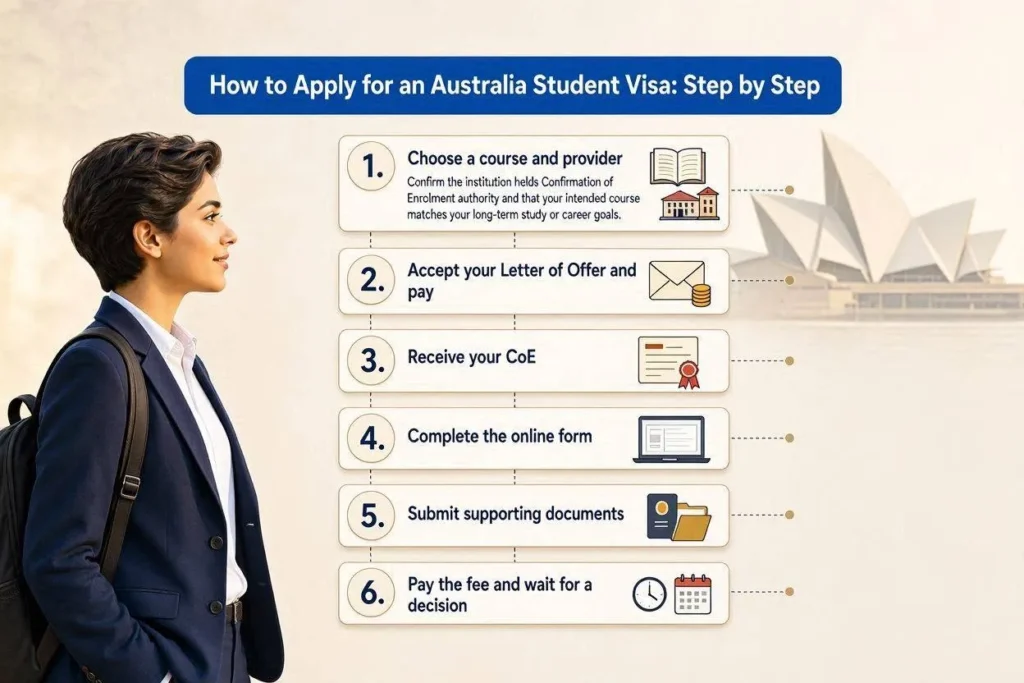
The application process runs through six stages: choosing a course, enrolling and receiving your CoE, completing the online form, submitting supporting documents, paying the fee, and waiting for a decision.
- Choose a course and provider. Confirm the institution holds Confirmation of Enrolment (CoE) authority and that your intended course matches your long-term study or career goals.
- Accept your Letter of Offer and pay the required deposit. Your education provider issues the CoE once payment clears.
- Create an ImmiAccount through the Department of Home Affairs’ online portal, then complete the student visa application form.
- Upload your supporting documents, including your passport, CoE, English test results, financial evidence, OSHC policy details, and your Genuine Student statements.
- Pay the visa application charge using a credit or debit card, factoring in the 1.4% surcharge.
- Record your Transaction Reference Number immediately after submission and keep printed copies of every form and receipt.
You do not need an agent to lodge this application. Students who prefer professional support can use a registered migration agent listed with the Migration Agents Registration Authority, or a qualified legal practitioner — education agents without that registration cannot legally provide immigration advice.
Australia Student Visa Processing Time
Processing times vary by individual case, running anywhere from a few days to several months, so applying well ahead of your course start date matters more than any single tip in this guide. The Department of Home Affairs recommends submitting your application eight to twelve weeks before your program begins.
Several factors extend processing time: incomplete applications, delayed responses to requests for additional evidence, mandatory health or character checks, applications lodged from inside Australia rather than offshore, and verification requests sent to agencies in your home country. A complete, well-documented application submitted early remains the single most reliable way to shorten your wait.
Work Rights on an Australia Student Visa
Subclass 500 holders can work up to 48 hours per fortnight once their course begins, with no cap at all during scheduled study breaks. This limit resets every two weeks, starting on a Monday, and applies only after your classes have officially started — not from your visa grant date.
Two groups fall outside the standard cap. Students completing a mandatory internship or placement that’s a required part of their course can work unrestricted hours during that placement. Students enrolled in a research master’s degree or a doctoral program face no work-hour restrictions at all, reflecting the different rhythm of research-based study. Partners and dependants included on your visa can generally work unrestricted hours once you, the primary applicant, have started your course.
Bringing Family Members on an Australia Student Visa

Yes, you can include a spouse, de facto partner, and dependent children on your Australia student visa application. Each dependant requires separate evidence and carries a separate visa fee.
For a partner, expect to provide a marriage certificate, evidence of at least 12 months living together, and documentation showing shared finances or public acknowledgment of the relationship. Australia recognizes same-sex marriages and partnerships under identical evidentiary standards. For children, required documents include a birth certificate and — for children aged 5 to 17 — confirmation of enrolment in an Australian school. Children under 18 traveling without both parents need a completed Form 1229, giving consent for the visa to be granted.
What Happens If Your Australia Student Visa Is Refused?
A refused Australia student visa application does not automatically end your options, but it does remove your visa fee permanently and may affect future applications if the refusal cited character or fraud concerns. Refusal reasons commonly include insufficient financial evidence, a Genuine Student statement that reads as generic or inconsistent, missing or mismatched documents, or a failed health or character check.
Two paths typically follow a refusal. You can lodge a fresh application addressing the specific reason for refusal, which the Department states clearly in its decision letter. Alternatively, in limited circumstances, you can seek a review through the Administrative Review Tribunal, though this route works only for certain refusal categories and comes with strict time limits — often as short as 21 days from the date of the refusal notice. A registered migration agent can assess which path fits your situation faster than reapplying blind.
After Your Studies: Graduate Visa (Subclass 485) and Pathways to Permanent Residency
Graduates of an Australian qualification lasting at least two academic years can generally apply for the subclass 485 Graduate visa, which permits a stay of up to 18 months to two years depending on the stream and qualification level. Two streams exist: the Graduate Work stream, for graduates whose qualification links to an occupation on Australia’s skilled occupation lists, and the Post-Study Work stream, for bachelor’s, master’s, or doctoral graduates regardless of field.
From there, several permanent pathways open up. The General Skilled Migration program suits graduates whose occupation appears on the relevant skills list. The Skills in Demand visa (subclass 482) works for graduates who secure a job offer from an Australian employer willing to sponsor them, provided the role pays at least AUD 79,423 per year as of July 2026 and appears on the Short-Term Skilled Occupation List. Many students treat the student visa, Graduate visa, and an eventual employer-sponsored or skilled visa as three connected stages of one longer migration plan, rather than three separate decisions made in isolation.
Australia Student Visa for Applicants From the USA, UK, Europe, Asia, and the Middle East
Every applicant follows the same subclass 500 framework regardless of nationality, but fee tiers, financial documentation norms, and English exemptions shift by passport and region.
- United States and United Kingdom applicants generally qualify for English proficiency exemptions if their prior education was taught in English, and they typically pay the Standard fee tier. Currency conversion matters here — budget in US dollars or British pounds against the AUD 29,710 living-cost threshold, since exchange rates shift year to year and affect how much you need to hold in savings.
- European applicants face the same Standard tier fees, though students from Norway, Sweden, and Belgium may qualify for Overseas Student Health Cover exemptions under reciprocal agreements — confirm this with your provider before purchasing separate insurance.
- Asian applicants, particularly from ASEAN member states including the Philippines, Vietnam, Indonesia, and Thailand, qualify for reduced visa fees under the ASEAN tier. Students from China, India, and South Korea — three of the largest source countries for Australian international education — should expect closer scrutiny of financial documentation, since these markets see higher application volumes.
- Middle Eastern applicants typically fall under the Standard fee tier and should budget extra processing time for character and security checks, which apply more broadly to applicants from the region regardless of individual circumstances.
Every applicant, regardless of region, should verify current fee and financial thresholds directly on the Department of Home Affairs website before applying, since these figures update periodically and third-party sites sometimes carry outdated numbers.
Common Mistakes That Delay or Reject Australia Student Visa Applications
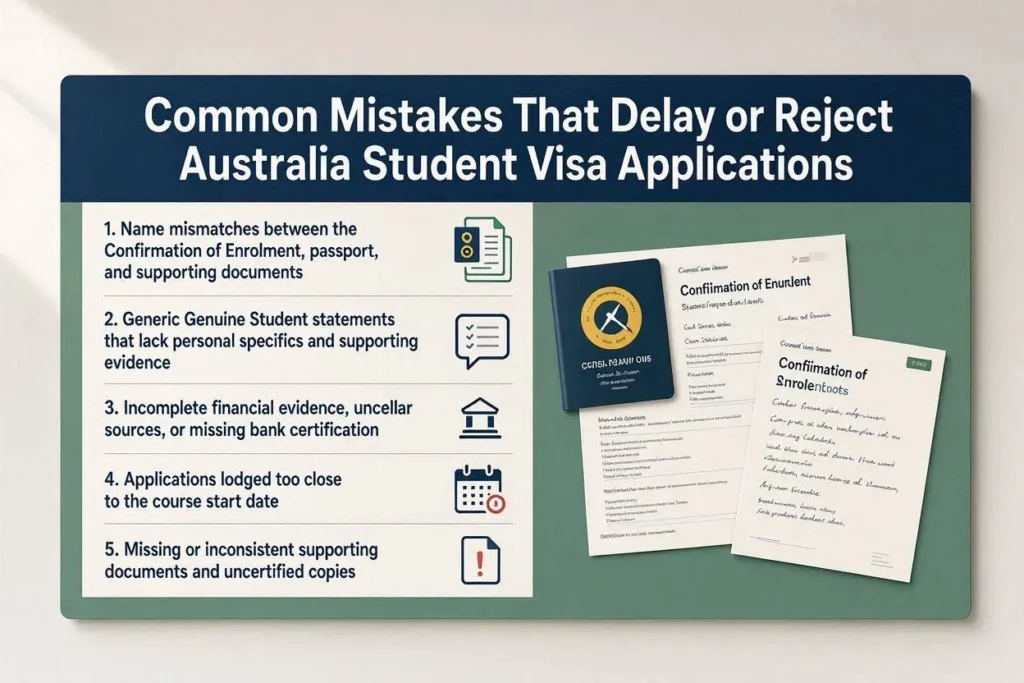
The most frequent errors involve mismatched documents, generic Genuine Student statements, incomplete financial evidence, and applications lodged too close to the course start date. Avoiding these five mistakes covers the majority of preventable refusals:
- Name mismatches between the Confirmation of Enrolment, passport, and supporting documents
- Generic Genuine Student answers that don’t connect the specific course to a clear career goal
- Financial evidence that doesn’t cover the full 12-month requirement, including tuition, living costs, and return airfare
- Health insurance gaps, where Overseas Student Health Cover starts after the course begins rather than a week before
- Late applications, submitted less than eight weeks before the course start date, leaving no buffer for processing delays or additional document requests
Building an application around accuracy first, then completeness, prevents most of the refusals that private migration agents see repeatedly.
Final Checklist Before You Apply
A strong Australia student visa application rests on six confirmed items: a valid Confirmation of Enrolment, a specific Genuine Student statement, financial evidence covering the full 12-month threshold, English test results matching your course, active Overseas Student Health Cover starting a week before your course, and a lodgement date at least eight weeks before your program begins. Each requirement gets assessed on its own, so a strong financial file won’t offset a weak Genuine Student statement, and a high English score won’t cover a gap in health insurance.
Confirm every dollar figure, fee tier, and English exemption against the Department of Home Affairs website before submitting, since these numbers change year to year and outdated figures on third-party sites cause real application errors. The subclass 500 visa rewards precision over persuasion — get the documents right, and the rest of the process runs on schedule.
FAQs

Michael Reynolds
Michael Reynolds leads ImmigrationWin’s immigration, visa, and global mobility content division. He specializes in researching immigration policies, visa requirements, application processes, and international relocation pathways for individuals, families, students, and professionals. With extensive experience analyzing immigration regulations and official government guidance, Michael brings a research-driven approach to complex immigration topics and changing visa policies. He is the primary author of ImmigrationWin’s visa guides, immigration resources, and country-specific content, helping readers better understand their options and make informed decisions about their international journey.
Related Posts