Passport Application Checklist: Documents, Forms & Fees You Need
A first-time U.S. passport application gets rejected far more often over a missing document than a mistake on the form itself. Acceptance agents at post offices, libraries, and county clerk offices see the same three errors daily: an expired photo ID, a photocopy instead of an original citizenship document, and a photo that doesn’t meet size requirements. This passport application checklist walks through every document, form, and fee required for a smooth first submission, whether the applicant is 8 years old or 80.
What You Need for a Passport Application Checklist
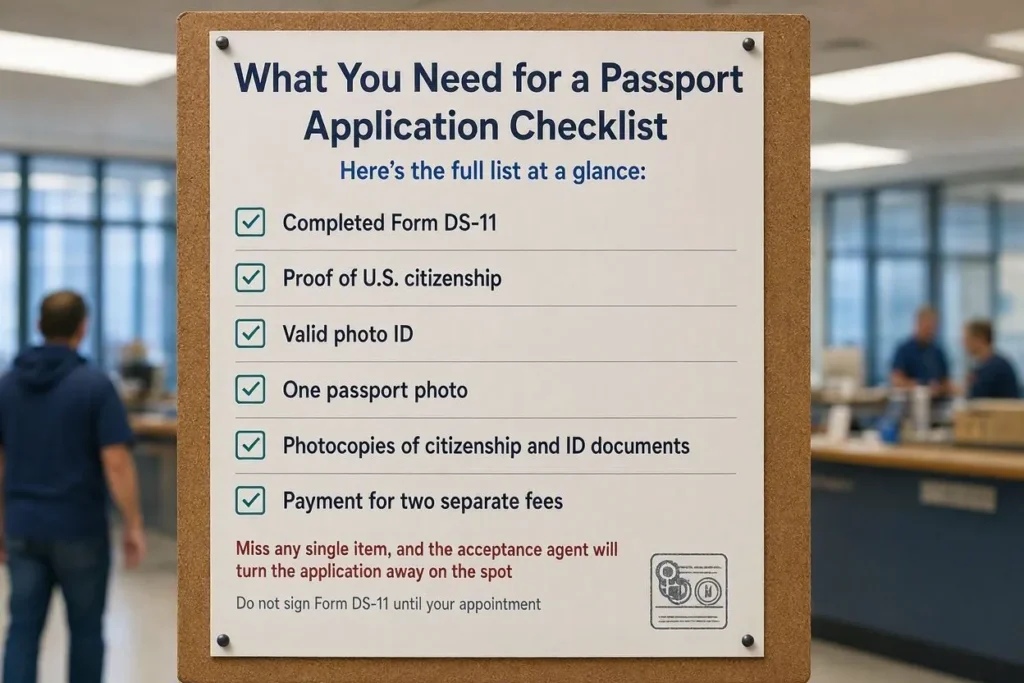
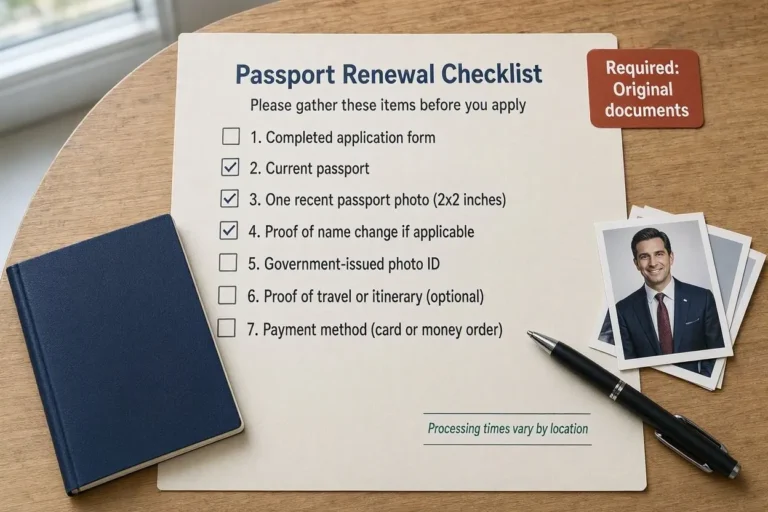
A complete passport application checklist requires six items: a filled-out DS-11 form, proof of U.S. citizenship, a valid photo ID, one passport photo, photocopies of citizenship and ID documents, and payment for two separate fees. Miss any single item, and the acceptance agent will turn the application away on the spot.
Here’s the full list at a glance:
- Completed Form DS-11 (unsigned until the appointment)
- One proof-of-citizenship document (original, not a copy)
- One valid photo ID (two IDs if the applicant’s ID doesn’t match the state of application)
- One 2×2 inch (51×51 mm) passport photo
- Photocopies of the front and back of the citizenship document and photo ID
- Payment for the passport application fee and the facility acceptance fee
Every applicant needs these six items. Age, however, changes which specific documents qualify and who needs to show up in person. Details are covered section by section below.
Proof of Citizenship: Accepted Documents
A U.S. birth certificate, an undamaged U.S. passport book or card, a Certificate of Naturalization, or a Consular Report of Birth Abroad satisfies the citizenship requirement. Applicants need only one of these four document types, and it must be the original or a certified copy. A photocopy, scan, or PDF will not work at the counter. The birth certificate has to include the applicant’s full name, date of birth, place of birth, and a raised or embossed seal from the issuing state or county; a hospital-issued birth notice or “souvenir” certificate without an official seal gets rejected every time. Applicants born abroad to U.S. citizen parents should bring a Consular Report of Birth Abroad instead, since it functions as the legal equivalent of a birth certificate for passport purposes.
Naturalised citizens submit their Certificate of Naturalisation, and those with an Alien Registration Number issued by U.S. Citizenship and Immigration Services (USCIS) need to write that number directly on the DS-11 form, since leaving it blank triggers a follow-up request that adds weeks to processing. If none of the four accepted documents exist, such as when a birth certificate was never issued or records were destroyed in a fire, the applicant needs to file secondary evidence of citizenship, which requires an in-person interview and additional documentation such as early public records, school records, or a notarized affidavit from a family member with direct knowledge of the birth.
Proof of Identity: Accepted Photo ID
A valid, unexpired driver’s license is the most commonly accepted photo ID for a passport application. Military identification, a government employee ID, and a current or expired U.S. passport also qualify on their own. Applicants without any of these need to bring a combination of two lesser-accepted IDs, such as a Social Security card paired with a school photo ID for a teenager.
The rule shifts by age. Applicants 18 and older just need one valid photo ID with a recognizable, recent photo. Applicants 16 and 17 need their own ID plus a parent standing next to them, since the State Department wants that parent to confirm the applicant’s identity in person. Applicants 15 and under don’t carry ID at all; both parents or legal guardians show their own photo IDs and sign the application together instead.
One detail trips up more people than any other: if an applicant’s driver’s license was issued in a different state than the one they’re applying in, the acceptance agent will ask for a second form of ID. A Texas resident applying at a post office in California, for example, needs a backup ID beyond the out-of-state license: a passport card, military ID, or government employee badge all work.
Passport Photo Requirements
A passport photo must measure exactly 2×2 inches (51×51 mm), taken within the last 6 months, against a plain white or off-white background. Reading glasses, hats, and headphones aren’t allowed in the frame, though religious head coverings that don’t obscure the face are an exception.
The photo needs a full front view of the face with a neutral expression: no smiling with teeth showing, no tilted head. Color photos are required; black-and-white submissions get bounced back automatically. Many acceptance facilities offer photo services on-site for a separate fee, typically in the range of $7 to $16 depending on location, but applicants can also bring their own printed photo as long as it meets every specification.
Digital photos submitted through a phone screen don’t count for in-person DS-11 applications. Only the online renewal system accepts a digital upload, and that system is limited to eligible renewals through Form DS-82, not first-time applications.
Which Form You Need
Form DS-11 is the one first-time applicants use. It covers new adult applicants, children under 16, and anyone who doesn’t qualify for renewal by mail. Two related forms come up specifically for minors:
| Form | Who Uses It |
| DS-11 | First-time applicants, children under 16, and adults who don’t qualify for mail renewal |
| DS-3053 | Parental consent when one parent can’t appear in person for a child’s application |
| DS-5525 | Special family circumstances when one parent can’t locate the other |
Renewing an eligible existing passport instead of applying for the first time? You’ll use Form DS-82, which has its own fees and mail-in steps not covered here.
Passport Application Fees for 2026
A passport book for an adult costs $130 in application fees plus a $35 acceptance facility fee, for a total of $165. A passport card runs $30 plus the same $35 facility fee, totaling $65. Getting both documents together costs $160 in application fees plus $35, for $195 total.
Minors under 16 pay less for the book: $100 in application fees plus the $35 facility fee, totaling $135. The passport card for a minor costs $15 plus $35, for $50 total.
| Applicant | Passport Book | Passport Card | Book + Card |
| Adult (16+) | $130 + $35 fee = $165 | $30 + $35 fee = $65 | $160 + $35 fee = $195 |
| Minor (under 16) | $100 + $35 fee = $135 | $15 + $35 fee = $50 | N/A (apply separately) |
Expedited service adds $60 to the application fee regardless of age. Applicants who need the passport back within 1 to 3 days after mailing can add expedited return shipping for roughly $22 to $23, depending on the facility.
Two separate payments are required at the counter. The application fee goes to the U.S. Department of State by check or money order only; credit cards and cash aren’t accepted for this portion. The facility acceptance fee, by contrast, varies by payment method depending on the location; some county clerk offices accept credit cards and cash for this fee, while others require a check.
How to Fill Out and Submit Your Application
The DS-11 form must be filled out using the State Department’s online Form Filler tool and printed on single-sided 8.5×11 inch (21.6×27.9 cm) paper. Applicants who run into technical issues can download a blank PDF version instead, though the online tool catches formatting errors the PDF won’t.
Print the form in portrait orientation only. A form printed sideways causes automatic delays. Leave the signature line blank. Passport acceptance agents witness the signature in person and won’t accept a form signed beforehand, since the signature functions as a legal oath administered at the counter.
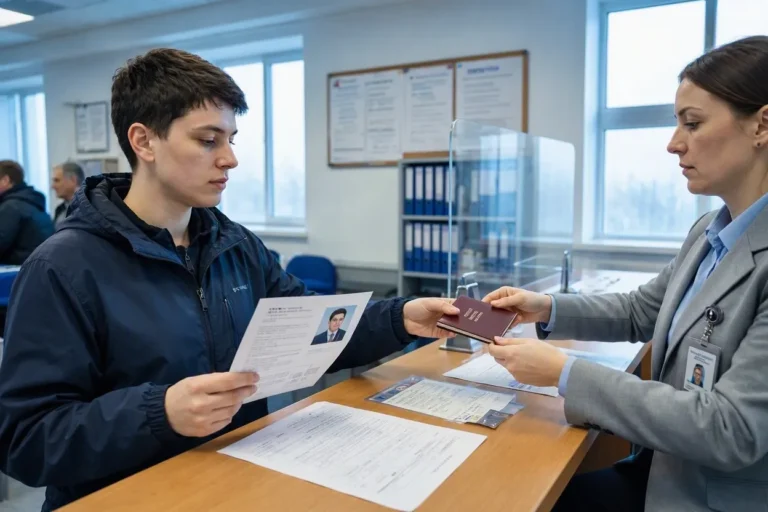
Bring the application to a passport acceptance facility such as a post office, public library, or county clerk’s office. Applicants with confirmed international travel within 14 calendar days should skip that route. Book an appointment directly at a regional passport agency instead, which can turn urgent applications around in a few business days. Someone flying out in 10 days, for example, would go straight to the Online Passport Appointment System and schedule an agency visit rather than heading to the post office.
Special Requirements for Minors Under 16
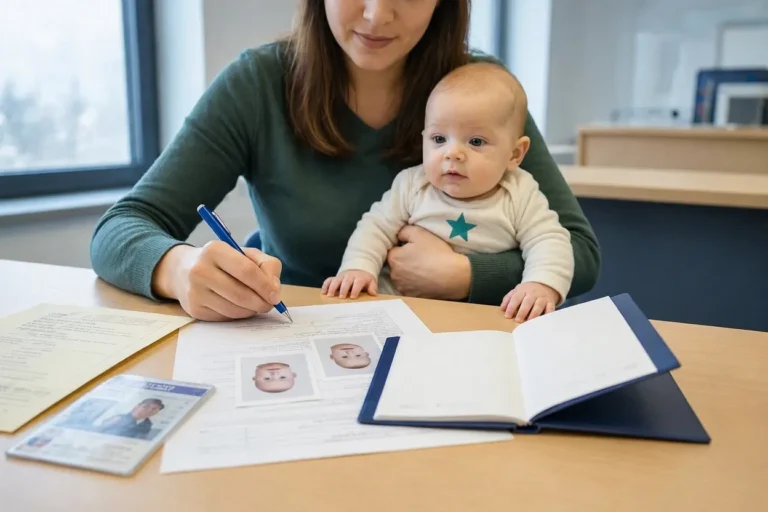
Both parents or legal guardians listed on the birth certificate must appear in person for a child’s passport application. If one parent can’t attend, the applicant needs Form DS-3053, a notarized statement of consent signed by the absent parent, along with a photocopy of that parent’s ID, front and back.
The child’s Social Security number and original birth certificate are required alongside both parents’ valid photo IDs. A parent with sole legal custody documented on court paperwork can sometimes skip the second-parent requirement entirely, but only with certified court documents proving that custody. An informal arrangement won’t satisfy the acceptance agent, no matter how amicable it is. Sole legal guardians who aren’t biological parents need to bring official guardianship or adoption paperwork on top of the standard document list.
Special Requirements for 16 and 17 Year Olds
Applicants aged 16 and 17 can apply using their own identification. A current school ID often works when paired with the standard citizenship documents, which is why teens without a driver’s license commonly rely on it. This age group doesn’t legally need both parents’ signatures or presence. Still, the State Department recommends a parent tag along, since that satisfies the “parental awareness” standard it prefers.
Common Reasons Applications Get Delayed or Rejected
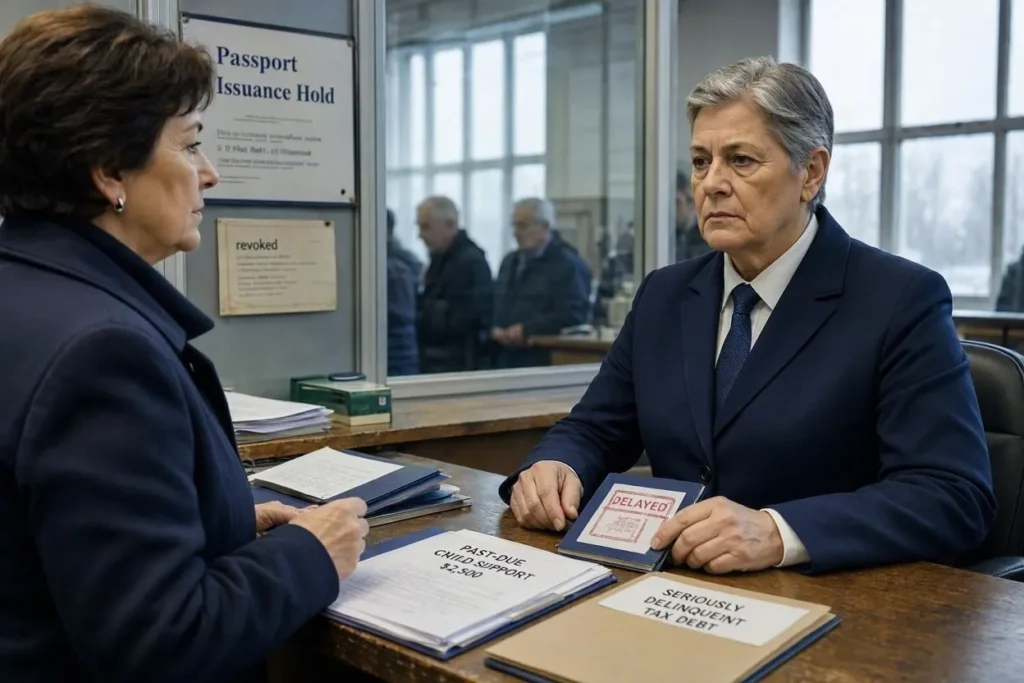
Owing $2,500 or more in past-due child support blocks passport issuance until the debt is resolved with the applicant’s state agency. Seriously delinquent federal tax debt triggers a similar hold under IRS rules. Either way, the applicant has to clear things up directly with the relevant agency before the State Department will move forward. (Worth knowing: since May 2026, the State Department has also started actively revoking already-issued passports for large child-support arrears. That’s a separate process from the denial rule covered here, which applies to new applications.)
A damaged passport submitted for renewal, such as one with water damage, mold, missing pages, or unofficial markings, gets denied outright unless the applicant includes a signed statement explaining what happened, though normal wear like a bent corner or faded cover doesn’t count.
Two disclosure gaps account for most of the rest. Applicants covered under International Megan’s Law, a federal statute requiring notification for certain sex offenders traveling internationally, need to submit a signed and dated statement acknowledging their status. And missing details about a previously lost or stolen passport trip people up on the DS-11 form itself; the State Department wants to know where and when the loss happened, plus a copy of any police report, before it will process a replacement.
How Long Passport Processing Takes
Routine processing takes 4 to 6 weeks from the date the application arrives at a State Department processing center, not from the date it was submitted at the local facility. Expedited processing cuts that window to 2 to 3 weeks for an additional $60.
Mailing time adds roughly 2 weeks on each end of that window: 2 weeks for the application to reach the processing center, and up to 2 more weeks for the finished passport to arrive by mail after processing completes. An applicant submitting a routine application in early January, for example, should expect the finished passport sometime in mid-to-late February once mailing time gets factored in alongside the standard 4-to-6-week window.
Applicants can track progress at passportstatus.state.gov using their last name, date of birth, and application locator number found on the receipt.
Printable Passport Application Checklist
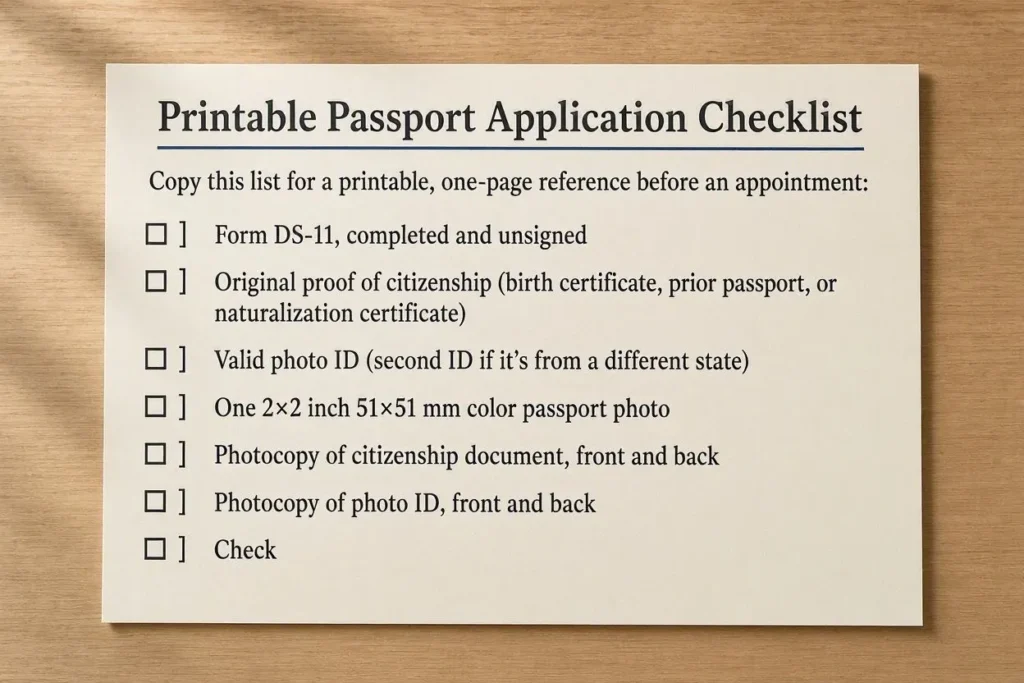
Copy this list for a printable, one-page reference before an appointment:
- [ ] Form DS-11, completed and unsigned
- [ ] Original proof of citizenship (birth certificate, prior passport, or naturalization certificate)
- [ ] Valid photo ID (second ID if it’s from a different state)
- [ ] One 2×2 inch (51×51 mm) color passport photo
- [ ] Photocopy of citizenship document, front and back
- [ ] Photocopy of photo ID, front and back
- [ ] Check or money order for the application fee
- [ ] Separate payment for the acceptance facility fee
- [ ] Social Security number ready to enter on the form
- [ ] DS-3053 consent form and second parent’s ID copy, if applying for a minor with one parent absent
Conclusion
A rejected passport application almost always traces back to one of six items on this checklist: the wrong form, an unacceptable ID, a photocopy instead of an original document, an out-of-spec photo, an incomplete fee payment, or a missing parental signature for a minor. Following this passport application checklist in order (form, citizenship proof, ID, photo, copies, fees) eliminates nearly every reason an acceptance agent turns an application away. Gather every original document the night before, and the appointment itself takes 15 to 20 minutes from start to finish.
FAQs

Michael Reynolds
Michael Reynolds leads ImmigrationWin’s immigration, visa, and global mobility content division. He specializes in researching immigration policies, visa requirements, application processes, and international relocation pathways for individuals, families, students, and professionals. With extensive experience analyzing immigration regulations and official government guidance, Michael brings a research-driven approach to complex immigration topics and changing visa policies. He is the primary author of ImmigrationWin’s visa guides, immigration resources, and country-specific content, helping readers better understand their options and make informed decisions about their international journey.
Related Posts