Poland Student Visa Requirements 2026: A Complete Guide for US Students
Studying in Poland requires a national D-type visa for most American students, along with proof of university enrollment, health insurance covering at least 30,000 euros, and evidence of sufficient funds. Poland tightened its student visa rules in July 2025, adding mandatory diploma recognition through the Syrena system and, for some bachelor’s applicants, an entrance exam. This guide covers every requirement, fee, and deadline a US applicant needs for the 2026 intake.
Poland Student Visa Requirements at a Glance
| Requirement | Detail |
| Visa type | National D-type visa (student annotation) |
| Visa fee | 80 euros (approximately 85 US dollars) |
| Processing time | Up to 30 days at US consulates; up to 15 days at some consulates in Poland’s own timeline |
| Application window | 90 days to 31 days before your program start date |
| Minimum health insurance | 30,000 euros (approximately 32,000 US dollars), including repatriation coverage |
| Minimum monthly funds | 776 Polish zloty for a single applicant (approximately 195 US dollars) |
| Visa validity | Up to 1 year |
| Temporary residence permit fee | 340 Polish zloty stamp duty plus 100 Polish zloty for the residence card (approximately 100 US dollars total) |
Figures above come from Poland’s Office for Foreigners, the Ministry of Foreign Affairs, and the European Commission’s EU Immigration Portal. Consulates can adjust document lists and appointment rules, so confirm details with your assigned consulate before submitting an application.
Who Needs a Student Visa to Study in Poland
US citizens need a Polish national visa for any academic program longer than 90 days. Poland belongs to the Schengen Area, and American passport holders can enter visa-free for tourism or short courses under 90 days within any 180-day period. A semester, full academic year, or degree program exceeds that window, so a D-type national visa becomes mandatory before departure.
European Union and European Free Trade Association citizens skip the visa step entirely. They enter Poland with a national identity card or passport and register their residence with the local Voivodeship Office within 90 days of arrival, at no cost. This guide focuses on non-EU applicants, since that covers nearly all US students.
Types of Polish Student Visas: C-Type vs. D-Type
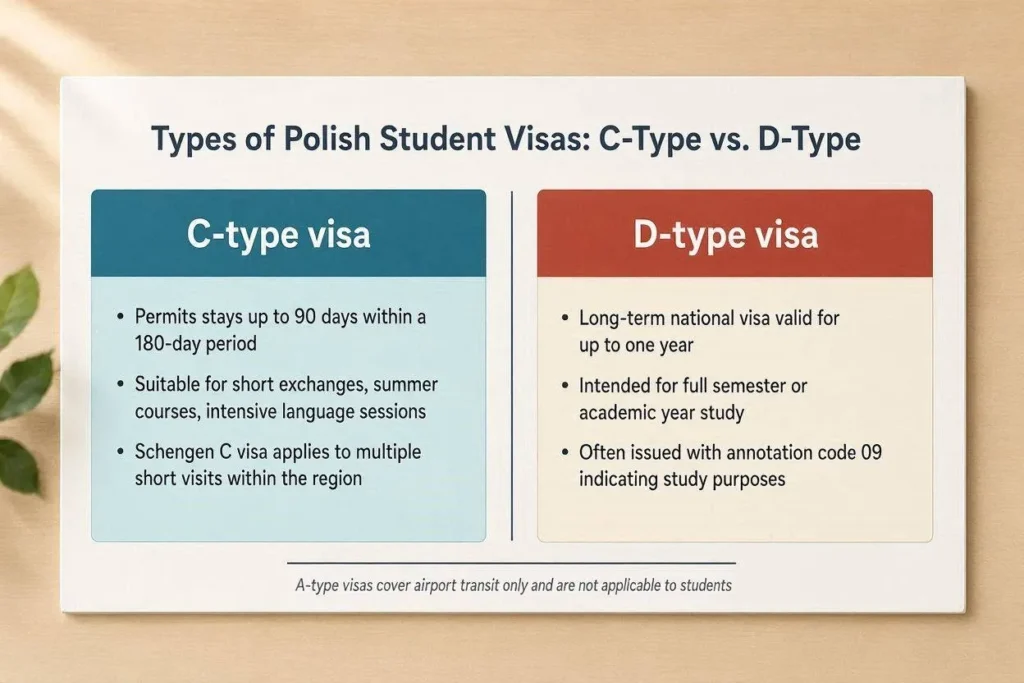
Poland issues three visa categories, but only one applies to students planning a full semester or academic year abroad.
A-type visas cover airport transit only and never apply to students. C-type visas permit stays up to 90 days within a 180-day period and suit short exchange programs, summer courses, or intensive language sessions. D-type visas are long-term national visas valid for up to one year, and they carry the “09” or “student” annotation required for degree programs and semester-long exchanges.
A D-type visa also allows travel throughout the Schengen Area for up to 90 days within any 180-day period, separate from the time spent studying in Poland. Extensions beyond one year require switching to a temporary residence permit rather than renewing the visa itself.
Document Checklist for a Poland Student Visa in 2026
Consulates reject incomplete applications outright rather than requesting missing items after submission, so gather every document before your appointment.
Core Application Documents
Your application packet needs the following items, confirmed against your specific consulate’s published list:
- Completed and signed visa application form
- Valid passport issued within the last 10 years, with at least two blank pages and validity extending 3 months past your visa expiration
- One recent biometric photograph meeting consulate specifications
- Letter of acceptance from a Polish higher education institution approved by Poland’s Ministry of Interior
- Proof of visa fee payment
- Health insurance documentation meeting the coverage minimum
- Proof of sufficient financial means
- Academic transcripts or certificates, legalized through an apostille or consular legalization
Some consulates request additional items such as a cover letter explaining your study plans or proof of accommodation in Poland. Chinese, Belarusian, Indian, Philippine, Turkish, and Ukrainian applicants can submit through an External Service Provider rather than the consulate directly, which can shorten wait times for an appointment.
Health Insurance Requirement
Your health insurance must cover a minimum of 30,000 euros and include repatriation and emergency medical treatment. The policy needs to remain valid for your entire intended stay in Poland. Acceptable coverage includes Polish public health insurance (available once enrolled) or a private travel medical policy from an insurer meeting Polish statutory requirements. Poland’s Ministry of Foreign Affairs publishes a list of accepted insurers on its visa information page, and consulates verify the policy document names repatriation explicitly rather than assuming general travel insurance qualifies.
Proof of Financial Means
Applicants show monthly funds exceeding 776 Polish zloty for a single person or 600 Polish zloty per family member, after accounting for housing costs. Poland calculates this figure against average accommodation and utility expenses, so bank statements should demonstrate funds well above the baseline once tuition and rent are factored in. Return-travel funds also count toward this requirement: 200 Polish zloty covers travel from a neighboring country, 500 Polish zloty covers travel from other European Union or European Economic Area states, and 2,500 Polish zloty covers travel from countries outside Europe, including the United States.
New Admission and Visa Rules for 2025-2026
Poland introduced significant changes to student admissions and visas starting July 1, 2025, and these rules remain in effect for the 2026 intake.
Bachelor’s degree applicants from outside the European Union, the Organisation for Economic Co-operation and Development (OECD), and the European Free Trade Association now face an entrance examination unless they hold an International Baccalaureate diploma, an Erasmus-recognized diploma, or a certificate covered by an international agreement. The exam takes the form of a written essay or oral interview, depending on the program, and candidates need at least 10 out of 20 points to pass. Universities publish exam topics in advance and typically return results within 2 business days.
Secondary school certificates and university diplomas issued outside the European Union, OECD, and European Free Trade Association member states now require formal recognition through Poland’s Syrena system, run by the National Agency for Academic Exchange (NAWA). Applicants submit scanned documents online at no charge, and NAWA issues an electronically signed recognition statement. This recognition document must accompany the original certificate or diploma during the visa application.
English language certificates changed too. Consulates and universities now require a minimum B2 level under the Common European Framework of Reference for Languages, with the International English Language Testing System (IELTS), Test of English as a Foreign Language (TOEFL), Pearson, and Cambridge exams explicitly accepted. Duolingo English Test scores face rejection at many institutions under the new standard, so confirm your chosen university’s accepted list before scheduling a language exam.
Applicants who completed their admissions process and paid tuition by June 23, 2025, with an admission decision recorded by June 30, 2025, remain grandfathered under the previous rules. Everyone applying after those dates follows the updated requirements described here.
Step-by-Step Application Process
Follow these 7 steps to apply for a Poland student visa from the United States.
- Secure university acceptance first. Confirm your program start date and collect your letter of acceptance before contacting a consulate.
- Identify your assigned consulate. The Polish consulate covering your state of residence handles your application; consulates generally do not accept applications from outside their assigned jurisdiction.
- Register through the e-Konsulat portal. Poland’s e-Konsulat system (secure.e-konsulat.gov.pl) handles appointment booking and application registration, though it does not accept the physical application itself.
- Gather your documents. Assemble every item on your consulate’s published checklist, including certified translations where required.
- Submit your application in person. Bring printed, signed documents to your appointment between 90 and 31 days before your program start date. Submitting outside this window risks rejection or delay.
- Pay the visa fee. The standard fee runs 80 euros, payable by the method your consulate specifies.
- Track your application and prepare for pickup. Processing generally takes up to 30 days for US applicants, though Polish government sources cite a 15-day timeline once all required documents accompany the application. Keep your tracking number if your consulate returns documents by mail.
Check your consulate’s exact document list and appointment procedures before submitting your application — requirements shift by jurisdiction and change without notice.
Poland Student Visa Fees and Processing Times
Budget for 3 separate cost categories: the visa fee itself, the temporary residence permit you apply for after arrival, and incidental costs like document legalization or translation.
The national visa fee costs 80 euros, roughly 85 US dollars at mid-2026 exchange rates. Processing takes up to 30 days from the date your consulate receives a complete application, though some consulates cite 15 days as their internal target once all supporting documents check out. Applicants missing documentation get 7 days to supplement their application before a consulate returns it unprocessed.
Once you arrive in Poland and need to extend your stay past the visa’s validity, the temporary residence permit costs 340 Polish zloty in stamp duty plus 100 Polish zloty for the residence card itself, totaling roughly 100 US dollars. That permit process takes up to 60 days from the date you submit a complete application to your local Voivodship Office, and applicants must submit fingerprints in person during the process.
Polish Consulates in the United States: Where to Apply
Five Polish diplomatic posts handle visa applications from the United States, each covering a specific set of states.
Embassy of the Republic of Poland, Washington, D.C. serves Alabama, the District of Columbia, Florida, Georgia, Kentucky, Maryland, Mississippi, North Carolina, South Carolina, Tennessee, Virginia, West Virginia, Puerto Rico, and US overseas territories. The consular division sits at 2224 Wyoming Avenue NW, Washington, DC 20008.
Consulate General in New York serves Connecticut, Delaware, Maine, Massachusetts, New Hampshire, New Jersey, New York, Ohio, Pennsylvania, Rhode Island, and Vermont, located at 233 Madison Avenue, New York, NY 10016.
Consulate General in Chicago serves Arkansas, Illinois, Indiana, Iowa, Kansas, Louisiana, Michigan, Minnesota, Missouri, Nebraska, North Dakota, South Dakota, and Wisconsin, at 1530 North Lake Shore Drive, Chicago, IL 60610.
Consulate General in Houston serves Arkansas, Kansas, Louisiana, Mississippi, New Mexico, Oklahoma, and Texas, located at 3040 Post Oak Boulevard, Suite 525, Houston, TX 77056.
Consulate General in Los Angeles serves Alaska, Arizona, California, Colorado, Hawaii, Idaho, Montana, Nevada, New Mexico, Oklahoma, Oregon, Texas, Utah, Washington, and Wyoming, at 12400 Wilshire Boulevard, Suite 555, Los Angeles, CA 90025.
Several states appear under more than one jurisdiction; contact both offices directly or check gov.pl/web/usa to confirm which consulate accepts your application before booking an appointment.
Temporary Residence Permit After Arrival
Every non-EU student needs a temporary residence permit if their studies extend beyond the visa’s validity period. Apply before your visa expires, but only after you legally enter Poland — applying too early or too late both create problems with your legal status.
Submit your application in person at the Voivodship Office covering your address in Poland. First-time permits run for 15 months, extendable in increments up to 3 years, though never beyond your program’s actual duration. Students admitted through a European Union mobility program or an inter-institutional agreement receive a longer first permit of 2 years.
Required documents include a completed application form, 4 recent photographs, a photocopy of your valid passport, proof of stamp duty payment, an enrollment certificate from your institution, health insurance documentation, and proof of financial means. Processing takes up to 60 days from submission of a complete application.
One notable restriction: time spent in Poland on a student visa or student residence permit counts only at half value toward the 5-year residency requirement for the European Union long-term residence permit. Students pursuing permanent settlement in Poland should factor this reduced counting into long-term planning.
Common Mistakes That Delay or Deny a Poland Student Visa
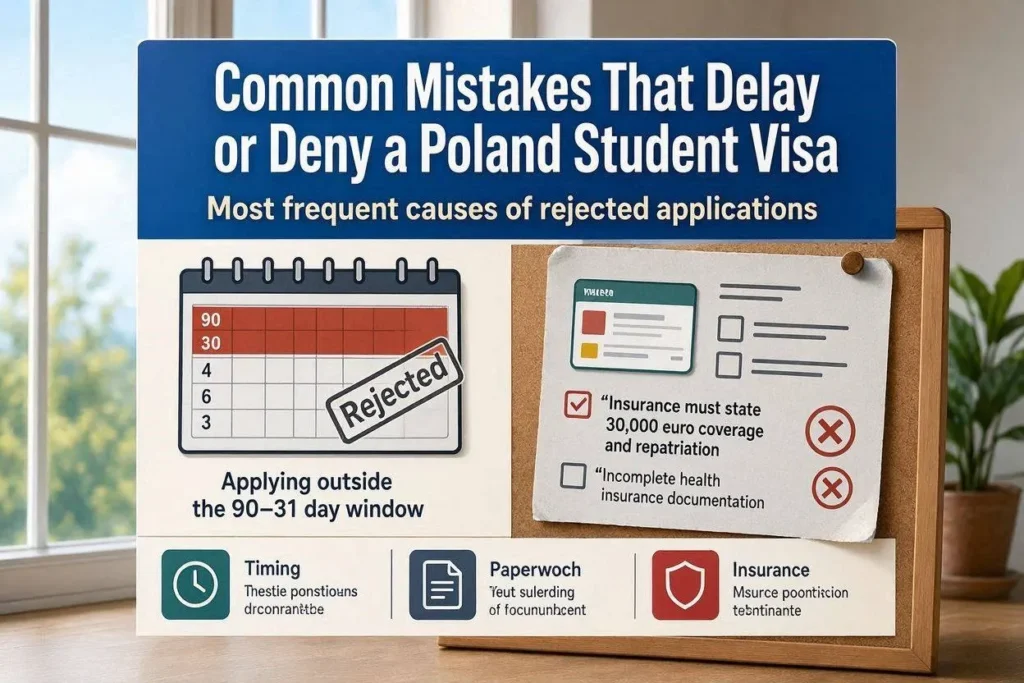
Submitting outside the 90-to-31-day application window causes the most frequent rejections. Consulates return applications submitted too early or too late without processing them, regardless of how complete the paperwork is otherwise.
Incomplete health insurance documentation ranks second. A general travel insurance policy that doesn’t explicitly state 30,000-euro coverage and repatriation gets rejected even when the policy technically covers medical emergencies. Request a certificate from your insurer that states the coverage amount and repatriation terms in the exact language Polish authorities expect.
Outdated English certificates trip up applicants who tested before the July 2025 rule change. Confirm your university still accepts your specific test and score under current standards before relying on results from an earlier application cycle.
Missing diploma or certificate recognition through the Syrena system delays bachelor’s and master’s applicants whose academic documents originate outside the European Union, OECD, or European Free Trade Association. Submit recognition requests as early as possible, since NAWA processing adds weeks to an already tight timeline.
Finally, assuming your consulate’s fee, document count, or submission method matches another consulate’s rules causes unnecessary appointment cancellations. Each of the 5 US posts sets its own operational details within the national framework, so confirm specifics directly rather than relying on a friend’s experience at a different consulate.
Visa Rights: Work, Travel, and Status Changes
Yes, a Polish student visa allows you to work without a separate work permit. Both the D-type visa with a student annotation and the temporary residence permit for study purposes carry automatic labor market access, and residence cards issued for study include an explicit “access to the labour market” annotation.
Holders of a temporary residence permit for study purposes can also start and run a business in Poland under the same terms as Polish citizens, a right not extended to visa holders who haven’t yet obtained the residence permit.
After completing your degree, you can apply for a temporary residence permit for job searching or business setup, giving graduates a legal pathway to remain in Poland beyond their studies. Family members can accompany students under general visa or residence permit rules, and after 2 years of consecutive temporary residence permits, family reunification rights apply.
Appeals exist at each stage. A visa refusal allows 14 days to request re-examination by the consul. A residence permit refusal allows 14 days to appeal to the Head of the Office for Foreigners, with further appeal available through Poland’s administrative courts.
Ready to start your Poland student visa application? Confirm your program acceptance, identify your assigned US consulate, and build your document checklist against the current 2026 requirements before booking your appointment.
Conclusion
A Poland student visa comes down to 4 things: the right visa type, a complete document set, insurance and funds that meet the exact thresholds, and a submission timed within the 90-to-31-day window. The July 2025 reforms added extra steps for some applicants — entrance exams for certain bachelor’s candidates, Syrena recognition for diplomas from outside the European Union, OECD, or European Free Trade Association, and a stricter English certificate list — but the core process still runs through your assigned US consulate on the same fee and timeline structure as before.
Start early. Confirm your university acceptance, check your consulate’s published checklist against the requirements in this guide, and submit your application the moment the 90-day window opens. Applicants who build in time for Syrena recognition, insurance verification, and document legalization avoid the delays that trip up last-minute filers each admissions cycle.
Frequently Asked Questions

Michael Reynolds
Michael Reynolds leads ImmigrationWin’s immigration, visa, and global mobility content division. He specializes in researching immigration policies, visa requirements, application processes, and international relocation pathways for individuals, families, students, and professionals. With extensive experience analyzing immigration regulations and official government guidance, Michael brings a research-driven approach to complex immigration topics and changing visa policies. He is the primary author of ImmigrationWin’s visa guides, immigration resources, and country-specific content, helping readers better understand their options and make informed decisions about their international journey.
Related Posts