Turkey Student Visa 2026: Requirements, Fees, and Application Steps
A Turkey student visa is a national visa that allows a non-Turkish citizen to enter Türkiye for education-related purposes, including university enrollment, a language course, or an internship. Turkish consulates issue this visa before travel, and it converts into a residence permit once a student arrives and registers with their university’s international office. Applicants heading to Boğaziçi University or Middle East Technical University (METU) still need this visa, even though both schools accept students from more than 100 countries.
The Ministry of Foreign Affairs (MFA) groups the student visa under one category with seven sub-purposes: internship visa, internship under the ERASMUS exchange program, internship through AIESEC, Turkish language course purpose, general course purpose, education purpose, and education in the Turkish Republic of Northern Cyprus. Each sub-type uses the same base document list. Internship applicants, however, submit one extra item: a placement letter from the host organization.
Who Needs a Turkey Student Visa
Yes, most international students need a Turkey student visa before traveling. Citizens of Northern Cyprus form the only broad exemption, and a few narrower exceptions apply depending on prior residence status or family ties in Türkiye.
Exemptions From the Student Visa Requirement
Three groups can skip the standard student visa process:
- Blue Card holders — former Turkish citizens who hold this card qualify for exemption
- Children of residence permit or work visa holders — students already living in Türkiye through a parent’s status don’t need a separate student visa
- Returning students — those who finished secondary school in Türkiye and continue directly into a bachelor’s or master’s program qualify for exemption
A student arriving from a visa-exempt country for a program under 90 days still needs a residence permit within that window, even without a visa stamp in their passport.
Types of Turkey Student Visas
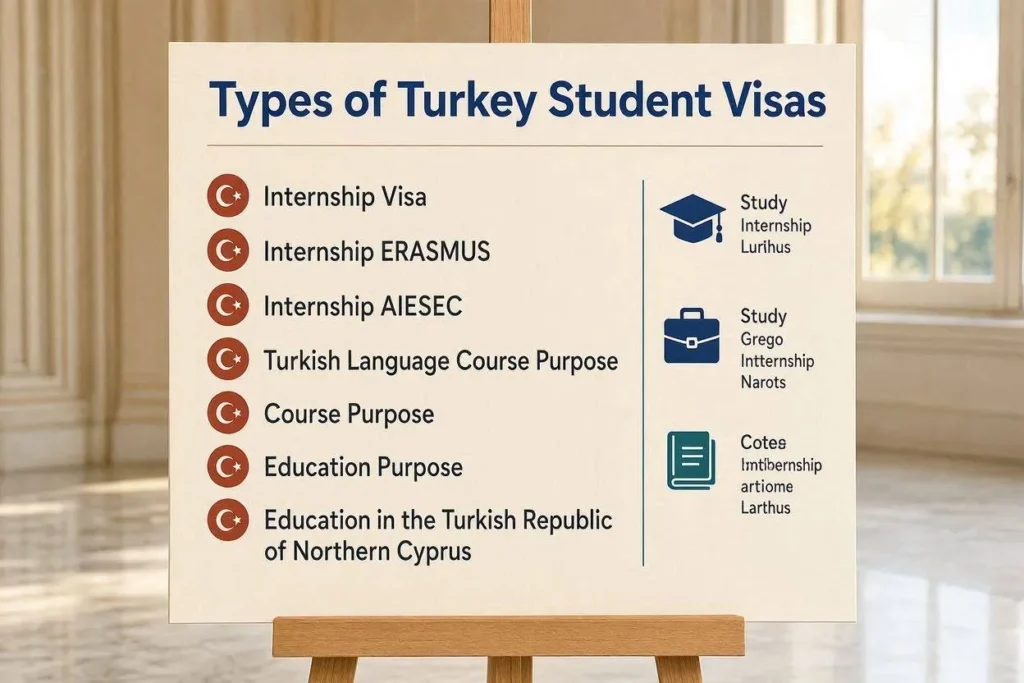
Applicants choose from seven visa purposes on the online pre-application form:
- Internship Visa
- Internship ERASMUS
- Internship AIESEC
- Turkish Language Course Purpose
- Course Purpose
- Education Purpose
- Education in the Turkish Republic of Northern Cyprus
Picking the wrong category slows the whole file down, since each purpose routes to a different review track at the consulate. A student enrolling in a one-year master’s program should select “Education Purpose,” not “Course Purpose,” a category the MFA reserves for short, non-degree instruction.
Required Documents for a Turkey Student Visa
Applicants need eight core documents for a complete file:
- Completed and signed visa application form — generated after the online pre-application
- Valid passport — at least six months of validity beyond the planned entry date, with a minimum of two blank pages
- Two biometric photographs — 5×6 cm, taken within the last six months, white background
- Letter of Acceptance — issued by the Turkish university, language school, or internship host, confirming program dates
- Proof of financial means — bank statements, a sponsor letter, or a scholarship award letter (Burs Mektubu)
- Health insurance certificate — covering the full duration of the intended stay
- Proof of paid tuition or a payment plan — required by most consulates, though some accept a fee waiver letter for scholarship holders
- Academic transcripts and diplomas — original or certified copies from the applicant’s previous institution
Documents not issued in Turkish or English require certified translation. Consulates in several countries request apostille certification on transcripts too, before accepting the file at all. A student applying from Lagos with a Nigerian diploma, for example, typically needs both a certified English translation and an apostille stamp from the National Universities Commission before the Turkish consulate will process the application.
Minors under 18 submit two additional items: a notarized parental consent letter (or a No Objection Certificate, if only one parent applies) and, in divorce cases, custody documentation confirming which parent holds legal guardianship.
How to Apply for a Turkey Student Visa (Step-by-Step)
The process runs through seven stages, from acceptance letter to visa collection:
- Secure a Letter of Acceptance from an accredited Turkish institution
- Complete the online pre-application at the consulate’s designated portal and book an appointment
- Gather all required documents, translated and apostilled where necessary
- Attend the visa interview at the Turkish consulate or embassy covering the applicant’s home region
- Pay the visa fee and keep the receipt as part of the permanent record
- Submit biometric data, if requested by that specific consulate
- Collect the passport with the visa sticker once the consulate approves the file
Consulates in the United States operate independently by jurisdiction. Applicants covered by the New York consulate follow a different appointment calendar than those under Chicago, Houston, Los Angeles, or the Washington, D.C. embassy. A student living in Boston, for instance, falls under New York’s coverage area rather than Washington’s, even though Boston sits closer to D.C. on a map. Confirming the correct jurisdiction before booking saves weeks of avoidable delay.
Turkey Student Visa Fee and Processing Time
The Turkey student visa costs between $100 and $150 (£80–£120, €95–€140). The exact amount depends on the applicant’s nationality and the consulate’s local currency conversion rate. Some consulates add a separate service fee for third-party application centers, tacking on roughly $20 to $40 more.
Processing typically takes 10 to 15 working days from the interview date, though timelines shift by country and by season. Applications submitted during the peak intake months of June and July often take longer, since consulates process a higher volume of student files alongside standard tourist and business visas. Submitting the file at least 60 days before departure, and no later than 30 days before travel, keeps the application inside the window most consulates enforce.
Proof of Funds and Financial Requirements
Applicants need to show at least $500 to $600 per month, or roughly $6,000 for a full academic year, to meet the financial requirement. Acceptable proof includes bank statements covering three to six months, a notarized sponsor letter paired with the sponsor’s own financial documents, or an official scholarship award letter.
Consulates scrutinize statements for consistency rather than a single large deposit made right before applying. A statement showing steady balances across four months carries more weight than one showing a lump sum deposited two weeks before the appointment, since consular officers flag sudden deposits as a common warning sign during review.
Sponsors who aren’t immediate family members face extra scrutiny at several consulates. Some jurisdictions, including Qatar-based application centers, restrict sponsorship to family members only. Applicants relying on a non-relative sponsor should confirm that specific consulate’s policy before building an application around that arrangement.
Health Insurance Requirements
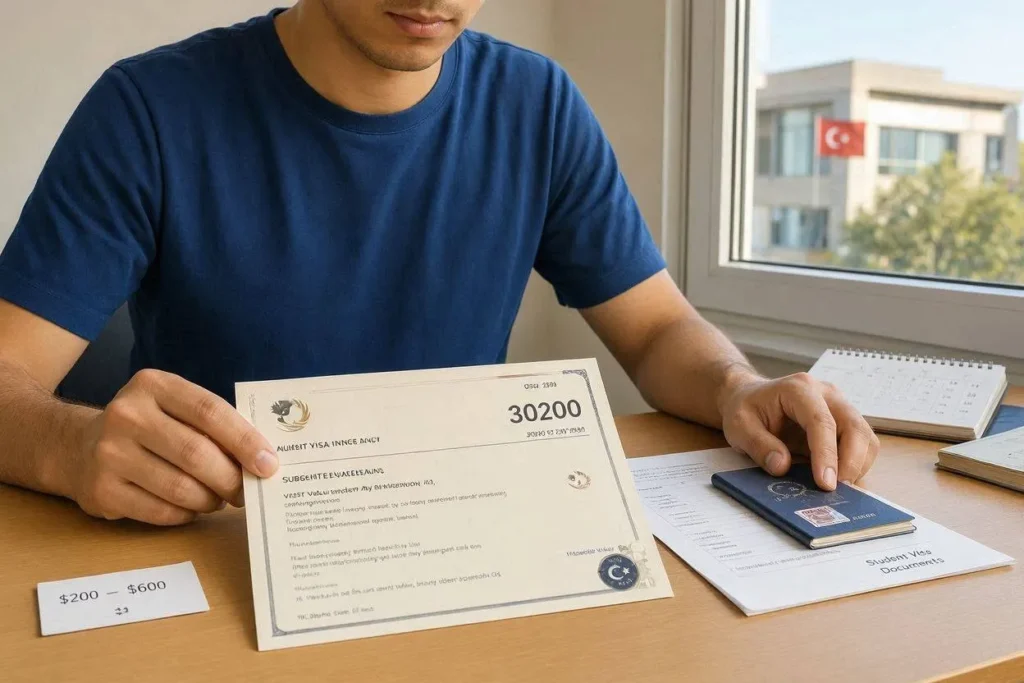
Yes, health insurance is mandatory for every Turkey student visa applicant. The policy needs to cover the applicant’s entire stay, and most consulates require a minimum coverage amount printed directly on the certificate rather than a general summary letter.
Premiums for a full academic year typically run $200 to $600, depending on coverage level and provider. A basic plan covering emergency care only sits at the lower end of that range. Broader coverage, including outpatient visits and prescription costs, pushes the premium toward $600.
Switching to SGK After Arrival
Students transition from their initial travel insurance to Turkish General Health Insurance, known as SGK (Sosyal Güvenlik Kurumu), within three months of receiving a residence permit. SGK enrollment happens at the local Social Security Institution office. Students who miss this window lose the option to enroll at the reduced student rate for that academic term. Private insurance remains an alternative for students who want broader hospital network access than SGK provides.
After You Arrive: Residence Permit Process
Students register for a residence permit within one month of arriving in Türkiye, a step separate from the visa itself. The process starts online through e-ikamet.goc.gov.tr, where applicants complete a pre-registration form before the university’s International Student Office finalizes the submission.
Under the cooperation protocol signed between the Presidency of Migration Management (PMM) and the Council of Higher Education (YÖK) on 29 November 2023, students no longer wait for a migration office appointment date to submit residence permit paperwork. Universities now forward documents directly to the relevant migration unit, cutting weeks off the previous timeline. A master’s student at Sabancı University who completes registration in the first week of the semester, for example, can have residence permit documents filed within days rather than waiting on a separate government appointment slot.
The residence permit card costs 964 Turkish lira, approximately $28 to $30, for the 2026 processing year. Students pay no separate visa or application fee for the permit itself, only the card production charge.
The YU Number and e-Devlet
Every residence permit holder receives a Foreign Identification Number, called a YU number, printed on the permit card. This number works the way a Social Security number does in the United States: banks require it to open an account, mobile carriers require it for a SIM card, and landlords require it on rental contracts. Students check residence permit status and renew their card through Türkiye’s e-Devlet portal using this same identification number.
Can You Work on a Turkey Student Visa?
No, a Turkey student visa alone doesn’t permit employment. Undergraduate and associate-degree students gain limited work rights only after completing their first year of study. Turkish law caps associate-degree students at 24 hours per week even then.
Master’s and doctoral students face fewer restrictions once they hold a valid residence permit, though any paid position still requires a separate work permit through the Ministry of Labor and Social Security. A doctoral candidate at Middle East Technical University who wants to work as a research assistant, for instance, needs a work permit issued specifically for that role, not general permission tied to the residence card.
Graduates get a defined window to convert their status. Applications for a post-study work permit must go in within six months of graduation, and the resulting permit lasts up to one year, non-renewable in that initial form. A bachelor’s degree alone doesn’t qualify a graduate for this permit — only those completing a higher degree, such as a master’s or doctorate, meet the eligibility threshold.
Turkish Scholarships (Türkiye Bursları) and Visa Proof of Funds
Türkiye Bursları, the Turkish government’s national scholarship program, covers tuition, monthly stipends, housing, and health insurance for selected international students. Recipients submit their official award letter in place of standard bank statements, since the stipend amount already satisfies the proof-of-funds requirement.
The program accepts applications annually between January and February for the following academic year, with award decisions typically arriving by June. That timing fits comfortably within the 60-day visa application window most consulates require. A student admitted through Türkiye Bursları for a September start date generally has enough lead time to complete both the scholarship confirmation and the visa process without rushing either one.
What to Do If Your Turkey Student Visa Is Rejected
Reapplication becomes possible one day after receiving a rejection notice, provided the applicant fixes whatever documentation error caused the denial. Common rejection reasons include insufficient proof of funds, a passport nearing expiration, and a Letter of Acceptance that doesn’t clearly state program dates or enrollment status.
Applicants who believe a consulate rejected their file without valid grounds can request a review directly through that Turkish embassy or consulate. This process sometimes takes several weeks to schedule, so preparing a fresh application in parallel makes more sense than waiting on the appeal alone. Written appeals work for applicants unable to visit the consulate in person, provided the letter includes supporting documents addressing the specific rejection reason.
Applying From Specific Countries (Consulate Variations)
Document requirements shift slightly by jurisdiction, even though the MFA sets the base national rules. Indian applicants submit a cover letter explaining their study plans alongside a No Objection Certificate from their current school, a requirement absent from the standard MFA checklist. Applicants processed through certain Gulf-region visa centers, including those serving Qatar residents, need to show a valid residency permit in that country for at least three months before the consulate accepts a file, and sponsors on those applications must be family members only.
United States applicants work through one of five jurisdictions: the embassy in Washington, D.C., or consulates in New York, Chicago, Houston, or Los Angeles. Each office maintains its own appointment calendar and, in some cases, its own supplemental document list. Confirming requirements with the specific consulate covering an applicant’s state prevents a file built around the wrong jurisdiction’s rules.
Common Mistakes That Delay or Reject Applications
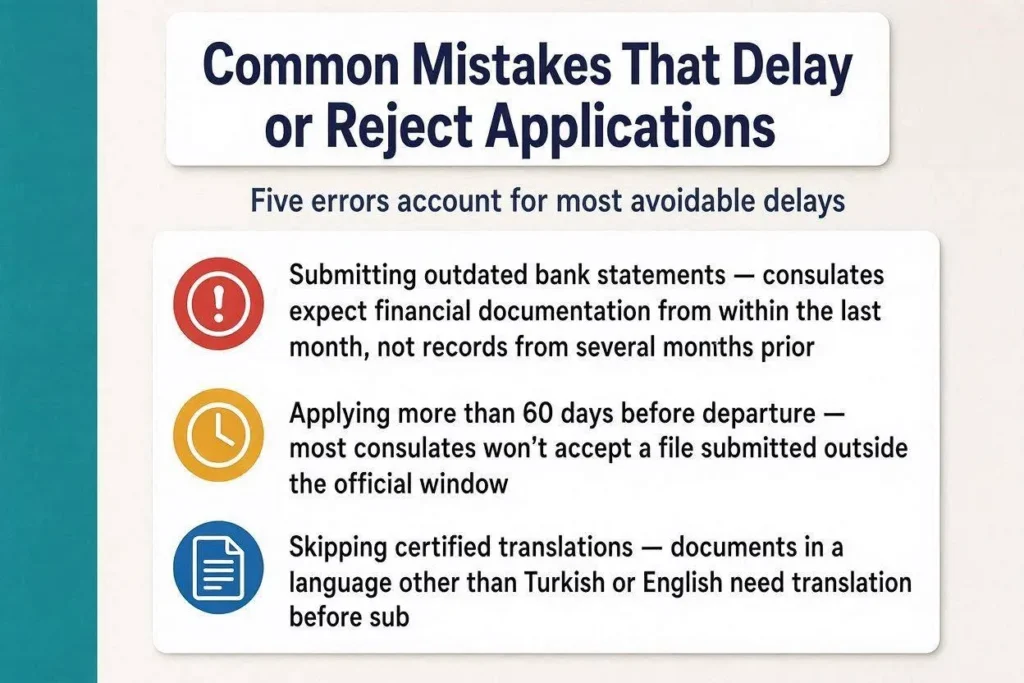
Five errors account for most avoidable delays:
- Submitting outdated bank statements — consulates expect financial documentation from within the last month, not records from several months prior
- Applying more than 60 days before departure — most consulates won’t accept a file submitted outside the official window
- Skipping certified translations — documents in a language other than Turkish or English need translation before submission, not after a consulate flags the gap
- Choosing the wrong visa sub-category — selecting “Course Purpose” for a full degree program routes the file to the wrong review track instead of “Education Purpose”
- Missing the residence permit deadline — arriving in Türkiye without registering for a residence permit within one month creates legal complications separate from the visa itself
A student who books a visa appointment 90 days before travel, expecting extra buffer time, actually risks rejection on procedural grounds alone. The consulate’s own window caps applications at 60 days out, regardless of how early an applicant would prefer to start.
Final Notes
A Turkey student visa application succeeds or fails on document accuracy and timing, not on complicated bureaucracy. Applicants who confirm their consulate’s exact jurisdiction, submit financial proof within the correct window, and register for a residence permit within that first month in Türkiye avoid the vast majority of processing delays. Requirements shift periodically, so checking current fees and document lists directly with the relevant Turkish consulate remains the most reliable step before submitting any file.
FAQs

Michael Reynolds
Michael Reynolds leads ImmigrationWin’s immigration, visa, and global mobility content division. He specializes in researching immigration policies, visa requirements, application processes, and international relocation pathways for individuals, families, students, and professionals. With extensive experience analyzing immigration regulations and official government guidance, Michael brings a research-driven approach to complex immigration topics and changing visa policies. He is the primary author of ImmigrationWin’s visa guides, immigration resources, and country-specific content, helping readers better understand their options and make informed decisions about their international journey.
Related Posts