Spain Student Visa 2026: Requirements, Costs, and Application Steps by Country
A Spain student visa is the authorization required for non-EU, non-EEA, and non-Swiss nationals to study in Spain for longer than 90 days. Citizens of the United States, United Kingdom, Canada, Australia, and most Asian countries fall into this category, while EU and EEA citizens can study in Spain without a visa. Requirements, fees, and processing steps vary by consulate and by nationality, and Spain updated its immigration framework under Royal Decree 1155/2024 (Real Decreto 1155/2024), which took full effect in 2025 and continues to govern applications in 2026.
This guide covers document requirements, fees by nationality, processing timelines, the difference between short-term and long-term visas, and the steps to take after arrival in Spain.
What Is a Spain Student Visa
A Spain student visa is a national (Type D) visa that permits study at an accredited Spanish institution for a period exceeding 90 days. The visa covers full-time university programs, doctoral studies, Spanish language courses at centers accredited by the Instituto Cervantes (Spain’s official institution for promoting Spanish language and culture), secondary-school mobility programs, internships, volunteer programs, healthcare specializations, and au pair placements.
Study stays of 90 days or fewer do not require a student visa. Applicants from visa-exempt countries can enter Spain under the standard Schengen short-stay rules for programs of this length, while applicants from non-exempt countries need a short-term Schengen visa instead of a student visa.
Who Needs a Spain Student Visa

Nationality determines whether a visa is required and which consulate processes the application.
- US citizens need a student visa for any program longer than 90 days and apply through the Spanish consulate covering their state of residence.
- UK citizens need a student visa under the same 90-day rule, since the United Kingdom left the EU and no longer qualifies for visa-free study stays beyond that threshold.
- Canadian citizens follow the identical 90-day rule and apply through Spain’s consulates in Toronto, Montreal, or the embassy in Ottawa, depending on province of residence.
- Australian citizens need a student visa for stays beyond 90 days and pay a higher reciprocity-based fee than most other nationalities.
- EU, EEA, and Swiss citizens do not need a student visa for any length of study, since freedom-of-movement rules apply.
- Most Asian nationals, including applicants from India, China, South Korea, and Southeast Asian countries, need a student visa for stays beyond 90 days and, in some cases, a short-term Schengen visa for shorter programs, depending on whether their country holds a visa-waiver agreement with the Schengen Area.
Short-Term vs. Long-Term Spain Student Visa
Two visa categories exist for study stays beyond 90 days, and the category depends on program length.
| Feature | Short-Term Student Visa | Long-Term Student Visa |
| Program length | 3 to 6 months | Longer than 6 months |
| Renewable | No | Yes, with annual renewal |
| Foreigner Identity Card (TIE) required | No | Yes, within 30 days of arrival |
| Typical use case | Single-semester exchange, short language course | Full degree program, multi-year study |
| Documentation complexity | Lower | Higher, including criminal record certificate |
Applicants enrolled in a single-semester program should apply for the short-term visa, while applicants pursuing a full degree or a program exceeding 6 months need the long-term visa and the additional documentation it requires.
Spain Student Visa Requirements
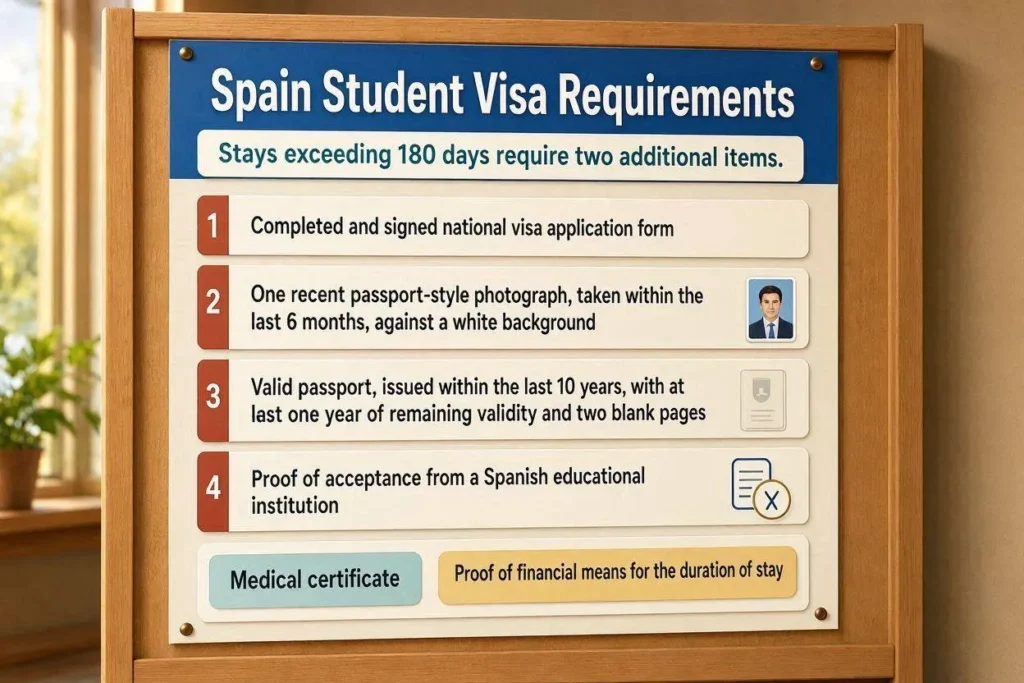
Every applicant submits a core set of documents, and stays exceeding 180 days require two additional items.
Core documents for all student visa applicants:
- Completed and signed national visa application form
- One recent passport-style photograph, taken within the last 6 months, against a white background
- Valid passport, issued within the last 10 years, with at least one year of remaining validity and two blank pages
- Proof of acceptance from an accredited Spanish institution, stating program dates and weekly hours (a minimum of 20 hours per week for full-time study)
- Proof of payment or exemption for enrollment fees
- Proof of financial means, calculated using Spain’s Public Multiple Effects Income Indicator (IPREM) or a fixed monthly minimum set by the applicant’s consulate
- Health insurance from a provider authorized to operate in Spain, with no deductible, no copayment, and a minimum coverage of 30,000 euros ($33,000 USD, based on July 2026 exchange rates)
- Medical certificate confirming freedom from diseases with serious public health implications, issued within 90 days of application
- Proof of legal residence in the applicant’s country of application, for applicants who are not citizens of that country
Additional documents for stays longer than 180 days:
- Criminal record certificate from every country of residence over the past 5 years, apostilled and translated into Spanish by a certified translator
- Foreigner Identity Card (TIE) application, filed within 30 days of arrival in Spain
Financial proof requirements differ by consulate. The Los Angeles consulate sets a minimum of 600 USD per month for applicants traveling alone, while the Houston BLS visa center sets a minimum of 700 USD per month for the same category. Applicants should confirm the exact figure with the consulate assigned to their state or province before submitting bank statements, since the numbers change annually and vary by jurisdiction.
Before booking an appointment, confirm the exact document list with your assigned consulate. Requirements shift year to year and differ between consulates even within the same country, so a checklist built from one consulate’s website may omit a document another consulate requires.
Spain Student Visa Cost by Nationality
Visa fees vary substantially by nationality due to reciprocity agreements between Spain and the applicant’s home country.
| Nationality | Visa Fee (Stays Under 180 Days) | Visa Fee (Stays Over 180 Days) |
| United States | $160 USD | $160 USD |
| United Kingdom | $106 USD | $462 USD |
| Canada | approximately $109 USD (95 euros) | approximately $109 USD |
| Australia | $472 USD | $472 USD |
| Most other nationalities | $106 USD | $106 USD |
BLS International, the visa outsourcing company that processes applications on behalf of several Spanish consulates in the United States, adds a separate service fee of $20 USD per applicant, plus a $5 USD notification fee for SMS updates. These service fees apply in addition to the consulate’s visa fee and are non-refundable, regardless of whether the consulate approves or denies the application.
Spain Student Visa Processing Time
Spain’s student visa takes approximately 1 month to process from the date of a complete application submission. The Spanish government sets this timeline by law, though consulates extend it when they request an interview or additional documents. Applicants should submit their application between 2 and 6 months before their program start date, and no later than 2 months before that date, since Royal Decree 1155/2024, Article 36, requires the 2-month minimum window for all student visa applications.
Applicants who submit fewer than 2 months before their program start date risk denial or delayed approval that pushes their arrival past the program’s start.
How to Apply for a Spain Student Visa
Applicants apply for a Spain student visa in five steps, starting with admission and ending with visa collection.
- Secure admission to a Spanish institution recognized by a public administration, then request an official acceptance letter that states program dates and weekly hours.
- Gather all required documents, including the completed application form, passport, financial proof, health insurance, and medical certificate.
- Book an appointment at the Spanish consulate or BLS visa center assigned to your jurisdiction, since most locations require appointments booked weeks in advance.
- Submit the application in person, along with the visa fee, at the scheduled appointment. A parent or legal guardian must sign the application and attend on behalf of an applicant under 18.
- Collect the visa in person once the consulate issues a decision, typically within 1 month of submission.
Applicants should not purchase travel tickets until the consulate approves the visa, since consulates deny a portion of applications and cannot refund the visa fee regardless of the outcome.
After You Arrive: Padrón Municipal and TIE (Tarjeta de Identidad de Extranjero)
Two administrative steps follow visa approval and entry into Spain: registering with the Padrón Municipal and applying for the Foreigner Identity Card.
The Padrón Municipal is a local town hall registry that confirms an applicant’s address in Spain. Registration typically happens within the first few weeks of arrival and supports several other procedures, including the TIE application.
The Foreigner Identity Card, known as the TIE, is the physical identification document required for stays exceeding 6 months. Applicants must apply for the TIE within 30 days of entering Spain at the Foreigners’ Office or police station in the province where their visa was processed. The application requires the passport, visa, a passport-style photograph, and proof of address from the Padrón registration. The TIE costs approximately 15 euros ($16 USD) per year and remains valid for the duration of the study program, subject to annual renewal for multi-year programs.
Applicants on a short-term visa, covering stays of 6 months or fewer, do not need a TIE, since the visa itself serves as proof of legal stay for the full duration.
Can You Work in Spain on a Student Visa
Yes. Spain permits international students to work up to 30 hours per week while holding a valid student visa, in roles unrelated to their field of study. This work cannot serve as the applicant’s primary source of income and does not count toward the financial means requirement for visa renewal. Students who plan to rely on part-time income to cover living costs should confirm with the Foreigners’ Office that their specific work arrangement qualifies, since renewal decisions weigh financial stability independently of employment income.
Common Reasons Spain Student Visa Applications Get Denied
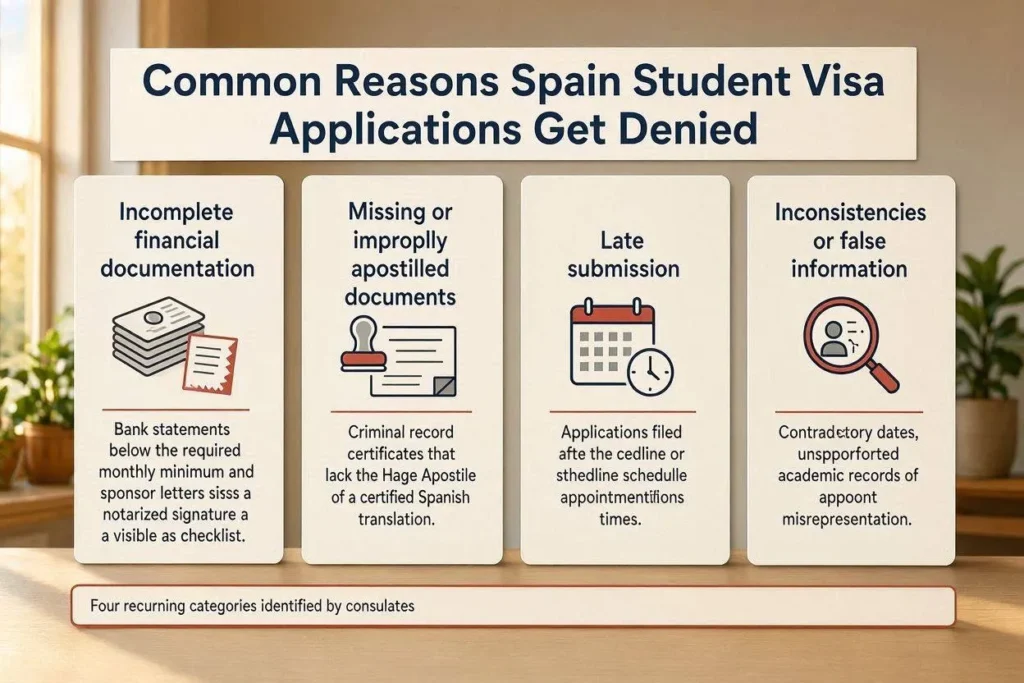
Consulates deny applications for reasons that fall into four recurring categories.
- Incomplete financial documentation, including bank statements that fall below the required monthly minimum or sponsor letters missing a notarized signature
- Missing or improperly apostilled documents, particularly criminal record certificates that lack the Hague Apostille or a certified Spanish translation
- Late submission, when an applicant files fewer than 2 months before the program start date, in violation of Article 36 of Royal Decree 1155/2024
- Insufficient health insurance coverage, when the policy includes a deductible, copayment, or coverage below 30,000 euros ($33,000 USD)
Applicants who receive a denial can file an appeal for reconsideration with the same consulate within 1 month of the decision, or pursue a judicial appeal with the High Court of Justice of Madrid within 2 months of the decision. A written explanation of the grounds for denial accompanies every refusal, and this document forms the basis for either appeal route.
Spain Student Visa vs. Digital Nomad Visa
A student visa and a digital nomad visa serve different purposes and cannot substitute for each other. The student visa authorizes enrollment in an accredited academic program and permits limited part-time work unrelated to that program. The digital nomad visa authorizes remote work for a non-Spanish employer or freelance clients outside Spain and does not require academic enrollment.
Applicants who plan to study full-time in Spain need the student visa, while applicants who plan to work remotely without enrolling in a program need the digital nomad visa. Combining both activities, such as full-time study alongside full-time remote employment, falls outside the scope of either visa category and requires a separate consultation with the consulate about which authorization applies.
Consulate Jurisdiction by Country
Spain assigns each applicant to a specific consulate based on their country of residence, and submitting an application to the wrong consulate results in rejection.
United States jurisdictions include:
- Los Angeles: Southern California, Arizona, Colorado, and Utah
- Chicago: Illinois, Indiana, Iowa, Kansas, Kentucky, Michigan, Minnesota, Missouri, Nebraska, North Dakota, Ohio, South Dakota, and Wisconsin
- Houston: Alabama, Arkansas, Louisiana, Mississippi, Tennessee, New Mexico, Oklahoma, and Texas
United Kingdom applicants submit through the Spanish Consulate General in London, Manchester, or Edinburgh, depending on region of residence.
Canadian applicants submit through the Spanish consulates in Toronto or Montreal, or the embassy in Ottawa, depending on province.
Australian applicants submit through the Spanish Consulate General in Sydney, which processes applications for all Australian states and territories.
Asian applicants submit through the Spanish consulate or embassy in their country of residence, and specific document requirements vary by location, since consulates in Asia often require additional proof of ties to the home country.
Applicants should confirm their assigned consulate on the Spanish Ministry of Foreign Affairs website before booking an appointment, since submitting an application outside the correct jurisdiction leads to automatic rejection regardless of document completeness.
Start Your Application With Confidence
A Spain student visa application succeeds when the applicant submits complete, correctly apostilled documents at least 2 months before their program start date, through the consulate assigned to their jurisdiction. Confirm the exact fee, financial minimum, and document checklist with your specific consulate, since these figures change annually and vary by location. Start gathering documents as soon as you receive your acceptance letter, and build in extra time for apostille processing, translation, and appointment availability.
FAQs

Michael Reynolds
Michael Reynolds leads ImmigrationWin’s immigration, visa, and global mobility content division. He specializes in researching immigration policies, visa requirements, application processes, and international relocation pathways for individuals, families, students, and professionals. With extensive experience analyzing immigration regulations and official government guidance, Michael brings a research-driven approach to complex immigration topics and changing visa policies. He is the primary author of ImmigrationWin’s visa guides, immigration resources, and country-specific content, helping readers better understand their options and make informed decisions about their international journey.
Related Posts