

US Golden Visa 2026: EB-5 & Gold Card Guide
The US golden visa gives foreign investors a direct path to US permanent residency through 2 programs: the EB-5 Immigrant Investor Program and the new Gold Card Program. Both programs lead to a Green Card — but they differ in cost, requirements, and timelines.
This guide explains each program’s requirements, application steps, processing timelines, and family inclusion rules — so you choose the right path for your investment goals.
What Is the US Golden Visa in 2026?
The US golden visa is not an official government term. It refers to any US residency-by-investment pathway that grants a Green Card — specifically the EB-5 program and the 2026 Gold Card Program.
Unlike a temporary work visa, a Green Card gives you lawful permanent resident (LPR) status. As an LPR, you live and work anywhere in the United States without employer sponsorship. You can also apply for US citizenship after 5 years of continuous residence.
The US Citizenship and Immigration Services (USCIS) administers both programs. USCIS operates under the Department of Homeland Security (DHS). Both pathways require a background check, a source-of-funds review, and a qualifying financial commitment.
To understand which program your investment budget qualifies for, review the business immigration services available through ImmigrationWin.
2 Programs That Act as a US Golden Visa
EB-5 Immigrant Investor Program
Congress created the EB-5 program in 1990 to channel international investment into the US economy. The program has granted Green Cards to thousands of investors and their families every year since 1992.
Under EB-5, you invest in a qualifying US commercial enterprise that creates at least 10 full-time jobs for US workers. USCIS processes the petition in 2 stages: the I-526E petition to prove your investment, and the I-829 petition to confirm job creation after 2 years.
EB-5 offers 2 investment routes:
- Regional Center investment: a professionally managed project in a USCIS-approved Regional Center — minimum $800,000 in a Targeted Employment Area (TEA)
- Direct investment: you invest directly into your own US business — minimum $1,050,000 outside a TEA or $800,000 inside a TEA
A Targeted Employment Area (TEA) is a rural area or an urban zone with unemployment at least 150% of the national average. TEA-designated projects qualify for the lower $800,000 threshold. Most investors choose Regional Center projects because the center manages job creation on their behalf.
Gold Card Program
The US government launched the Gold Card Program in 2026. The Gold Card grants lawful permanent residency through a direct financial contribution to the US government — not through a commercial investment in a business.
Gold Card requirements include a $15,000 non-refundable application fee paid upfront, followed by a $1,000,000 contribution to the US government upon approval. A corporate sponsorship tier exists at $2,000,000 per employee sponsored.
The Gold Card does not require you to create jobs, manage an investment, or work with a Regional Center. USCIS performs comprehensive background and security checks on all applicants.
Because the Gold Card launched in 2026, regulatory procedures remain subject to policy updates. Applicants should monitor USCIS guidance at uscis.gov throughout the application process.
US Golden Visa Requirements by Program
EB-5 Requirements

To qualify for the EB-5 program, you must meet 4 core requirements:
- Invest the minimum required capital — $800,000 in a TEA or $1,050,000 outside a TEA
- Prove the investment came from a lawful source — employment income, business sale, inheritance, or real estate proceeds
- Place the investment in a qualifying New Commercial Enterprise (NCE) incorporated after November 29, 1990, or a troubled business with 100+ existing employees
- Show that your investment creates or preserves 10 full-time jobs for qualifying US workers
USCIS does not require you to hold any specific education level, speak English, or have prior business experience. You do not need to be physically present in the US when you file your I-526E petition.
Source-of-funds documentation is the most scrutinized part of the EB-5 application. You must trace every dollar of the investment from its original source to the NCE account. Bank statements, tax returns, business ownership records, and wire transfer confirmations all form part of a complete source-of-funds package.
Gold Card Requirements
To qualify for the Gold Card, you must meet 3 requirements:
- Pay a $15,000 non-refundable application fee at the time of filing
- Contribute $1,000,000 to the US government upon approval — this amount is not returned
- Pass comprehensive USCIS background and security checks — criminal history, financial fraud, and national security reviews
The Gold Card has no job creation requirement and no minimum education level. USCIS does not require you to manage a business or report investment outcomes after you receive your Green Card.
How to Apply for the US Golden Visa Step by Step
To apply for the US golden visa through the EB-5 program, follow these 6 steps:
Step 1: Select a Regional Center project or direct investment target.
Research USCIS-approved Regional Centers at uscis.gov. Review each center’s track record, prior USCIS approvals, job creation history, and capital structure. For direct investment, identify the New Commercial Enterprise and confirm TEA designation.
Step 2: Transfer the investment capital.
Move funds to the NCE’s escrow or capital account. Document every step of the transfer chain. Your source-of-funds file must trace the capital from its origin to its final destination.
Step 3: File Form I-526E with USCIS.
Form I-526E is the Immigrant Petition by Regional Center Investor. It includes your investment documentation, source-of-funds evidence, and your personal background information. The filing fee is $11,160 as of 2026.
Step 4: Apply for an immigrant visa or adjustment of status.
If you are outside the US, apply for an EB-5 immigrant visa at a US Embassy or Consulate. If you are inside the US on a valid visa, you can file Form I-485 (adjustment of status) concurrently with your I-526E petition in many cases — a process USCIS calls concurrent filing.
Step 5: Receive your conditional Green Card.
USCIS grants a 2-year conditional permanent residency. Your spouse and unmarried children under 21 receive conditional Green Cards on the same petition.
Step 6: File Form I-829 to remove conditions.
Within the 90-day window before your conditional Green Card expires, file Form I-829 with evidence that your investment created 10 full-time US jobs. USCIS reviews the job creation data and removes the conditions, converting your status to full permanent residency.
To apply through the Gold Card program, file the Gold Card application with the $15,000 fee, pass the security check, and pay the $1,000,000 contribution upon approval. USCIS then issues your Green Card directly — no job creation filing is required.
Our team handles both application types. Explore our investor & entrepreneur visas service to discuss your options with a certified consultant.
US Golden Visa Processing Timeline
Processing time for the US golden visa varies significantly by program and applicant nationality.
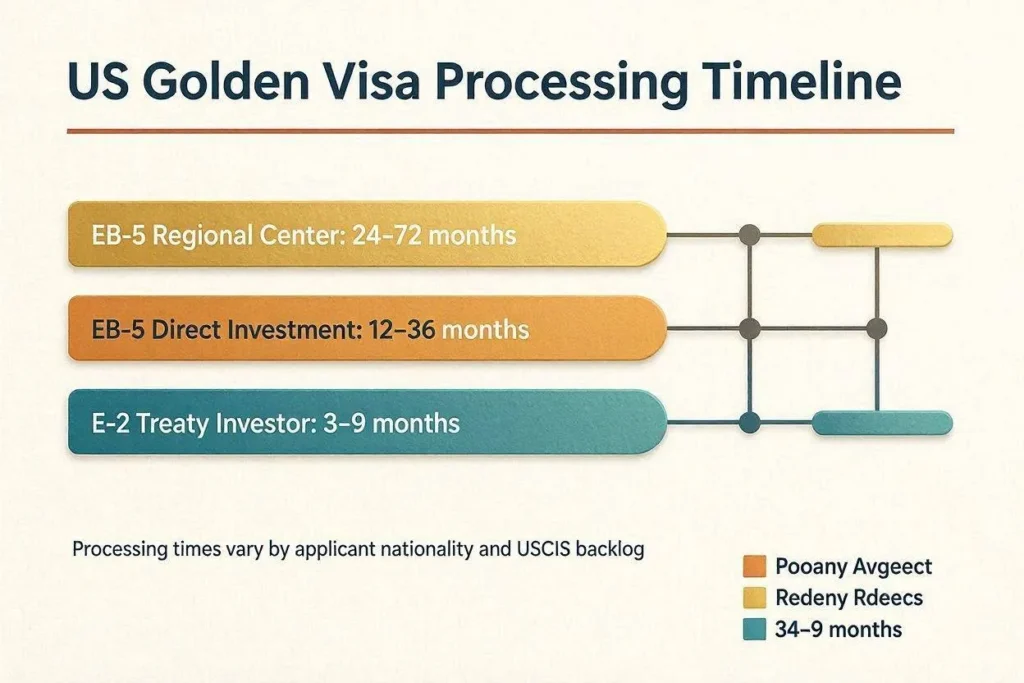
| Stage | EB-5 (TEA / Regional Center) | Gold Card | Difficulty |
|---|---|---|---|
| Capital transfer & due diligence | 4–8 weeks | Not required | Medium |
| I-526E petition (USCIS) | 18–36 months | Not applicable | High |
| Immigrant visa / I-485 filing | 2–6 months | Processed together | Medium |
| Conditional Green Card issued | Months 20–40 total | 3–6 months total | Low |
| I-829 petition (remove conditions) | 24 months after Green Card | Not required | Medium |
| Full permanent residency | 4–6 years total | 6–12 months total | Low |
| Citizenship eligibility | Year 5 of LPR status | Year 5 of LPR status | Medium |
Chinese nationals face a visa backlog in the EB-5 unreserved category due to high demand. USCIS created 3 reserved visa categories — rural, high unemployment, and infrastructure — that remain current for all nationalities including Chinese investors. Applying through a TEA-designated rural or high-unemployment project reduces or eliminates backlog wait times.
Investors from the UAE, Saudi Arabia, Qatar, India, and most other countries face no EB-5 backlog in the unreserved category as of 2026.
What Your Family Gets Under the US Golden Visa
Both the EB-5 program and the Gold Card extend Green Card status to your immediate family members on a single petition. No separate investment is required for dependents.
EB-5 and Gold Card family inclusion covers 2 categories of dependents:
- Your legally married spouse — receives a derivative Green Card linked to your principal petition
- Your unmarried children under 21 — each receives a derivative Green Card on the same petition
Family members receive the same conditional or permanent residency status as the principal applicant. They gain the right to live, work, and study anywhere in the United States. Children under 21 on the petition age-protected during processing — USCIS counts their age at the time you file the I-526E petition, not at the time of approval.
Neither program covers parents, adult children, siblings, or unmarried partners. These family members must qualify for US residency through separate immigration pathways.
Gold Card vs EB-5: Which US Golden Visa Fits You?
| Feature | Gold Card 2026 | EB-5 (TEA Route) |
|---|---|---|
| Minimum cost | $1,015,000 ($1M contribution + $15K fee) | $800,000 investment + ~$50–70K fees |
| Capital returned? | No — non-refundable contribution | Yes — investment may be returned after I-829 |
| Job creation required? | No | Yes — 10 full-time US jobs |
| Processing time | 3–6 months | 4–6 years (backlog-free countries) |
| Business management required? | No | No (Regional Center handles it) |
| Program stability | New — policy changes possible | Established since 1990 |
| Pathway to citizenship? | Yes — 5 years after Green Card | Yes — 5 years after full Green Card |
| Best for | Speed + simplicity | Capital recovery + structured investment |
Choose the Gold Card if speed matters more than capital recovery and you have $1,000,000 available as a non-refundable contribution. The Gold Card delivers a Green Card in 3–6 months — the fastest investor-based residency pathway in US history.
Choose EB-5 if you want your capital returned after the I-829 approval, prefer a 34-year-old established program with predictable USCIS adjudication, and have 18–36 months of patience for the I-526E stage.
Both programs lead to the same outcome: full US permanent residency and a 5-year pathway to citizenship.
5 Things US Golden Visa Guides Don’t Tell You
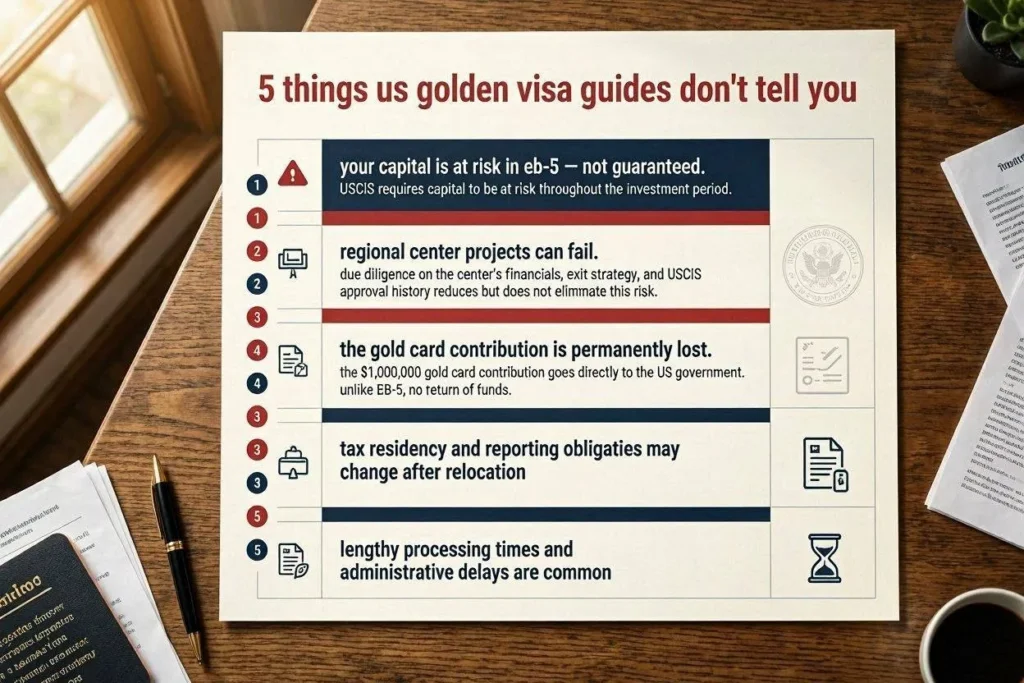
- Your capital is at risk in EB-5 — not guaranteed.
USCIS requires capital to be “at risk” throughout the investment period. Regional Center projects can fail. Due diligence on the center’s financials, exit strategy, and USCIS approval history reduces — but does not eliminate — this risk.
- The Gold Card contribution is permanently lost.
The $1,000,000 Gold Card contribution goes directly to the US government. Unlike EB-5, no return of capital is possible. Factor this into your total immigration cost comparison.
- Citizenship timeline starts from your Green Card issue date — not your investment date.
You become eligible for naturalization 5 years after USCIS issues your first Green Card. EB-5 applicants with 4–6-year processing timelines do not start the citizenship clock until they receive their conditional Green Card.
- US tax obligations begin the moment you become an LPR.
The US taxes lawful permanent residents on worldwide income. From the day you receive your Green Card — whether Gold Card or EB-5 — you must file US federal and state tax returns. Consult a US tax attorney before activating your residency.
- Concurrent EB-5 filing can shorten your wait inside the US.
If you already hold a valid US visa, you can file Form I-485 alongside your I-526E petition. This concurrent filing keeps you in legal status while USCIS processes both forms simultaneously — cutting out the immigrant visa stage entirely.
Start Your US Golden Visa Application
The US golden visa offers 2 proven paths to permanent US residency in 2026 — the EB-5 program from $800,000 and the Gold Card at $1,000,000. Your choice depends on how quickly you need your Green Card, whether you want capital recovery, and how much management involvement you prefer.
ImmigrationWin’s certified consultants have processed over 5,000 investor immigration cases with a 98% approval rate. Contact Us today at https://immigrationwin.com/contact-us/ to book your free consultation and get a personalized assessment of your eligibility for both programs.
Frequently Asked Questions

Michael Reynolds
Michael Reynolds leads ImmigrationWin’s immigration, visa, and global mobility content division. He specializes in researching immigration policies, visa requirements, application processes, and international relocation pathways for individuals, families, students, and professionals. With extensive experience analyzing immigration regulations and official government guidance, Michael brings a research-driven approach to complex immigration topics and changing visa policies. He is the primary author of ImmigrationWin’s visa guides, immigration resources, and country-specific content, helping readers better understand their options and make informed decisions about their international journey.
Related Posts