
What Is a Golden Visa? 2026 Complete Guide, Top Countries
A golden visa is a government-issued residence permit granted to foreign investors who make a qualifying investment in a country’s economy. Programs exist across Europe, the Middle East, and beyond. Minimum investments range from €50,000 (15,000 AED/~$54,000 USD) in Latvia to over $10 million in Singapore.
In 2026, more than 20 countries offer active golden visa programs. Each program differs by investment type, processing time, stay requirement, and pathway to permanent residency or citizenship. This guide covers all of it — from the definition and 5 core benefits to the 8 top programs, 4 investment routes, and a 6-step application process.
Before choosing a program, explore our immigration services to see how ImmigrationWin guides investors from program selection through approval.
What Is a Golden Visa and Who Created It?
Portugal launched the first modern golden visa program in October 2012 to attract foreign capital during an economic downturn. The term “golden visa” refers to a residence permit earned through a significant financial contribution — not through employment or family ties.

Countries offer these programs to stimulate economic growth, attract real estate investment, create jobs, and fund arts or science projects. In return, investors receive legal residency rights, family inclusion, and in many cases a path to a second passport.
A golden visa is not citizenship by investment (CBI). CBI programs grant a passport immediately upon investment. A golden visa grants a residence permit first; citizenship only becomes possible after a qualifying residency period — typically 5 to 10 years, depending on the country.
5 Key Benefits of a Golden Visa in 2026
1. Legal Residency Without Full Relocation
Most golden visa programs carry zero or minimal stay requirements. Greece, Malta, Portugal, Italy, Latvia, Hungary, and Panama all allow investors to hold residency without living in the host country full-time. You keep your current job, tax residency, and home while maintaining a legal right to live abroad.
2. Schengen Zone Access for EU Programs
EU golden visa holders in Portugal, Greece, Italy, Latvia, Hungary, and Cyprus gain visa-free travel across all 29 Schengen Area countries. A single EU residence permit replaces the need for separate short-stay visas when visiting Germany, France, or any other Schengen member.
3. Family Inclusion in 1 Application
Every major golden visa program covers immediate family members — spouse and dependent children — under a single application. Malta extends this to 5 generations, including parents and grandparents. Family members receive the same residency rights as the main applicant with no additional investment required.
2 additional benefits worth noting:
- Tax advantages: Malta, Cyprus, Greece, and Italy offer flat-tax regimes or territorial tax structures that reduce the burden on foreign income for new residents.
- Plan B security: A golden visa provides a ready-made legal pathway to relocate if political or economic conditions in your home country change rapidly.
8 Best Golden Visa Programs: Quick-Reference Comparison Table for 2026
Use this table to compare the 8 most active programs by investment threshold, processing time, stay requirement, and citizenship timeline.
| Country | Min. Investment | Processing Time | Stay Required | Perm. Residency | Citizenship Path |
|---|---|---|---|---|---|
| Greece | €250,000 | 4 months | None | 5 years | 7 years |
| Portugal | €250,000 | 18–24 months | 7 days/year | 5 years | 10 years |
| UAE | AED 500K | 1–8 weeks | None | N/A | N/A |
| Malta | €53,000+ | Up to 12 mo | None | Immediate | 10–15 years |
| Latvia | €50,000 | 2–3 months | None | 5 years | 10 years |
| Italy | €250,000 | 3–4 months | None | 5 years | 10 years |
| Hungary | €250,000 | 3 months | None | Yes | 8 years |
| Cyprus | €300,000 | 2–4 months | Once/2 years | Immediate | 7 years |
Top 3 Golden Visa Programs Explained in Depth for 2026

Greece: Best for Real Estate Investment and Fast Processing
Greece remains the most popular EU golden visa in 2026. Minimum investment starts at €250,000 ($275,000 / 917,000 AED) for commercial real estate or heritage building restoration. High-demand zones — including Athens, Thessaloniki, Mykonos, and Santorini — now require €800,000 ($880,000). Processing takes approximately 4 months, one of the fastest timelines in Europe.
Greece has no minimum stay requirement. After 5 years of residency, you can apply for permanent residency. Greek citizenship requires 7 years of lawful residence. Greece also offers a flat 7% tax on foreign pension income and a €100,000 annual flat tax on worldwide foreign income for high-net-worth individuals.
Portugal: Best for Low Stay Requirements and Fund Investment
Portugal’s golden visa requires only 7 days of physical presence per year — the lowest stay threshold in Europe. Real estate no longer qualifies as of 2023. Active routes include a €500,000 fund investment, a €250,000 cultural donation, a €500,000 science contribution, or company formation creating 5 full-time jobs.
Permanent residency is available after 5 years. The 2026 nationality reform extended citizenship eligibility to 10 years for most applicants. A Portuguese passport grants visa-free access to over 185 countries and the right to live and work across all EU member states.
UAE: Best for Tax Efficiency and Business Flexibility
The UAE Golden Visa grants a 10-year self-sponsored residency with no employer required. Qualifying routes include a AED 2,000,000 ($545,000) real estate investment, AED 2,000,000 in a UAE-accredited investment fund, or company formation with AED 2,000,000 in capital. Processing takes 1 to 8 weeks.
The UAE charges no personal income tax, no capital gains tax, and no inheritance tax. VAT stands at 5% and corporate tax at 9% above AED 375,000 (~$102,000). Golden visa holders can sponsor a spouse, children, parents, and domestic staff.
Who Qualifies for a Golden Visa in 2026?
Eligibility criteria vary by country, but these 5 requirements apply to nearly every program:
- Age: Applicants must be 18 years or older.
- Criminal record: A clean criminal record certificate from your country of residence is required.
- Legal source of funds: You must prove the investment capital came from a legitimate source — salary, business income, property sale, or inheritance.
- Health insurance: Most programs require private health coverage valid in the host country.
- Investment completion: The qualifying investment must be made and legally registered before residency is granted.
3 investor profiles that apply most frequently:
- Business owners and entrepreneurs: Seeking second residency for asset diversification and international business access.
- Families with children: Prioritizing EU education rights, healthcare access, and long-term citizenship for the next generation.
- Retirees and remote workers: Choosing programs with no stay requirements and favorable tax regimes on foreign pension or passive income.
4 Investment Routes Available in Most Golden Visa Programs
Investment type determines cost, risk, and return potential. Choose from these 4 primary routes:
- Real estate: Purchase residential or commercial property. Greece, UAE, Latvia, and Cyprus still accept real estate. Portugal removed this option in 2023. Typical threshold: €250,000–€800,000 ($275,000–$880,000).
- Investment funds: Channel capital into government-approved private equity or venture funds. Portugal’s fund route starts at €500,000 ($550,000). Hungary’s fund route starts at €250,000 ($275,000).
- Government bonds or bank deposits: Lend money to the state at a fixed return. Latvia accepts a €250,000 (~$275,000) bank deposit. Risk is low since the state backs the investment.
- Business or job creation: Form a company or invest in an existing business while creating a defined number of full-time local jobs. Portugal requires 5 jobs; the USA’s EB-5 visa requires 10 jobs.
Investors considering investment migration across multiple countries should also review Canada visa types for employer-sponsored and investor routes available in North America.
How to Apply for a Golden Visa in 2026: 6 Steps
To apply for a golden visa, follow these 6 steps in order:
Step 1: Compare Programs and Choose a Country
To compare programs, use the table above and weigh investment cost, processing time, stay requirement, tax regime, and citizenship timeline. Your choice should match your primary goal — residency only, tax optimization, education access, or a long-term citizenship pathway.
Step 2: Choose Your Investment Route
To select your investment route, match it to your risk tolerance and objectives. Real estate provides a tangible asset; funds offer passive management; bonds carry state-backed low risk; business investment requires operational involvement.
Step 3: Prepare Your Documents
To prepare documents, gather a valid passport, proof of address, criminal record certificate, health insurance policy, and full financial documentation proving the legal source of funds. Documents may require translation, apostille stamps, or embassy attestation depending on the target country.
Step 4: Submit Your Application
To submit your application, file it with the relevant government authority — the immigration ministry or investment authority of the host country. Most programs now accept digital submissions. Biometric appointments may still require a physical visit.
Step 5: Complete Due Diligence
To clear due diligence, provide all source-of-wealth documentation requested. Governments conduct background checks covering criminal history, financial standing, and beneficial ownership of assets. This stage typically takes 4–8 weeks.
Step 6: Receive Your Residence Permit and Renew
To maintain your golden visa status, keep the qualifying investment in place, meet stay requirements (if any), and file renewal documents before the permit expires. Permit validity ranges from 1 year (Montenegro) to 10 years (UAE, Hungary).
What Does a Golden Visa Cost in 2026?
Total golden visa costs include the minimum investment plus government fees, legal fees, due diligence charges, and healthcare costs. Government fees alone range from €2,000 to over €30,000 depending on the country and program.
3 cost tiers to consider:
- Budget tier (€50,000–€300,000 / $54,000–$330,000): Latvia, Montenegro, Panama, and Brazil offer the lowest entry points. These suit investors primarily seeking a residence permit rather than an EU passport.
- Mid-range tier (€250,000–€500,000 / $275,000–$550,000): Greece, Portugal, Italy, Hungary, and Cyprus fall here. These programs offer EU residency with strong citizenship pathways.
- Premium tier (€500,000+ / $550,000+): Malta, Luxembourg, Singapore, and UAE premium routes target high-net-worth investors seeking immediate permanent residency or programs with the strongest passport benefits.
Important: If you sell the qualifying investment before your permit expires, your residence permit gets revoked in most programs. Greece, Portugal, and Cyprus all enforce this rule. Buy a replacement investment before selling to avoid a gap in residency status.
3 Risks to Know Before Applying for a Golden Visa
Competitors rarely discuss these 3 risk factors:
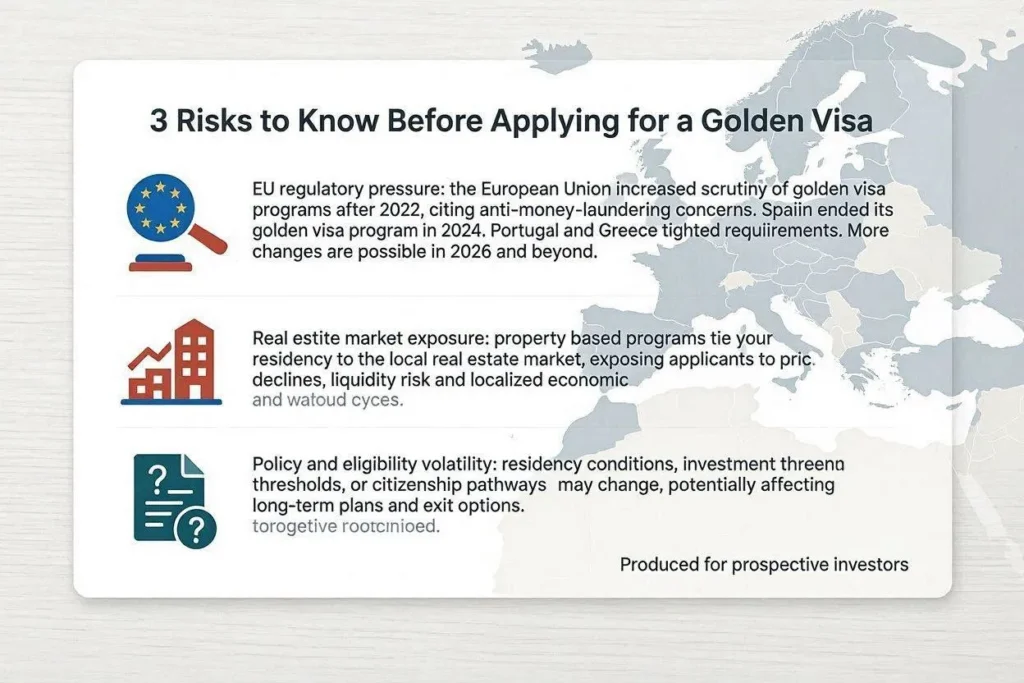
- EU regulatory pressure: The European Union increased scrutiny of golden visa programs after 2022, citing anti-money-laundering concerns. Spain ended its golden visa program in 2024. Portugal and Greece tightened requirements. More changes are possible in 2026 and beyond.
- Real estate market exposure: Property-based programs tie your residency to the local real estate market. A fall in property values below the qualifying threshold in some programs can trigger permit issues at renewal.
- Processing delays: Published timelines are estimates. Portugal’s current biometric appointment backlog runs approximately 12 months. Budget extra time before your planned move or travel date.
Start Your Golden Visa Application with ImmigrationWin
Choosing the right golden visa program depends on your investment budget, family size, tax goals, and long-term citizenship plans. ImmigrationWin’s certified consultants compare all active programs for your profile and guide you through every document, due diligence check, and government submission.
With a 98% approval rate across more than 5,000 cases, ImmigrationWin handles golden visa applications for Portugal, Greece, UAE, Malta, and 10+ other countries. Book a free consultation today and get a personalized program recommendation within 48 hours.
Frequently Asked Questions

Michael Reynolds
Michael Reynolds leads ImmigrationWin’s immigration, visa, and global mobility content division. He specializes in researching immigration policies, visa requirements, application processes, and international relocation pathways for individuals, families, students, and professionals. With extensive experience analyzing immigration regulations and official government guidance, Michael brings a research-driven approach to complex immigration topics and changing visa policies. He is the primary author of ImmigrationWin’s visa guides, immigration resources, and country-specific content, helping readers better understand their options and make informed decisions about their international journey.
Related Posts