Malta Student Visa 2026: Requirements, Fees, Documents & Process
Non-EU, non-EEA, and non-Swiss citizens need a Malta student visa to study in Malta for longer than 90 days. EU, EEA, and Swiss citizens skip the visa entirely. They only register with Identity Malta if their course runs beyond three months. Everyone else applies for a National Type D Long-Stay Visa before departure. After landing, that visa converts into a residence permit.
Malta draws students from India, Nigeria, Pakistan, the Philippines, the Gulf states, and Southeast Asia for one straightforward reason: tuition and living costs sit 30 to 40 percent below Switzerland, the UK, and Scandinavia. Degrees still carry full European Union recognition. Higher education in Malta runs almost entirely in English. Schengen membership adds another advantage — a Type D visa holder can travel visa-free across 29 European countries for 90 days within any 180-day period.
This guide covers eligibility, documents, financial thresholds, fees, timelines, and post-graduation options for the 2026 intake. Figures come from Identity Malta, the European Commission’s immigration portal, and current institutional data.
Do You Need a Malta Student Visa?
Yes, if the applicant holds a passport from outside the EU, EEA, or Switzerland and plans to study in Malta for more than 90 days. Malta splits international students into two administrative tracks. Citizenship determines which one applies.
EU, EEA, and Swiss nationals enter Malta on a passport or national identity card. No visa application, embassy appointment, or biometric submission applies to this group. Students staying beyond three months register an eResidence document through Identity Malta as part of exercising free movement rights — nothing more.
Non-EU/EEA students from India, China, Nigeria, the Philippines, Pakistan, the Middle East, and most of Asia, Africa, and the Americas need a National Long-Stay (D) visa. A Maltese embassy, consulate, or authorized visa center issues it before travel. Think of the Type D visa as the entry ticket. The residence permit issued after arrival is what legalizes the stay for the full course duration.
Short courses under 90 days follow a different rule entirely. A Schengen Type C visa covers summer schools, foundation programs, and short certificate courses. This visa skips the residence permit step that longer programs require.
Types of Malta Student Visas: Type C vs Type D
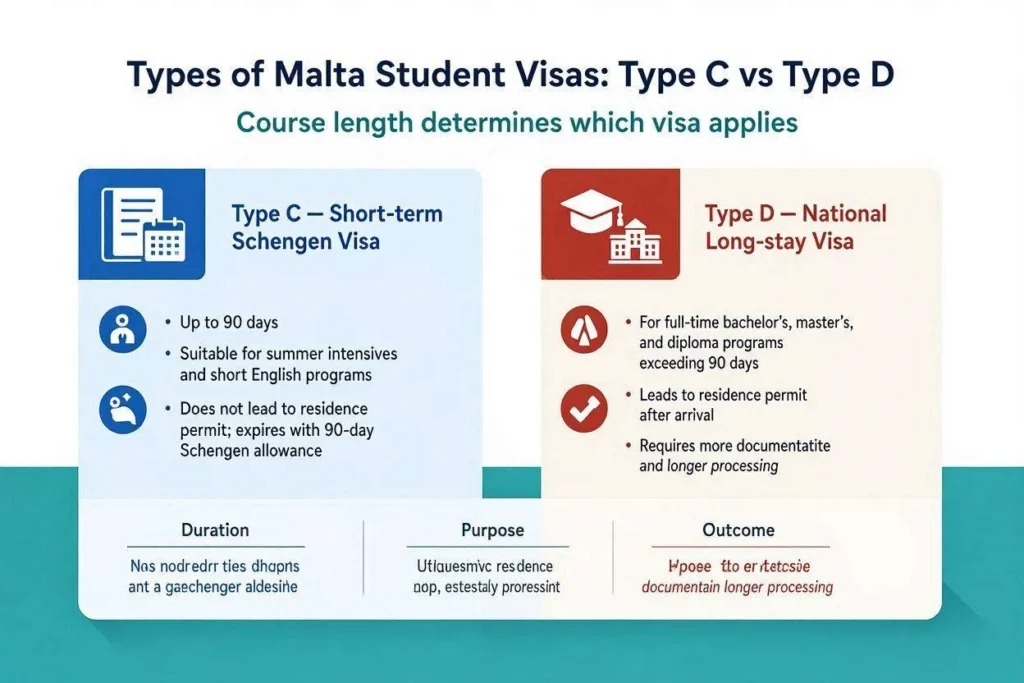
Malta issues two visa categories for international students. Course length determines which one applies.
The Schengen Type C visa covers courses lasting up to 90 days — summer intensives, short English-language programs, pre-sessional courses. It does not lead to a residence permit and expires when the 90-day Schengen allowance runs out.
The National Type D visa covers full-time bachelor’s, master’s, and diploma programs exceeding 90 days. Identity Malta issues it for up to 365 days, renewable annually for the course duration. Anyone pursuing a full undergraduate or postgraduate degree in Malta needs this visa, not the Type C.
| Feature | Type C Visa | Type D Visa |
| Course length | Up to 90 days | Over 90 days |
| Validity | 90 days within 180 days | Up to 365 days, renewable |
| Leads to residence permit | No | Yes |
| Typical use case | Summer school, short course | Bachelor’s, Master’s, Diploma |
Malta Student Visa Requirements
Five core conditions determine eligibility. Each needs supporting documentation at the visa appointment.
Admission to an accredited institution comes first. The institution must hold accreditation from the Malta Further and Higher Education Authority (MFHEA). Degree-track applicants need a course registered at Malta Qualifications Framework (MQF) Level 5 or above. Courses at MQF Level 1 to 4 — including English-language and foundation programs — follow a separate document set with a lower application fee.
A valid passport satisfies the travel document requirement: at least six months of validity beyond the intended stay, plus a minimum of two blank pages. Several competitor guides list eight months. Identity Malta’s own published standard is six months beyond the stay. Applicants should follow the shorter, verified figure rather than pad the requirement unnecessarily.
Proof of financial means demonstrates the ability to cover living costs without relying on Malta’s social assistance system. No single universal number exists. The practical range across verified sources runs from €700 to €1,200 per month — roughly €9,000 to €10,800 for a full academic year.
Health insurance is non-negotiable. Coverage must reach a minimum of €30,000 for medical treatment and hospitalization, valid across the entire Schengen Area. The policy stays active for the full course duration, with no coverage gaps.
Confirmed accommodation completes the eligibility set. A signed lease, university housing confirmation, or dormitory booking all work. A vague plan to “find a flat on arrival” weakens the application and raises rejection risk.
Malta Student Visa Documents Checklist
A single missing or improperly translated document causes more rejections than any other factor. The checklist below consolidates requirements from Identity Malta’s official guidance and institutional visa-support pages.
Passport and identity documents
- Valid passport with six months’ validity beyond the stay and two blank pages
- Two recent passport-sized photographs meeting Schengen photo standards
- Copy of the passport’s biographical page
Academic documents
- Original letter of acceptance from an MFHEA-accredited institution, listing course title, MQF level, tuition language, and start and end dates
- Proof of tuition fee payment (deposit or full amount, depending on institutional policy)
- Academic transcripts and certificates from prior education
- English proficiency certificate (IELTS, TOEFL, or a Secure English Language Test result) waived if prior education was conducted entirely in English
Financial documents
- Bank statements from the past three to six months showing steady funds, not a single large deposit shortly before applying
- Notarized sponsorship affidavit and the sponsor’s tax returns, if a parent or guardian funds the stay
- Scholarship award letter, if applicable
Insurance and accommodation
- Health insurance policy documentation showing €30,000 minimum Schengen-wide coverage
- Signed rental agreement, dormitory confirmation, or institutional housing letter
Other required items
- Completed and signed Type D visa application form
- Certificate of good conduct or police clearance, required by some missions
- Certified English or Maltese translations of any document in another language
- Application fee payment receipt
Financial Proof: How Much Money You Need
A non-EU applicant needs to show €9,000 to €10,800 for one academic year of living costs, separate from tuition. That works out to €700 to €1,200 monthly, depending on accommodation choice and lifestyle.
Where does the money go? Shared accommodation runs €550 to €700. Groceries and food cost €200 to €300. A monthly bus pass costs €26. Utilities — electricity and water — add €50 to €100. Internet and mobile service run €30 to €50. Health insurance costs €50 to €100. Social activities and discretionary spending add another €100 to €200.
Identity Malta accepts three forms of financial proof. First, a bank statement in the applicant’s own name covering three to six months with a stable balance. Second, a sponsor’s bank statement paired with a notarized affidavit and tax returns, when parents or guardians fund the stay. Third, a scholarship award letter from Malta’s government or from the enrolling university, which can stand on its own.
One red flag matters more than most: sudden large deposits made shortly before an application. Visa officers want to see a steady balance pattern across the full three-to-six-month window, not a lump sum that appeared two weeks before the appointment.
Health Insurance Requirements
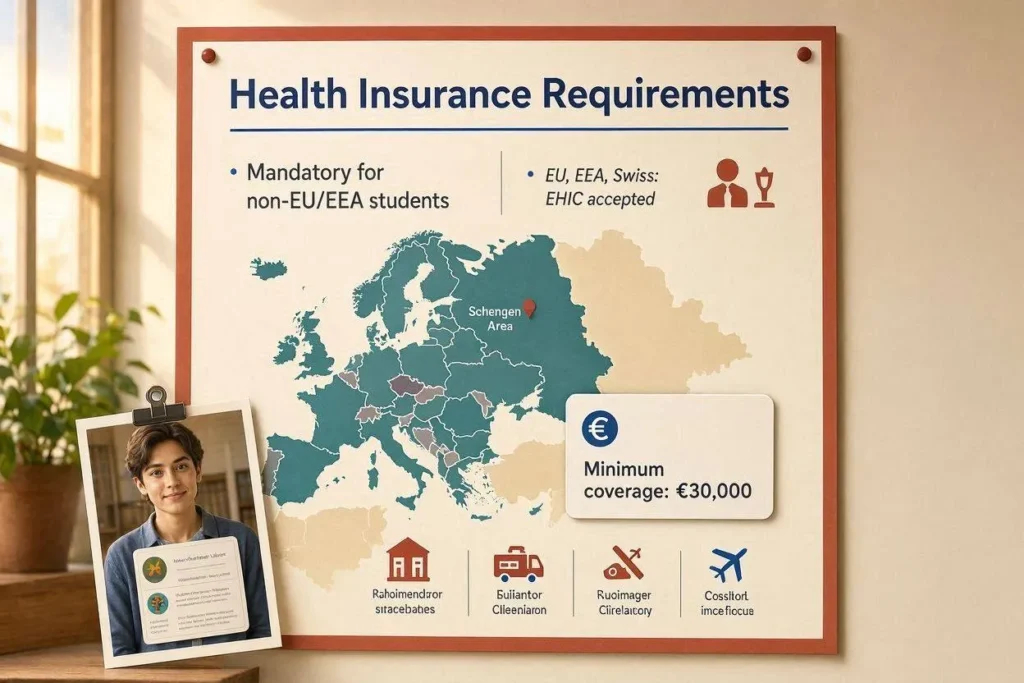
Health insurance is mandatory for every non-EU/EEA Malta student visa applicant. No exceptions exist. The policy must cover a minimum of €30,000 in medical treatment, hospitalization, and emergency repatriation, extending across the entire Schengen Area — not Malta alone.
EU, EEA, and Swiss students rely on the European Health Insurance Card (EHIC) for state healthcare access. Many buy supplemental private cover for convenience, though it stays optional for this group.
Monthly premiums for adequate non-EU student coverage range from €30 to €100, depending on provider and tier. Skip the cheapest available policy. Claims on minimal plans frequently fail because coverage falls short of the required threshold or excludes standard treatments. Look for a policy that explicitly names Malta and the Schengen Area as covered territories, with hospitalization and repatriation included.
Without valid insurance, Identity Malta rejects the application outright. A student who somehow enters Malta without adequate coverage risks fines and, in serious cases, deportation.
Step-by-Step Application Process
Twelve sequential steps carry an applicant from admission to residence card collection.
- Secure admission to an MFHEA-accredited institution and receive the official letter of acceptance.
- Gather all required documents. Allow two to four weeks for translations, notarizations, and financial proof compilation.
- Identify the nearest VFS Global center or Maltese consulate serving the applicant’s country of residence.
- Book a visa appointment online through VFS Global — ideally three to six months before the intended course start date, since January-to-May slots fill quickly.
- Attend the visa appointment with original documents and copies. The interview lasts five to ten minutes.
- Submit biometric data, including fingerprints and a photograph, at the appointment.
- Pay the visa fee at submission.
- Wait for a decision. This typically takes four to eight weeks.
- Receive the visa as a passport sticker or digital approval.
- Travel to Malta with the passport containing the approved Type D visa.
- Apply for the residence permit at an Identity Malta office within three months of arrival.
- Attend the residence permit appointment, submit biometrics again, and collect the physical residence card five to six weeks later.
Start the process three to six months before the intended intake. Work backward from the course start date, not forward from today. An autumn intake needs applications submitted around June or July. A January intake needs the process starting in October or November.
Malta Student Visa Processing Time and Fees
| Phase | Timeline | Fee |
| Document preparation | 2–4 weeks | None |
| Type D visa processing | 4–8 weeks | €180 |
| VFS Global service charge | 1 appointment day | €100 |
| Travel to Malta | 1–7 days | None |
| Residence permit application | Within 3 months of arrival | €27.50–€50 |
| Residence permit processing | 5–6 weeks | Included above |
Total time from initial application to residence card in hand runs approximately 10 to 14 weeks when every step proceeds without delay. Peak season — the months leading into the autumn intake — pushes processing toward the higher end of these ranges.
Fee amounts vary slightly by source and course type. MQF Level 5 and above courses carry a €27.50 residence permit application fee, according to the European Commission’s official immigration portal. Other courses at MQF Level 1 to 4 carry a €70 fee. Confirm the exact current fee with the nearest Maltese mission, since amounts adjust periodically.
The Malta Residence Permit After Arrival
A Type D visa grants entry into Malta. The residence permit is the document that legalizes the stay for the full course duration. Confusing the two causes some of the most common compliance mistakes among new students.
Within three months of landing, students must visit an Identity Malta office in person to submit a residence permit application. This step cannot happen online. Biometric data collection — fingerprints and a photograph — requires physical attendance and takes 15 to 20 minutes.
The residence permit works as an official identification card throughout the stay. It doubles as valid travel documentation within the Schengen Area, alongside a passport, and proves legal residence to employers, banks, and landlords.
Processing takes five to six weeks from the Identity Malta appointment to physical card collection. Students should open a Maltese bank account at this stage using the residence documentation. Bank of Valletta, HSBC Malta, APS Bank, and BNF Bank all require proof of legal residence before opening a student account.
Renewal applications should begin two to three months before the current permit expires. Renewal requires updated proof of enrollment, refreshed financial proof, current accommodation confirmation, and valid insurance. A lapsed residence permit creates fines and complicates future visa applications, including scholarship or family reunification requests.
Part-Time Work Rights for Malta Student Visa Holders
Yes, Malta student visa holders can work part-time — up to 20 hours per week during the academic term — without a separate work visa.
Eligibility depends on course level and timing. Students on MQF Level 5 or higher courses, covering most bachelor’s and master’s degrees, gain work eligibility after completing 12 weeks of study, according to the European Commission’s official guidance. Some institutional sources cite a 13-week threshold. Treat 12 weeks as the verified figure and confirm the exact date with the institution’s compliance office before applying for a Jobsplus employment license.
Employment requires a Jobsplus employment license, which the employer typically initiates once a job offer is confirmed. Tourism, hospitality, retail, English-language schools, and Malta’s growing iGaming industry offer the most part-time openings for students.
Malta’s 2026 minimum wage stands at €229.44 per week for full-time work — approximately €5.74 per hour. Student part-time positions typically pay €7 to €11 per hour. At €8 per hour for 20 hours weekly, a student earns roughly €160 per week, or €640 per month. That covers more than half of typical monthly living costs.
During academic breaks and holidays, the 20-hour cap disappears. Students can work full-time hours outside term time, adding meaningful income without academic conflict.
Living Costs in Malta for International Students
Monthly living expenses in Malta vary by accommodation type and lifestyle, across three realistic budget tiers.
Accommodation represents the largest single expense. Shared apartments run €550 to €700 monthly. Single studio apartments cost €800 to €1,200. On-campus dormitories, where available, cost €600 to €800.
Food costs split between home cooking and eating out. Groceries for home cooking run €200 to €300 monthly. A casual restaurant meal costs €15 to €25. Local markets consistently undercut supermarket prices for fresh produce.
Transport stays cheap thanks to Malta’s public bus network. A monthly bus pass covering all public transport costs €26. Occasional taxi or rideshare use adds €50 to €100 monthly for students who supplement bus travel.
Utilities and connectivity add €50 to €100 for electricity and water, plus €30 to €50 for internet and mobile service. Health insurance premiums run €50 to €100 monthly for adequate non-EU coverage. Entertainment and social activities typically add €100 to €200.
Add these categories together and three budget tiers emerge: a minimal budget totals €700 to €850 monthly, a comfortable budget reaches €1,000 to €1,200, and private studio living calls for €1,400 or more. Malta’s overall cost of living runs 30 to 40 percent below Switzerland, the UK, and Scandinavian countries, while education quality and post-graduation salary outcomes in fintech and IT hold up well by comparison.
Country-Specific Requirements
Malta’s core visa framework applies universally. Supporting document requirements and financial proof formats shift by country of origin.
Indian applicants typically need to show a minimum bank balance equivalent to roughly ₹10 lakhs alongside tuition fee proof, plus an Aadhaar card copy as standard identification. Cross-check every document against the official checklist published by Identity Malta’s Central Visa Unit — consulate-specific requirements shift without prior notice.
Nigerian and other West African applicants often face additional scrutiny on financial proof sourcing, given documented patterns of visa fraud from the region in past cycles. Sponsor letters need substantial supporting evidence: the sponsor’s employment verification and multi-month bank statements, not a simple promissory letter.
Middle Eastern applicants, including students from the UAE, Saudi Arabia, and other Gulf states, generally process through regional VFS Global centers with comparatively faster turnaround, given lower application volumes relative to South Asian missions.
Southeast Asian applicants, including those from the Philippines and Malaysia, follow the standard document set. Confirm whether the local mission requires English-language test scores even when prior education occurred in English, since practice varies by consulate.
Pakistani applicants follow requirements closely mirroring the Indian process. Financial proof and sponsor documentation carry similarly heavy verification weight.
One thing matters for every non-EU applicant, regardless of country of origin: genuine study intent during the visa interview. Visa officers assess whether the applicant’s stated academic and career goals align logically with the chosen course and institution. Vague or rehearsed-sounding answers raise red flags regardless of nationality.
Common Reasons for Malta Student Visa Rejection
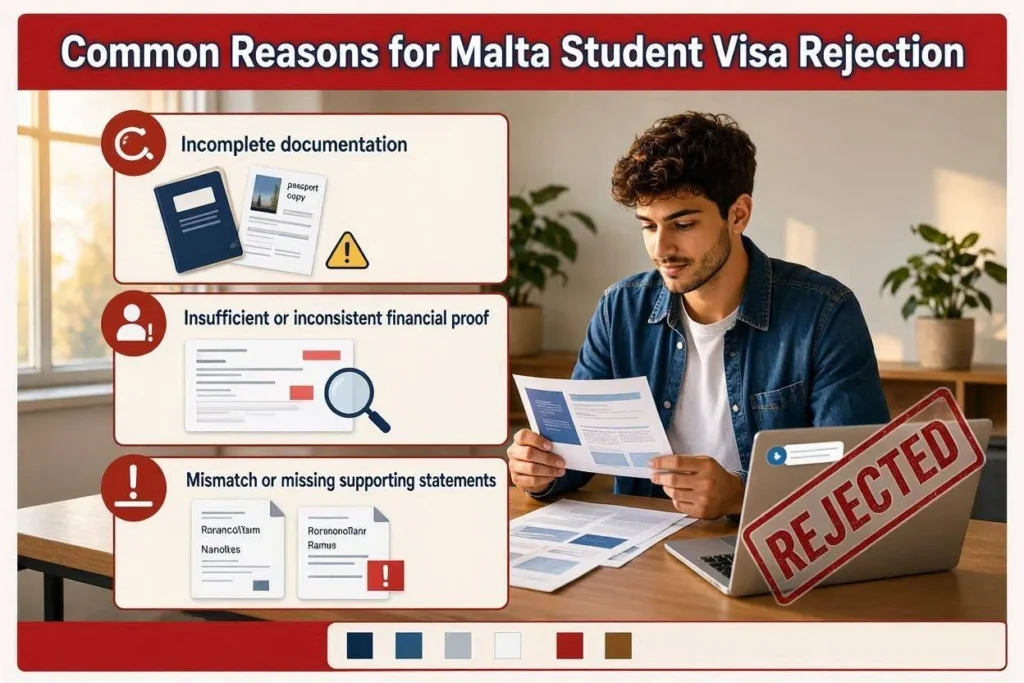
Visa officers cite a consistent set of avoidable mistakes across rejected applications.
Incomplete documentation causes the largest share of rejections. A single missing document — even a minor one like a passport photocopy — can trigger a full rejection rather than a request for the missing item.
Insufficient or inconsistent financial proof ranks second. Bank statements showing sudden deposits shortly before application, or balances that don’t cover the full stay period, read as unreliable to visa officers.
Invalid or insufficient health insurance causes automatic rejection when coverage falls below €30,000, excludes the Schengen Area, or expires before the course ends.
Poor-quality document translations cause trouble too. Uncertified translators or machine translation tools instead of certified professionals trigger rejection, since Identity Malta requires certified translations for any non-English or non-Maltese document.
Late applications submitted close to the intended start date leave no buffer for processing delays, particularly during the busy summer application season.
Weak or fabricated accommodation proof — without a genuine lease, dormitory confirmation, or institutional housing letter — undermines the application’s credibility.
Inconsistent answers during the visa interview, particularly around return-home intentions or study motivation, can cost an otherwise complete application.
Applicants whose visa applications get refused retain the right to appeal to Malta’s Immigration Appeals Board. The appeal must be filed within three working days of the refusal decision — a tight window that makes prompt action essential for anyone considering this route.
Life After Graduation: Staying On in Malta
Malta’s economy offers realistic post-graduation pathways in several specialized sectors: iGaming, financial services, fintech, information technology, English-language teaching, tourism and hospitality, and maritime and aviation services.
Graduates who secure a job offer can transition from a student residence permit to a work-based single permit, combining work authorization and residence status. The employer initiates this application through Identity Malta and Jobsplus jointly. The process favors candidates whose employment aligns with their field of study.
Students without an immediate job offer can extend their student visa status for a defined job-search period rather than departing right after graduation. This extension gives graduates realistic time to interview and secure sponsorship without the pressure of an immediate exit deadline.
Long-term residents building a career in Malta can eventually pursue permanent residence after five years on a work-based permit. This timeline starts fresh once the status shifts from student to worker classification.
Bringing Family Members to Malta
A Malta student visa covers only the primary visa holder. Family members cannot travel or reside in Malta under a student’s visa status. Spouses and minor children who wish to join a student need their own visa application, and the bar for approval sits considerably higher than the student’s own application.
Family reunification applications require the student to demonstrate sufficient income to support each dependent financially, adequate accommodation sized for the full family, and health insurance coverage for every family member individually — on top of the student’s own financial proof. Identity Malta sets specific income and housing thresholds for family applications. Confirm these figures directly before committing to a family reunification plan, since they shift more frequently than the core student visa requirements.
Family members visiting as tourists rather than co-residents follow separate, simpler rules. EU citizens receive 90 visa-free days under standard Schengen tourist allowances. Non-EU family members need a standard Schengen tourist visa for short visits.
Conclusion
Malta’s student visa process runs on two distinct stages: a Type D visa obtained before departure, followed by a residence permit secured within three months of arrival. Non-EU applicants who prepare financial proof carefully, buy adequate Schengen-wide health insurance, and submit complete documentation three to six months ahead of their intake avoid the most common rejection triggers. Living costs sit 30 to 40 percent below comparable Western European destinations. Legitimate part-time work rights kick in from week twelve onward. Together, these factors make Malta a practical, English-taught path into European higher education for students from India, Nigeria, the Gulf states, Southeast Asia, and beyond.
Frequently Asked Questions

Michael Reynolds
Michael Reynolds leads ImmigrationWin’s immigration, visa, and global mobility content division. He specializes in researching immigration policies, visa requirements, application processes, and international relocation pathways for individuals, families, students, and professionals. With extensive experience analyzing immigration regulations and official government guidance, Michael brings a research-driven approach to complex immigration topics and changing visa policies. He is the primary author of ImmigrationWin’s visa guides, immigration resources, and country-specific content, helping readers better understand their options and make informed decisions about their international journey.
Related Posts