Saudi Arabia Student Visa 2026: Requirements, Costs & Application Steps
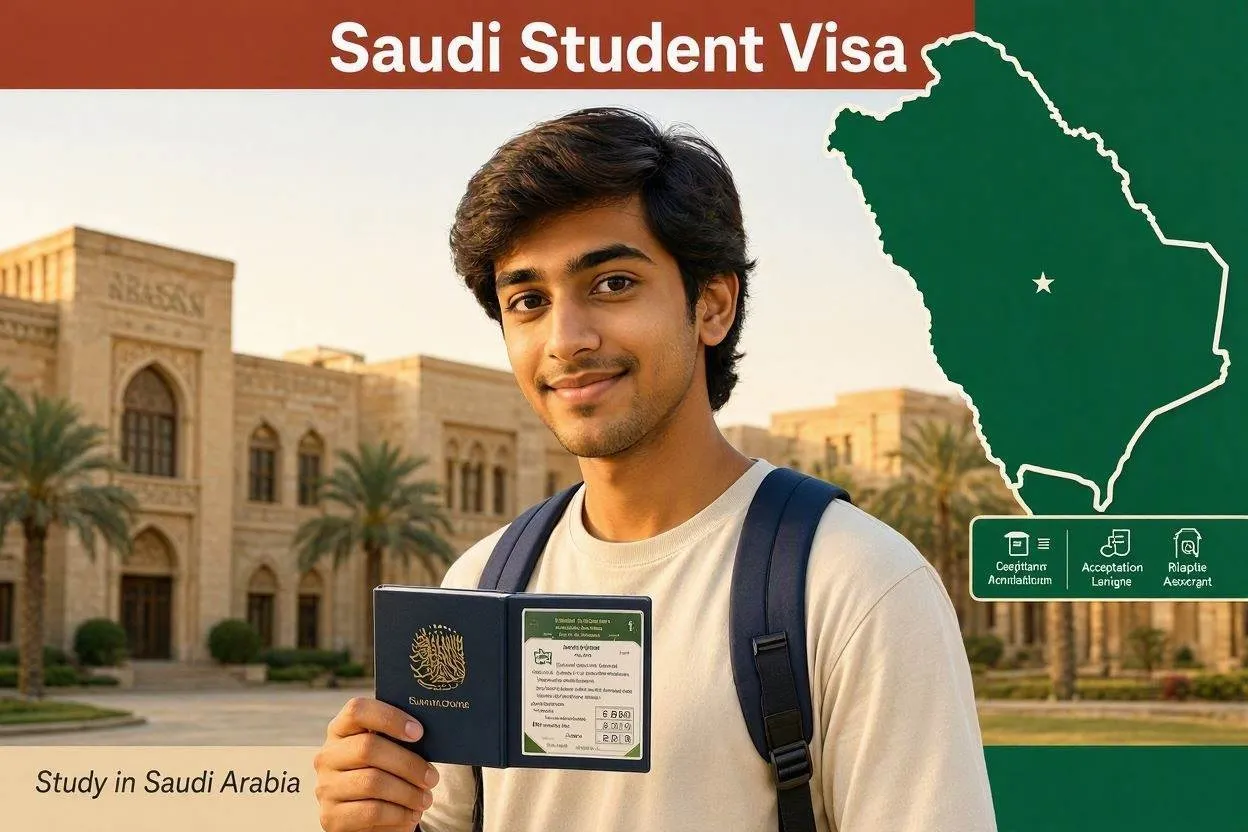
A Saudi Arabia student visa is an entry permit issued by the Ministry of Foreign Affairs (MOFA) that allows a foreign national to study at a licensed Saudi institution. The Ministry of Education (MOE) sets the academic eligibility rules, while MOFA and its consulates issue the physical visa. A student can’t enroll, attend classes, or hold residency in Saudi Arabia without this document. For example, a student accepted into a bachelor’s program at King Saud University still needs a separate visa approval before booking a flight, even after receiving an official admission letter.
The visa ties directly to the sponsoring institution. If a student transfers schools before arrival, the sponsoring university must reissue the acceptance documents and the visa referral tied to them.
Types of Saudi Arabia Student Visas
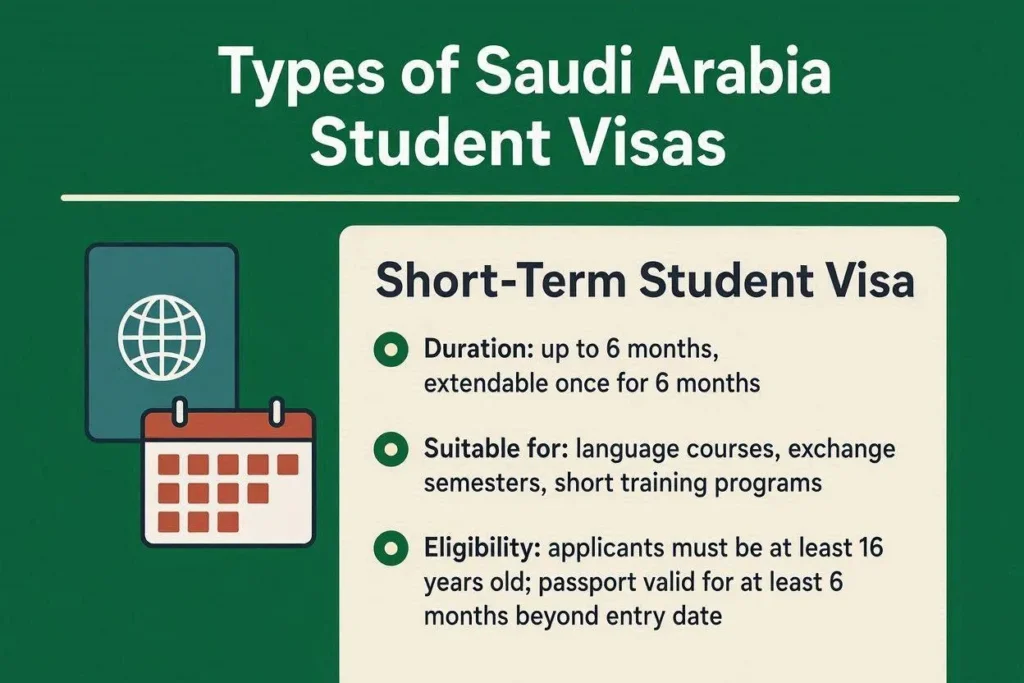
Saudi Arabia issues two categories of student visa, and the correct one depends on program length.
Short-Term Student Visa
A short-term student visa covers study periods of six months or less and can be extended once for another six months. This type suits language courses, exchange semesters, and short training programs. Applicants must be at least 16 years old and hold a passport valid for at least six months beyond their entry date.
Long-Term Student Visa
A long-term student visa covers degree programs lasting more than one year, including bachelor’s, master’s, and doctoral studies, and it renews annually. Unlike the short-term category, this visa requires proof of language proficiency in the language of instruction, a medical report confirming the applicant is free of infectious disease, and mandatory health insurance for the visa holder and any dependents. Arabic-language applicants are exempt from the language proficiency requirement.
Who Needs a Saudi Arabia Student Visa
Any foreign national enrolling in a degree program, exchange semester, or short-term course at a licensed Saudi institution needs a student visa. Saudi citizens and residents already holding valid Saudi residency don’t need one. Visitors attending informal workshops or unaccredited short courses may fall outside this requirement, but a student should confirm the exact category with the sponsoring institution before assuming a visa isn’t needed.
Age matters too. Students under 18 need written consent from a guardian, and that guardian’s information must appear on the visa application alongside the student’s own documents.
Saudi Arabia Student Visa Requirements
Applicants must gather a specific set of documents before submitting a visa request. The exact list can vary slightly by consulate, so a student should always confirm requirements with the nearest Saudi embassy or the sponsoring university’s admissions office. The core documents include:
- Official acceptance letter from a licensed Saudi university or college
- Valid passport with at least six months of validity remaining and two blank visa pages
- Recent passport-style photograph on a plain white background, typically no older than one month
- Proof of funds showing roughly 30,000 SAR ($8,000) available for tuition and living costs
- Medical report confirming freedom from infectious disease, including test results for HIV, syphilis, and hepatitis B and C
- Health insurance certificate covering the student for the duration of study
- Academic transcripts and diploma or degree certificate matching the level of admission
- Guardian consent letter, required only for applicants under 18
- Visa referral note, issued by the university through MOFA once admission is confirmed
- Police clearance certificate, requested by some consulates depending on the applicant’s country of origin
A student applying from Canada, for instance, must also submit an original police records check dated within three months of the application, notarized by the issuing province’s college of physicians if a medical exam was involved.
Each document serves a distinct verification purpose, and consulates check them against each other rather than reviewing them in isolation. The acceptance letter confirms the applicant has a legitimate academic reason to enter the country, so the university name, program title, and start date on that letter must match the same details on the visa application form exactly. A mismatch as small as a misspelled program name can trigger a request for clarification and add days to the review.
Proof of funds works the same way. Consulates typically want a bank statement covering the trailing three to six months, not a single-day balance, because a sudden large deposit right before applying can raise questions about the source of the funds. Students relying on a family sponsor rather than personal savings usually need a notarized sponsorship letter alongside the sponsor’s own bank statement.
Transcripts and diplomas need to match the admission level stated in the acceptance letter. An applicant admitted to a master’s program, for example, submits their bachelor’s degree certificate and full transcript, not just a summary GPA sheet, since Saudi consulates verify academic progression before approving a long-term visa.
Saudi Arabia Student Visa Cost
The Saudi Arabia student visa fee runs approximately 500 SAR, or 133 USD, though total costs are higher once insurance and living expenses are factored in. Below is a breakdown of what applicants should budget:
| Cost Item | Amount in SAR | Amount in USD |
| Student visa fee | 500 SAR | $133 |
| Proof of funds required | 30,000 SAR | $8,000 |
| Monthly living costs | 1,500–3,000 SAR | $400–$800 |
| Annual health insurance premium | 1,000–3,000 SAR | $267–$800 |
Universities and scholarship programs sometimes cover part of these costs directly, which reduces what an applicant needs to show as personal funds. A student holding a King Abdullah Scholarship Program award, for example, can submit the scholarship letter in place of a personal bank statement to satisfy the proof-of-funds requirement.
How to Apply for a Saudi Arabia Student Visa
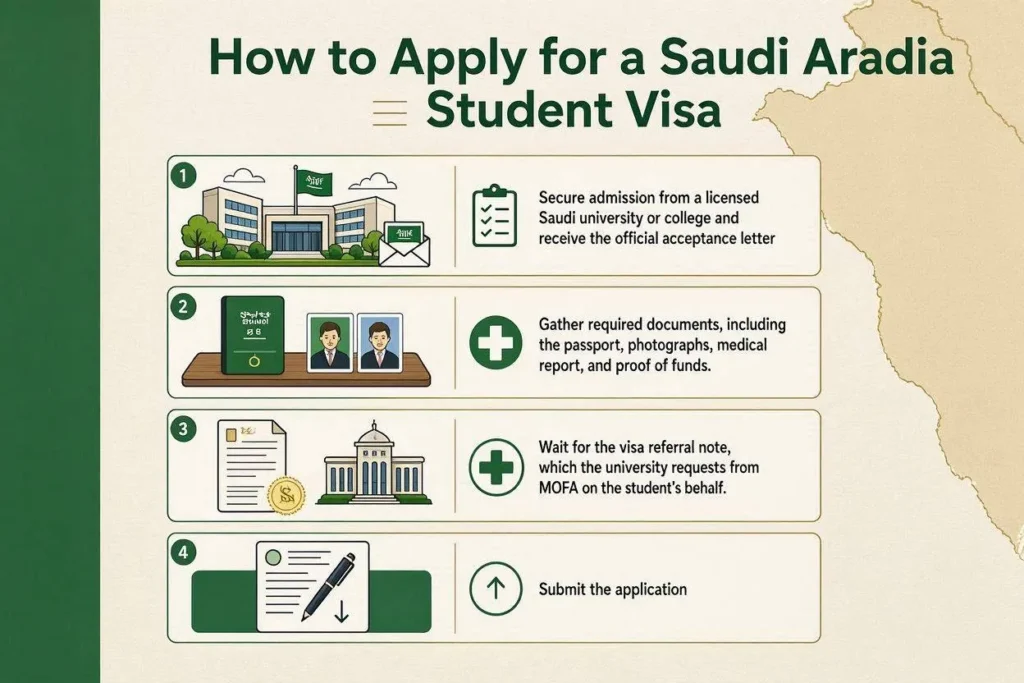
Applying for a Saudi Arabia student visa follows a defined sequence, and skipping a step usually causes delays.
- Secure admission from a licensed Saudi university or college and receive the official acceptance letter.
- Gather required documents, including the passport, photographs, medical report, and proof of funds.
- Wait for the visa referral note, which the university requests from MOFA on the student’s behalf.
- Submit the application through the Visa Services Platform (ksavisa.sa) or directly at the nearest Saudi consulate, depending on the applicant’s location.
- Pay the visa fee of approximately 500 SAR at the time of submission.
- Track the application and respond promptly if the consulate requests additional documents.
- Collect the visa once approved, then confirm travel dates with the sponsoring university.
Students should submit their documents 60 to 90 days before their intended travel date. Universities running a September intake typically set application deadlines between June and August, so an applicant targeting that semester needs to start the process well before summer ends.
Saudi Arabia Student Visa Processing Time
Standard processing for a Saudi Arabia student visa takes about three business days once the university submits the referral through MOFA’s e-services system. That timeline covers only the government processing stage. It doesn’t include the time a university spends preparing the referral, the time an applicant spends gathering documents, or delays caused by high application volume during peak intake periods.
Consulates outside Saudi Arabia sometimes add their own processing windows on top of the MOFA timeline. An applicant in a country with a smaller consular staff, or one applying during the June-to-August rush before fall intake, should expect longer waits than the baseline three-day estimate suggests.
Medical Report and Health Insurance Rules
Every long-term student visa applicant must submit a medical report confirming they’re free of infectious disease, along with proof of health insurance covering their study period. The medical report must be dated within three months of submission and include test results for HIV, syphilis, and hepatitis B and C. A licensed physician completes the form and marks each result as positive or negative using a clear checkmark; numerical lab values need a typed explanation from the doctor confirming a negative interpretation.
If the medical exam takes place outside Saudi Arabia, the Saudi embassy in the country where the test was performed must authenticate the report before submission. Health insurance premiums generally fall between 1,000 and 3,000 SAR ($267 to $800) per year, and some universities require students to purchase a specific local policy rather than bringing coverage from home.
How Saudi Universities Handle the Visa Application
Most Saudi universities manage the visa application on behalf of admitted students once enrollment is confirmed. After a student submits copies of their passport, medical report, and academic documents to the admissions office, the university’s international student team requests the visa referral note through MOFA and forwards the necessary paperwork to the appropriate consulate.
King Fahd University of Petroleum and Minerals (KFUPM) follows this model closely: admitted students email their documents directly to the admissions team, and the university handles the referral and embassy coordination from there. This concierge-style process removes much of the guesswork for first-time applicants, though the student is still responsible for supplying accurate, complete documents on time.
Scholarships That Reduce Visa and Tuition Costs
The King Abdullah Scholarship Program and individual university scholarships can cover tuition, living costs, and sometimes travel expenses, which lowers the proof-of-funds threshold a student must otherwise demonstrate. Scholarship recipients typically submit their award letter alongside the standard visa application to substitute for a personal bank statement.
Coverage terms vary by scholarship. A student receiving a partial scholarship, for example, may still need to show supplementary funds covering the gap between the award amount and the full 30,000 SAR proof-of-funds requirement. Applicants should confirm exactly what their scholarship covers before assuming it satisfies the entire financial documentation requirement.
Can Students Work While Holding a Saudi Arabia Student Visa
No, a standard Saudi Arabia student visa doesn’t grant work authorization, and students who take paid employment without a separate permit risk visa cancellation. Some universities offer supervised on-campus roles, such as research assistantships or teaching support positions, which fall under academic activity rather than outside employment and don’t require a separate work permit. Off-campus jobs are a different matter entirely and generally require a distinct authorization from the Ministry of Human Resources and Social Development.
Students planning to fund part of their studies through part-time work should confirm the exact rules with their university’s international office before assuming any employment is permitted under the student visa alone.
Saudi Arabia Student Visa Extension and Renewal
Long-term student visas renew annually, and short-term visas can be extended once for an additional six months. Renewal for a long-term visa typically runs through the university, which confirms continued enrollment and good academic standing before requesting the extension through MOFA. A student who withdraws from their program or falls below the minimum credit load required for full-time status can lose eligibility for renewal.
Short-term visa holders who want to extend past the maximum 12-month combined period, made up of the initial six months plus one six-month extension, generally need to exit Saudi Arabia and reapply as a new applicant rather than requesting a further extension in-country.
After Arrival: Iqama, Absher, and Exit-Re-Entry Visas
Students must convert their entry visa into an Iqama, Saudi Arabia’s residency permit, within 90 days of arrival. The sponsoring university typically initiates this process, and the student completes biometric registration as part of it. Without a valid Iqama, a student can’t legally remain in the country past the initial entry window.
Once issued, the Iqama links to Absher, the Saudi government’s digital platform for tracking residency status, renewals, and travel permissions. Students planning to leave Saudi Arabia during their studies, whether for a holiday or a family visit, need an exit-re-entry visa processed through Absher before departing. Traveling without one can result in the Iqama being canceled, which forces the student to restart the visa process from their home country.
Dependent Visas for Spouses and Children
Yes, a student holding a long-term visa can sponsor a spouse and children for dependent visas, provided the student demonstrates sufficient income and appropriate housing. Dependent visa applications require the same core documents as the student’s own visa, including passport copies, photographs, and medical reports for each family member.
Universities rarely coordinate dependent visa paperwork the way they handle a student’s own application, so a student bringing family members should expect to manage that process directly with MOFA or a Saudi consulate, separate from the university’s admissions support.
Common Reasons Saudi Arabia Student Visas Get Rejected
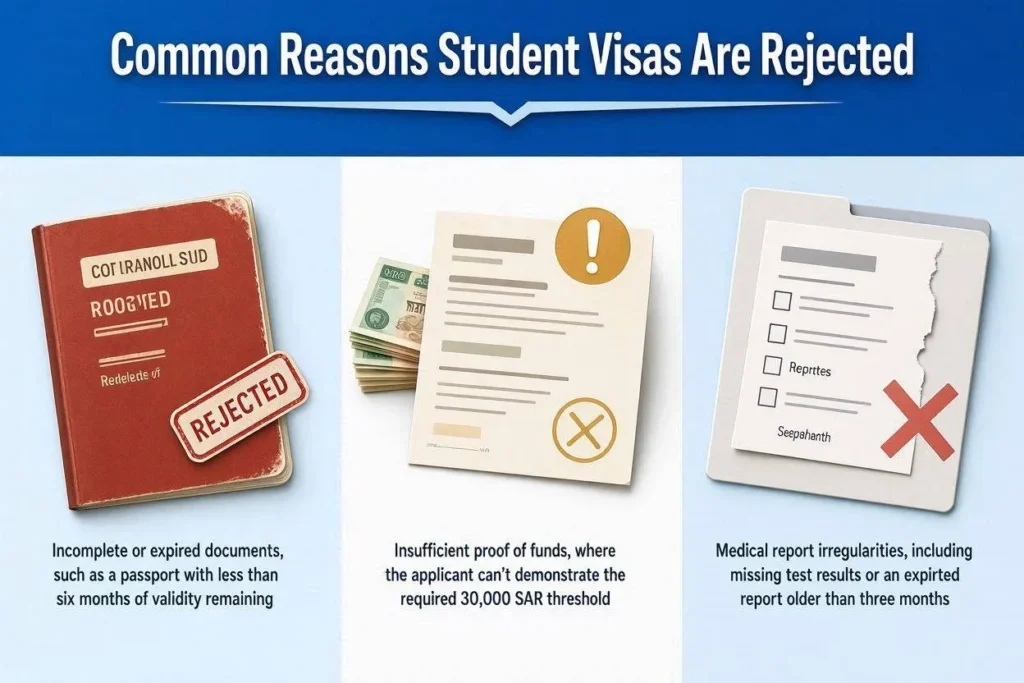
Visa applications get denied for a handful of recurring reasons, and most are preventable with careful preparation.
- Incomplete or expired documents, such as a passport with less than six months of validity remaining
- Insufficient proof of funds, where the applicant can’t demonstrate the required 30,000 SAR threshold
- Medical report irregularities, including missing test results or an expired report older than three months
- Mismatched personal information between the passport, acceptance letter, and visa application form
- Missing guardian consent, applicable to applicants under 18 traveling without a parent
A student who submits documents in a rush, without double-checking names and dates across every form, runs a higher risk of triggering one of these rejections. Reapplying after a denial adds weeks to the timeline, so accuracy on the first submission matters more than speed.
How the Process Differs by Nationality
Core visa requirements stay consistent worldwide, but consulate-specific steps and processing details vary by country. Applicants from Canada, for instance, submit their medical report through a process authenticated by the Saudi embassy in Ottawa and typically include an original police records check obtained through a name-based search. Applicants from the United States generally route their applications through the Royal Embassy of Saudi Arabia in Washington, D.C., or one of the Saudi consulates in the country, and may face different appointment-booking systems depending on location.
The table below outlines common variations by region. Applicants should treat these as starting points rather than final checklists, since consulate practices change.
| Applicant Location | Typical Submission Point | Common Extra Requirement |
| United States | Royal Embassy of Saudi Arabia, Washington, D.C., or a regional consulate | Passport photo specifications may differ from standard U.S. visa photos |
| Canada | Royal Embassy of Saudi Arabia, Ottawa | Police records check plus medical form authenticated by the embassy |
| United Kingdom | Saudi Arabia visa application center or embassy in London | Biometric appointment often required in person |
| India | Saudi consulate in New Delhi or Mumbai | Additional attestation of academic documents may be requested |
| Pakistan | Saudi consulate in Islamabad or Karachi | Police clearance and medical screening at approved centers only |
Applicants should always confirm document formats, translation requirements, and submission channels with the Saudi consulate covering their country of residence, since a checklist built for one country doesn’t always transfer directly to another. Documents issued in a language other than Arabic or English typically need certified translation before submission, regardless of the applicant’s nationality.
Conclusion
A Saudi Arabia student visa requires more than an acceptance letter. Applicants need a valid passport, verified funds, a clean medical report, and correctly timed submissions through their university and the nearest Saudi consulate. Missing one document or misjudging the 60-to-90-day application window causes most of the delays students run into, so building the checklist early and confirming country-specific steps with the consulate remains the most reliable path to an approved visa.
Frequently Asked Questions

Michael Reynolds
Michael Reynolds leads ImmigrationWin’s immigration, visa, and global mobility content division. He specializes in researching immigration policies, visa requirements, application processes, and international relocation pathways for individuals, families, students, and professionals. With extensive experience analyzing immigration regulations and official government guidance, Michael brings a research-driven approach to complex immigration topics and changing visa policies. He is the primary author of ImmigrationWin’s visa guides, immigration resources, and country-specific content, helping readers better understand their options and make informed decisions about their international journey.
Related Posts