
How Long Does It Take to Get a Work Permit? EAD Wait Times
Most applicants wait between 4 and 16 months for an Employment Authorization Document (EAD), and the eligibility category on your Form I-765 decides where you land in that range. Type “how long does it take to get a work permit” into a search bar and you’ll see answers ranging from a few days to a few years. Both extremes are real. A first-time asylum applicant can get a decision in about a month once the 150-day waiting period is over, while someone with a pending green card case is currently looking at roughly 11 to 15.5 months.
That spread is why the category code matters more than any average. Below you’ll find current waits by category, the checkpoints between filing and the card arriving in your mailbox, today’s fees, and the late-2025 rule changes that turned renewals into the riskiest part of the process.
What Counts as a Work Permit in the U.S.?

For immigrants, a work permit is the Employment Authorization Document, a wallet-size card officially called Form I-766 that USCIS issues after approving Form I-765. It proves you can work for any U.S. employer during the dates printed on it. Teenagers are a separate story. A state youth work permit comes from a school district or state labor office, never from USCIS, and there’s a short section on those near the end.
Plenty of people don’t need an EAD at all. Green card holders and citizens are authorized to work by their status, and so are many visa holders who work “incident to status.” An H-1B engineer, for instance, works for the sponsoring employer with no separate card. L-2 and E-2 spouses belong in that group too, provided their I-94 record carries the L-2S or E-2S annotation.
How Long Does It Take to Get a Work Permit by Category?
Current waits range from about 1 month for a first-time pending-asylum EAD to roughly 19 months for refugee-based filings, according to USCIS-posted data compiled in early September 2026. Your number depends on the code you enter in the eligibility section of Form I-765. It also depends on the USCIS office handling the case, which is printed on your receipt notice.
| Who you are | I-765 category | Current wait (Sept. 2026) | Premium processing? |
| Pending green card (I-485 filed) | (c)(9) | 11 to 15.5 months | No |
| Pending asylum, first EAD | (c)(8) | 1 to 4 months, after the 150-day wait | No |
| Pending asylum, renewal or replacement | (c)(8) | 15.5 to 19 months | No |
| Granted asylum (asylee) | (a)(5) | About 3.5 months | No |
| Refugee | (a)(3) | About 19 months | No |
| F-1 OPT or STEM OPT | (c)(3)(A), (B), (C) | 4 to 6 months | Yes, 30 business days |
| H-4 spouse, filed with Form I-539 | (c)(26) | 6.5 to 10 months | No |
| H-4 spouse, filed alone | (c)(26) | 17 to 18.5 months | No |
| Parolee | (c)(11) | About 14 months | No |
| TPS (El Salvador example) | (a)(12) or (c)(19) | 18 to 18.5 months | No |
Ranges combine USCIS-posted estimates reported by Beyond Border (September 8, 2026 snapshot) and Manifest Law (updated September 1, 2026). Check the live tool for your own office.
Pending Green Card Applicants, Category (c)(9)
Adjustment-of-status applicants are currently waiting about 11 to 15.5 months for a (c)(9) work permit. Most people file the I-765 in the same package as Form I-485, which keeps the fee lower and starts both clocks on the same day. Picture a nurse who mails her I-485 package in October. On today’s numbers, her EAD lands somewhere between the following September and the January after that, so she’d be wise to keep any existing work status alive in the meantime.
Asylum Applicants, Category (c)(8)
A first asylum-based EAD cannot be approved until your asylum case has been pending for 180 days, and you cannot file the I-765 until day 150. USCIS calls this the 180-Day Asylum EAD Clock. Since a 2022 federal court decision in Asylumworks v. Mayorkas, the agency has applied that 150/180-day framework along with a 30-day window to decide initial (c)(8) applications. Delays you cause, like rescheduling your asylum interview, stop the clock.
One newer trap is worth flagging. Starting August 21, 2026, USCIS wants all asylum evidence at least 14 calendar days before the interview, and a reschedule caused by late evidence can affect EAD eligibility.
Renewals are where the math turns ugly. A (c)(8) card is now valid for a maximum of 18 months, and renewals are taking 15.5 to 19 months. File exactly 180 days before expiration and hit a 15.5-month wait, and the old card runs out about 9.5 months before the new one arrives.
You may have read that USCIS has stopped accepting first-time asylum EAD applications. That’s a proposed rule, not current law, as explained further down.
F-1 Students on OPT and STEM OPT
OPT applicants are currently seeing decisions in about 4 to 6 months, or within 30 business days when they pay $1,780 for premium processing. Students can file post-completion OPT up to 90 days before the program end date, and that early window is the cheapest speed boost available. Waiting until graduation week to file is how a June graduate ends up missing an October start date.
STEM OPT has its own safety net. A timely filed STEM extension lets you keep working for up to 180 days while USCIS decides, which is separate from the general renewal rules covered later.
H-4, L-2 and E-2 Spouses
H-4 spouses who file the I-765 together with Form I-539 are waiting about 6.5 to 10 months, while standalone H-4 EAD filings take 17 to 18.5 months. That gap is enormous. If an H-4 extension is due anyway, bundling the two forms roughly halves the wait. Premium processing on the H-1B petition doesn’t carry over to the spouse’s forms, a detail that surprises plenty of families.
L-2 and E-2 spouses usually skip the queue entirely. Their annotated I-94 already counts as proof of work authorization, so an EAD is optional for them.
TPS Holders, Parolees, Refugees and Asylees
Humanitarian categories show the widest spread, running from about 3.5 months for people already granted asylum to around 19 months for refugee-based filings. TPS timelines follow each country’s designation. Salvadoran TPS filings, for example, are posted at 18 to 18.5 months, and some TPS cards get extended by Federal Register notice rather than by a new approval. Parole-based applications currently sit around 14 months.
Why Is the USCIS Median So Much Shorter Than the Posted Wait?
USCIS publishes two different numbers: a national median that describes finished cases, and an office-level processing time that shows how long it took to complete 80% of recent cases. They answer different questions. Through June 30 of fiscal year 2026, the national medians were 5.1 months for (c)(9), 0.7 months for (c)(8), and 3.7 months for the “all other” group. Those look reassuring.
Anyone who answers “how long does it take to get a work permit” with one national figure is almost always quoting that median. Here’s the catch. A median only counts cases that were completed, so thousands of applications still stuck in the queue don’t pull it upward until they’re finally decided. The posted processing time for your form, category and office is the better planning figure. It also comes with an “inquiry date,” which tells you when USCIS will accept a question about a slow case.
What Happens Between Filing and Getting the Card?
The process moves through a handful of checkpoints, and only the officer review stage takes months. Knowing each one helps you read your case status without panicking.
- Receipt notice. Form I-797C confirms USCIS has your application. Online filers get the receipt number right away; paper filers wait for it in the mail.
- Biometrics appointment. Since December 12, 2025, USCIS uses only photos it takes itself, so expect a notice to visit an Application Support Center. OPT filers may have a photo under three years old reused, at USCIS’s discretion. Skipping the appointment can get your application denied.
- Officer review. This is the long stretch. A Request for Evidence (RFE) here pauses progress until you respond.
- Decision. Approval triggers an approval notice and a status update in your online account.
- Card production and mailing. USCIS says the card should be produced within 2 weeks of approval and mailed by USPS Priority Mail.
- Social Security number. If you checked the SSN box on Form I-765, the Social Security Administration issues your number without a separate office visit.
How Much Does Form I-765 Cost Right Now?
The standard I-765 fee is $470 online or $520 on paper, but asylum, parole and TPS applicants pay separate statutory fees created by H.R. 1. Those H.R. 1 fees can’t be waived, and they’re adjusted for inflation every year.
| Filing type | USCIS fee |
| Standard I-765, filed online | $470 |
| Standard I-765, filed on paper | $520 |
| Filed with a pending I-485 (I-485 paid on or after April 1, 2024) | $260 |
| Initial EAD for pending asylum, parole or TPS | $560 |
| Renewal for pending asylum, (c)(8) | $275 |
| Renewal for parole or TPS | $280 |
| Premium processing (OPT and STEM OPT only) | $1,780 on top of the filing fee |
A wrong fee gets the whole package rejected, and a rejection means starting the clock again. Confirm your amount on the USCIS Fee Schedule (Form G-1055) the day you file.
What Slows Down a Work Permit Application?
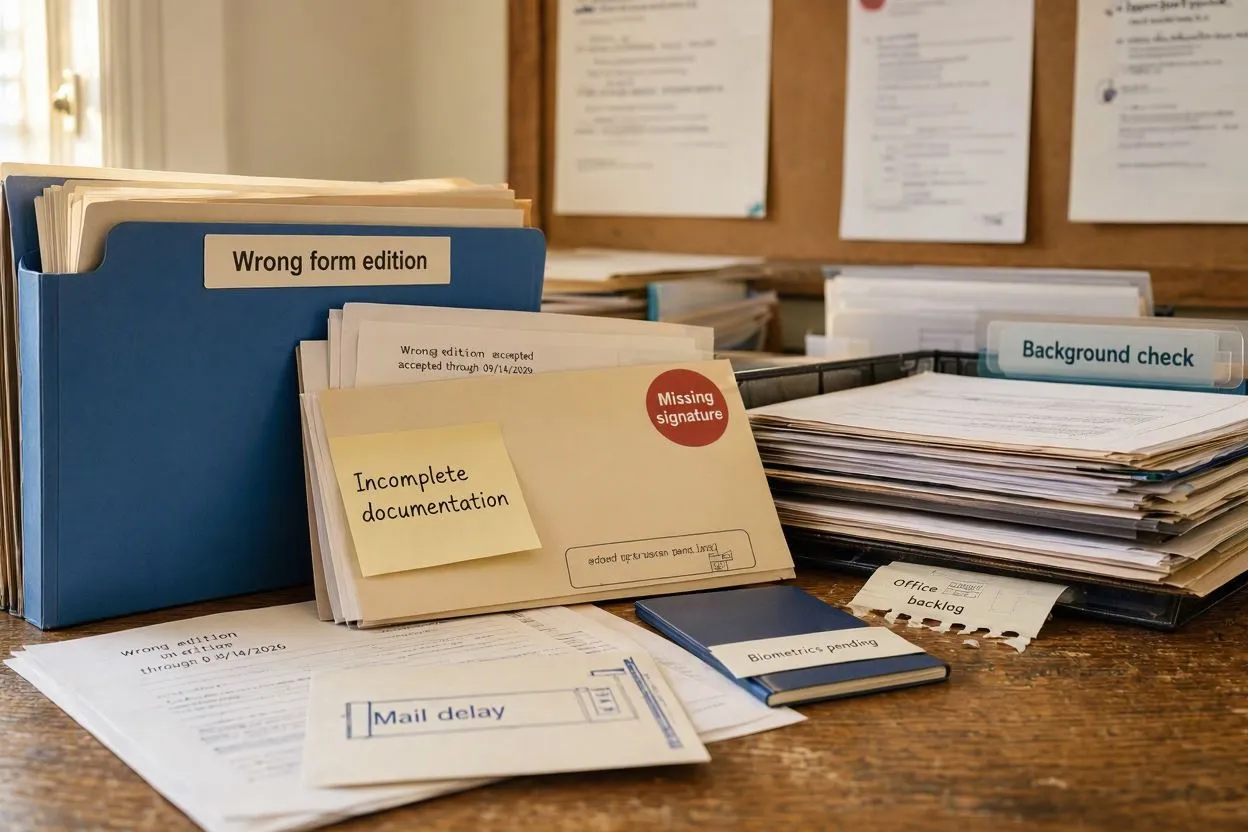
Most avoidable delays trace back to the paperwork itself, and a rejected filing is the costliest version because it sends you back to day one. Unavoidable delays exist too. Office backlogs vary widely, which is why two friends who filed the same week can get answers months apart.
These are the problems that show up most often:
- Wrong form edition. After a September 14, 2026 court order, USCIS continues to accept the 08/21/25 edition of Form I-765 and is not accepting the 09/15/26 edition. Check the edition date at the bottom of each page before mailing.
- Wrong fee. Fees now vary by category, and a mismatch triggers rejection.
- Requests for Evidence. An RFE adds weeks or months, depending on how fast you respond and how long the case waits afterward.
- Missed biometrics. Failing to appear can lead to denial, so reschedule before the date rather than after.
- Applicant-caused asylum delays. Rescheduling an asylum interview stops the 180-day clock.
- Agency-wide holds. Earlier in 2026, some cases stalled under USCIS adjudication pause policies until a federal court vacated those policies on June 5, 2026 and USCIS agreed to comply.
Can You Speed Up an EAD Application?
Only F-1 students in the OPT and STEM OPT categories can pay for faster EAD processing; everyone else has to qualify for an expedite request. Premium processing costs $1,780 through Form I-907 and guarantees some action within 30 business days. That action might be an approval or an RFE. If it’s an RFE, the 30-day clock restarts once USCIS receives your response.
Expedite requests are decided case by case. USCIS looks for evidence of situations like these:
- Severe financial loss to you or a company
- Urgent humanitarian reasons
- Nonprofit work that furthers U.S. cultural or social interests
- U.S. government interests
- A clear USCIS error
A job offer on its own rarely clears that bar. Two cheaper moves help more often than people expect: filing online when your category allows it, which saves $50 and gets you a receipt number instantly, and bundling the I-765 with a related form when that’s an option.
What Should You Do If Your Work Permit Is Late?
Once your receipt date is earlier than the inquiry date USCIS posts for your form, category and office, you can submit an outside-normal-processing-time request through the USCIS e-Request portal. Before that date, an inquiry will simply be turned away. Work through these steps in order:
- Check your USCIS online account for an RFE or a notice you haven’t seen.
- Submit the e-Request once you’re past the inquiry date and keep the service request number.
- Ask the CIS Ombudsman’s office for case assistance if e-Request goes nowhere.
- Contact your U.S. representative’s or senator’s office, since congressional caseworkers can send inquiries to USCIS.
- Talk to an immigration attorney about a mandamus lawsuit in federal court if the delay is extreme and well past posted times.
How Early Should You Renew Your Work Permit?

File your renewal as soon as USCIS allows, which is 180 days before your current EAD expires, because most renewals filed on or after October 30, 2025 receive no automatic extension. Before that date, a timely renewal kept many workers employed for up to 540 extra days. That safety net is gone for most categories, with limited exceptions for TPS cards extended by Federal Register notice and the separate STEM OPT rule. Renewals filed before October 30, 2025 keep their old extension.
Shorter cards make this harder. Effective December 5, 2025, USCIS cut maximum validity to 18 months for refugees, asylees, people granted withholding of removal, pending asylum applicants, pending adjustment applicants and certain others. Cards already issued with five-year validity keep their printed dates.
Employers feel this too. Every expiring card means a Form I-9 reverification, and a worker whose EAD lapses has to stop working until the new card arrives. HR teams that track expiration dates six to seven months out avoid most of those surprise gaps.
Which Rule Changes Could Affect Your Timeline?
Two proposed rules could lengthen waits if they are finalized, but as of this writing neither one is in effect. The first, published February 23, 2026, would raise the asylum EAD waiting period to 365 days and pause first-time (c)(8) filings whenever affirmative asylum processing averages more than 180 days. According to the American Immigration Council, it had not been finalized as of August 5, 2026.
The second, proposed June 5, 2026, targets “discretionary” work permits. It focuses on people with parole, deferred action or final removal orders. Watch both. A final rule usually takes effect on a specific date, and applications filed before that date are often treated differently from those filed after.
Looking for a Youth Work Permit Instead?
If you are under 18 and need a permit for a part-time job, you need a state document from your school or state labor office, and the wait is short compared with any federal EAD. Rules differ a lot by state. Wisconsin requires permits only for 14- and 15-year-olds, charges a $10 fee that the employer must reimburse by the first paycheck, and handles applications online. Maryland requires a permit for every worker aged 14 to 17 and ties it to one employer, so a new job means a new permit. Illinois sends families to their school district or regional education office first, and its permits stay valid for one year with the named employer.
Conclusion
Your category code, not a national average, is the real answer to how long it takes to get a work permit. A pending asylum case, an OPT filing and a green card application can sit in completely different queues, even when all three were mailed the same afternoon. Start with the table above, then check the live USCIS number for your office. After that, file early, pay the right fee, use the current form edition, and treat the 180-day renewal window as a deadline. Anyone still asking how long does it take to get a work permit after reading this should have a planning date in hand, not just a range.
Frequently Asked Questions

Michael Reynolds
Michael Reynolds leads ImmigrationWin’s immigration, visa, and global mobility content division. He specializes in researching immigration policies, visa requirements, application processes, and international relocation pathways for individuals, families, students, and professionals. With extensive experience analyzing immigration regulations and official government guidance, Michael brings a research-driven approach to complex immigration topics and changing visa policies. He is the primary author of ImmigrationWin’s visa guides, immigration resources, and country-specific content, helping readers better understand their options and make informed decisions about their international journey.
Related Posts