

Spain Golden Visa 2026: Program Ended — What It Was & Best Alternatives Now
Spain’s Golden Visa program ended on April 3, 2025. New applications are no longer accepted. If you applied before that date, your application processes under the old rules. If you hold a valid permit, you can still renew it. This guide explains what the program offered, who still qualifies for renewals, and the 3 active residency pathways that replace it in 2026.
Is the Spain Golden Visa Still Available in 2026?
No. The Spanish government abolished the investor residency program through Organic Law 1/2025 (Ley Orgánica 1/2025), published in Spain’s Official State Gazette (BOE) on January 3, 2025. The law took effect on April 3, 2025, after a 3-month transition window. Its 21st final provision removed Articles 63 to 67 from Law 14/2013 — the legal basis for the investor visa.
3 key facts every investor must know in 2026:
- The €500,000 real estate route is permanently closed. No new applications are accepted, regardless of where in Spain you buy.
- Applications filed before April 3, 2025 continue processing under the original rules.
- Existing permit holders keep full rights. Renewals are available under transitional protections — the closure affects new applicants only.
Why Spain Ended the Golden Visa
Prime Minister Pedro Sánchez cited housing affordability as the primary reason. The program attracted over €1 billion per year in foreign investment, mainly from Chinese, American, Russian, and British buyers. This accelerated property price increases in Madrid, Barcelona, and coastal cities, pricing out Spanish residents from their local housing markets. The government determined that the economic benefits no longer outweighed the social cost.
What the Spain Golden Visa Was: Program Overview (2013–2025)
Spain launched the Golden Visa in 2013 under Law 14/2013 to attract foreign capital during Spain’s economic recovery. It ran for 12 years and issued thousands of residency permits to non-EU investors.
Investment Routes That Qualified
| Investment Type | Minimum Amount | Notes |
| Real estate purchase | €500,000 | Free of mortgage for the minimum amount |
| Spanish government bonds | €2,000,000 | Held for minimum 5 years |
| Shares in Spanish companies | €1,000,000 | Listed or unlisted companies |
| Bank deposits in Spain | €1,000,000 | Held in Spanish financial institution |
| Investment funds / venture capital | €1,000,000 | Spanish funds only |
| Business project of general interest | No minimum | Requires ICEX approval |
Who Was Eligible
- Non-EU/EEA nationals aged 18 or older
- Clean criminal record in all countries of residence for the past 5 years
- Private health insurance from a company licensed to operate in Spain
- Financial solvency: bank account in Spain with a minimum of €28,800 (400% of annual IPREM) — in 2026, IPREM is €600/month or €7,200/year
- Additional €7,200 required per dependent family member
Key Benefits the Program Offered
| Benefit | Detail |
| Live, work, study in Spain | Full rights with no language exam requirement |
| Schengen Area travel | Visa-free access to all 27 Schengen countries; 90 days per 180-day period |
| No minimum stay required | Visit Spain once per renewal period — no 183-day residency rule |
| Family inclusion | Spouse/partner, dependent children, dependent parents included |
| Path to permanent residency | Apply after 5 continuous years of legal residence in Spain |
| Path to citizenship | Apply after 10 years; children born in Spain qualify after just 1 year |
| Tax flexibility | Stay under 183 days per year to remain a non-resident for tax purposes |
| Emergency access | Enter Spain even during border closures or travel restrictions |
Spain Golden Visa Renewal in 2026: What Existing Holders Must Know
Yes — existing Golden Visa holders can renew their permits. The program closure affects new applications only. Organic Law 1/2025 includes a grandfathering clause that protects permit holders under the original legal framework. Renewals are processed by the UGE-CE (Unidad de Grandes Empresas y Colectivos Estratégicos).
Renewal Timeline
- Year 0: Initial residence authorization valid for 1 year (if applied from abroad) or 3 years (if applied from inside Spain)
- First renewal: 5-year permit (upgraded from previous 2-year blocks)
- Subsequent renewals: 5-year periods as long as qualifying conditions are met
- File renewal up to 60 days before your TIE (Tarjeta de Identidad de Extranjero) expires electronically via Mercurio
- Legal response time: 20 working days; positive silence applies if no response received
4 Conditions You Must Meet to Renew
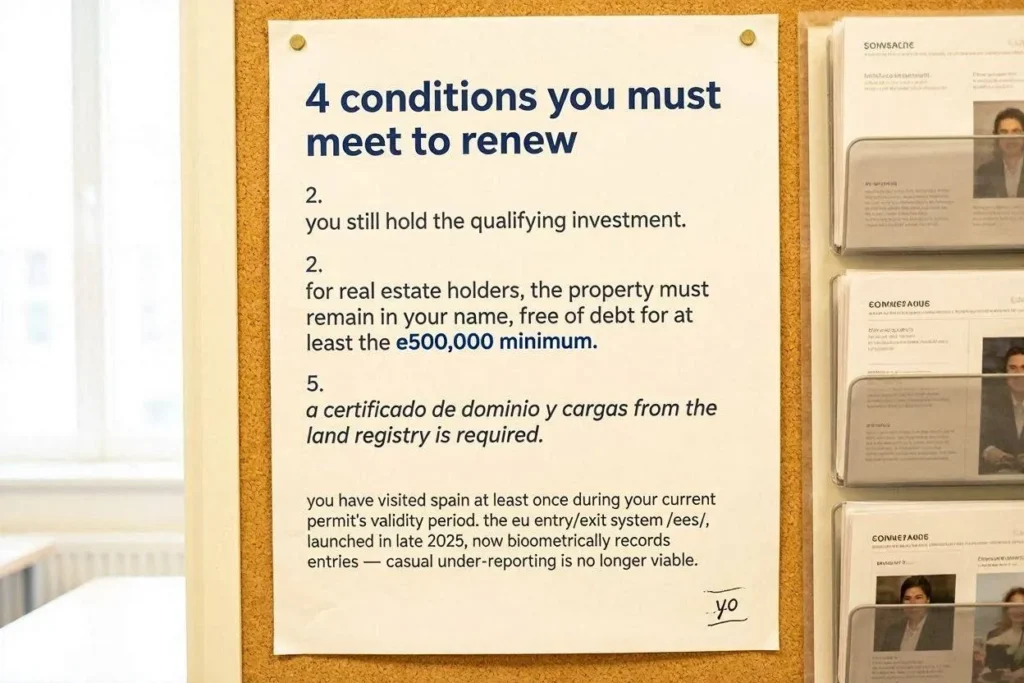
- You still hold the qualifying investment. For real estate holders, the property must remain in your name, free of debt for at least the €500,000 minimum. A certificado de dominio y cargas from the Land Registry is required.
- You have visited Spain at least once during your current permit’s validity period. The EU Entry/Exit System (EES), launched in late 2025, now biometrically records entries — casual under-reporting is no longer viable.
- You hold private health insurance with full coverage in Spain and no co-payments or deductibles.
- You maintain a clean criminal record in Spain and every country where you lived during the past 5 years.
Can You Sell and Reinvest During Renewal?
This is the most critical rule change: the replacement property must have been acquired before April 3, 2025. If you sold your original qualifying property and bought a new one after that date, Spain will not accept the new property as a qualifying investment. Existing Golden Visa holders who want to swap properties should seek immediate legal advice from a Spanish immigration lawyer before making any real estate transaction.
Tax Obligations for Golden Visa Holders in 2026
Your tax status depends on how many days per year you spend in Spain. 2 distinct tax profiles apply:
| Non-Resident (under 183 days/year) | Tax Resident (183+ days/year) |
| IRNR (Non-Resident Income Tax) on Spain-sourced income | IRPF (progressive income tax) on worldwide income: 19–47% |
| Imputed income tax on owned property, even if not rented | Modelo 720 reporting on worldwide assets over €50,000 |
| IBI (local property tax) paid annually to municipality | Wealth Tax on Spanish assets above regional threshold |
| Wealth Tax applies to Spanish assets if net wealth exceeds regional threshold (e.g. €500,000 in Catalonia) | Spanish social security contributions if employed in Spain |
3 Best Spain Golden Visa Alternatives in 2026
Spain has no remaining residency-by-property route in 2026. Buying real estate no longer grants residency under any program. These 3 active pathways serve different investor and relocator profiles:
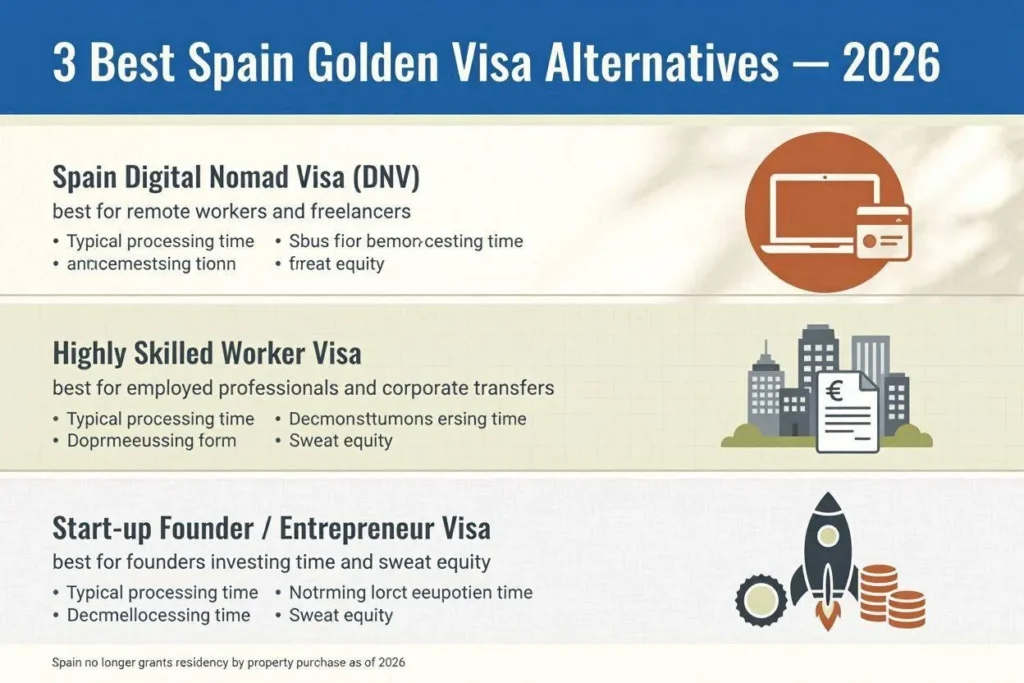
1. Spain Digital Nomad Visa (DNV) — Best for Remote Workers and Freelancers
Created under Law 28/2022 (Startup Law), the Digital Nomad Visa (DNV) is the most popular replacement for the Golden Visa in 2026 for professionals who work remotely for non-Spanish clients or employers.
Financial requirements in 2026 (based on SMI — Salario Mínimo Interprofesional):
| Applicant | Minimum Monthly Income (2026) |
| Main applicant | €2,762 – €2,849/month (200% of SMI) |
| First dependent (spouse/partner) | +€1,035/month (75% of SMI) |
| Each additional dependent child | +€345/month (25% of SMI) |
Eligibility requirements:
- Employment or freelance income from non-Spanish sources — at least 80% of total income must come from outside Spain
- Higher education degree OR 3+ years of relevant professional experience in your field
- Private health insurance with no co-payments or deductibles
- Professional relationship (contract or client agreement) of at least 3 months standing
- A clean criminal record from all countries of residence in the past 5 years
Permit duration and renewal:
- Applied from abroad: 1-year initial visa, then convert to 3-year residence permit
- Applied from inside Spain: 3-year initial residence permit directly
- Renewal: 2-year periods after the initial permit
- Permanent residency: eligible after 5 years of continuous legal residence
Beckham Law tax advantage: The DNV qualifies for the Special Tax Regime for Displaced Workers (Régimen Especial de Trabajadores Desplazados), known as the Beckham Law. This caps personal income tax at a flat 24% rate on the first €600,000 of annual Spanish income for up to 6 years. Standard Spanish progressive rates reach 47%. This is the single biggest financial advantage the DNV holds over the Non-Lucrative Visa.
2. Non-Lucrative Visa (NLV) — Best for Retirees and Passive Income Earners
The Non-Lucrative Visa (NLV) is the primary route for financially independent individuals who do not work — retirees, FIRE individuals, dividend earners, and pension recipients.
Financial requirements in 2026 (based on IPREM at €600/month):
| Requirement | 2026 Amount |
| Main applicant annual income | €28,800/year (400% of IPREM) |
| Each dependent family member | +€7,200/year (100% of IPREM) |
| Renewal (must show means for full 2-year period) | ~€57,600 for main applicant + €14,400 per dependent |
Accepted income sources include pensions, annuities, dividends, rental income from overseas properties, Social Security payments, and investment returns. Work income — including remote work — does not qualify. The NLV strictly prohibits any professional activity on Spanish territory.
Key difference from the Golden Visa: the NLV requires you to spend at least 183 days per calendar year in Spain to renew and to have those years count toward permanent residency. This is a fundamental shift for ex-Golden Visa holders accustomed to visiting Spain only a few weeks per year.
Permit structure: 1 year initial, then renewable in 2-year periods (1+2+2 structure). Permanent residency after 5 years.
Tax warning: The NLV makes you a Spanish tax resident on worldwide income. Standard progressive rates of 19–47% apply. Unlike the DNV, the NLV does not qualify for the Beckham Law flat rate. High-net-worth individuals (HNWI) should model their tax liability before choosing between NLV and DNV.
3. Spain Entrepreneur Visa — Best for Business Founders and Startup Investors
The Entrepreneur Visa (also called the Business Investor Visa) suits non-EU nationals who want to actively build or invest in a business in Spain, rather than live off passive income or remote work.
Requirements:
- A viable business plan approved by ICEX (Instituto Español de Comercio Exterior) — Spain’s trade promotion body
- Demonstrated professional experience relevant to the proposed business
- Sufficient financial means: approximately €2,763/month (based on IPREM)
- No minimum investment amount — unlike the old Golden Visa, there is no set financial floor
- Clean criminal record and private health insurance
The initial permit is granted for 1 year and renewable for up to 5 years. The entrepreneur must register under Spain’s tax and social security systems. Permanent residency eligibility begins after 5 years of continuous legal residence.
Spain Residency Options Compared: 2026 Side-by-Side
| Factor | Old Golden Visa | Digital Nomad Visa | Non-Lucrative Visa | Entrepreneur Visa |
| Min. investment | €500,000 | None | None | None (ICEX plan required) |
| Income needed | None (investment-based) | €2,762–2,849/month | €28,800/year passive | ~€2,763/month |
| Work allowed | Yes | Yes (remote/foreign) | No | Yes (own business) |
| Min. stay | None (visit once/period) | 183+ days/year | 183+ days/year | 183+ days/year |
| Beckham Law | No | Yes (up to 6 years) | No | Possible (case by case) |
| Permanent residency | After 5 years | After 5 years | After 5 years | After 5 years |
| Schengen travel | Yes | Yes | Yes | Yes |
| Currently available | CLOSED April 2025 | Yes | Yes | Yes |
Other European Golden Visa Programs Still Open in 2026
Spain is not the only option. These 4 European programs remain active for investors seeking EU residency through investment:
| Country | Minimum Investment | Key Route | Status 2026 |
| Portugal | €250,000–€500,000 | Investment funds, cultural heritage | Open |
| Greece | €250,000–€800,000 | Real estate (varies by region) | Open |
| Malta | €150,000+ | Combined donation + rental | Open |
| Hungary | €250,000 | Investment fund units | Open |
| Italy | €250,000–€1,000,000 | Startups, bonds, government bonds | Open |
| Cyprus | €300,000 | Real estate purchase | Open (limited) |
Portugal’s Golden Visa is the most popular alternative for former Spain investors. The minimum is €250,000 via approved investment funds, significantly lower than Spain’s former €500,000 real estate threshold. Greece offers real estate investment starting at €250,000 in most regions, rising to €800,000 in high-demand areas including Athens and Thessaloniki.
How to Apply for a Spain Residency Visa in 2026: Step-by-Step
The general application process applies to both the Digital Nomad Visa and Non-Lucrative Visa. Specific document requirements vary by visa type.
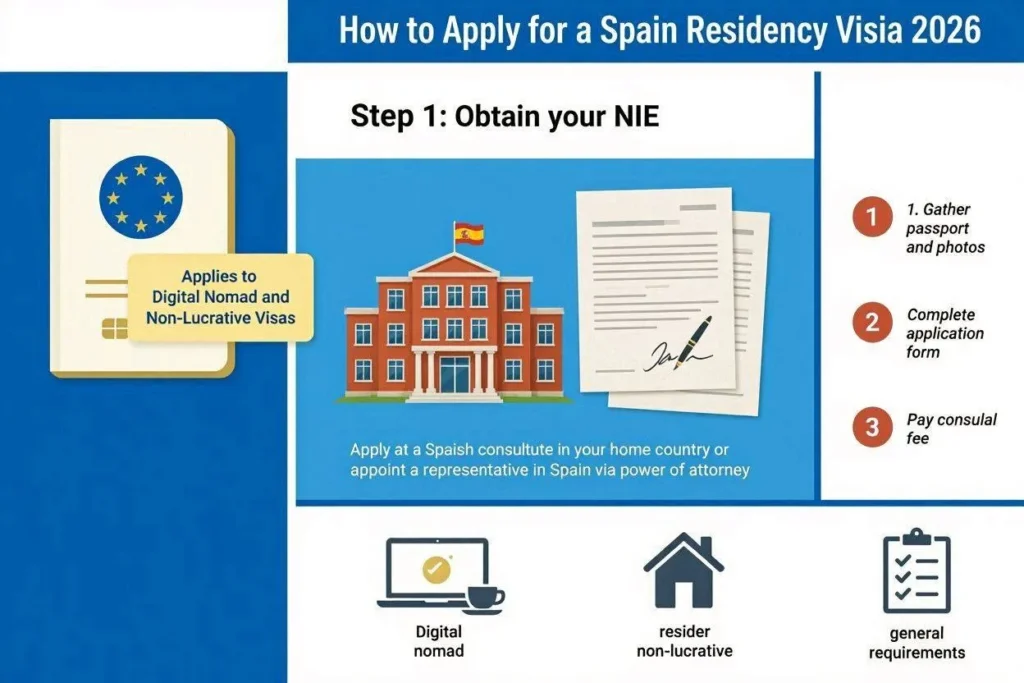
Step 1: Obtain Your NIE Number
Before any application, obtain your NIE (Número de Identidad de Extranjero) — your Spanish tax identification number. Apply at a Spanish consulate in your home country or appoint a representative in Spain through a Power of Attorney (Poder Notarial). Processing takes 1–4 weeks.
Step 2: Gather Required Documents
- Valid passport issued within the last 10 years
- Criminal record certificate from your country of origin and every country where you lived in the past 5 years — issued within the last 90 days
- Medical certificate confirming no diseases that pose a public health risk under International Health Regulations 2005
- Private health insurance from a company licensed to operate in Spain — no co-payments or deductibles
- Proof of sufficient financial means (bank statements, pension certificates, employment contracts depending on visa type)
- Proof of accommodation in Spain (property title deed or rental contract)
- Completed national visa application form and 2 passport-sized photos
Critical compliance note: All foreign documents require legalization via the Hague Apostille and a sworn translation (Traducción Jurada) into Spanish by a translator certified by Spain’s Ministry of Foreign Affairs.
Step 3: Submit the Application
Apply at the Spanish consulate in your country of residence (not inside Spain) for the initial visa. Once in Spain with the visa, register at your local Padrón and apply for your TIE (Tarjeta de Identidad de Extranjero) within 30 days at the Oficina de Extranjería or designated police station. UGE-CE processes Digital Nomad Visa applications.
Step 4: Wait for Approval
Approval typically takes 2–3 months from submission for standard visas. Responsible Declaration (Declaración Responsable) errors are the most common reason for delays — verify it is correctly signed before submitting.
Immigration fees in 2026: approximately €80 for the main applicant and €16 per family member for the police card (TIE) issuance.
Spain Permanent Residency and Citizenship: The Full Timeline
Spain does not offer citizenship by investment. The path to a Spanish passport requires continuous legal residence and meeting naturalization criteria.
| Timeline | Milestone |
| Year 0 | Receive initial residence permit (1 or 3 years depending on application location) |
| Year 5 | Apply for permanent residency — must have 5 years of continuous legal residence in Spain |
| Year 10 | Apply for Spanish citizenship — must pass language (DELE A2 minimum) and culture exam (CCSE) |
| Special case: Ibero-American nationals | Citizenship eligible after just 2 years of legal residence (nationals of Latin American countries, Philippines, Equatorial Guinea, Portugal, Andorra) |
| Children born in Spain | Eligible for Spanish citizenship after just 1 year of residence, regardless of parents’ status |
Passport renunciation warning: Spanish citizenship requires renouncing previous nationality, with exceptions for nationals of Ibero-American countries, Portugal, Andorra, Philippines, and Equatorial Guinea. Verify your country’s dual citizenship rules before committing to this path.
Conclusion: Spain’s Golden Visa Is Gone
The Spain Golden Visa ended on April 3, 2025 and will not return under the current political environment. Existing holders renew under full legal protection. New applicants choose between 3 clear pathways:
- Remote workers and freelancers: Digital Nomad Visa — €2,762/month income minimum, Beckham Law tax advantage, 3-year initial permit
- Retirees and passive income earners: Non-Lucrative Visa — €28,800/year passive income minimum, 183-day residence requirement, no work allowed
- Business founders: Entrepreneur Visa — no minimum investment, ICEX-approved business plan required, active business operation mandatory
If Spain was your target for EU residency through real estate investment, Portugal and Greece now represent the most direct alternatives — with active programs, established processing infrastructure, and Schengen access equivalent to what Spain offered.
Consult a licensed Spanish immigration lawyer before starting any application. NIE errors, document expiration, and incorrect health insurance selection are the 3 most common reasons for application rejections in 2026.
Frequently Asked Questions

Michael Reynolds
Michael Reynolds leads ImmigrationWin’s immigration, visa, and global mobility content division. He specializes in researching immigration policies, visa requirements, application processes, and international relocation pathways for individuals, families, students, and professionals. With extensive experience analyzing immigration regulations and official government guidance, Michael brings a research-driven approach to complex immigration topics and changing visa policies. He is the primary author of ImmigrationWin’s visa guides, immigration resources, and country-specific content, helping readers better understand their options and make informed decisions about their international journey.
Related Posts