
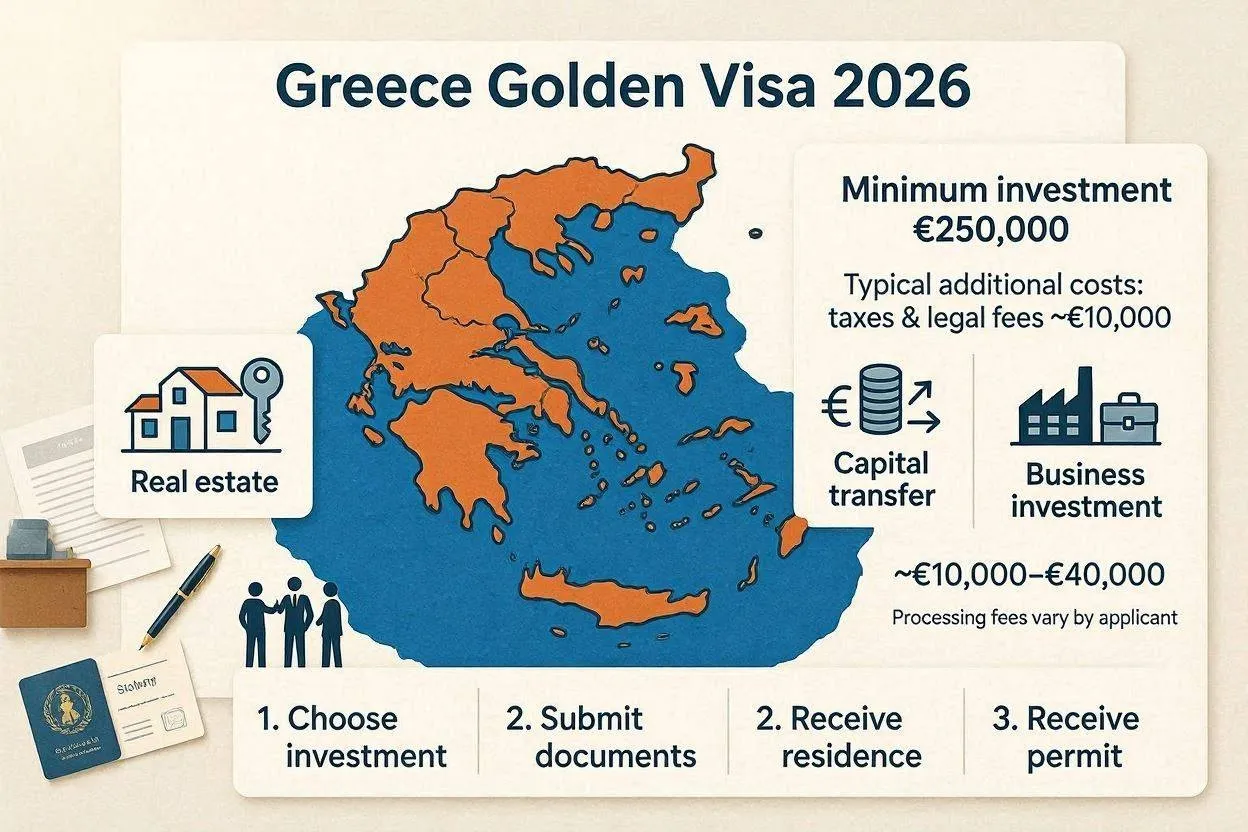
Greece Golden Visa 2026: Requirements, Investment Options, Costs & How to Apply
The Greece Golden Visa grants a 5-year renewable EU residency permit to non-EU nationals who invest in Greek real estate or qualifying assets. The minimum investment starts at €250,000 (~$276,000) for specific property types and reaches €800,000 (~$882,000) in high-demand zones like Athens, Mykonos, and Santorini.
As of 2026, 79,000+ residence permits have been issued under the program. Applications reached a record 9,289 in 2024, up from 1,993 in 2021. Greece remains the most in-demand golden visa program in the EU.
No minimum stay is required. The permit renews every 5 years and can lead to Greek citizenship after 7 years of lawful residence.
What Is the Greece Golden Visa?
The Greece Golden Visa — officially known as the Permanent Investor Residence Permit (Category B.5) — is a residency-by-investment program launched in 2013 under the Hellenic Republic. The program grants non-EU nationals and their families a 5-year residence permit in exchange for a qualifying investment in Greece.
The legal framework operates under Law 5038/2023, Law 5100/2024, and Law 5275/2026, administered by the Greek Ministry of Migration and Asylum. The 2024 and 2026 law updates raised investment thresholds in high-demand areas and introduced new investment routes including commercial property conversions and startup funding.
Key Program Facts
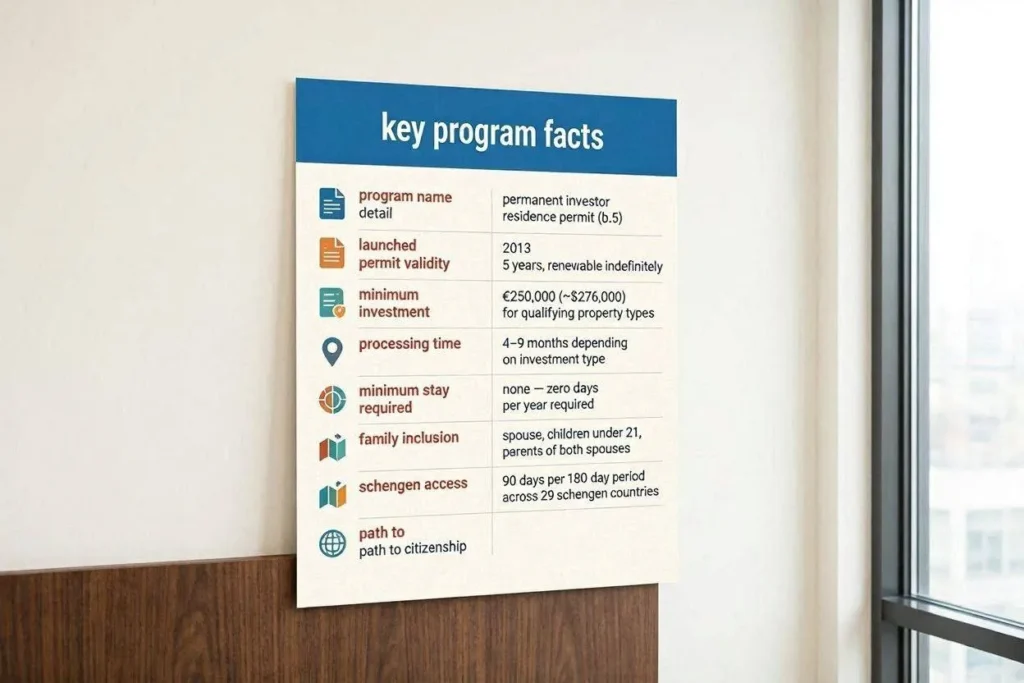
| Factor | Detail |
| Program name | Permanent Investor Residence Permit (B.5) |
| Launched | 2013 |
| Permit validity | 5 years, renewable indefinitely |
| Minimum investment | €250,000 (~$276,000) for qualifying property types |
| Processing time | 4–9 months depending on investment type |
| Minimum stay required | None — zero days per year required |
| Family inclusion | Spouse, children under 21, parents of both spouses |
| Schengen access | 90 days per 180-day period across 29 Schengen countries |
| Path to citizenship | After 7 years of lawful residence with language proficiency |
| Total permits issued | 79,000+ as of December 2025 |
| Governing law | Law 5100/2024 and Law 5275/2026 |
Greece Golden Visa Investment Options 2026
Greece offers 5 qualifying investment routes in 2026. Real estate remains the most popular path — it combines a clear threshold with asset ownership and rental income potential.
Route 1: Real Estate — 3-Tier Property Zones
The 2026 real estate investment structure runs across 3 location-based tiers. The tier determines both the minimum investment and the property rules.
| Tier | Minimum Investment | Locations | Property Rules |
| Tier 1 | €800,000 (~$882,000) | Athens, Thessaloniki, Mykonos, Santorini, islands with pop. >3,100 | Single property, min. 120 m² (1,292 sq ft), no short-term rentals |
| Tier 2 | €400,000 (~$441,000) | All other Greek regions, smaller islands, northern mainland | Single property, min. 120 m² (1,292 sq ft), no short-term rentals |
| Tier 3 | €250,000 (~$276,000) | Anywhere in Greece | Commercial-to-residential conversion or listed heritage building restoration only |
Important property rules for all real estate tiers:
- Financing via mortgage is not permitted for the investment portion
- Short-term rentals (Airbnb-style) are prohibited on qualifying properties
- The full investment amount must come from the investor’s personal funds
- Selling the property without replacing it with a qualifying asset terminates the visa
Route 2: Investment Fund — €350,000
Minimum: €350,000 (~$386,000) in units of a mutual fund or investment fund that invests in Greek equities, corporate bonds, or government bonds. Funds typically yield 4–5% annually. This route suits investors who prefer financial assets over physical property.
Route 3: Bank Deposit — €500,000
Minimum: €500,000 (~$552,000) in a term deposit with a Greek bank. Processing time for this route is typically 4+ months — faster than the real estate route.
Route 4: Greek Government Bonds — €500,000
Minimum: €500,000 (~$552,000) in Greek government bonds with a minimum 3-year maturity. Bonds provide stable but modest yields compared to real estate.
Route 5: Startup Investment — €250,000 (New in 2026)
Minimum: €250,000 (~$276,000) in a startup company registered in the Elevate Greece national startup registry. Introduced under Article 44 of Law 5162/2024, this route targets technology, finance, real estate, and defense sectors. The investor must maintain the startup investment to keep the permit active.
Greece Golden Visa Eligibility Requirements
To qualify for the Greece Golden Visa, applicants must meet 5 core eligibility criteria:
- Non-EU national: Any citizen of a country outside the European Union. Eligible nationalities include USA, UK, Canada, UAE, Saudi Arabia, Egypt, Lebanon, China, Turkey, Israel, Russia, and 150+ others.
- Age 18 or above: The main applicant must be at least 18 years old at the time of application.
- Clean criminal record: No convictions in the applicant’s home country or in Greece. A background check certificate is required from all countries of residence in the past 5 years.
- Valid health insurance: Private international health insurance covering Greece, or a Greek insurance policy. Public coverage is not automatically included until the investor pays into the social insurance system.
- Proof of legal investment funds: Bank statements, employment records, or business documentation showing the source of capital. Greece applies Anti-Money Laundering (AML) standards — funds must be traceable and lawfully obtained.
Family Members Included in One Application
The Greece Golden Visa covers the entire family under a single application at no additional investment cost. 4 family categories qualify:
- Spouse or registered partner (same-sex couples included; cohabitation agreement must be registered in Greece)
- Unmarried children of the main applicant under age 21
- Parents of both the main applicant and the spouse
- Minor children under 18 can be listed as the primary applicant — this allows the parents to be included and future spouses/children of those minors to benefit
Greece Golden Visa Total Costs in 2026
Budget 7–10% above the property purchase price for taxes, legal fees, and government charges. The exact breakdown for a €400,000 property:
| Cost Item | Rate / Amount | On €400K Property |
| Property transfer tax (resale properties) | 3.09% | ~€12,360 |
| VAT on new builds (frozen until end 2026) | 0% until Dec 2026, then 24% | €0 currently |
| Notary fees | ~1% | ~€4,000 |
| Land Registry registration | ~0.5% | ~€2,000 |
| Legal / lawyer fees | 1–2% | ~€4,000–€8,000 |
| Golden Visa application fee (main applicant) | €2,000 flat | €2,000 |
| Golden Visa fee (per family member) | €150 flat | €150 each |
| Health insurance (annual) | ~€500–€1,500/year | Variable |
| Total additional costs (approx.) | ~5.5–7% | ~€22,000–€28,000 |
How to Apply: Step-by-Step Process
The real estate route takes 6–9 months from start to permit issuance. The fund and bank deposit routes take 4+ months. Below is the full step-by-step process for the property route.
Step 1: Due Diligence Check (Week 1–2)
An Anti-Money Laundering (AML) officer reviews the applicant’s background against international legal and business databases. This preliminary check reduces the application rejection risk to under 1%. Do not skip this step — the 2026 enforcement rules under Law 5275/2026 increased scrutiny of fund sources.
Step 2: Obtain Greek Tax Number — AFM (Week 1–4)
Every non-EU investor must obtain an AFM (Arithmos Forologikou Mitroou) — the Greek tax identification number — before making any investment. This is done remotely through a Power of Attorney (PoA) granted to a Greek lawyer. The lawyer files at the local tax office (Eforia) on the investor’s behalf.
Step 3: Open a Greek Bank Account (Week 2–4)
A Greek bank account is required to transfer investment funds transparently. The account holds the purchase funds and documents the clean source of capital for AML compliance. Most major Greek banks — Alpha Bank, Eurobank, Piraeus Bank, National Bank of Greece — open accounts for foreign investors via a PoA.
Step 4: Property Legal Due Diligence (Week 4–10)
A Greek real estate lawyer conducts a full title search at the Land Registry (Cadastre). The due diligence covers 5 areas:
- Title chain — confirm clean ownership with no encumbrances or liens
- Tax debt check — verify the property has no outstanding tax liabilities
- Building permits — confirm all construction approvals are in place
- Structural survey — physical inspection of the property condition
- For conversion properties — confirm change-of-use permits from commercial to residential
Step 5: Sign Preliminary Contract and Pay Deposit (Week 8–12)
Sign the preliminary sale and purchase agreement with a 10% deposit. The contract locks the price and commits both parties to the transaction.
Step 6: Notary Closing (Week 10–14)
Transfer the full purchase price from the Greek bank account to the seller. Sign the final deed before a notary. Pay the 3.09% transfer tax. Register the title at the Greek Land Registry (Cadastre). The investor now legally owns the property.
Step 7: Submit Golden Visa Application (Week 14–22)
Submit the application online through the Greek Ministry of Migration and Asylum portal. Required documents include:
- Title deed registered at the Cadastre
- Greek tax certificate (AFM confirmation)
- Valid passport + biometric data
- Criminal background check from all countries of residence in the past 5 years
- Private health insurance certificate valid in Greece
- Source-of-funds documentation (bank statements, employment contracts, tax returns)
- Marriage certificate or cohabitation agreement (for family inclusion)
- Birth certificates of children and parents (for family inclusion)
All documents must be translated into Greek and notarially certified before submission.
Step 8: Receive Blue Paper Temporary Certificate (Week 15–16)
Within approximately one week of submission, the applicant receives a Blue Paper — a temporary residency certificate valid for 1 year. The Blue Paper allows free entry into Greece during processing.
Step 9: Biometric Data Submission (Week 16–18)
The main applicant and all family members must visit Greece in person to submit biometrics — fingerprints and a digital photograph. This appointment must happen within 6 months of receiving the Blue Paper.
Step 10: Receive Residence Permit Card (Week 22–30)
The Greek Golden Visa residence card is issued within 2–4 months of the biometric appointment. The card is valid for 5 years and is renewable indefinitely, provided the qualifying investment is maintained.
Greece Golden Visa Benefits in 2026
The Greece Golden Visa delivers 7 core benefits that competitors in the EU market do not consistently combine:

Benefit 1: Schengen Area Freedom of Movement
Permit holders travel visa-free across 29 Schengen Area countries for up to 90 days per 180-day period. Countries include Germany, France, Italy, Spain, Netherlands, Austria, Switzerland, and 22 others. Greece Golden Visa also enables visa-free or visa-on-arrival entry to UAE, Hong Kong, and Singapore for Greek residents.
Benefit 2: No Minimum Stay Requirement
Zero days per year in Greece are required to maintain or renew the permit. Investors can live anywhere globally and still hold active EU residency. This makes Greece the most flexible major EU residency program.
Benefit 3: Full Family Inclusion — No Extra Investment
The spouse, children under 21, and parents of both spouses receive residency under the same application with the same investment amount. No additional investment is required per family member.
Benefit 4: Access to EU Healthcare and Education
Golden Visa holders access Greece’s public healthcare system by contributing to the social insurance fund (EFKA). Children attend Greek public schools and universities under the same terms as Greek citizens.
Benefit 5: Passive Rental Income
Greek real estate generates 4.5–7% annual rental yield for long-term rentals, with some high-demand locations reaching 10%. Capital appreciation rates run at approximately 10% per year in Athens and island markets (2024–2026 data). Short-term rental (Airbnb) is prohibited on Golden Visa properties specifically, but long-term rental income is permitted.
Benefit 6: Pathway to Greek Citizenship
After 7 years of continuous legal residence in Greece — meaning 183+ days per year for those 7 years — investors may apply for Greek citizenship through naturalization. Requirements include: Greek language proficiency exam, cultural knowledge test, clean criminal record, and integration interview before the Naturalization Committee. Greek citizenship grants EU citizenship, an EU passport, and full rights to live, work, and study across all 27 EU member states.
Benefit 7: EU Banking and Business Access
A Greek residence permit enables investors to open EU bank accounts, access euro-denominated financial services, and establish Greek-registered companies. Greece Golden Visa holders can own and operate businesses — setting up a company, acting as directors, hiring staff, invoicing clients, and distributing profits as dividends. Employment in a third-party job is not permitted under the permit.
Greece Golden Visa Tax Benefits
Golden Visa holders who spend fewer than 183 days per year in Greece do not become Greek tax residents and pay no Greek tax on worldwide income. Those who choose to become Greek tax residents access 3 favourable tax regimes.
Non-Domicile (Non-Dom) Tax Regime
The Non-Dom regime is Greece’s most powerful tax incentive for high-net-worth investors who transfer tax residency to Greece.
- Structure: A flat annual tax of €100,000 on all foreign-source income, regardless of amount earned. Greece’s standard progressive income tax reaches 44% — the Non-Dom regime replaces this with a fixed capped cost.
- Family inclusion: Each family member joining the regime pays an additional €20,000 per year.
- Duration: Valid for up to 15 years.
- Foreign income exemptions: No obligation to declare foreign income. Exemption from Greek inheritance and gift tax on overseas assets.
- Eligibility: Must not have been a Greek tax resident for 7 of the previous 8 years. Must make a qualifying investment of at least €500,000 in Greece.
Example: An investor earning €500,000 per year from international sources would pay €220,000 under Greece’s standard 44% rate. Under the Non-Dom regime, the investor pays only €100,000 — saving €120,000 annually.
Foreign Pensioner Flat Tax Regime
Foreign retirees who transfer tax residency to Greece pay a flat 7% tax on all foreign pension income for up to 15 years. The applicant must come from a country that has a Double Taxation Treaty (DTT) with Greece and must not have been a Greek tax resident for the past 5 years.
Rental Income Tax in Greece
Income earned from renting out a Golden Visa property is taxed separately under Greece’s rental income tax system. Tax applies from the first euro with no tax-free allowance:
- Up to €12,000/year: 15% tax rate
- €12,001–€35,000/year: 35% tax rate
- Above €35,000/year: 45% tax rate
Renewing the Greece Golden Visa and Path to Citizenship
To Renew the Golden Visa Every 5 Years
Renewal requires meeting 3 conditions:
- Maintain full ownership of the qualifying property or investment
- Maintain valid private health insurance
- Submit renewal application before the current permit expires
There is no limit on renewals. The permit can be extended indefinitely as long as the investment is held.
To Apply for Permanent Residency
After 5 years of continuous legal residence, investors may apply for permanent residency under Greek law. Permanent residency removes the requirement to maintain the investment.
To Apply for Greek Citizenship
Citizenship through naturalization requires:
- 7 consecutive years of legal residence in Greece with 183+ days per year
- Clean criminal record in Greece and country of origin
- Greek language proficiency at B1 level minimum
- Greek history and culture knowledge — tested by interview with the Naturalization Committee
- Declaration of naturalization filed at the local municipality
Dual citizenship is permitted. Greek citizenship grants an EU passport with full rights to live, work, and study in all 27 EU member states.
Greece Golden Visa 2026 New Rules and Updates
Law 5275/2026 and the Ministry of Migration Circular No. 1/2026 (issued April 22, 2026) introduced 5 key changes:
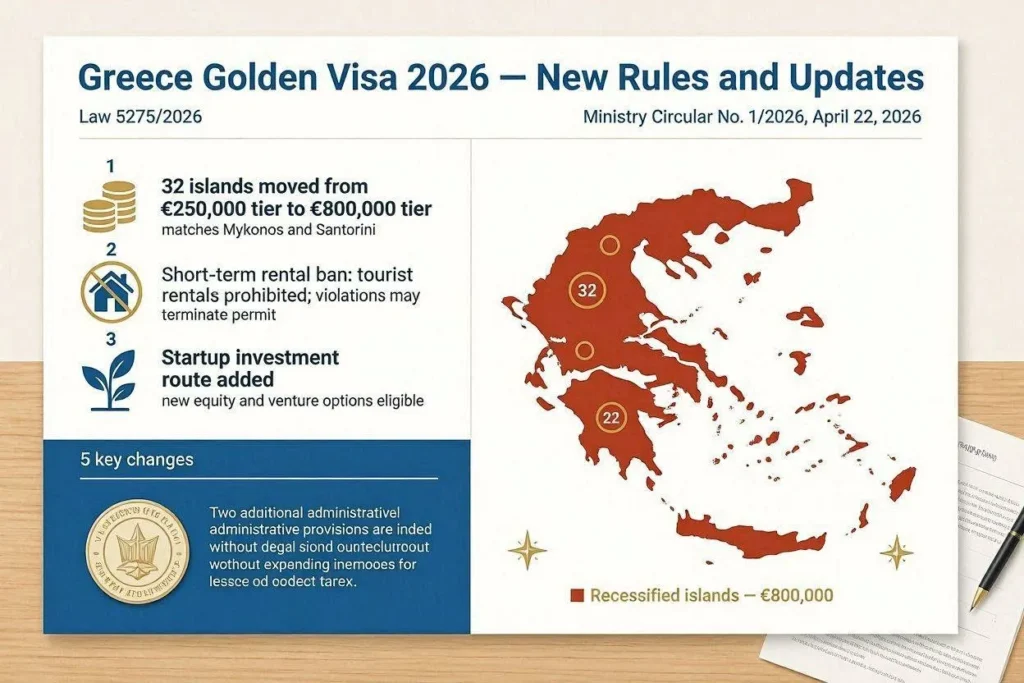
- Threshold increase for 32 additional islands: 32 smaller islands moved from the €250,000 tier directly to €800,000, matching Mykonos and Santorini.
- Short-term rental ban enforced: Golden Visa properties cannot be used for short-term tourist rentals. Violations can terminate the permit.
- Startup investment route added: Investors can now qualify via €250,000 in Elevate Greece-registered startups under Article 44 of Law 5162/2024.
- Stricter AML enforcement: The 2026 circular tightened source-of-funds scrutiny. Investors should prepare 12–24 months of documented fund history.
- Application approval rate improved: Despite a 43% drop in new applications (Jan–Apr 2026 vs Jan–Apr 2025), approvals increased 11% — 3,816 permits approved in the first 4 months of 2026 vs 3,429 in the same 2025 period.
Who Invests in the Greece Golden Visa?
The program attracts 5 primary investor profiles in 2026:
- Family education planners: Parents who want EU residency and access to European universities for their children. Single-child family applications structured around long-term planning increased 35–40% in 2025–2026.
- Wealth preservation investors: High-net-worth individuals (HNWIs) diversifying assets into stable EU real estate. Athens prime property saw 10%+ capital appreciation in 2024.
- Backup residency seekers: Investors from geopolitically unstable regions who want an EU Plan B without relocating. Chinese investors lead applications — Turkey ranks second.
- Passive income earners: Remote business owners and remote workers who rent out the Greek property for 4.5–7% annual yield while living elsewhere.
- Retirees seeking Mediterranean lifestyle: Foreign pensioners who move to Greece and use the 7% flat pension tax regime for 15 years.
Greece Golden Visa vs Other EU Programs
Greece competes directly with Portugal, Spain, Malta, and Hungary for EU residency investors. Here is how the programs compare on 5 key dimensions:
| Factor | Greece | Portugal | Spain | Malta |
| Min. investment | €250K–€800K | €500K (funds) | €500K | €150K + €600K donation |
| Min. stay required | 0 days/year | 7 days/year | None | 183 days/year |
| Citizenship timeline | 7 years | 5 years | 10 years | 1 year (MEIN) |
| Family inclusion | Free with main | Free with main | Free with main | Additional cost |
| Processing time | 6–9 months | 12–18 months | 6–12 months | 12–24 months |
Frequently Asked Questions
Is the Greece Golden Visa program still open in 2026?
Yes. Greece is not ending the Golden Visa program. Law 5275/2026 updated investment thresholds and added new routes but confirmed the program’s continuation. Approval rates increased 11% in the first 4 months of 2026.
Can I get a Greece Golden Visa for €250,000 in 2026?
Yes, but only for 2 specific property types: commercial-to-residential conversion projects or listed heritage buildings undergoing full restoration. Standard residential property in most locations now requires €400,000–€800,000.
Does the Greece Golden Visa lead to EU citizenship?
Yes, after 7 years of continuous legal residence (183+ days/year) with Greek language proficiency and a clean criminal record. The Golden Visa itself is a residence permit — citizenship requires the separate naturalization process.
Can I rent out my Golden Visa property in Greece?
Long-term rental is permitted. Short-term rental (Airbnb-style) is prohibited. Long-term rentals generate 4.5–7% annual yield. Violating the short-term rental ban can terminate the visa under 2026 enforcement rules.
Do I need to live in Greece to keep the Golden Visa?
No. Zero days per year in Greece are required to maintain or renew the permit. The investor must maintain the qualifying investment and valid health insurance.
How long does the Greece Golden Visa application take in 2026?
6–9 months for the real estate route. 4+ months for fund or bank deposit routes. Processing time starts after property closing and biometric submission. The Blue Paper temporary certificate is issued within approximately 1 week of application submission.
Which nationalities invest most in the Greece Golden Visa?
Chinese investors lead applications in 2026, followed by Turkish investors as the fastest-growing group. US, UK, Canadian, Lebanese, Egyptian, Saudi Arabian, and Israeli nationals are also significant applicant groups.
Conclusion
The Greece Golden Visa remains Europe’s most flexible residency-by-investment program in 2026 — zero mandatory stay, full family inclusion at no extra investment, and 3 price tiers starting at €250,000 for qualifying property types.
The 2026 law updates raised thresholds in Athens, Thessaloniki, Mykonos, Santorini, and 32 additional islands to €800,000. For investors focused on lower-entry regions or commercial conversions, the €250,000 and €400,000 routes remain open.
Choose the investment route that matches your financial goals: real estate for asset ownership and rental yield, funds for portfolio diversification, or the new startup route for equity exposure to Greece’s growing tech sector.
Work with a licensed Greek immigration lawyer. The 2026 AML enforcement rules and property eligibility requirements are technical. A qualified legal team reduces rejection risk, handles remote setup via Power of Attorney, and ensures full compliance from AFM registration through biometric submission.

Michael Reynolds
Michael Reynolds leads ImmigrationWin’s immigration, visa, and global mobility content division. He specializes in researching immigration policies, visa requirements, application processes, and international relocation pathways for individuals, families, students, and professionals. With extensive experience analyzing immigration regulations and official government guidance, Michael brings a research-driven approach to complex immigration topics and changing visa policies. He is the primary author of ImmigrationWin’s visa guides, immigration resources, and country-specific content, helping readers better understand their options and make informed decisions about their international journey.
Related Posts