How to Apply for a China Visa in 2026: Step-by-Step Guide
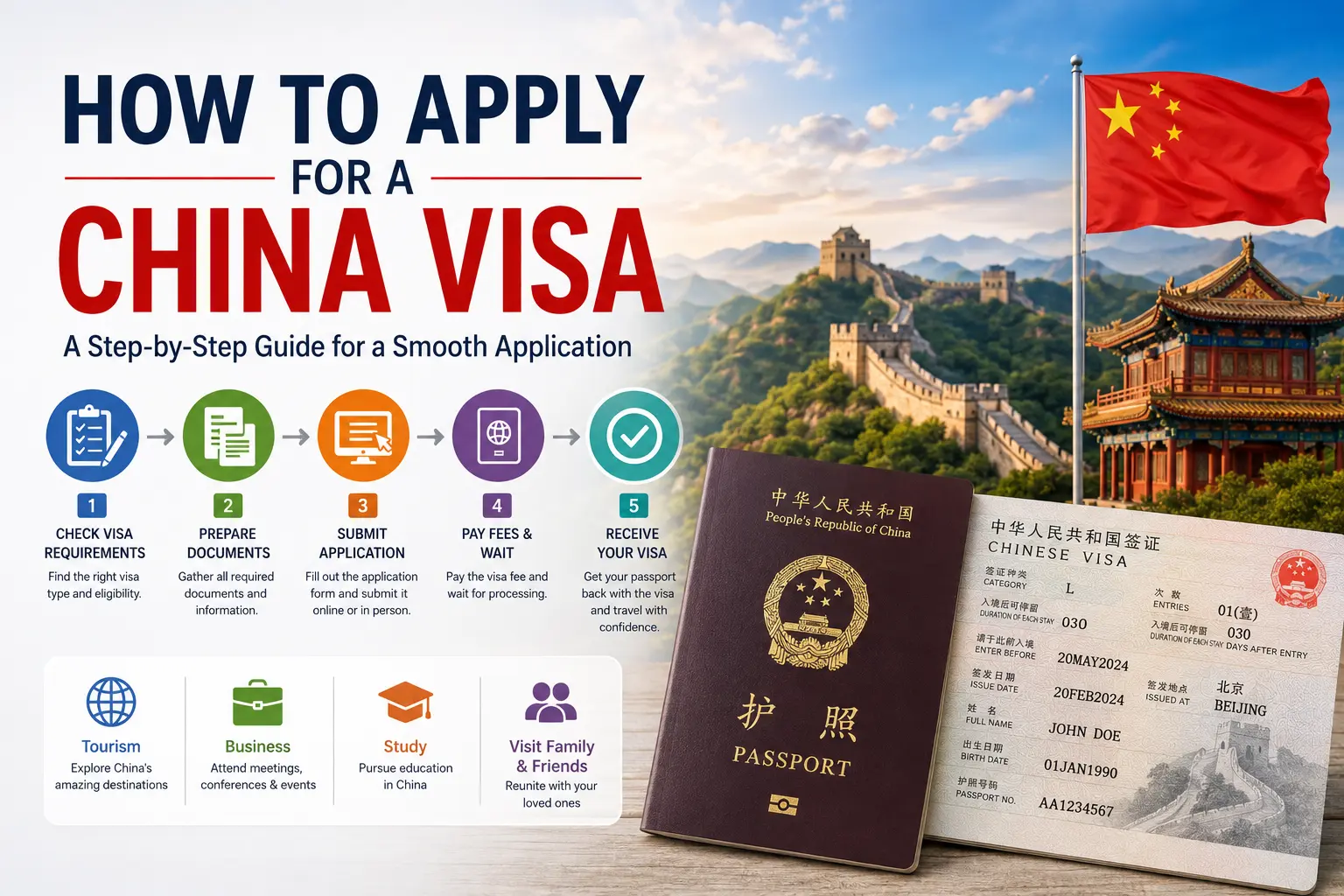
You apply for a China visa in 2026 by completing the China Online Visa Application (COVA) form, gathering your required documents, and submitting your passport at a Chinese embassy, consulate, or China Visa Application Service Center (CVASC). Most applicants receive an approved visa within 4 to 15 working days after submission.
This guide explains how to apply for a China visa in 2026, step by step. You find the 6 visa categories, the exact documents each category requires, current fees by nationality, and realistic processing timelines below. China simplified its visa system in 2025 and 2026 through the new COVA platform, and following the correct sequence prevents delays and rejections.
What Is a China Visa and Who Needs One in 2026
A China visa is an official endorsement that permits you to enter mainland China for tourism, business, study, work, or a family visit. The Ministry of Foreign Affairs (MFA) and the National Immigration Administration (NIA) issue and manage these visas through embassies, consulates, and CVASCs worldwide.
You need a China visa unless your nationality qualifies for a visa-free program or a transit exemption. China extended its unilateral visa-free policy through December 31, 2026, and citizens of 30+ countries, including France, Germany, and Australia, can enter for stays of up to 30 days without a visa. Travelers from 55 countries can also use the 240-hour visa-free transit policy to pass through China on the way to a third country.
US citizens do not qualify for the 30-day visa-free program. American travelers must apply for a standard visa before departure, though the 240-hour transit exemption still applies for connecting flights through Beijing, Shanghai, or Guangzhou.
What Are the 6 Main Types of China Visas
China offers 6 primary visa categories: the L visa, M visa, X visa, Z visa, Q visa, and S visa. Each category serves a distinct travel purpose, and selecting the wrong category delays your application by 2 to 4 weeks.
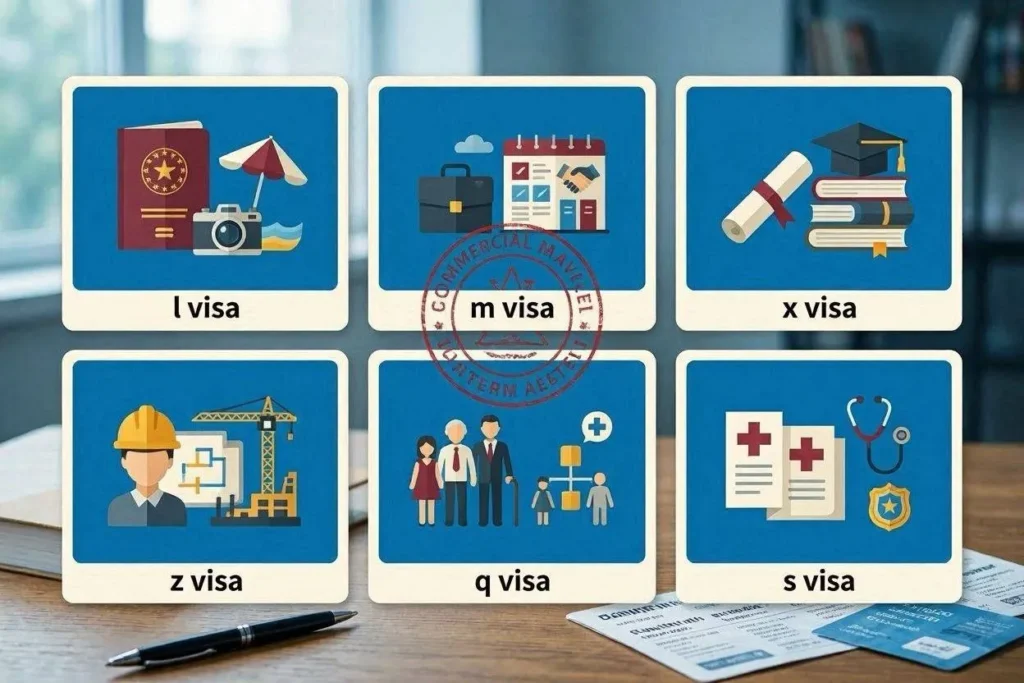
The 6 categories cover these purposes:
- L Visa: tourism, sightseeing, and short family visits under 90 days
- M Visa: business meetings, trade fairs, and commercial negotiations
- X Visa: long-term study at accredited Chinese institutions
- Z Visa: employment under a confirmed job offer from a Chinese employer
- Q Visa: long-term family visits or residence with Chinese relatives
- S Visa: short-term visits to family members already living in China
What Is the L Visa Tourist Permit
To qualify for the L visa, you show proof of onward travel and a confirmed itinerary. The L visa covers sightseeing, leisure travel, and short family visits. Most L visas allow stays of 30 to 60 days per entry. Some nationalities, including US citizens, qualify for a 10-year multiple-entry version that allows unlimited entries with each stay capped at 60 days. The L visa remains the most common category among China visa applicants.
What Is the M Visa Business Permit
To qualify for the M visa, you need an invitation letter from a Chinese company, trade association, or government body. The M visa does not authorize paid employment or ongoing business operations inside China. Standard M visa processing takes 1 to 4 weeks. Applicants must show a defined business purpose, such as a signed meeting agenda or trade fair registration confirmation, along with the host company’s official seal on the invitation letter.
What Is the X Visa Student Permit
To qualify for the X visa, you need an admission letter from an accredited Chinese school or university. The X visa splits into 2 subtypes: X1 for programs lasting more than 180 days and X2 for programs under 180 days. Processing takes 2 to 6 weeks. X1 holders must register with local police within 30 days of arrival and typically convert their visa into a residence permit at a local Public Security Bureau (PSB) office.
How to Apply for a China Visa Step by Step
To apply for a China visa, you complete 6 sequential steps: select your visa type, register on COVA, upload your documents, book a CVASC appointment, submit your passport in person, and track your application online.
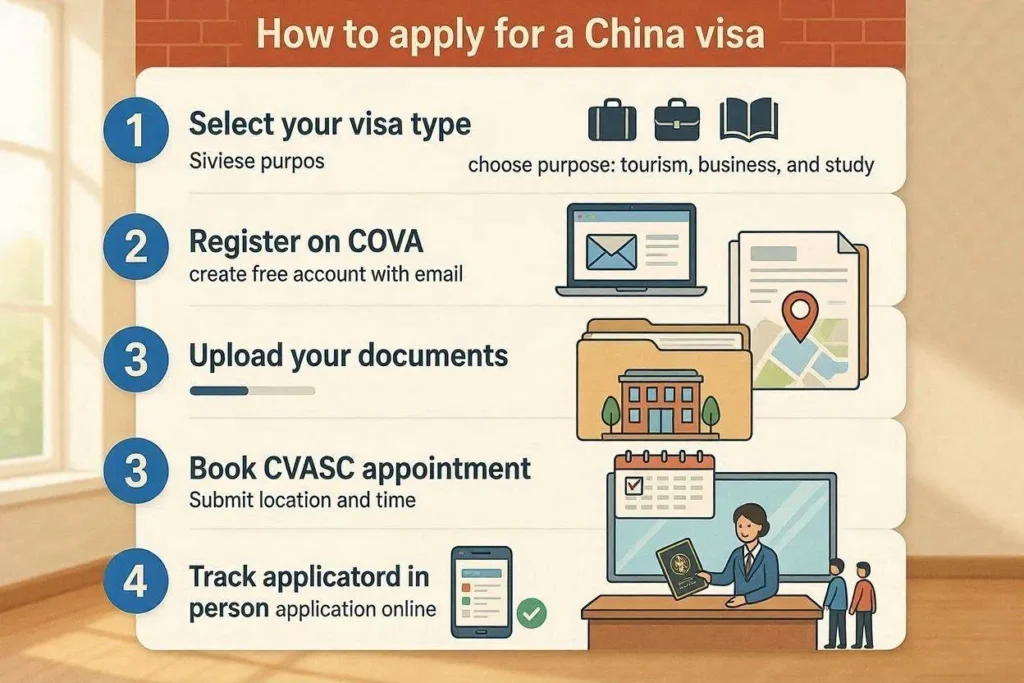
- Select your visa category based on your travel purpose, such as tourism, business, or study.
- Register a free account on the COVA platform using your email address.
- Fill in personal details, travel dates, and host information, then upload scanned copies of your documents.
- Book an appointment at your nearest CVASC or embassy visa office.
- Submit your original passport, printed application form, and photo in person.
- Pay the visa fee and track your application status through the online portal.
Each step builds on the previous one, and skipping the online form stage delays your in-person appointment by several days.
How to Complete the COVA Online Form
To complete the COVA online form, you enter your passport details, your travel history for the last 12 months, and your host or inviter information. The system flags missing fields before you submit the form. Save your application ID immediately after submission, since you need this ID to track your status and book your CVASC appointment. Institutional sponsors such as university travel offices note that mismatched names between the form and passport trigger automatic rejection at the review stage.
How to Submit Your Passport in Person
To submit your passport in person, you bring your printed COVA form, passport, 1 passport photo, and all supporting documents to the CVASC. Staff collect fingerprints in some jurisdictions and issue a pickup receipt showing your estimated collection date. Avoid Mondays, Fridays, and the first workday after a public holiday, since these days generate the highest foot traffic. The busiest hours run from 10:30 a.m. to 12:30 p.m. at most centers.
What Documents Do You Need for a China Visa Application
You need 5 core documents for a standard China visa application: a valid passport, a completed application form, 1 passport photo, proof of itinerary, and an invitation or host letter.
Your passport must have at least 6 months (180 days) of remaining validity and 2 completely blank visa pages. The application form must be typed, not handwritten, and every entry must match your passport exactly. Handwritten forms face rejection at most consulates in 2026.
What Photo Requirements Apply to Your Application
Your photo must measure 33mm x 48mm (1.3 in x 1.89 in) against a plain white or light background. The photo must show a neutral expression, open eyes, and no glasses, jewelry, or headwear. Submit a color photo taken within the last 6 months, with no shadows or filters applied. Incorrect photo dimensions remain a leading cause of rejection, so verify every measurement before you upload or print your photo.
What Documents Do Minors Need for a China Visa
Minors under 18 need a birth certificate, both parents’ passport copies, and a notarized consent letter when traveling without both parents. The consent letter must state the child’s travel dates, destination, and the accompanying adult’s relationship to the child. Adopted children need adoption papers showing the adoptive parents’ names and a photo with the family. Children born to parents of Chinese descent must also submit parental birth certificates or naturalization certificates. Consulates review minor applications with extra scrutiny, so submit every supporting document with the original application to avoid a second visit.
How Much Does a China Visa Cost in 2026
China visa fees range from $23 to $185 depending on your nationality, visa type, and number of entries. US citizens pay a flat $140 for most standard visas, while a 10-year multiple-entry tourist visa costs $68 through December 31, 2026, under a reduced bilateral fee arrangement.
Canadian citizens pay approximately CAD 75 (about $55), and UK citizens pay £255 for standard visas, though citizens of both countries also qualify for the 30-day visa-free program through December 2026. Non-US applicants from most other countries pay between $30 and $80 for single-entry visas.
CVASCs charge an additional service fee on top of the embassy visa fee, and this service fee varies by country and application volume. Express processing adds $25 to $37 to your total cost, and rush processing adds a similar or higher surcharge where centers offer it. Visa fees and service fees remain non-refundable, even when the consulate rejects your application.
Use the table below to plan your application timeline before you begin the COVA form.
| Task | Timing | Method | Difficulty |
|---|---|---|---|
| Create COVA account | 10 minutes | Online | Easy |
| Complete application form | 30-45 minutes | Online | Moderate |
| Gather required documents | 1-3 days | In person and online | Moderate |
| Book CVASC appointment | Same day | Online booking | Easy |
| Submit passport | 15-30 minutes | In person at CVASC | Easy |
| Standard processing | 4-15 working days | CVASC review | Moderate |
| Express processing | 2-4 working days | CVASC review, extra fee | Easy |
| Collect passport | 15 minutes | In person or courier | Easy |
How Long Does China Visa Processing Take in 2026
Standard China visa processing takes 4 to 15 working days after you submit your passport in person. Express service reduces this window to 2 to 4 working days, and rush service shortens processing to 1 to 2 working days at select CVASCs.
Peak seasons add 5 to 10 days to standard processing times. Summer travel months and the Chinese New Year period, which falls in late January or February, generate the highest application volumes of the year. Apply 4 to 6 weeks before your travel date to avoid these seasonal delays. The online pre-review stage inside COVA usually takes 1 to 3 days before you receive an appointment slot for passport submission.
How to Avoid Common China Visa Application Mistakes
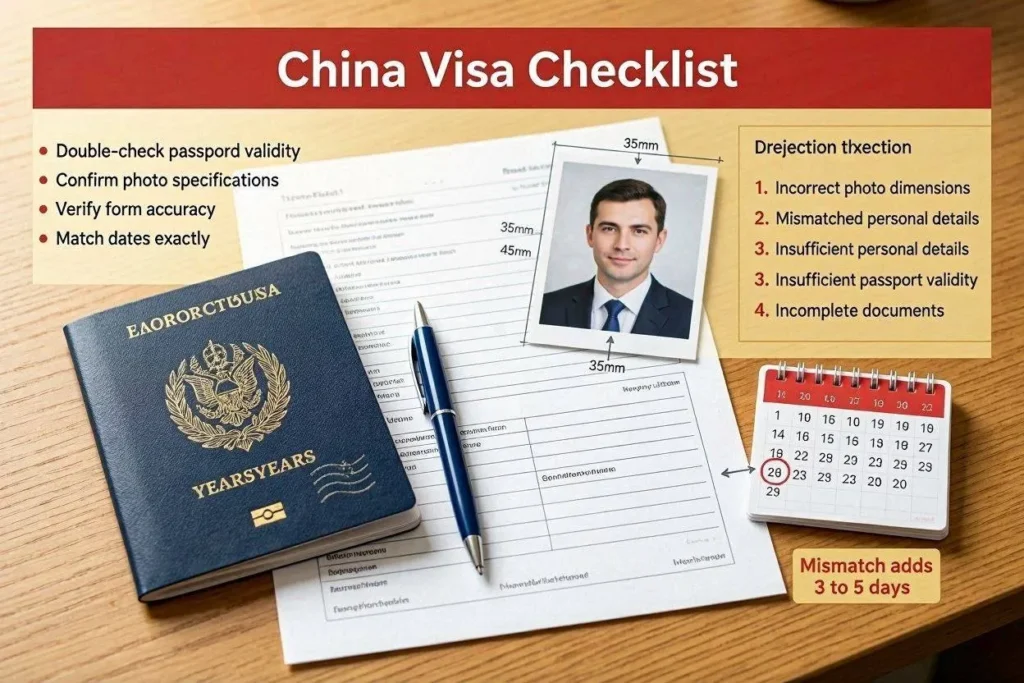
To avoid common mistakes, you double-check your passport validity, photo specifications, and form accuracy before submission. A single mismatched date between your form and passport triggers a resubmission request and adds 3 to 5 days to your timeline.
Why Applications Get Rejected
Applications get rejected for 4 main reasons: incorrect photo dimensions, mismatched personal details, insufficient passport validity, and incomplete supporting documents. Officers also reject applications when travel dates conflict with visa-free entry limits or when an invitation letter lacks a required official seal. Applicants with a criminal record must appear in person to provide biometrics, and skipping this step results in an automatic denial. Military service members must also submit a signed declaration form alongside their standard application documents.
How to Fix a Rejected Application
To fix a rejected application, you review the written refusal notice for the exact reason stated by the consulate. You then correct the identified issue and reapply with stronger supporting evidence. Some applicants request an Administrative Review within 28 to 90 days of the refusal, depending on the visa category. Reapplying without addressing the original refusal reason typically produces a second denial, so consult a licensed immigration advisor if your case involves complex employment or family circumstances.
How to Extend a China Visa If You Need More Time
To extend a China visa, you visit the local Public Security Bureau (PSB) Exit-Entry Administration Office at least 7 days before your current stay expires. Bring your passport, current visa, proof of accommodation, and 1 passport photo to the appointment.
The PSB typically grants 1 extension of up to 30 days for tourist visa holders with a valid reason, such as a medical emergency or a canceled flight. Business and student visa holders follow a similar process but must also submit a letter from their host organization confirming the extended stay. Overstaying your visa without an approved extension leads to fines and can result in future entry restrictions, so apply for your extension before your current visa expires.
How to Track and Collect Your China Visa
To track your China visa, you log into the COVA portal or your local CVASC website using your application ID. Status updates include “Under Review,” “Supplementary Materials to be Provided,” and “Passport to be Collected.”
Collect your passport in person using your pickup receipt, or arrange courier delivery for an additional fee. Payment happens at pickup, and most centers accept credit cards, money orders, or cashier’s checks only; personal checks and cash are not accepted at most locations. Check every detail on your visa immediately at pickup, since corrections requested after you leave the office take longer to process than corrections caught on-site.
Start Your China Visa Application Today
Applying for a China visa in 2026 requires the correct visa category, accurate documents, and enough lead time before departure. Follow the 6-step COVA process, submit your passport at your nearest CVASC, and track your status online until your passport reaches the collection stage. Give yourself 4 to 6 weeks before travel to absorb any delays or supplementary document requests. Reach out through Immigration Win for personalized guidance on your visa category and documents before you begin your application.
Frequently Asked Questions

Michael Reynolds
Michael Reynolds leads immigration content at ImmigrationWin, covering visa requirements, application and relocation pathways. He researches immigration policies and official government guidance to explain changing rules clearly. His guides help students, families, and professionals make informed decisions about moving abroad.
Related Posts