China Visa Types 2026: Complete Guide to All Categories
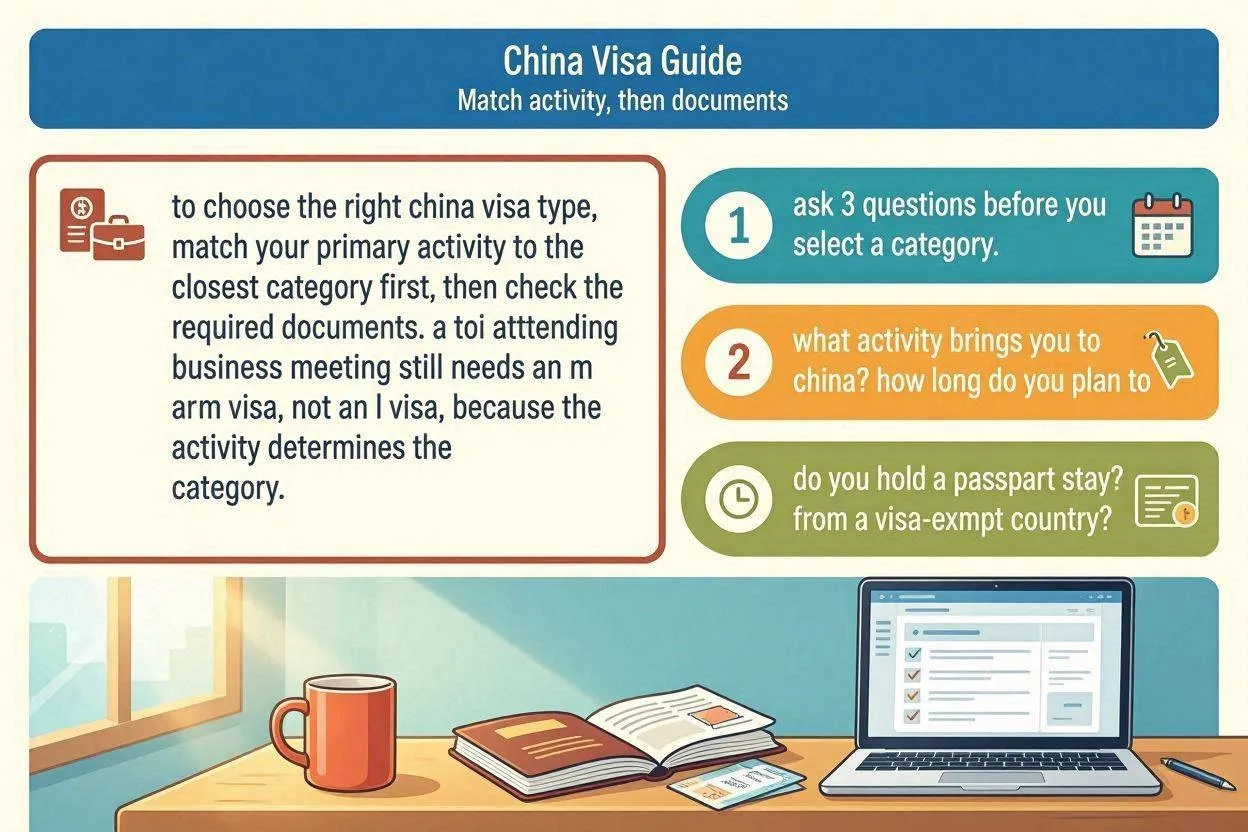
China visa types include 16 categories, each marked with a letter such as L, M, Z, X, Q, S, F, G, C, D, J, and R. You match your travel purpose to the correct category before you book a flight to Beijing, Shanghai, or any other Chinese city.
This guide breaks down every China visa type by purpose, duration, and application steps. You get exact numbers for validity periods, fees, and processing times, so you avoid submitting the wrong application.
What Are the Main China Visa Types in 2026?
China offers 16 ordinary visa categories under 4 broader groups: diplomatic, service, courtesy, and ordinary visas. Most travelers apply for an ordinary visa, which covers tourism, business, work, study, and family reunions.
The ordinary visa group includes these letter categories: L, M, F, Z, X1, X2, Q1, Q2, S1, S2, C, J1, J2, G, D, and R. Each letter tells the Chinese embassy or consulate your exact purpose of travel.
- L visa – tourism and visits to friends
- M visa – business and trade activities
- Z visa – employment in China
- X1 and X2 visas – long-term and short-term study
- Q1 and Q2 visas – family reunion with Chinese citizens
- S1 and S2 visas – family reunion with foreign residents
- G visa – transit through China
- D visa – permanent residence
China extended visa-free entry for France and several other countries through December 31, 2026, and added Sweden to the visa-free list starting November 10, 2025. Check your nationality against the current exemption list before you apply.
How to Choose the Right China Visa Type for Your Trip
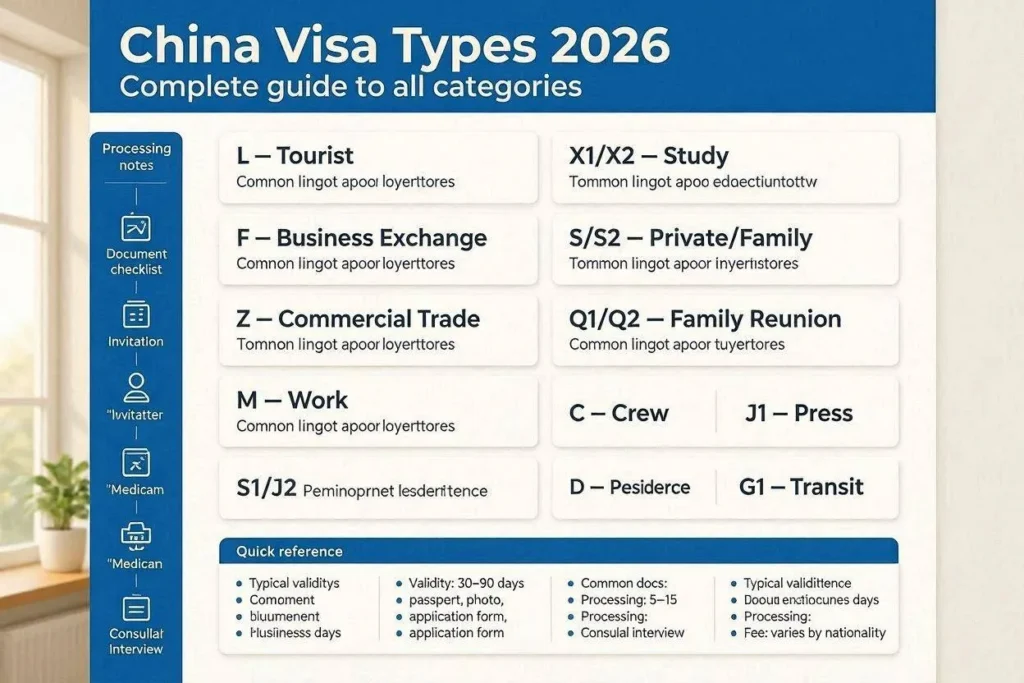
To choose the right China visa type, match your primary activity to the closest category first, then check the required documents. A tourist attending a business meeting still needs an M visa, not an L visa, because the activity determines the category.
Ask 3 questions before you select a category. What activity brings you to China? How long do you plan to stay? Do you hold a passport from a visa-exempt country?
If your passport qualifies for the 72-hour or 144-hour visa-free transit, you skip the application process for short layovers in cities such as Beijing, Shanghai, Guangzhou, Chengdu, and Xi’an.
China Tourist Visa (L): Requirements and Duration
The China tourist visa, marked L, covers sightseeing trips and visits to friends or relatives. You submit flight confirmation and a hotel reservation as proof of travel.
US passport holders receive multiple-entry validity up to 10 years, while each individual visit allows a stay of 30 to 90 days. Travelers heading to Tibet need an approval notice from the Tibet Tourism Bureau before they apply.
Single-entry, double-entry, and multiple-entry options exist for the L visa. Groups of 5 or more members traveling together qualify for a separate Group Visa category.
China Business Visa (M): Who Qualifies and How Long It Lasts
The China business visa, marked M, covers commercial and trade activities such as attending meetings, signing contracts, and visiting trade fairs.
M visa holders from the United States receive validity of up to 10 years with multiple entries, and each visit allows a stay of 30 to 90 days depending on the issuing consulate.
You need an invitation letter from a Chinese company, trade partner, or government agency to apply. The government application fee runs $185 for US passport holders in 2026.
China Work Visa (Z): Rules for Foreign Employees
The China work visa, marked Z, applies to foreigners who accept employment or commercial performance contracts in China.
You need a government-issued employment license or work permit before you apply for a Z visa. The consulate issues single-entry validity only for this category.
Z visa holders must register with the Public Security Bureau (PSB) within 30 days of entry to obtain a residence permit. The residence permit then allows multiple entries for the length of the contract.
China Student Visa (X1 and X2): Differences Explained
China splits student visas into 2 categories: X1 and X2. The dividing line is your study duration in China.
X1 Visa for Long-Term Students
The X1 visa applies to students enrolled in programs lasting more than 180 days. You submit an original admission letter from a Chinese university before you apply.
X1 visa holders register with the PSB within 30 days of arrival and receive a residence permit valid for up to 5 years with multiple entries.
X2 Visa for Short-Term Students
The X2 visa applies to students enrolled in programs lasting 180 days or less, such as a single semester exchange program.
X2 visa holders receive single-entry validity only, and they do not need to register with the PSB for a residence permit.
China Family and Private Visas (Q1, Q2, S1, S2): Which One Applies to You
China issues 4 family and private visa categories: Q1, Q2, S1, and S2. The category depends on whether your host relative holds Chinese citizenship or foreign residency.
Q1 and Q2 Visas for Relatives of Chinese Citizens
The Q1 visa applies to family reunions lasting more than 180 days with a spouse, parent, child under 18, or parent-in-law who holds Chinese citizenship.
The Q2 visa covers shorter visits of up to 180 days per entry to relatives who are Chinese citizens. US passport holders can receive Q2 validity of up to 10 years.
S1 and S2 Visas for Family of Foreign Residents
The S1 visa applies to family members joining a foreign relative who works or studies in China long-term, with stays exceeding 180 days.
The S2 visa covers short-term visits of 180 days or less to a foreign relative holding a valid Chinese residence permit.
China Transit Visa (G) and Visa-Free Transit Options
The China transit visa, marked G, covers travelers passing through China on the way to a third country.
Most travelers skip the G visa and use the 72-hour or 144-hour visa-free transit policy instead, available at airports including PEK, PVG, SHA, CAN, CTU, CKG, and 6 other major hubs.
To qualify for visa-free transit, you need a confirmed onward ticket to a third country and a passport from 1 of the 51 eligible countries.
How to Apply for a China Visa Step by Step
To apply for a China visa, complete your application through the China Online Visa Application system (COVA), then finalize it in person. The full process runs 4 to 5 business days from submission.
- Complete the COVA application form online with your travel details
- Print the confirmation page and book an embassy appointment
- Gather your passport, photo, and supporting documents
- Submit your application in person at the Chinese embassy or consulate
- Pay the visa fee for your category
- Collect your passport with the visa once processing completes
Documents You Need for a China Visa Application
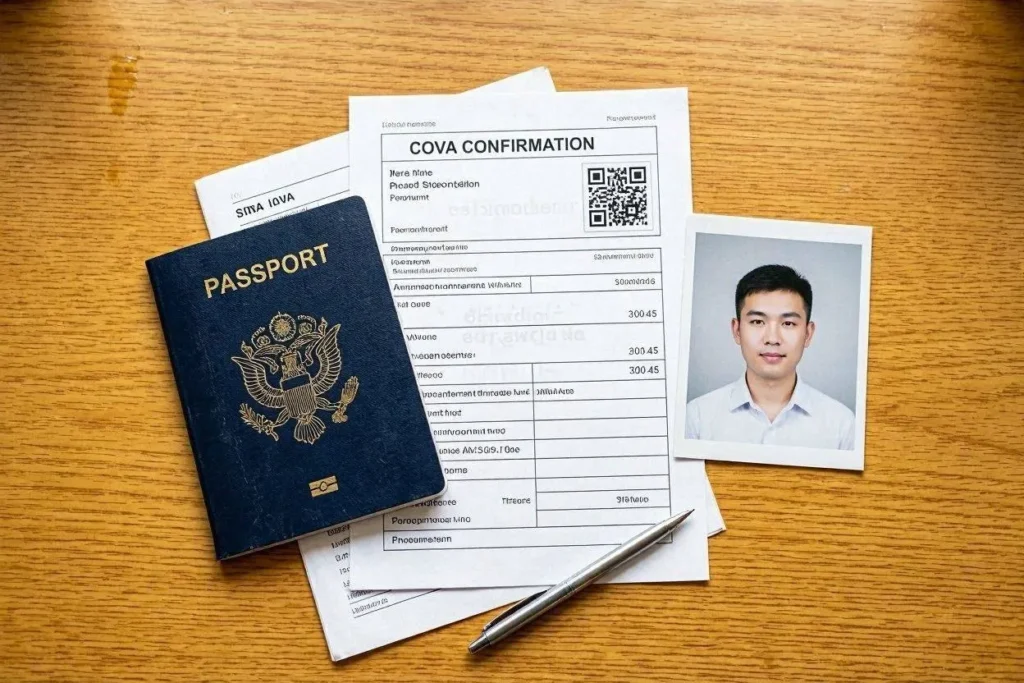
Every China visa application requires a valid passport, a printed COVA confirmation page, and a recent photo.
- Passport valid for at least 6 months (15cm) with 2 blank visa pages
- Passport photo sized 33mm x 48mm (1.3 inches x 1.9 inches), taken within the last 6 months
- Soft copy photo between 354 x 472 pixels and 420 x 560 pixels, sized 40KB to 120KB
- Category-specific documents such as invitation letters, admission letters, or employment licenses
How to Track Your China Visa Application Status
To track your China visa application status, check the pick-up slip issued at submission for your collection date. Standard processing takes 4 business days from the submission date.
Express service delivers your visa in 3 business days, and rush service delivers it in 2 business days for an added fee.
China Visa Fees and Processing Times in 2026
China visa fees for US passport holders run $185 for both tourist and business categories in 2026. Processing typically takes 4 to 5 business days.
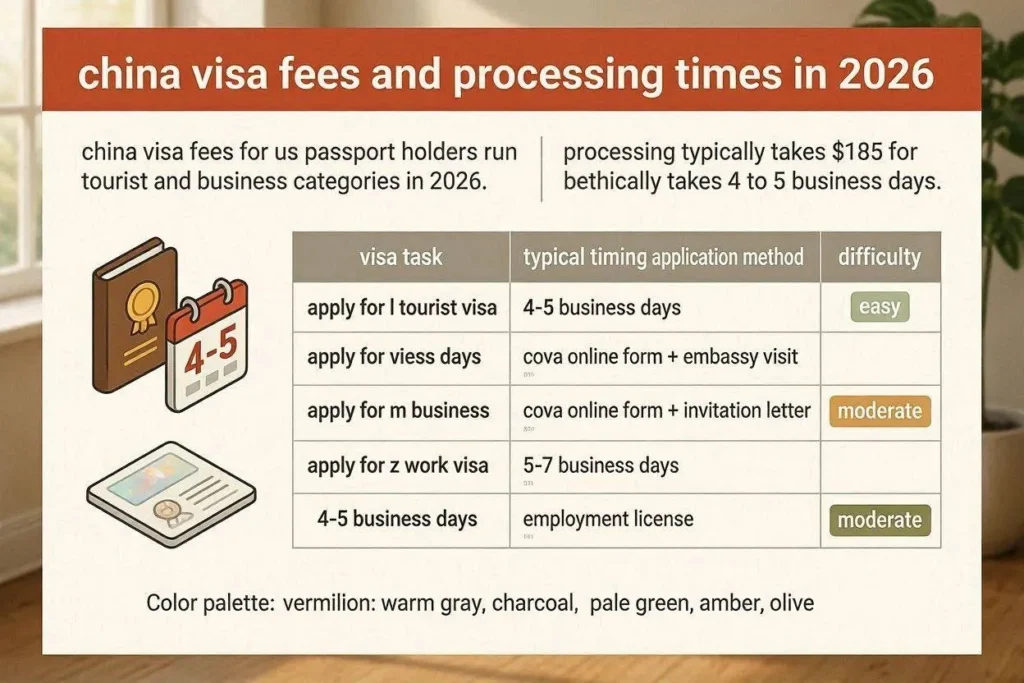
| Visa Task | Typical Timing | Application Method | Difficulty |
|---|---|---|---|
| Apply for L tourist visa | 4-5 business days | COVA online form + embassy visit | Easy |
| Apply for M business visa | 4-5 business days | COVA online form + invitation letter | Moderate |
| Apply for Z work visa | 5-7 business days | Employment license + embassy visit | Hard |
| Register X1 student visa | Within 30 days of entry | Public Security Bureau (PSB) office | Moderate |
| Register Q1 family visa | Within 30 days of entry | Public Security Bureau (PSB) office | Moderate |
| Extend any visa type | 7 days before expiry | PSB Exit & Entry Administration Office | Easy |
Choosing Your China Visa Type With Confidence
You now have exact numbers for every major China visa category, from the L tourist visa to the Z work visa and the Q and S family categories. Match your travel purpose to the correct letter, gather the required documents, and submit your COVA application 4 to 5 business days before your planned collection date.
Immigrationwin.com helps travelers select the correct visa category and prepare accurate applications for China and other destinations.
Frequently Asked Questions

Michael Reynolds
Michael Reynolds leads ImmigrationWin’s immigration, visa, and global mobility content division. He specializes in researching immigration policies, visa requirements, application processes, and international relocation pathways for individuals, families, students, and professionals. With extensive experience analyzing immigration regulations and official government guidance, Michael brings a research-driven approach to complex immigration topics and changing visa policies. He is the primary author of ImmigrationWin’s visa guides, immigration resources, and country-specific content, helping readers better understand their options and make informed decisions about their international journey.
Related Posts