
US Visa Types 2026: Complete Guide to All Categories
The United States offers 3 main us visa types: nonimmigrant, immigrant, and humanitarian. Each category splits into specific subtypes based on your travel purpose, from business meetings to permanent residence.
You need the correct visa category before you book flights, pay fees, or schedule an interview. This guide breaks down every major us visa type, explains eligibility rules, and shows you the exact steps to apply in 2026.
Confusing 1 category for another causes delays, denials, and wasted fees. A tourist who plans to work, for example, needs an H-1B or L-1 visa instead of a B-2 visitor visa. This guide covers nonimmigrant visa categories, immigrant visa types, humanitarian protections, application steps, and current 2026 fees so you match your travel purpose to the right form on the first attempt.
What Are the Main US Visa Types in 2026?
The 3 main us visa types are nonimmigrant, immigrant, and humanitarian visas. Nonimmigrant visas cover temporary visits such as tourism, study, and work assignments. Immigrant visas lead to a green card and permanent residence. Humanitarian visas protect crime victims, trafficking survivors, and refugees.
The U.S. Department of State manages visa issuance abroad, while U.S. Citizenship and Immigration Services (USCIS) approves most underlying petitions. Some travelers skip the visa step entirely. Citizens of 42 countries can use the Visa Waiver Program (VWP) with an Electronic System for Travel Authorization (ESTA) for stays of 90 days or less.
Choosing among us visa types depends on 3 factors: your purpose of travel, your intended length of stay, and whether you plan to return home or settle permanently. Every application also depends on your country of citizenship, since reciprocity agreements set different visa validity periods for different nationalities.
What Is the Difference Between Immigrant and Nonimmigrant Visas?
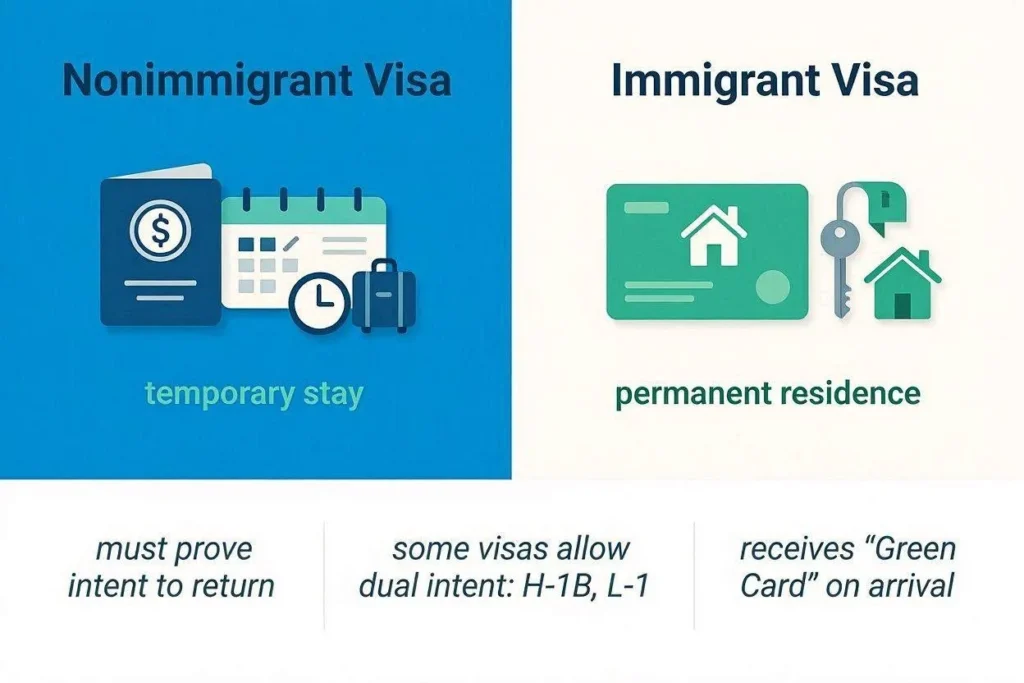
Nonimmigrant visas allow a temporary stay, while immigrant visas grant permanent residence. A nonimmigrant visa holder must prove intent to return home after a set period. An immigrant visa holder receives a green card on arrival and can live in the United States indefinitely.
Some categories blend both concepts. The H-1B and L-1 work visas carry “dual intent,” meaning you can hold a temporary visa while pursuing a green card at the same time. Most other nonimmigrant categories, including the B-2 tourist visa and F-1 student visa, require you to maintain ties to your home country throughout your stay.
What Are the 5 Main Nonimmigrant Visa Categories?
The 5 main nonimmigrant categories are visitor, student, work, exchange, and fiance visas. These nonimmigrant us visa types each carry a distinct letter code, application form, and set of eligibility rules.
B-1/B-2 Visitor Visas for Business and Tourism
The B-1 visa covers business activities such as contract negotiations, conferences, and consultations with business partners. The B-2 visa covers tourism, family visits, and medical treatment. Both visas typically allow stays of up to 6 months (180 days) per entry.
Applicants must show a foreign residence they do not intend to abandon. Border officers at ports of entry decide the exact authorized stay, recorded on Form I-94.
F-1 and M-1 Student Visas for Education
The F-1 visa serves students enrolled in academic programs at universities, colleges, and language schools. The M-1 visa serves students in vocational and technical programs such as flight training and culinary schools. F-1 students can work up to 20 hours per week on campus during the school term.
M-1 students cannot work during their program and cannot change to F-1 status after enrollment. Both categories require a Form I-20 issued by a school certified under the Student and Exchange Visitor Information System (SEVIS).
H-1B and L-1 Work Visas for Employment
The H-1B visa applies to specialty occupations that require a bachelor’s degree or higher, such as software engineering, finance, and architecture. The H-1B carries an annual cap and requires an employer-filed Form I-129 plus a certified Labor Condition Application.
The L-1 visa serves employees transferring within the same company from an office abroad. The L-1A covers managers and executives, and the L-1B covers employees with specialized knowledge. Applicants need 1 continuous year of employment abroad within the past 3 years before the transfer.
J-1 Exchange Visitor Visas for Cultural Programs
The J-1 visa serves participants in exchange programs such as au pairs, camp counselors, research scholars, and medical residents. Program sponsors issue Form DS-2019 instead of Form I-20, and USCIS approval is not required before the visa interview.
Some J-1 categories carry a 2-year home-country physical presence requirement. This rule blocks a change of status or an H, L, or immigrant visa until you complete the requirement or receive a waiver.
K-1 Fiance Visas for Marriage-Based Travel
The K-1 visa allows the foreign fiance of a U.S. citizen to enter the United States and marry within 90 days of arrival. The U.S. citizen sponsor files Form I-129F, and both partners must show they met in person within the past 2 years.
After the marriage, the K-1 holder files Form I-485 to adjust status to a green card. Children under 21 accompanying a K-1 applicant travel on a K-2 visa.
What Are the 3 Main Immigrant Visa Categories?
The 3 main immigrant visa categories are family-based, employment-based, and diversity visas. Each of these immigrant us visa types leads to a green card, but the sponsor, wait times, and annual limits differ sharply.
Family-Based Immigrant Visas
U.S. citizens can petition for spouses, parents, children, and siblings using Form I-130. Green card holders can petition only for spouses and unmarried children. Immediate relatives of U.S. citizens, including spouses and children under 21, face no annual numerical limit.
Other family categories fall under preference limits, which creates wait times of several years for siblings and adult children from countries such as Mexico, India, and the Philippines.
Employment-Based Immigrant Visas
Employment-based green cards split into 5 preference categories, labeled EB-1 through EB-5. EB-1 covers individuals with extraordinary ability, outstanding professors, and multinational executives. EB-2 and EB-3 cover professionals with advanced degrees and skilled workers. EB-5 grants a green card to investors who commit at least $800,000 (roughly 800,000 EUR) to a qualifying U.S. business that creates 10 jobs.
Most employment categories require a labor certification from the Department of Labor before the employer files Form I-140 with USCIS. Processing centers assign a priority date to each petition, and the Visa Bulletin published monthly by the Department of State determines when your priority date becomes current for final green card approval.
Diversity Visa Lottery Program
The Diversity Visa program issues 55,000 immigrant visas each year through a random lottery for applicants from countries with low rates of immigration to the United States. Entrants register online during a designated period each October, and winners must meet education or work experience requirements before consular processing. Selection does not guarantee a visa, since demand regularly exceeds the annual allocation.
What Humanitarian Visa Types Does the US Offer?
The main humanitarian visa types are U visas, T visas, and asylum-related protections. These categories protect people who face danger, abuse, or persecution rather than travelers seeking business or leisure. Applicants generally file directly with USCIS instead of applying at a consulate abroad.
U Visas for Crime Victims
The U visa protects victims of qualifying crimes such as domestic violence, kidnapping, and sexual assault. Applicants must show substantial physical or mental abuse and cooperate with law enforcement during the investigation. USCIS caps U visa approvals at 10,000 per year, which creates a multi-year waiting list.
T Visas for Trafficking Survivors
The T visa protects survivors of severe human trafficking, including forced labor and sex trafficking. Applicants must demonstrate presence in the United States due to trafficking and cooperation with a reasonable request from law enforcement. T visa holders can apply for a green card after 3 years of continuous presence.
How to Choose the Right US Visa Type for Your Situation
To choose the right us visa type, match your specific purpose of travel to the closest official category before you file any paperwork. Many applicants compare several us visa types side by side before settling on 1 clear path. Business travelers and tourists from Visa Waiver Program countries should check ESTA eligibility first, since a full visa application becomes unnecessary for short trips.
Workers need a confirmed job offer and employer sponsorship for most employment categories, including the H-1B, L-1, and EB-2 visas. Students need acceptance and a Form I-20 from a SEVIS-certified school before applying for an F-1 or M-1 visa. Family members need a qualifying relationship with a U.S. citizen or green card holder who files the initial petition.
Consulting an immigration attorney helps you avoid costly mistakes, especially when your case involves a prior visa denial, a criminal record, or an overstay.
Timing also shapes your choice among us visa types. Some us visa types move faster than others based on annual caps and country demand. The H-1B carries an annual lottery each spring, with a limited number of registrations selected for the fiscal year. Family-based categories for siblings and adult children can take 10 years or longer due to per-country limits. Investors pursuing the EB-5 visa should budget 18 to 36 months for petition review, consular processing, and conditional green card removal. Compare your timeline against your goals before you commit to a specific application path.
How to Apply for a US Visa in 2026
Applying for a us visa in 2026 requires 5 core steps: identify your category, file the petition or form, pay fees, attend an interview, and receive your passport. Every one of the us visa types below follows this same general framework, though specific documents differ. Nonimmigrant applicants complete Form DS-160 online, while immigrant applicants go through consular processing after USCIS approves the underlying petition.
How to Complete Form DS-160
To complete Form DS-160, you enter your travel history, employment details, and family information through the Consular Electronic Application Center (CEAC) website. You upload a digital photo that meets State Department specifications and print the confirmation page for your interview.
Save your application ID number as you work, since the online system does not save partial entries automatically after long periods of inactivity.
How to Prepare for Your Consular Interview
To prepare for your consular interview, you gather your passport, DS-160 confirmation page, fee receipt, and supporting documents such as bank statements or an employer letter. Nonimmigrant visa interviews are generally required for applicants between 14 and 79 years of age.
Arrive early, dress professionally, and answer questions directly and honestly. Consular officers approve or deny most applications within minutes of the interview.
What Are the 2026 US Visa Fees and Processing Times?
Visa fees and surcharges changed for 2026, including new integrity fees on select employment petitions such as H-1B, H-2B, and L-1. Always verify current fees on the Department of State and USCIS websites before you pay, since amounts adjust throughout the year.
Nonimmigrant visa application fees generally range from $185 (roughly 170 EUR) for most B, F, and J categories to $205 (roughly 190 EUR) for H, L, and O work visas. Immigrant visa processing adds separate fees for the underlying petition, the National Visa Center processing fee, and the Affidavit of Support review for family cases. Processing times vary by embassy and consulate, so check current wait times before you schedule travel or resign from a current job.
| Task | Typical Timing | Method | Difficulty |
| File Form DS-160 | Same day | Online via CEAC | Easy |
| Schedule visa interview | 2 to 8 weeks | U.S. embassy or consulate | Moderate |
| H-1B petition approval | 2 to 6 months | Employer files Form I-129 | Hard |
| Family petition (I-130) approval | 7 to 24 months | USCIS online or mail filing | Hard |
| Green card adjustment of status | 8 to 14 months | Form I-485 with USCIS | Hard |
Choosing among the many us visa types determines your timeline, your costs, and your path to permanent residence. Understanding these us visa types before you file protects your fees and your travel plans. Review your purpose of travel, confirm eligibility for your closest category, and gather documentation early to avoid delays. Visit immigrationwin.com for detailed guides on specific visa categories and step-by-step application support.
Frequently Asked Questions

Michael Reynolds
Michael Reynolds leads ImmigrationWin’s immigration, visa, and global mobility content division. He specializes in researching immigration policies, visa requirements, application processes, and international relocation pathways for individuals, families, students, and professionals. With extensive experience analyzing immigration regulations and official government guidance, Michael brings a research-driven approach to complex immigration topics and changing visa policies. He is the primary author of ImmigrationWin’s visa guides, immigration resources, and country-specific content, helping readers better understand their options and make informed decisions about their international journey.
Related Posts